
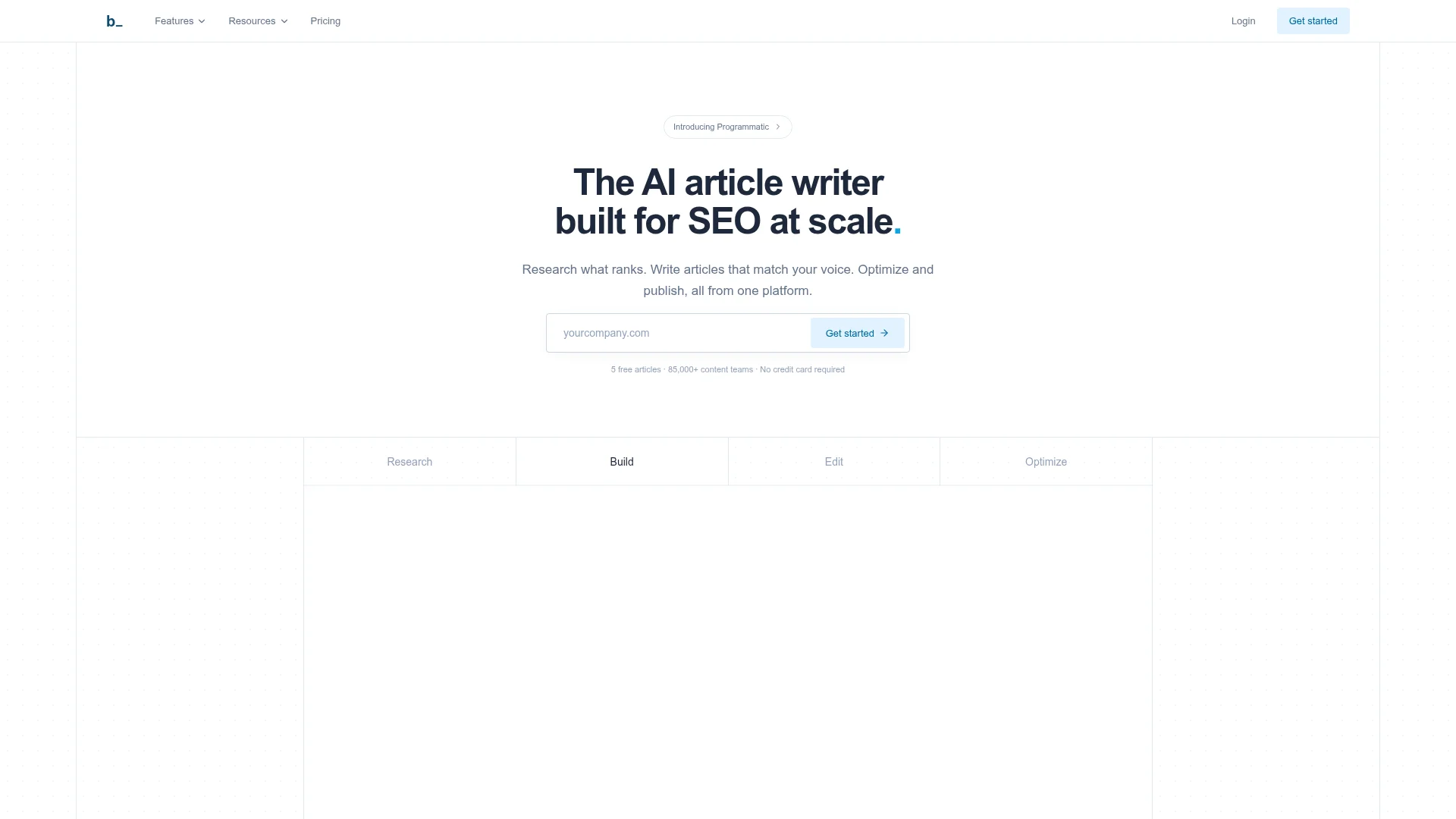
Byword is one of the most focused AI SEO article writers on the market. The v2.0 relaunch in January 2026 rebuilt the product with multi-model AI (GPT-5.4, Claude Opus 4.6, and Gemini 3.1 Pro, all included on every plan), article generation in 60 to 90 seconds, programmatic SEO templates, and direct publishing to WordPress, Webflow, Ghost, HubSpot, Medium, and Notion. Named customers include Coursera, Capgemini, Chanel, Blinkist, n8n, and Ramp. That's unusual breadth for a bulk article tool.
But it's not the right fit for every team.
If you're evaluating alternatives, you've probably bumped into one or more of these friction points:
Every article is a first draft that needs 20 to 45 minutes of editing. A 30-day test by Aboah Reviews documented editing time per article at 20 to 45 minutes to reach publishable quality. That's invisible in the $2.50 to $3.50 per-article price. A team generating 80 articles per month on Standard ($249/mo) is looking at roughly 25 to 60 hours of monthly editor time. That's not a drop-in content team.
There's no in-app editor for post-generation refinement. Once an article generates, you can't revise sections inside Byword. You export to Google Docs, Notion, or your CMS editor to do substantive rewrites. The "all from one platform" promise stops at the draft.
No built-in humanizer for AI detection. Byword v2.0 claims more natural output, but there is no humanization module. Teams publishing to AdSense-monetized sites, E-E-A-T-sensitive niches, or regulated industries treat detection exposure as a real concern and need a separate tool in the stack.
No AI search visibility tracking. Byword doesn't track how your brand appears in ChatGPT, Gemini, Perplexity, or Google AI Mode. In 2026, that's a meaningful gap for teams who care about being cited in AI answers, not just ranking in blue links.
The public review footprint is very small. Despite 85,000+ self-reported users, there are 3 reviews on G2, 1 on Capterra, and 7 on Trustpilot at 2.8/5. Trustpilot also flags the profile for not replying to negative reviews. Thin social proof for rigorous vendor evaluation.
This guide compares 8 alternatives: full production pipelines, broader AI writing platforms, AI visibility trackers, SEO optimizers, and direct bulk competitors at lower price points. Honest strengths, limitations, and verified pricing for each.
How We Evaluated These Alternatives
We analyzed pricing from each tool's official website, feature sets from product pages, and user feedback from G2, Capterra, Trustpilot, Reddit, and named independent reviewers (Aboah Reviews, Originality.ai). Evaluation dimensions: content production scope, editorial QA depth, SEO/AEO capabilities, pricing structure, publishing workflow, and distribution coverage. DeepSmith is our product. We've included it because it fits the "complete pipeline, not just a generator" gap Byword creates, and we've noted where other tools are the better choice, with a "what to consider" caveat for DeepSmith. All pricing and features verified as of April 2026.
Quick Comparison Table
| Tool | Best For | Starting Price | Scope |
|---|---|---|---|
| DeepSmith | Teams needing the full pipeline, not just the generator | $80/mo | Full pipeline (idea → publish → 14 channels) |
| Jasper | Brand voice across articles, ads, social, email | $59/mo (annual) | AI writing + Brand Voice |
| Writesonic | AI search visibility across 8+ platforms | $99/mo | AI writing + broad AEO |
| Surfer SEO | Mature SEO optimization + AI tracking | $49/mo (annual) | Optimizer + AEO tracking |
| Frase | Research + optimization + AI writing at lower cost | $39/mo (annual) | Research + drafting + optimizer |
| Junia AI | Cheapest direct bulk article writer | $15/mo | Bulk AI with SEO |
| Scalenut | Guided SEO workflow with bundled modules | $59/mo | AI writing + Cruise Mode SEO |
| ChatGPT | DIY at the lowest price point | $20/mo | General LLM, DIY |
What Byword Does Well
Before getting into alternatives, Byword's strengths deserve recognition.
The fastest bulk article generation in the category. Articles generate in 60 to 90 seconds. Research-heavier pieces complete in about 2 to 3 minutes. In a 30-day test, Aboah Reviews uploaded 25 home-improvement keywords and had 25 completed articles averaging 1,800 words each in about 40 minutes. That's roughly 45,000 words of first-draft content in under an hour. If the unit of work is "get 25 keywords into first drafts this afternoon," Byword delivers.
Programmatic SEO that actually works at this price. Upload a keyword CSV, define a template with dynamic variables, generate hundreds of structured pages. Aboah Reviews built a template for 50 location-based pages that generated in roughly 90 minutes. Agencies running location pages, long-tail keyword sweeps, or product-variant pages have a clear fit.
All AI models included on every plan. GPT-5.4, Claude Opus 4.6, and Gemini 3.1 Pro are available on the Free tier and every paid plan. Most tools gate top-tier models behind higher pricing. Byword's flat-access model is a real pricing advantage for power users who want to switch models per article.
One-click publishing to six CMSs. WordPress, Webflow, Ghost, HubSpot, Medium, and Notion are native, with Google Docs, Airtable, and 5,000+ destinations via Zapier and Make. Aboah Reviews notes the WordPress integration "published without errors in my tests," a detail that matters because many competitor tools require manual formatting cleanup after import.
Serious enterprise customer list. Coursera, Capgemini, Chanel, Blinkist, n8n, and Ramp span education, consulting, luxury, media, automation, and fintech. A reasonable trust signal even given the thin public review base.
These strengths are real. If bulk article throughput is your primary constraint and your editorial workflow handles the 20-to-45-minute-per-article cleanup, Byword may be the right tool for you. The alternatives below serve teams whose needs extend beyond "generate first drafts fast."
1. DeepSmith
Best for teams who need a complete production pipeline, not just a fast generator
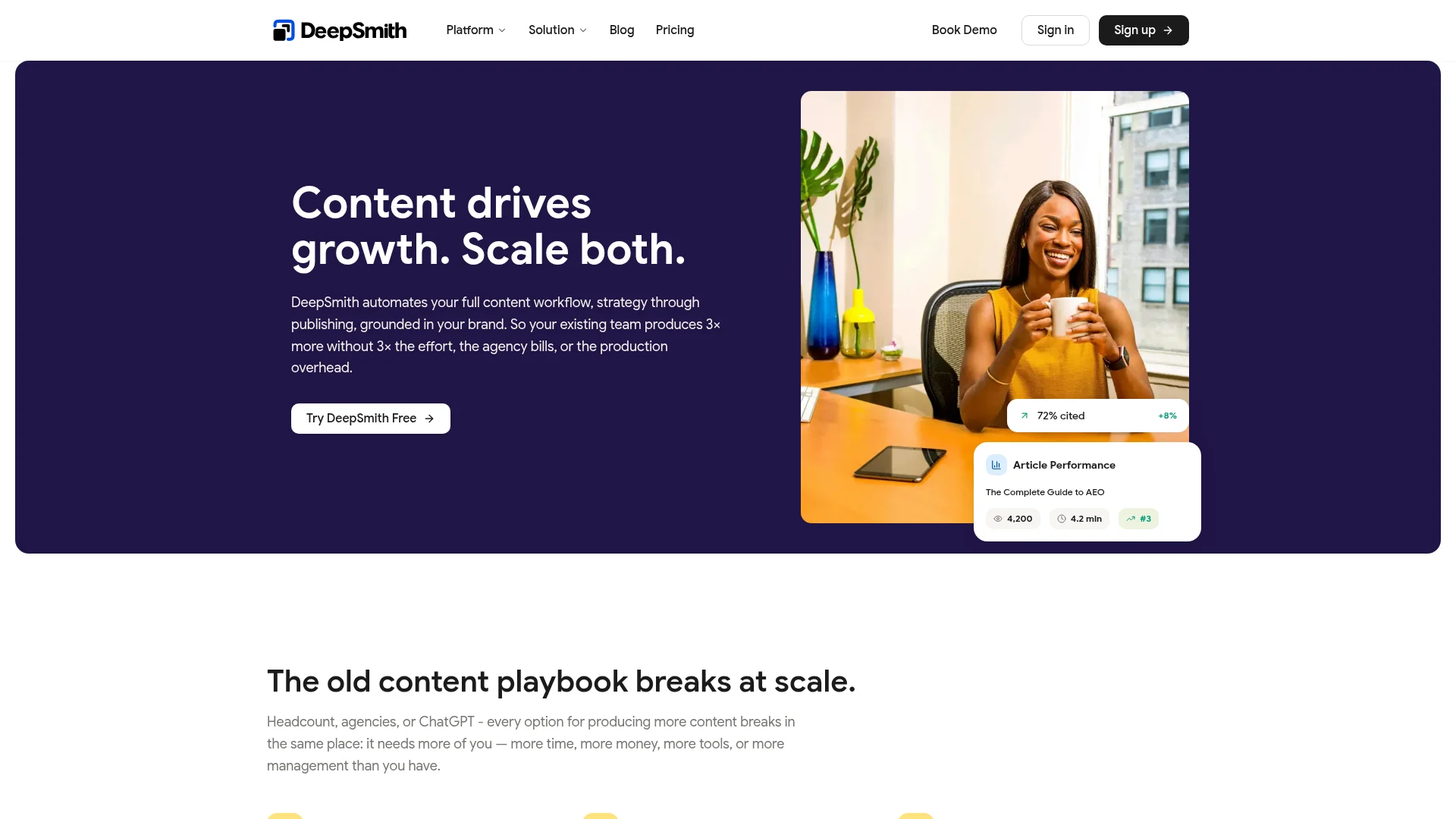
What it is: An AI content automation platform that handles the full production lifecycle: strategy and ideation through research, drafting, editorial QA, voice styling, internal linking, cover image generation, publishing metadata, CMS publishing, and automated distribution across 14 channels.
Pricing: Pro at $80/mo, Scale at $299/mo, Enterprise custom. Team-oriented tiers, not per-seat pricing.
Why teams switch from Byword to DeepSmith:
The switch isn't about swapping one article generator for a faster one. It's about changing the unit of work. Byword's unit is a first draft. DeepSmith's unit is a distributed, on-brand, internally linked, image-paired published article. Byword is a fast article factory. DeepSmith is a governed pipeline.
With Byword, every article means this: upload keywords, wait 60 to 90 seconds for generation, export to Google Docs for 20 to 45 minutes of voice and fact-check editing, optionally run a separate humanizer, publish to your CMS, then manually write LinkedIn posts, newsletter copy, and social snippets in other tools. Four to five tools. Editorial labor that doesn't appear in the sticker price.
With DeepSmith, you select an idea from Topic Explorer (or let the 5-agent ideation pipeline generate one). The 10-agent writing pipeline runs research collection, brief architecture, drafting, editorial review, voice styling, sitemap-matched internal linking, cover image generation, and publishing metadata. One-button publish to WordPress. Then the Agent Library produces LinkedIn posts, X threads, newsletter emails, and Medium articles, all voiced from Deep IQ brand context. Roughly 15 minutes of automated pipeline plus human review.
What DeepSmith does that Byword doesn't:
- Multi-pass editorial pipeline. An Editorial Reviewer agent audits structure, coverage, and claim validation. A separate Voice Stylist agent tightens filler, cuts AI patterns, and applies Brand Voice Texture settings. Byword's voice matching is a single prompt layer with no post-generation editorial QA.
- Deep IQ brand context across 6 structured dimensions. About Company, Products & Services, Buyer Personas, Brand Voice (8 Tone Sliders + 8 Voice Texture settings), Visual Guidelines, and Content Types. Byword's voice matching is narrower than this structured approach.
- Sitemap-powered internal linking. DeepSmith crawls and enriches your sitemap with AI-generated metadata (summary, primary topic, angle, buyer stage, key phrases), then matches article phrases against the inventory. Byword suggests internal links but doesn't build a structured inventory.
- 5-agent idea generation pipeline. Strategic Brief Builder, Opportunity Mapper, Angle Planner, Idea Generator, and Editorial QA produce publish-ready ideas with buyer stage and article shape per slot. Byword starts from keywords or titles you supply.
- 14 distribution agents across 4 categories. LinkedIn, X, Facebook, Instagram, Reddit, Medium, Substack, newsletter, nurture email, Slack/Discord, WhatsApp. Byword is article-only.
- Cover image generation from visual guidelines. The Cover Image Prompt Builder parses visual guidelines and article content. Byword generates images across 17 styles but not from structured brand visual rules.
- Publishing metadata automation. Slug, SEO title (under 60 chars), and meta description (140 to 155 chars) generated automatically.
- AI Prompt Tracking across ChatGPT, Gemini, Perplexity, and Google AI Mode. Twice-weekly refresh with brand mentions, citations, competitor mentions, and sentiment. Byword has no AEO tracking.
What to consider:
DeepSmith isn't the right fit if your primary use case is massive programmatic SEO throughput, hundreds of template-driven pages per month where the editorial bar is "structurally correct and SEO-aware." Byword's programmatic SEO workflow is more direct and scales better at the per-page level. If you run pure programmatic plays on long-tail keywords, Byword or Junia AI are the better tools. For teams whose editorial standard is higher and whose workflow includes distribution, DeepSmith fits. Teams that need short-form ad copy alongside articles get a broader marketing-agent library from Jasper.
Best for: SaaS founders, content marketing managers, and lean growth teams who need the full content lifecycle in one system, and whose unit of work is "published, distributed, on-brand article" rather than "first draft."
2. Jasper
Best for teams who need brand voice across articles, ads, social, and email
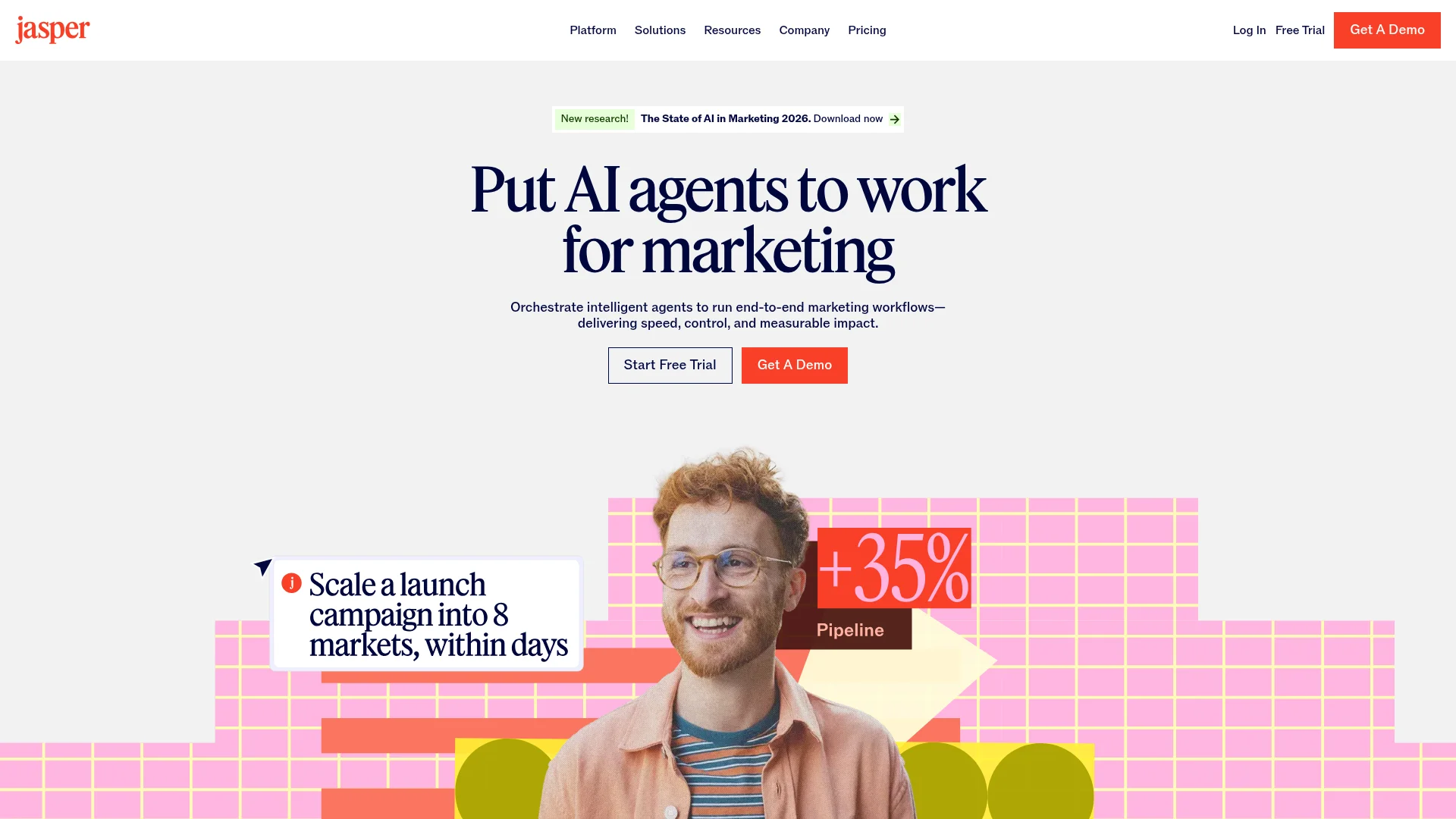
What it is: An AI marketing platform with 100+ marketing agents, Content Pipelines, and Jasper IQ (a brand context layer). Was the AI writing tool of choice before category specialization emerged. Natively integrates with Surfer SEO for optimization scoring.
Pricing: Pro at $59/mo annual ($69/mo monthly, single seat), Business custom (12-month commitment). 7-day free trial. Pricing verified from jasper.ai/pricing.
Key strengths:
- Superior brand voice handling. Jasper IQ learns from sample URLs and applies across formats, deeper than Byword's voice matching.
- 100+ marketing agents cover articles, ads, email sequences, social posts, and landing page copy in one tool.
- Enterprise governance available: SSO, SCIM, SOC 2 Type II. Byword has team workspaces but less formal governance.
- Review footprint is solid: 4.7/5 on G2 from 1,269 reviews and 4.8/5 on Capterra from 1,855 reviews.
Key limitations:
- Pro tier is single-seat. Team features require Business (custom), a pricing conversation before you know the cost.
- No native SEO scoring. You pair Jasper with Surfer ($99/mo+) or work without optimization.
- Long-form articles produce less SEO-optimized structure than Byword. Jasper is a marketing writer, not an SEO writer.
- Trustpilot shows 3.4/5 from 4,145 reviews with a cluster of billing complaints. Worth noting if billing sensitivity is material.
Best for: Teams whose real bottleneck is brand voice across multiple content formats, not bulk article throughput, and who need ad copy, email, and social alongside articles. A good Byword alternative if your primary frustration is Byword's article-only scope.
3. Writesonic
Best for AI search visibility tracking alongside article production
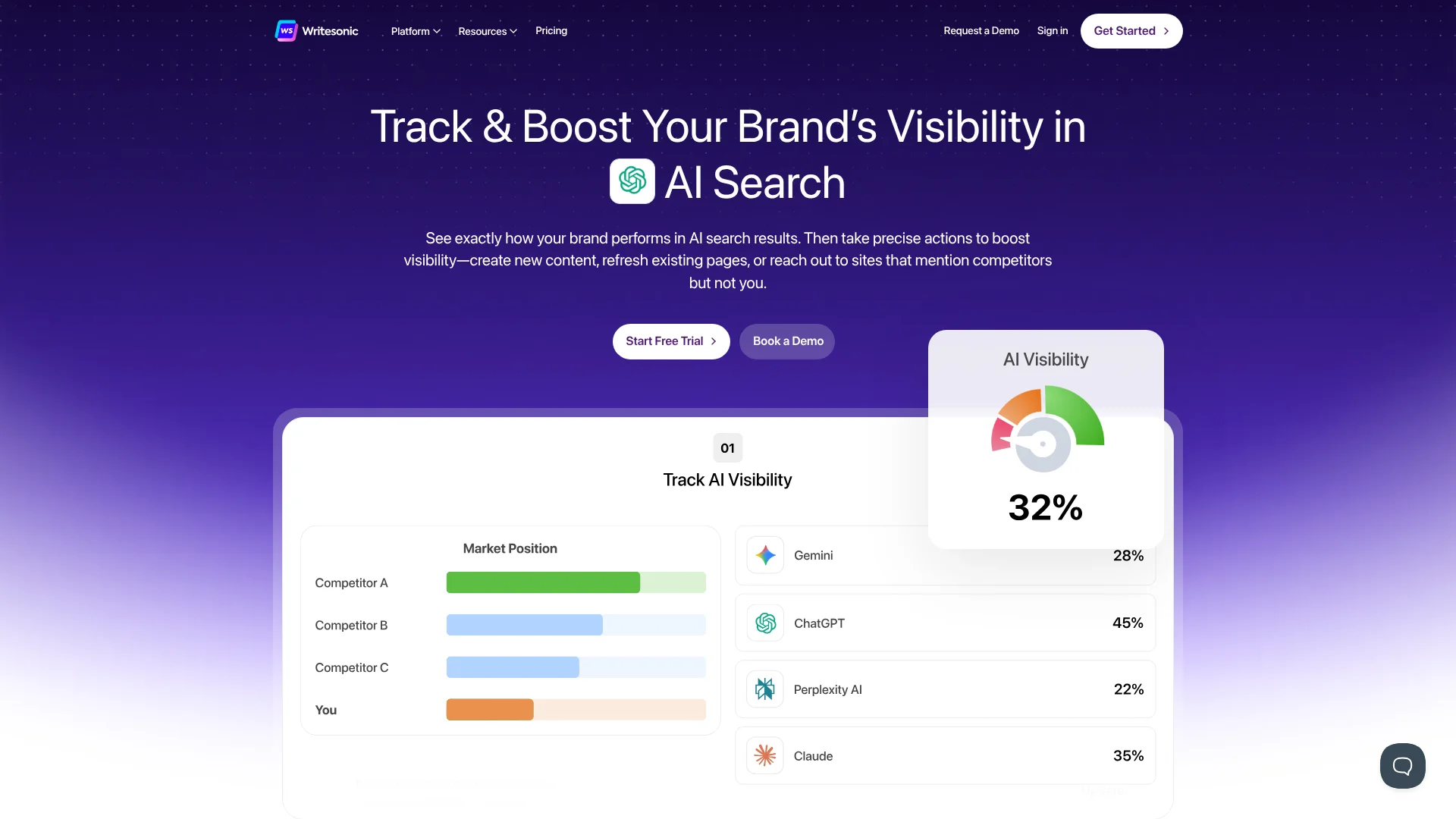
What it is: An AI Search Visibility platform with integrated AI writing and SEO tools. Tracks brand appearance across 8+ AI search engines (ChatGPT, Google AI Mode, Gemini, Claude, Perplexity, Microsoft Copilot, Grok, Google AI Overviews), backed by what the company describes as a 120M+ real AI conversation dataset for AI search volume prediction.
Pricing: Free tier available. Starter at $99/mo ($79 annual), Basic at $249/mo ($199 annual), Growth at $499/mo ($399 annual), higher tiers Enterprise. Pricing verified from writesonic.com/pricing.
Key strengths:
- AI Search Visibility tracking across 8+ platforms. Byword has no AEO tracking, so this closes a real gap.
- Large verifiable review footprint: 4.7/5 on G2 from 2,093 reviews, 4.8/5 on Capterra from 2,102 reviews, and 4.6/5 on Trustpilot from 5,808 reviews.
- Content Engine combines SEO and GEO optimization during generation, not as a separate step.
- 120M+ AI conversation dataset informs what people actually ask AI tools.
Key limitations:
- Starter at $99/mo includes only 15 AI articles per month. Byword Starter at $83/mo annual gives 25.
- Prompt tracking limited to 50 prompts and ChatGPT only on Starter. Full multi-platform tracking requires higher tiers.
- Users through 2023 to 2025 report tier changes and pricing volatility. Worth verifying current terms during trial.
- No in-app editor comparable to a dedicated editorial tool.
Best for: Teams who need AI search visibility tracking baked into the same tool that generates articles, and who value the social proof of a large verifiable review base. A good Byword alternative if your primary frustration is Byword's missing AEO tracking.
4. Surfer SEO
Best for mature SEO optimization scoring plus AI tracking
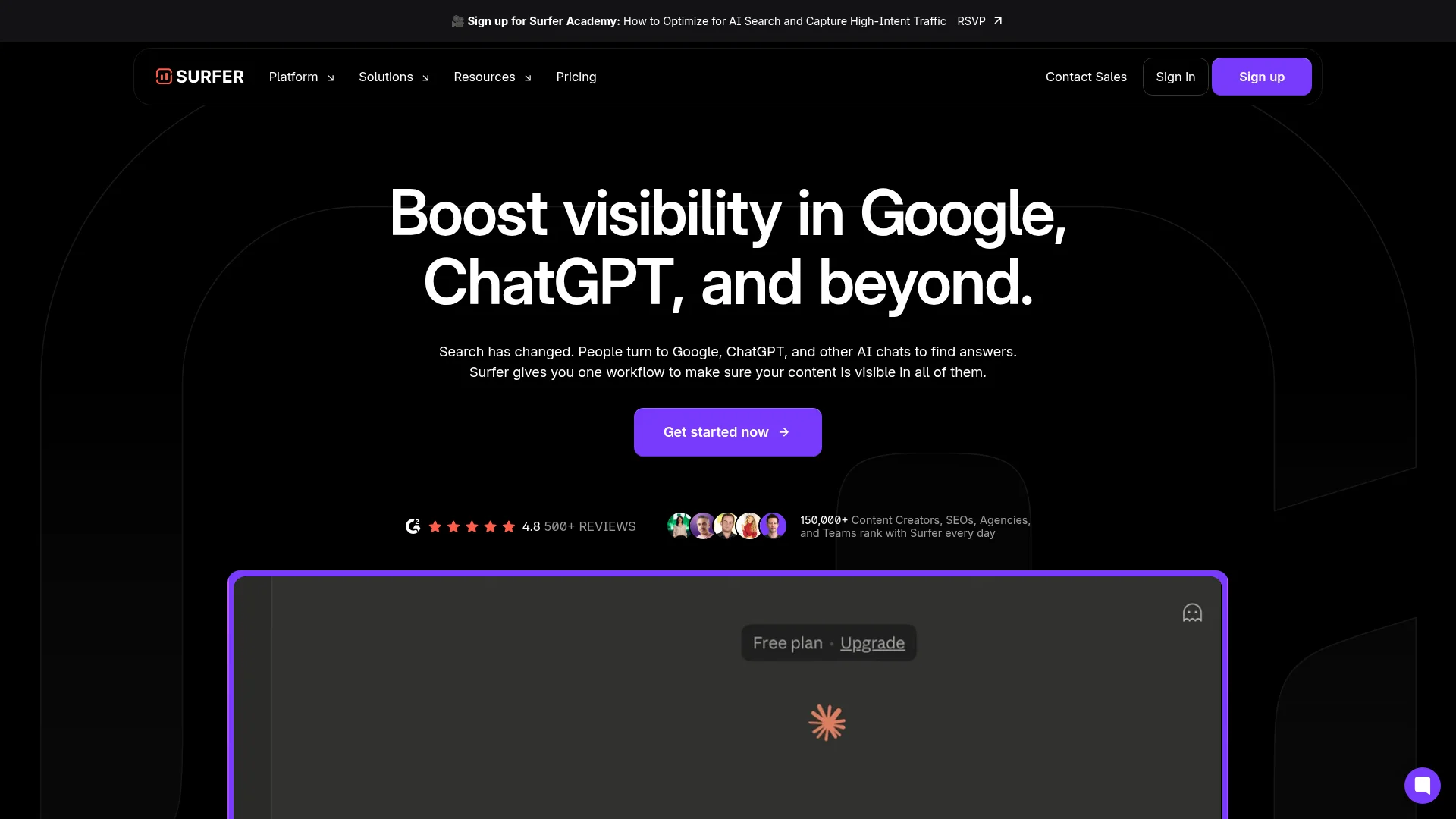
What it is: An SEO content optimization platform with the industry-standard Content Score metric and an AI Tracker covering 5 AI platforms (Mention Gap and Sentiment Analysis included). Pairs with separate AI writers or uses Surfer AI for integrated generation.
Pricing: Discovery at $49/mo (120 docs/yr, 1 seat), Standard at $99/mo (360 docs/yr, 3 seats), Pro at $182/mo (360 docs/yr, 5 seats, AI Tracker all models, 1-click Internal Linking), Peace of Mind at $299/mo, Enterprise at $999+/mo. All billed annually. Pricing verified from surferseo.com/pricing.
Key strengths:
- Content Score is widely referenced in the SEO community as a benchmark optimization metric.
- AI Tracker across 5 AI platforms with Mention Gap and Sentiment Analysis on Pro+. Addresses the AEO gap Byword doesn't cover.
- 1-click Internal Linking and Auto-Optimize on Pro, which cut manual work for teams with existing content inventories.
- Rated 4.8/5 on G2 from 540 reviews and 4.4/5 on Trustpilot from 213 reviews.
Key limitations:
- More expensive than Byword at pure article throughput. Standard at $99/mo caps at 360 docs per year, roughly 30 per month, well below Byword Standard's 80.
- Surfer AI output still needs humanization. Same AI detection concern as Byword.
- An optimizer paired with a writer. Not a full production system, no CMS publishing, no distribution.
- Acquired by Group Positive in recent years, which may affect product direction.
Best for: SEO-focused teams willing to trade bulk throughput for optimization depth and AI tracker. A good Byword alternative if your primary frustration is that Byword's SEO scoring is real-time but not deep, and you want Content Score benchmarking plus AEO tracking from one tool.
5. Frase
Best for research, optimization, and AI writing at a lower entry price
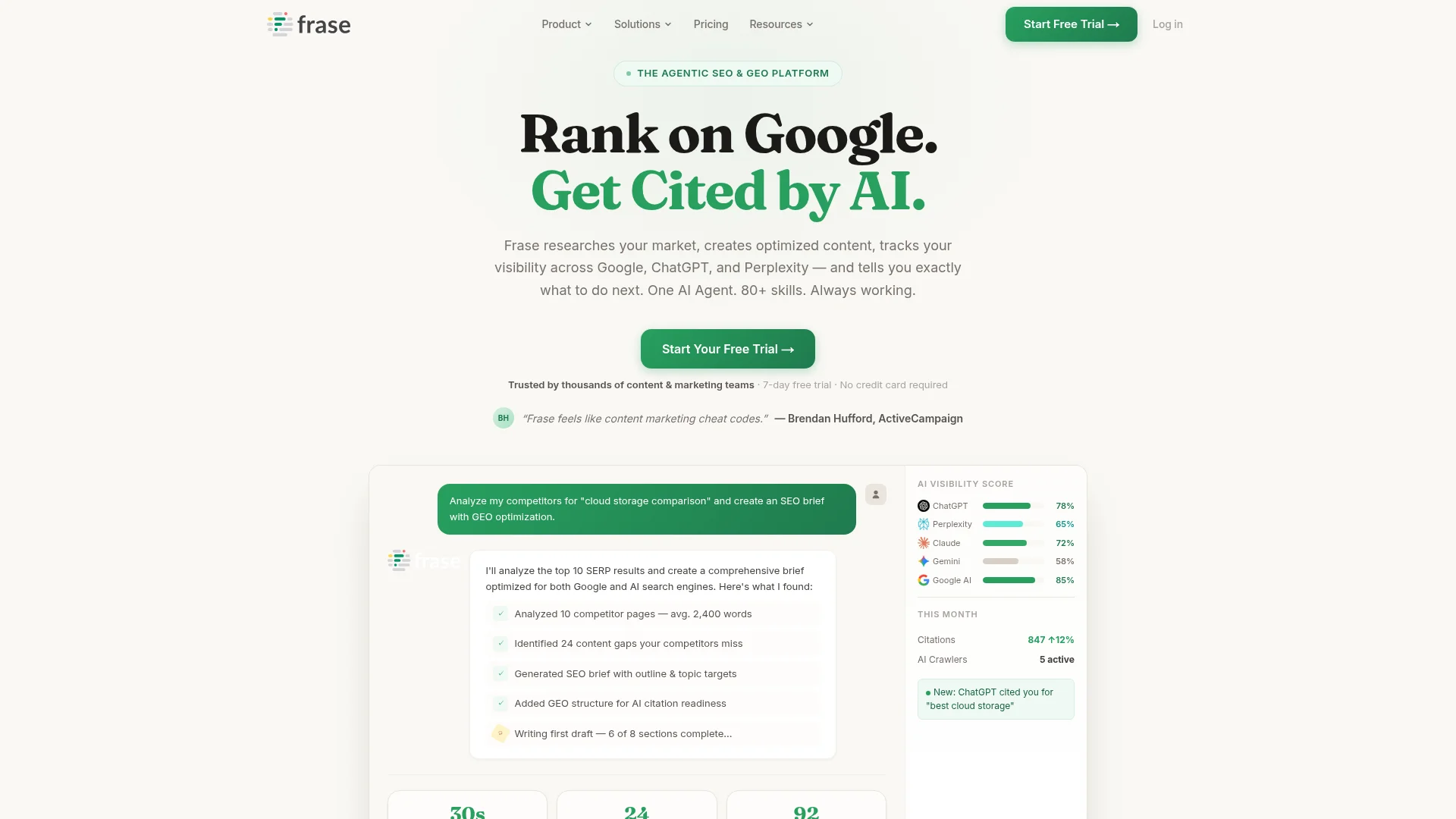
What it is: An agentic SEO and GEO platform combining SERP research, content briefs, SEO/GEO optimization, AI writing, AI visibility tracking, and site audits through a single AI Agent with 80+ skills.
Pricing: Starter at $39/mo annual ($49 monthly, 10 articles/mo), Professional at $103/mo annual, Scale at $239/mo annual, Enterprise custom. 7-day free trial, no credit card. Pricing verified from frase.io/pricing.
Key strengths:
- Closest price-to-functionality alternative at the entry tier: $39/mo Starter vs. Byword Starter at $83/mo annual.
- AI Visibility tracking across 2 to 8 platforms depending on tier. Byword has none.
- Auto internal linking included at the Starter tier, unusual at this price point.
- Named enterprise customers include Shopify, GitLab, Oracle, Coursera, and Talkspace.
- Rated 4.8/5 on G2 from 301 reviews and 4.8/5 on Capterra from 335 reviews.
Key limitations:
- 10 articles per month on Starter. Byword Starter at $83/mo gives 25. If pure article count matters, Byword wins at the entry tier.
- Single brand voice on Starter, limiting for teams with multiple brand voices.
- Trustpilot rating is 1.3/5 from 52 reviews, with a refund complaints cluster. Small sample, but worth verifying before annual commitment.
- UI is functional but less polished than newer platforms.
Best for: Solo creators and small teams who want Byword's article-generation function at a lower entry cost, plus AI visibility tracking and auto internal linking. A good Byword alternative if your primary frustration is Byword's price tier and missing AEO tracking.
6. Junia AI
Best for direct bulk SEO article generation at the lowest price point
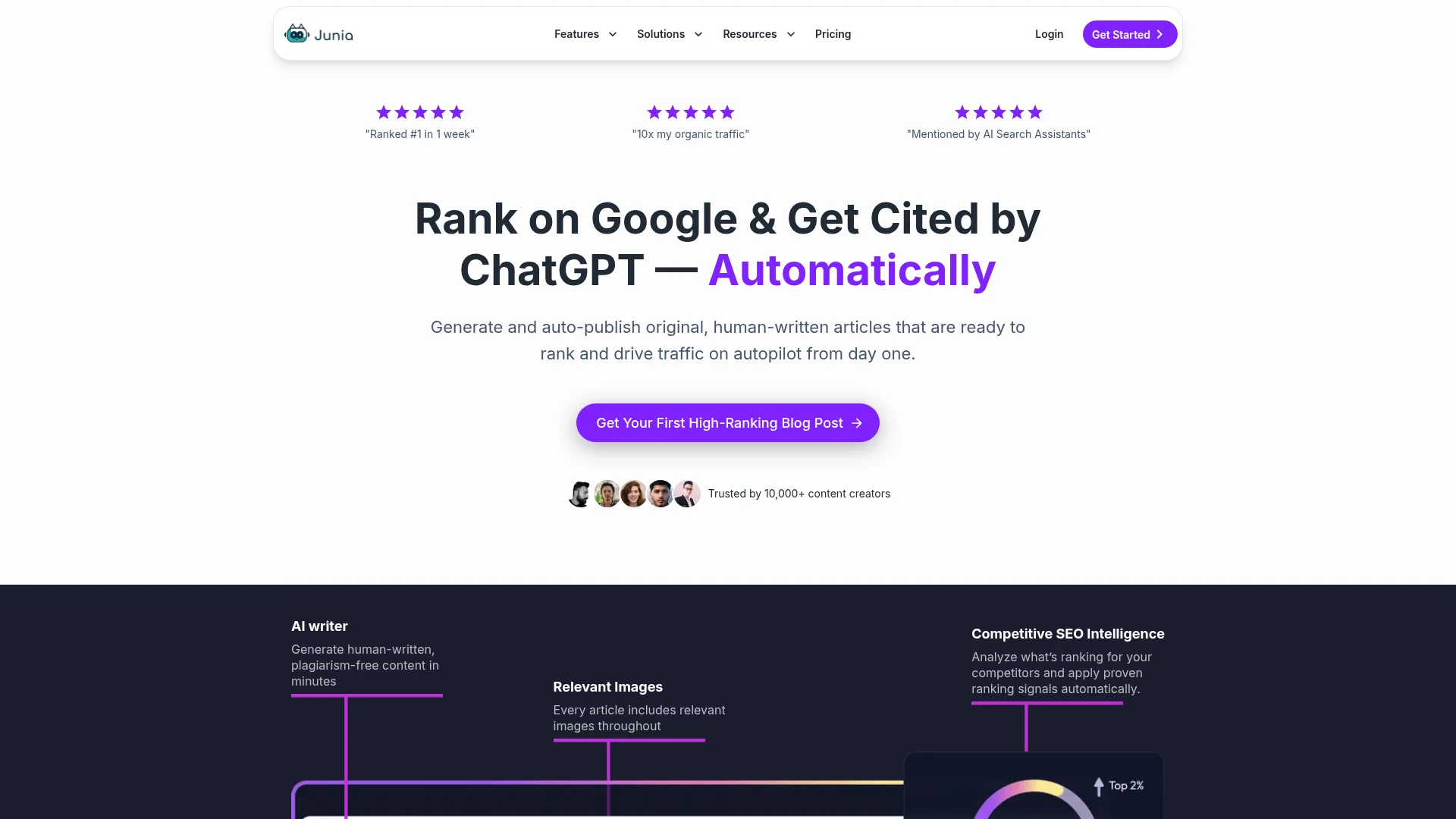
What it is: An AI SEO article writer positioned for "rank on Google and get cited by ChatGPT, automatically." Competes directly with Byword on bulk AI SEO article generation, with auto-publishing and autoblogging features. Reports 10,000+ content creators on the platform.
Pricing: Basic at $15/mo (5 articles/mo), Growth at $27/mo (10 articles/mo, auto internal linking, keyword and competitor research, Google indexing), Scale Starter at $47/mo (68 articles/mo, autoblogging, auto-publish). 40%+ savings on annual billing. Pricing verified from junia.ai/pricing.
Key strengths:
- Significantly cheaper at the entry tier: Basic at $15/mo vs. Byword Starter at $83/mo annual.
- Autoblogging on Scale Starter: articles generate and publish automatically on schedule. Byword has programmatic SEO but not fully autonomous scheduled publishing.
- Auto internal and external linking included on Growth at $27/mo.
- 150+ languages supported, broader than Byword's 47.
Key limitations:
- Much smaller enterprise trust signal. No comparable enterprise logo set to Byword's.
- Very limited public review data. No confirmed G2 or Capterra footprint captured in research.
- Feature depth per plan is narrower than Byword's. Fewer CMS integrations, less granular SEO scoring.
- AI detection and quality concerns are similar to Byword's, inherent to bulk AI generation at speed.
Best for: Solopreneurs, bloggers, and small teams who want Byword-style bulk SEO article generation at a fraction of the cost and can accept narrower features. A good Byword alternative if your primary frustration is the Byword price tier and you're comfortable trading enterprise polish for raw price.
7. Scalenut
Best for a guided SEO workflow with bundled content and backlink modules

What it is: An AI content and GEO platform combining Cruise Mode (a guided article creation workflow), keyword clustering, SERP-based optimization, AI visibility tracking, auto-publishing to WordPress and Shopify, and bolt-on modules for social distribution (Social Upreach) and backlinks (Backlinks Marketplace).
Pricing: Starter at $59/mo, Plus at $89/mo (30 articles + auto-publish + Social Upreach + Backlinks Marketplace), Professional at $199/mo (75 articles + Perplexity tracking + unlimited team), VIP Service custom. Promotional pricing frequently runs. Pricing verified from scalenut.com/pricing.
Key strengths:
- Cruise Mode is a friendlier guided workflow than Byword's bulk-batch UX. Better for teams who want more per-article control.
- Bundled Backlinks Marketplace and Social Upreach on the Plus tier, unusual at this price point.
- AI visibility tracking included on the entry tier (ChatGPT and Google AI Overviews).
- Rated 4.7/5 on G2 from 315 reviews.
Key limitations:
- Lower bulk throughput than Byword: 30 articles/mo on Plus vs. Byword Standard's 80.
- Cruise Mode requires operator time per article, roughly 5 to 10 minutes each. Not suited for pure-throughput programmatic SEO.
- Trustpilot rating is 3.2/5 from 159 reviews, reflecting support and refund friction some teams report.
- Recent shift toward VIP Service (done-for-you) may deprioritize the self-serve product over time.
Best for: Small-to-mid teams who want a guided all-in-one SEO content workflow with bundled add-ons, rather than a batch-generator. A good Byword alternative if your primary frustration is Byword's lack of guided per-article workflow and you value bundled social and backlink modules.
8. ChatGPT
Best DIY option at the lowest price point
What it is: OpenAI's general-purpose conversational AI, running GPT-5.3 and GPT-5.4 Pro flagship models. Used as a DIY content tool via Custom GPTs, Projects, and prompt libraries.
Pricing: Free tier available. Go at $8/mo (may include ads), Plus at $20/mo, Pro from $100/mo, Business at $20/user/mo, Enterprise custom.
Key strengths:
- Cheapest option on this list by a wide margin. Plus at $20/mo vs. Byword Starter at $83/mo annual.
- Raw LLM quality is strong across multiple models, with recent flagship access at the Plus tier.
- Custom GPTs allow pipeline-style prompts: a briefing GPT, a writing GPT, a voice-styling GPT. Senior operators can build a workflow covering much of what Byword automates.
- Rated 4.7/5 on G2 from 2,013 reviews and 4.4/5 on Capterra from 339 reviews.
Key limitations:
- No SEO scoring, no keyword research, no SERP analysis, no AI visibility tracking. You lose every structured feature Byword provides.
- No CMS publishing, no internal linking, no batch article workflow. You're the pipeline.
- Building a reliable bulk workflow requires prompt engineering time that doesn't appear in the $20/mo price.
- Hallucinations and citation gaps require fact-checking. The tradeoff of raw model access is governance loss.
Best for: Senior marketers and operators who can build their own Custom GPTs and are willing to trade workflow automation for raw model access at a fraction of the cost. A good Byword alternative if your primary frustration is the Byword price tier and you already run DIY prompt-driven workflows.
How to Choose the Right Byword Alternative
The right tool depends on where your real bottleneck sits.
You're paying for Byword + a humanizer + Google Docs + a social tool + an AEO tracker, and the combined bill exceeds one full system.
→ DeepSmith.
One pipeline on team pricing at $80/mo Pro.
You write 30+ articles a month and manually turn each into 14 channels of distribution assets.
→ DeepSmith.
Agent Library produces 14 channels from each article.
Everything in Byword fits your shape of work, hundreds of long-tail programmatic pages at 60-to-90-second generation, and the migration cost outweighs any gain.
→ Stay with Byword.
60-to-90-second programmatic generation at per-article price.
Your tool budget is capped under $30, and you accept structural-only output with no enterprise polish.
→ Junia AI.
Basic at $15/mo handles bulk AI SEO articles.
You already have strong writers, brand voice, and a CMS workflow handled, and your one remaining gap is tracking how your brand appears in ChatGPT, Gemini, and Perplexity.
→ Writesonic.
AI Search Visibility across 8+ platforms with conversation data.
Ready to Move Beyond a First-Draft Generator?
DeepSmith handles your entire content production pipeline, from ideation through publishing to 14-channel distribution, so your team can produce more content without growing headcount or stitching together a tool stack around a bulk generator. Pro starts at $80/mo, team-tier pricing, not per-seat.
→ Start your free trial at deepsmith.ai
7-day free trial. See how it compares in your first session.