
Clearscope is one of the most respected content optimization tools on the market. Its NLP-powered term recommendations are widely regarded as the most accurate available, and its Google Docs integration fits neatly into how most content teams already work. There's a reason it holds a 4.9/5 on both G2 (92 reviews) and Capterra (60 reviews).
But it's not the right fit for every team.
If you're evaluating alternatives, you've likely bumped into one or more of these friction points:
The $129/month starting price is hard to justify on a lean budget. Clearscope Essentials costs roughly $6.45 per content report. Frase offers comparable reports at about $1.50 each. Surfer SEO brings it down to $0.28 per document. For freelancers and small teams, the math doesn't work, especially with no free trial to test ROI before committing.
Clearscope optimizes content but doesn't produce it. Every article still requires researching in a separate tool, writing a draft manually or with a separate AI writer, pasting into Clearscope, then copying the optimized version back to your CMS. The optimization step is excellent, but it's one step in a four-to-five tool workflow.
Usage limits feel tight, even on the Business plan. Essentials caps at 50 Content Inventory pages, 20 drafts, and 20 Topic Explorations per month. The jump to 300 pages requires upgrading to Business at $399/month, and the 20-draft cap on AI writing doesn't increase at the higher tier.
There's no path from optimized article to published and distributed. No CMS publishing, no internal linking automation, no repurposing tools. After Clearscope, you're on your own for everything between "optimized draft" and "live on the site with a LinkedIn post and newsletter version."
Email-only support on a premium product. For a tool starting at $129/month serving enterprise customers like IBM and Webflow, there's no live chat or phone support. As one reviewer noted: "Email-only support on a tool this expensive feels wrong. When you're stuck on a deadline, waiting 24+ hours for responses sucks."
This guide compares 8 alternatives across different categories: full production systems, optimization-focused tools, strategy platforms, and budget-friendly options. We've included honest strengths, limitations, and verified pricing for each.
How We Evaluated These Alternatives
We analyzed pricing from each tool's website, features from product pages, and user feedback from G2, Capterra, TrustRadius, Reddit, and independent reviews. Evaluation dimensions: content production scope, optimization accuracy, SEO/AEO capabilities, pricing structure, ease of use, and integration ecosystem. DeepSmith is our product. We've included it because it genuinely fits the "content production, not just optimization" gap, but we've also noted where other tools are the better choice, and included a "what to consider" section. All pricing and features verified as of April 2026.
Quick Comparison Table
| Tool | Best For | Starting Price | Scope |
|---|---|---|---|
| DeepSmith | Teams needing a full content system, not just optimization | $80/mo | Full pipeline (idea to published, 14 channels) |
| Surfer SEO | Optimization plus a broader SEO toolkit | $99/mo | Optimizer + basic AI drafts |
| Frase | AI drafting + optimization on a tight budget | $15/mo | Research + drafting + optimizer |
| MarketMuse | Portfolio-level content strategy and topic modeling | Free / ~$99/mo | Portfolio strategy, no writing |
| Dashword | Simple, affordable optimization with monitoring | $39/mo | Budget optimizer + monitoring |
| Content Harmony | Content briefs and search intent planning | $99/mo | Briefs only |
| Jasper | AI content creation with brand voice | $49/mo | AI writing + Brand Voice |
| ChatGPT | Budget-conscious solo creators | Free / $20/mo | General LLM, DIY |
What Clearscope Does Well
Before recommending alternatives, Clearscope's strengths deserve recognition. These are genuine, well-documented capabilities.
The NLP content recommendations are the most accurate in the category. Clearscope uses Google Cloud NLP, OpenAI, and IBM Watson to generate term suggestions that consistently surface in reviewer praise. As you write, keywords get checked off in the right sidebar with green checkmarks. The semantic grouping toggle reorganizes terms into color-coded clusters so you can focus on one topic at a time, with each keyword showing typical usage numbers from top-ranking articles (e.g., "coffee beans appeared 6 to 16 times"). As Kristian Larsen wrote in his 2026 review: "I've replaced SurferSEO and a series of other tools in favor for it."
The UI is genuinely simple. In a category filled with feature-heavy dashboards, Clearscope stays focused. Reviewers consistently describe a workflow where you insert a keyword, create a report link, and send it to a writer. Enes B., a Content Creator at a 51-200 employee company with 2+ years of use, put it directly on Capterra: "Being a customizable and flexible product makes my work process incredibly easy."
Customer support goes beyond tickets. Multiple reviewers cite direct access to founder Bernard Huang for strategy guidance, not just technical help. Steven L., a Marketing Agency Principal with 1-2 years of use, noted on Capterra: "They also help you understand how to use the tool to maximize impact, rather than just having the subscription." Free training and onboarding come standard on all plans.
The Google Docs integration reduces real friction. Install a browser extension, connect it to your account, link a content report, and the optimization sidebar appears alongside your document. Most content teams already live in Google Docs, and having term suggestions and content grades right there eliminates the tab-switching that slows down editing.
These strengths are real. If they match your primary use case, Clearscope may be the right tool for you. The alternatives below serve teams whose needs extend beyond what Clearscope covers.
1. DeepSmith
Best for Teams Who Need a Complete Content System, Not Just an Optimizer
What it is: An AI content automation platform that handles the full production pipeline: content strategy and ideation through writing, QA, SEO/AEO optimization, internal linking, image generation, CMS publishing, and automated repurposing across 14 distribution channels.
Pricing: Pro at $80/mo, Scale at $299/mo, Enterprise custom. Team-oriented tiers, not per-seat pricing.
Why teams switch from Clearscope to DeepSmith:
The switch isn't about replacing an optimizer with a better optimizer. It's about replacing one stage of a multi-tool workflow with a single system that handles the full production lifecycle, including the optimization stage.
With Clearscope, every article means: research keywords in a separate tool, write a draft in Google Docs, open a Clearscope report, revise until you hit an A grade, copy the optimized content into your CMS, build internal links by hand, create a cover image in Canva, publish, then manually write LinkedIn posts and newsletter versions. Four to five tools, two to three hours of coordination per article beyond the writing itself.
With DeepSmith, you select an idea from the content calendar (or let the 5-agent ideation pipeline generate one). The 10-agent pipeline handles research, brief generation, drafting, editorial QA, voice styling, internal linking, cover image creation, and publishing metadata. One-button publish to WordPress. Then the Agent Library turns the article into distribution assets across 14 channels. One tool, about 15 minutes of automated pipeline plus human review.
What DeepSmith does that Clearscope doesn't:
- 10-agent article writing pipeline. Automated research, brief generation, writing, editorial review, voice styling, and internal linking. Produces publish-ready articles, not optimization suggestions for drafts you write separately.
- Automated internal linking. Sitemap-powered matching finds relevant link targets and places them editorially during writing. Clearscope offers linking guidance but doesn't automate placement.
- Content repurposing across 14 channels. Turns any article into LinkedIn posts, X threads, newsletter emails, Medium articles, and more. Clearscope has no distribution features.
- Deep IQ brand context system. Six structured context elements (company, products, personas, voice with 16 settings, visual guidelines, content types) that persist across all content.
- Autowrite scheduled production. Pre-configure articles to write automatically on planned dates. Content production runs on a schedule, even when you're not in the tool.
- 5-agent idea generation pipeline. Generates structured content ideas with titles, angles, buyer stages, and keyword alignment. Goes beyond Clearscope's Topic Explorations keyword clusters.
- AEO prompt tracking across 4 AI platforms. Monitors brand visibility in ChatGPT, Gemini, Perplexity, and Google AI Mode with twice-weekly refresh.
- Direct CMS publishing. One-button WordPress publishing from the article view.
What to consider:
DeepSmith is not the right fit for teams whose primary need is optimizing content they've already written, especially if writers prefer working inside Google Docs with real-time sidebar feedback. If optimization scoring accuracy is your single most important factor and your production workflow is already solid, Clearscope's focused approach may be more suitable. For teams that only need optimization (not production), Surfer SEO ($99/mo) or Frase ($15/mo) are also worth evaluating.
Best for: SaaS founders, content marketing managers, and lean growth teams who need the full content lifecycle handled in one system, and whose bottleneck is production, not just optimization.
2. Surfer SEO
Best for Optimization Plus a Broader SEO Toolkit
What it is: A content optimization and AI writing platform with a content editor, site-wide audit tools, AI search visibility tracking, and keyword research. One of the most established tools in the SEO content space.
Pricing: Standard at $99/mo (annual), Pro at $182/mo (annual), Peace of Mind at $299/mo (annual). 360 documents per month on all plans. Pricing verified from surferseo.com.
Key strengths:
- Optimization scoring on par with Clearscope, plus broader capabilities: content audits, internal linking, and AI visibility tracking
- 360 documents/month on Standard vs. Clearscope's 50 pages on Essentials, dramatically better per-report economics
- Google Docs integration and native Jasper AI integration for writing with real-time scoring
- Rated 4.8/5 on G2 (500+ reviews) and 4.9/5 on Capterra (400+ reviews)
Key limitations:
- Feature-heavy UI has a steeper learning curve than Clearscope, meaning more onboarding time before the team is productive
- Not a production system: no CMS publishing, no content calendar, no automated repurposing
- AI writing available but less polished than dedicated AI writers for quality-sensitive content
- Was acquired by Group Positive, which may affect product direction
Best for: Agencies and SEO teams who want Clearscope-caliber optimization with a broader toolkit, at better per-document economics. A good Clearscope alternative if your primary frustration is the per-report cost or the narrow feature scope on Clearscope's Essentials plan.
3. Frase
Best for AI Drafting Plus Optimization on a Tight Budget
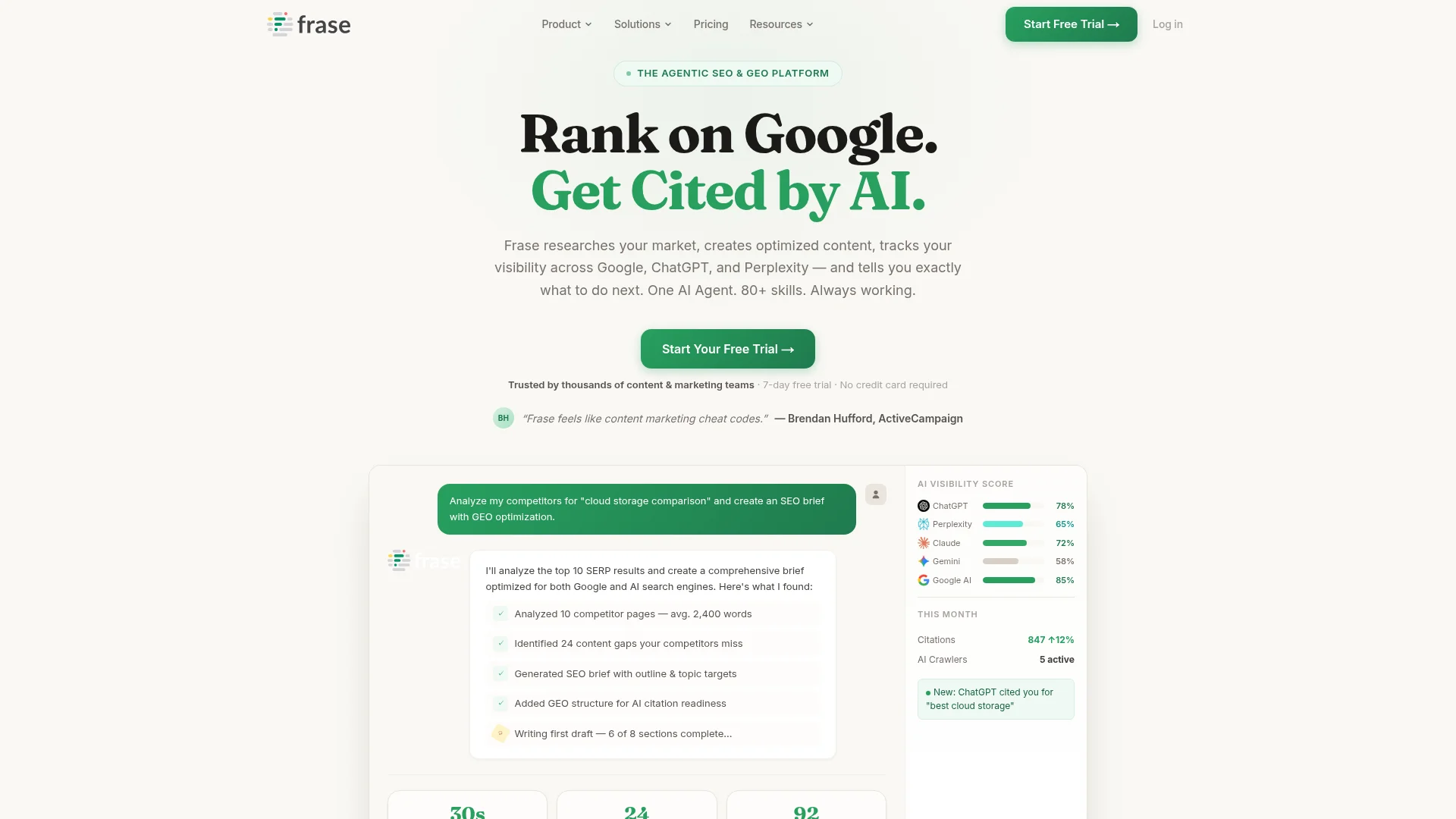
What it is: A content research, AI-assisted drafting, optimization, and analytics platform. Combines SERP-based outline creation with AI writing and real-time SEO scoring in one workflow.
Pricing: Solo at $15/mo (10 reports), Basic at $45/mo (30 reports), Team at $115/mo (unlimited reports). Pricing from frase.io.
Key strengths:
- Best per-report value in this category: roughly $1.50 per report on Basic vs. Clearscope's $6.45 on Essentials
- Combines research, AI drafting, optimization, and analytics in one tool, covering more of the content workflow than Clearscope
- GEO scoring alongside SEO scoring for AI search engine optimization
- Unlimited reports on Team ($115/mo) vs. Clearscope's 20-draft cap on both Essentials and Business
- Rated 4.8/5 on both G2 and Capterra
Key limitations:
- Optimization recommendations may be less precise than Clearscope's NLP engine. Multiple comparison articles position Clearscope as more accurate.
- UI is functional but not as polished. Teams switching from Clearscope notice the difference.
- No CMS publishing, no content calendar, no automated internal linking, no repurposing. More workflow coverage than Clearscope but still manual post-draft.
- Smaller community and ecosystem means fewer templates and learning resources
Best for: Small teams and solo operators who need AI drafting help alongside SEO scoring at an affordable price. A good Clearscope alternative if your primary frustration is the cost per report and you want writing and optimization combined in one tool.
4. MarketMuse
Best for Portfolio-Level Content Strategy
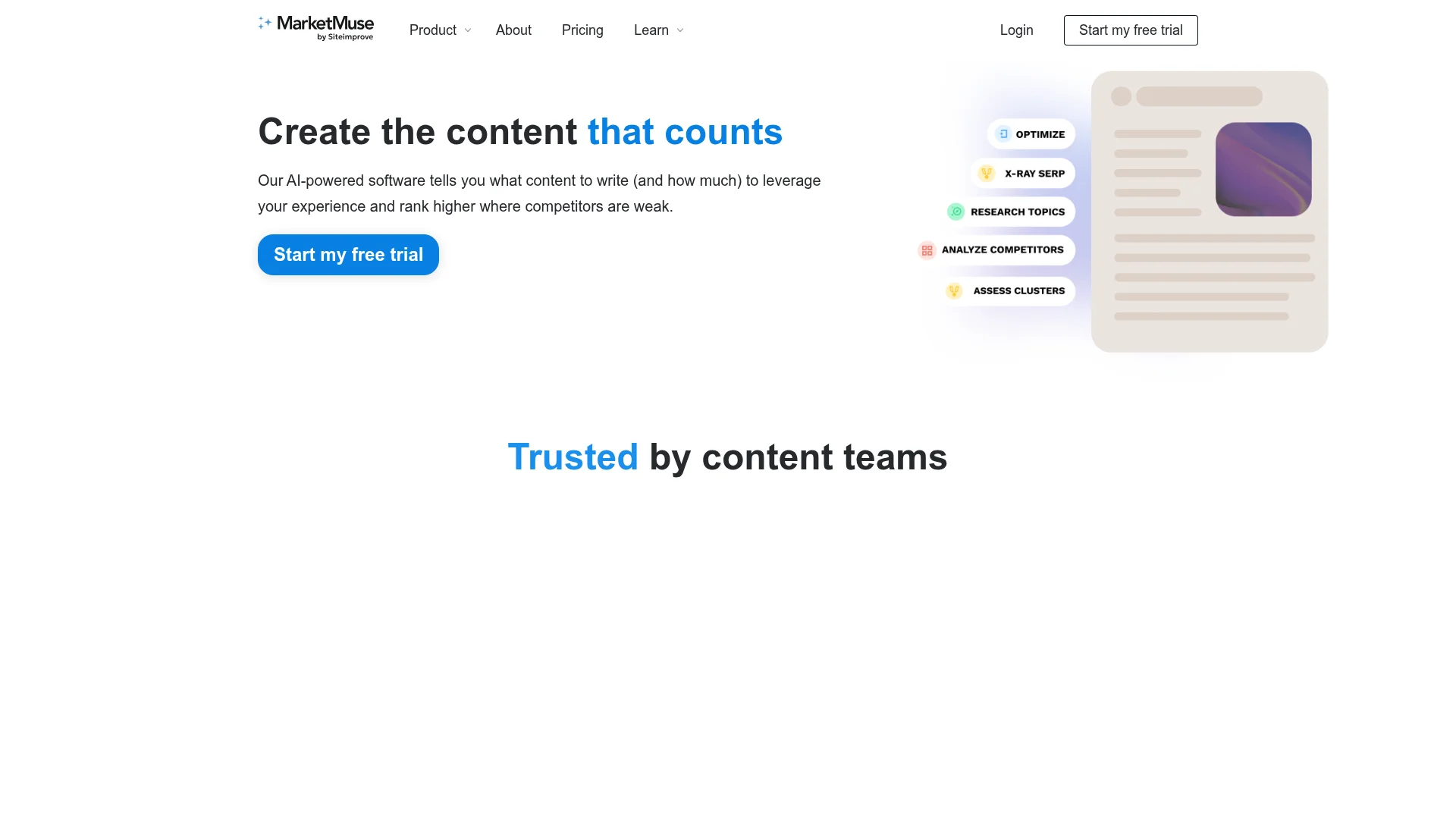
What it is: An AI content strategy and planning platform focused on topic modeling, topical authority analysis, and content inventory gap analysis. Leans heavier into strategy than page-level optimization.
Pricing: Free plan (10 queries/mo), Standard starting at roughly $99/mo, Enterprise custom (approximately $7,200/yr per Alex Birkett's review). Pricing from marketmuse.com and secondary sources.
Key strengths:
- Deeper topic modeling and topical authority analysis than any tool on this list, built for teams managing hundreds of pages
- Personalized difficulty scoring based on your site's existing authority, not just global keyword difficulty
- Content inventory gap analysis identifying what your site should cover but doesn't yet
- Free tier (10 queries/month) and rated 4.6/5 on G2
Key limitations:
- Enterprise-oriented pricing for full features. The Standard plan may feel limiting, and Enterprise at an estimated $7,200/yr is a significant commitment.
- Steeper learning curve than Clearscope. Extracting value requires strategic SEO knowledge, not just writing ability.
- Less useful for individual article optimization. If you need per-page term recommendations and content grades, Clearscope or Surfer are more precise for that job.
- No AI writing, no CMS publishing, no repurposing features, so the production workflow remains entirely manual.
Best for: Larger content programs and publishers who need portfolio-level strategy (what to write and why) rather than page-level optimization (how to improve this specific draft). A good Clearscope alternative if your primary frustration is the lack of strategic planning tools and your content library is large enough that topic modeling matters.
5. Dashword
Best for Simple, Affordable Optimization With Content Monitoring
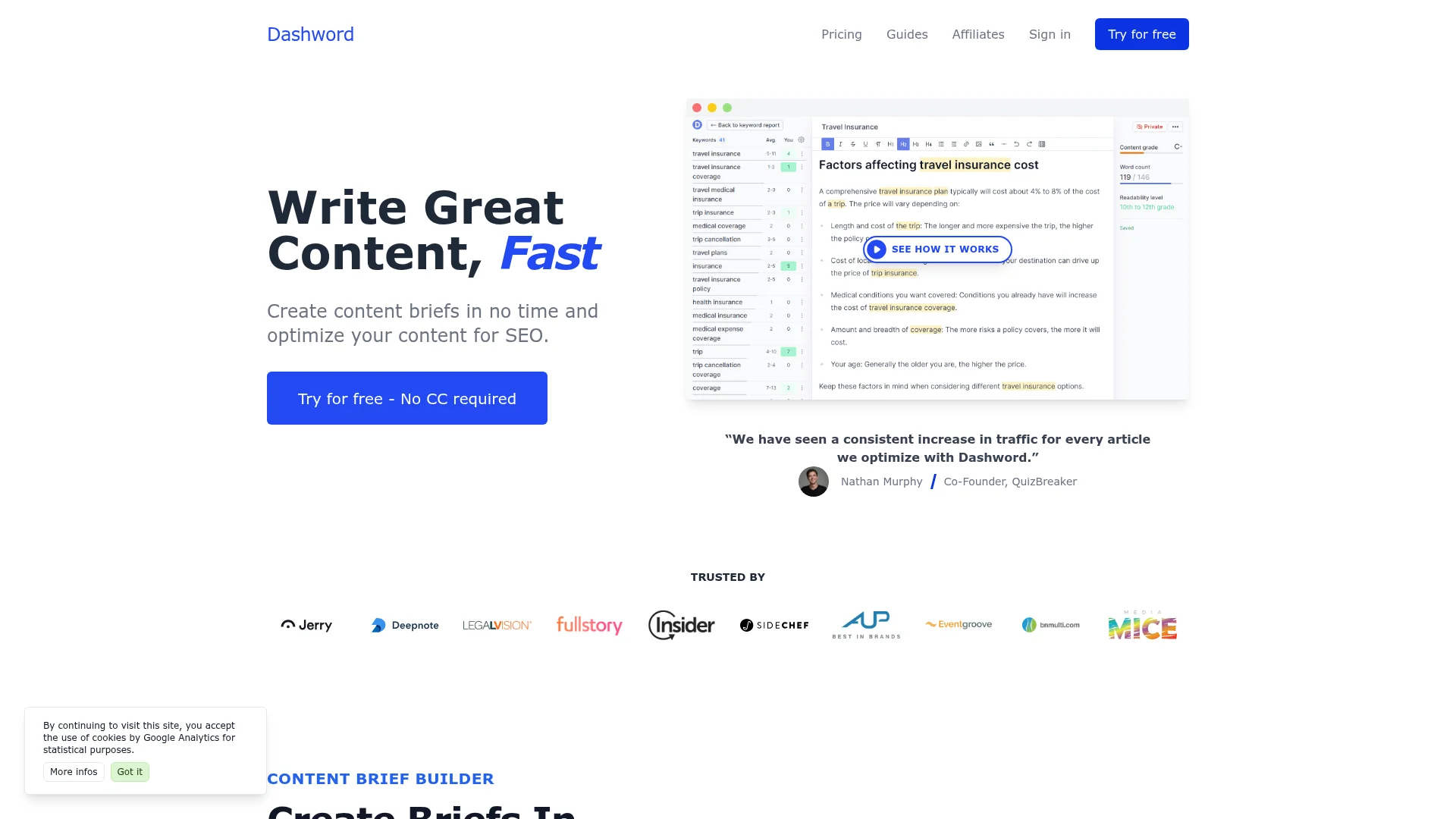
What it is: A straightforward content optimization platform with content reports, a brief builder, AI writer, and content monitoring for published pages. Positioned as a simpler, more affordable Clearscope alternative.
Pricing: Hobby at $39/mo (5 reports), Startup at $99/mo (20 reports), Business at $249/mo (100 reports). One free content report to test. Pricing from dashword.com.
Key strengths:
- Lower-friction UI than Clearscope, designed for fast adoption without training
- Built-in content monitoring catches pages that are losing ranking performance, similar to Clearscope's Content Inventory but available at a lower price point
- Letter-grade scoring system familiar to Clearscope users (A-to-F approach)
- Content brief builder with competitor research via a drag-and-drop interface
- Lower entry point at $39/mo, and one free report to evaluate before subscribing
Key limitations:
- Less NLP depth than Clearscope or Surfer. The optimization recommendations cover the basics but don't match the granularity of Clearscope's term suggestions.
- Smaller user community means fewer resources, templates, and third-party guides available
- Per-report cost on Hobby ($7.80 each) is comparable to Clearscope's. The savings kick in at Startup ($4.95/report) and Business ($2.49/report).
- No Google Docs integration, which is one of Clearscope's strongest workflow features. Writing happens in Dashword's editor or via copy-paste.
Best for: Writers and smaller teams who want simple optimization without the complexity or cost of larger platforms. A good Clearscope alternative if your primary frustration is the price and you don't need the deepest NLP accuracy, just reliable content scoring at a lower tier.
6. Content Harmony
Best for Content Briefs and Search Intent Planning
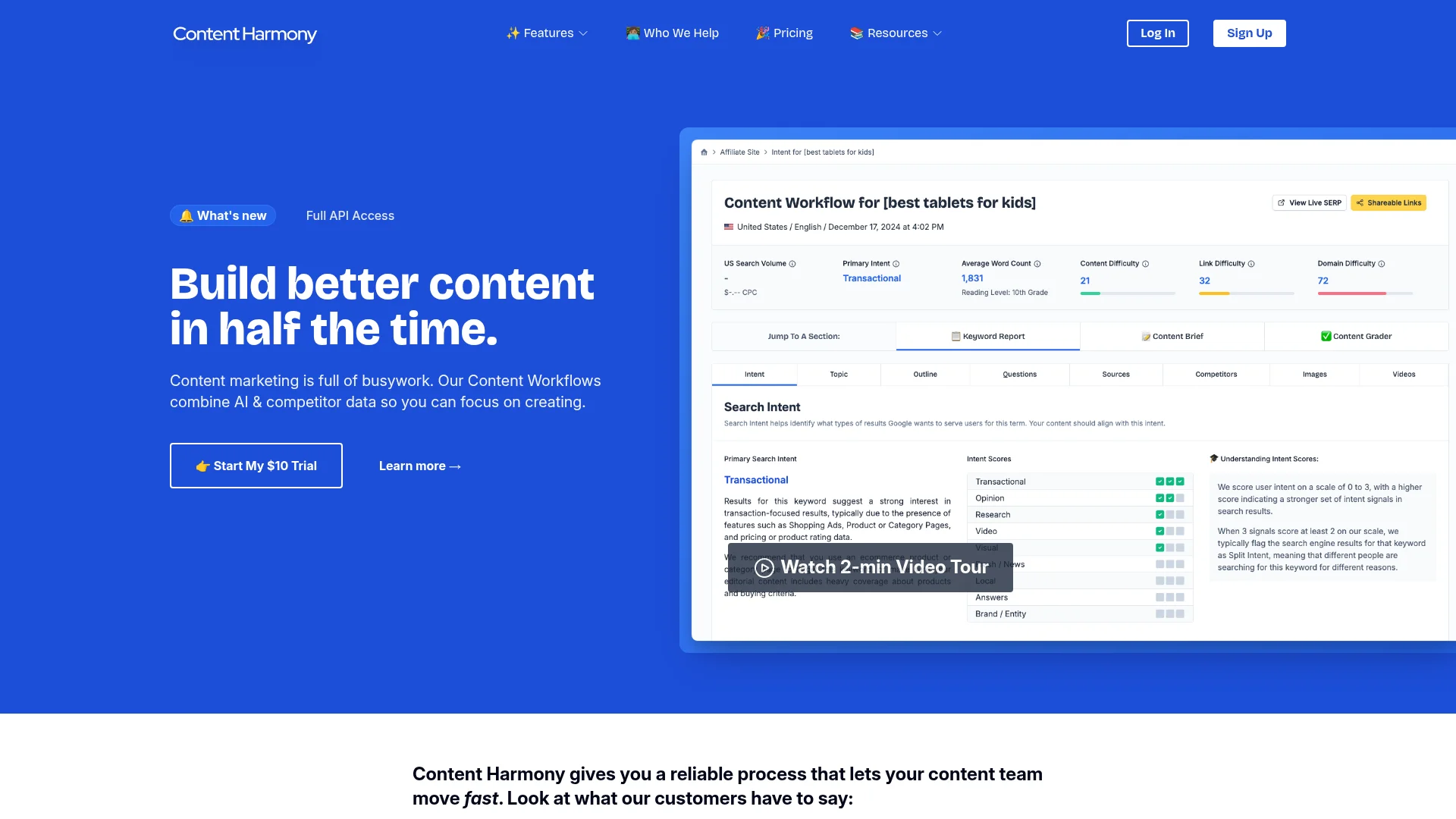
What it is: A content brief and planning platform built around search intent analysis, competitor structure review, and structured editorial workflows. Focused on the pre-writing phase that Clearscope handles lightly.
Pricing: Standard at $99/mo (12 content briefs), Pro at $299/mo (50 briefs), Enterprise at $1,000+/mo (200+ briefs). First 10 briefs for $10. Pricing from contentharmony.com.
Key strengths:
- The strongest content brief generation in this category, with search intent analysis, competitor document structure review, and visual content identification
- Shareable, standardized brief exports for writers, editors, and clients, built into the workflow rather than bolted on
- Unlimited projects and users even on the Standard plan
- $10 trial for 10 briefs is a genuinely low-risk way to evaluate
- Rated 4.8/5 on G2
Key limitations:
- Primarily a briefing tool. Post-draft optimization features are less developed than Clearscope's or Surfer's, so you may still need a separate optimizer after the brief stage.
- 12 briefs/month on Standard can be limiting for teams publishing more frequently than weekly
- No AI writing or draft generation. Content Harmony helps you plan what to write, not produce the writing itself.
- No CMS publishing, no internal linking automation, no repurposing, so the post-brief workflow is entirely manual.
Best for: Teams where the bottleneck is planning, not writing or optimizing. Strategists, editors, and agencies who create detailed content briefs at scale before handing off to writers. A good Clearscope alternative if your primary frustration is that Clearscope doesn't help you plan content before drafting.
7. Jasper
Best for AI Content Creation With Brand Voice
What it is: The most recognized AI content creation platform, with brand voice training, 50+ templates for short and long-form content, and collaborative writing features. Addresses the "Clearscope doesn't create content" gap.
Pricing: Creator at $49/mo (1 seat), Pro at $69/mo per seat (includes SEO mode), Business custom (starts at roughly $5K/yr). Pricing from jasper.ai.
Key strengths:
- Strong brand voice training from URL samples, keeping output consistent across writers and formats
- Extensive template library for both short-form marketing copy and long-form articles
- Native Surfer SEO integration gives real-time optimization scoring while writing, combining what Clearscope and a writing tool each do separately
- Rated 4.7/5 on G2 from 1,200+ reviews, with a large active community
Key limitations:
- Per-seat pricing gets expensive for teams. A five-person team pays $345/mo on Pro just for writing, before adding SEO tools.
- Produces content but doesn't manage the production pipeline: no publishing, no internal linking, no scheduled production, no repurposing
- SEO optimization requires a separate Surfer subscription at $99+/mo
- Better suited for short-form marketing copy than end-to-end long-form SEO content
Best for: Teams that need AI-assisted content creation with brand voice, particularly for marketing copy. A good Clearscope alternative if your primary frustration is that Clearscope doesn't create content and you want AI writing with built-in voice training.
8. ChatGPT
Best Free Option for Solo Creators
What it is: OpenAI's general-purpose AI assistant, widely used for content drafting, research, and brainstorming. Not a dedicated SEO tool, but the lowest-cost option for basic content work.
Pricing: Free (GPT-4o mini), Plus at $20/mo (GPT-4o), Team at $25/user/mo, Enterprise custom.
Key strengths:
- The cheapest option on this list by a wide margin ($0-$20/mo)
- Flexible enough to handle drafting, research, outlining, and basic optimization guidance in one interface
- Web browsing for real-time competitive research and Custom GPTs for repeatable workflows
- Improving constantly with multimodal capabilities and file analysis
Key limitations:
- No SERP data or NLP-based term recommendations. You lose the core value of Clearscope: data-driven content scoring against what's actually ranking.
- No content grading against top-ranking pages, no content monitoring, no inventory tracking
- Requires significant prompt engineering to approach dedicated tool quality. Even Frase at $15/mo outperforms a prompt-based approach for structured optimization.
- No team collaboration, project organization, or workflow management features
- Cannot reliably distinguish facts from hallucinated content
Best for: Budget-conscious solo creators who want a DIY approach and are willing to invest time in prompt engineering. A good Clearscope alternative if your primary frustration is the $129/mo price and you only need basic content drafting with manual optimization checks. The tradeoff: you save money but lose the structured, data-driven scoring that makes Clearscope valuable.
How to Choose the Right Clearscope Alternative
The right tool depends on where your real bottleneck sits.
You're stitching Clearscope + a separate writer + Ahrefs + Canva + manual LinkedIn and newsletter repurposing, and the coordination takes longer than the writing.
→ DeepSmith.
Replaces the patchwork with one pipeline: ideation, writing, editorial review, internal linking, publishing, and 14-channel distribution on team pricing at $80/mo Pro.
You specifically need term-level recommendations and intent analysis inside Google Docs, and you have writers, CMS, linking, and distribution already handled.
→ Clearscope (stay).
Term recommendations and search intent analysis cover that narrow job well at $129/mo Essentials.
You're specifically a content strategist managing 500+ published pages across multiple topic clusters, and your question is what to write next for topical authority.
→ MarketMuse.
Portfolio-level topic modeling and content inventory gap analysis answer the portfolio question Clearscope doesn't.
You publish 30+ articles a month, and your team is too small to add another coordinator or editor.
→ DeepSmith.
Autowrite runs scheduled production against Deep IQ brand context, and the 14-agent Library produces distribution assets without adding headcount.
Your tool budget is capped under $30, and you accept basic scoring in place of deeper NLP term analysis.
→ Frase Solo.
At $15/mo it handles basic scoring, research, and drafting for that narrow shape of work.
Ready to Move Beyond an Optimization Tool?
DeepSmith handles your entire content production pipeline, from strategy to published article to LinkedIn post, so your team can produce more content without growing headcount. Pro starts at $80/mo, $49 less than Clearscope Essentials.
→ Start your free trial at deepsmith.ai
7-day free trial. See how it compares in your first session.