
Freelance writers still do things software cannot. A specialist with 20 years inside a regulated industry, a journalist who can report a story, a bylined author whose name carries weight with your readers. That category of work is not going away. If you need it, hire for it.
For most content marketing teams, that is not the job. The job is volume. Blog posts, SEO articles, newsletter copy, LinkedIn posts, category pages. Work where structural quality matters more than a specific byline. The economics of hiring freelancers for that work have shifted sharply.
Ramp's Economics Lab published data in February 2026 showing companies' share of spend on freelance labor marketplaces (Upwork, Fiverr) fell from 0.66% in Q4 2021 to 0.14% in Q3 2025, a 78% decline. Over the same period, AI model provider spend rose from zero to nearly 3%. More than half the businesses using freelancers in 2022 had stopped entirely by 2025.
If you are wondering whether a different operating model fits your volume work better, the friction points tend to be the same:
Per-article cost scales linearly with volume. Mid-market freelance rates of $0.10 to $0.30 per word put a 1,500-word article at $150 to $450. Thirty articles a month at $300 each is $9,000 before editing, publishing, or distribution. AI tools covering the same structural work run $80 to $299 a month flat.
Quality varies between writers, and between articles from the same writer. One writer nails your voice. The next returns something that reads like a different company wrote it. Onboarding each new writer costs hours, and the context lives in that person's head, not in a system.
Turnaround is measured in days, not minutes. A typical freelance cycle runs 1 to 3 days for a draft, plus another 1 to 3 days for revisions. AI pipelines produce a complete article in about 15 minutes.
Coordination becomes a full-time job. Finding writers, briefing them, reviewing drafts, requesting revisions, approving invoices, managing availability. Teams producing 30+ articles a month often end up managing 5 to 15 freelancers, and that coordination layer is its own role.
Distribution isn't part of most freelance engagements. You get the article. LinkedIn posts, newsletters, Medium versions, X threads: still on your team, or it never happens.
This guide compares 8 alternatives: AI content systems, managed networks, hybrid platforms, and a DIY baseline. Each is honestly assessed for where it wins, where it breaks, and the kind of team it fits.
How We Evaluated These Alternatives
We analyzed pricing from each tool's website, features from product pages, and user feedback from G2, Capterra, TrustRadius, Reddit, and independent reviews. Evaluation dimensions: content production scope, brand voice consistency, SEO and AEO capabilities, pricing, scalability, and what each option replaces or augments in a freelance-led workflow. DeepSmith is our product. We've included it because it fits the "replace volume freelance writing with an AI production pipeline" gap, and flagged where specialized freelancers or managed networks remain the better call. All pricing and features verified April 2026.
Quick Comparison Table
| Option | Best For | Starting Price | Scope |
|---|---|---|---|
| DeepSmith | Teams replacing volume freelance work with an AI production system | $80/mo | Full pipeline (idea → publish → 14 channels) |
| Jasper | Marketing teams building an in-house AI content operation | $59/mo annual | AI writing + Brand Voice |
| Frase | Budget-constrained teams wanting SEO + AEO + AI writing | $39/mo annual | Research + drafting + optimizer |
| Writesonic | Teams prioritizing AI search visibility alongside content | $99/mo ($79 annual) | AI writing + broad AEO |
| Narrato | Teams keeping freelancers but adding AI + workflow + payments | $36/mo yearly | Team content workspace |
| Verblio | Teams wanting managed US writers on subscription pricing | $0.06/word + $49.50/mo | Freelance writer network |
| Contently | Enterprise teams needing vetted SME writers at scale | Enterprise (demo) | Managed content agency |
| ChatGPT | Solo operators willing to prompt their own pipeline | $20/mo Plus | General LLM, DIY |
What Freelance Writers Do Well
Before walking through alternatives, be explicit about what the freelance writer model does better than any software. These strengths are real and durable. The alternatives in this guide do not match them for the work where they matter.
Specialized subject-matter expertise. A freelancer with 20 years of legal practice, a board-certified physician writing about clinical workflows, a CFA covering financial markets. AI tools produce competent general writing. They do not produce content grounded in lived professional judgment. For regulated industries, original analysis, or content where being wrong has real consequences, specialized writers are not substitutable.
Bylined authority and E-E-A-T signals. An article under the byline of a known industry author, with a linked LinkedIn profile and a track record of published work in the field, carries authority AI output does not. For topics where Google weighs E-E-A-T heavily, the byline is part of the product.
Original reporting and investigation. Interviewing sources, sitting through an earnings call, reading a 200-page regulatory filing and pulling out what matters. Work that turns into a real point of view rather than a restatement of what other articles already say. AI can summarize. It cannot report.
Cultural nuance and emotional depth. Founding stories, customer profiles with emotional arcs, brand narratives that have to land with specific communities. Skilled writers bring texture AI flattens.
Editorial judgment about your specific business. A writer who has worked with you for two years knows which product claims are defensible, which customers make good quotes, and what your CEO will and will not say in print. That context lives in a person, not a prompt.
This is why most serious content operations keep specialized freelancers in the mix. The alternatives below do not target this work. They target the volume layer: structurally-standard content that consumes most of a freelance budget without requiring any of the above.
1. DeepSmith
Best for lean SaaS teams replacing volume freelance work with an AI production pipeline
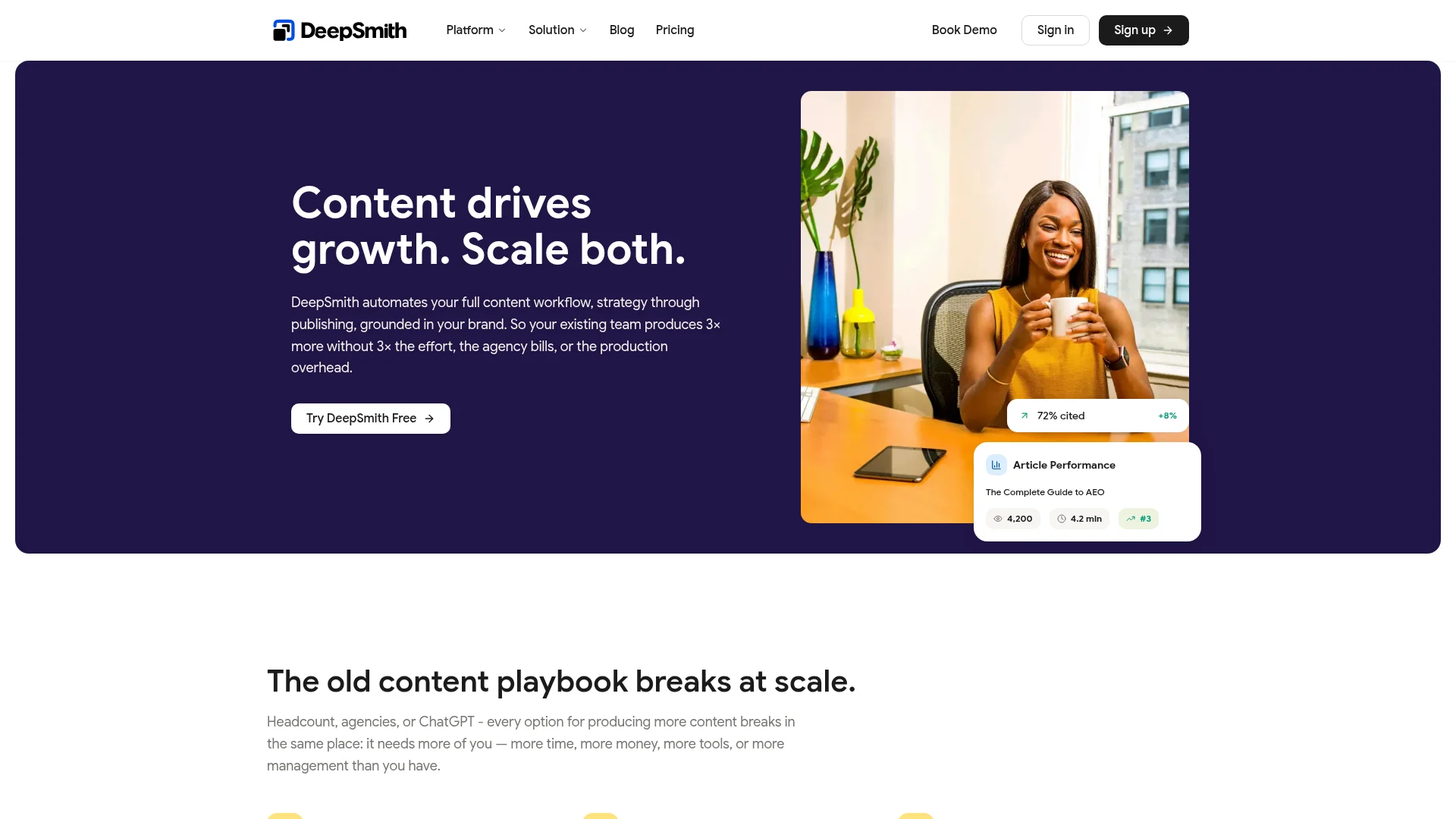
What it is: An AI content automation platform that handles the full production pipeline: strategy and ideation through writing, editorial QA, SEO and AEO optimization, internal linking, image generation, CMS publishing, and automated repurposing across 14 distribution channels.
Pricing: Pro $80/mo, Scale $225/mo, Enterprise custom. Team-oriented tiers, not per-seat.
Why teams switch from freelance writers to DeepSmith:
The switch is not about firing every writer you work with. It is about moving the volume layer (blog posts, SEO articles, distributed social) off per-article freelance economics onto a subscription-priced system. Specialized SME content stays with specialized writers. Volume moves into the pipeline.
With a freelance-led workflow, every article means posting on Upwork or contacting a known writer, reviewing applicants, running a sample brief, onboarding to brand context, submitting the brief, waiting 1 to 3 days for a draft, requesting revisions, waiting another 1 to 3 days, approving, publishing manually, then handing the article to your social and newsletter person. With DeepSmith, you configure Deep IQ once (product, persona, voice with 16 settings, visual guidelines, content types), pick an idea from the Topic Explorer, and the 10-agent pipeline handles research, brief, draft, editorial QA, voice styling, internal linking, cover image, and publishing metadata in about 15 minutes. One-button WordPress publishing. The Agent Library turns the article into LinkedIn posts, X threads, newsletter emails, Medium articles, and community posts.
At mid-market rates of $300 each, 30 articles a month is $9,000. DeepSmith Pro is $80 a month for unlimited pipeline runs. At premium rates of $1.00 per word, a 1,500-word article is $1,500. Thirty of those is $45,000 against DeepSmith Scale at $299.
What DeepSmith does that a freelance-writer workflow doesn't:
- 10-agent article writing pipeline. Automated research, brief, draft, editorial review, voice styling, internal linking, and cover image generation. Publish-ready articles in roughly 15 minutes, not days.
- Deep IQ brand context system. Six structured elements: company positioning, product profiles, buyer personas, brand voice (16 settings), visual guidelines, content type templates. Context lives in a system, not in each freelancer's head.
- Sitemap-powered internal linking. Crawls your content, matches article topics against key phrases, and places up to 5 editorially relevant links per article automatically. Freelancers rarely touch internal linking.
- Content repurposing across 14 channels. Turns any article into LinkedIn posts, X threads, newsletter emails, Medium articles, and Slack announcements, all brand-voiced. Freelancers deliver one article.
- Autowrite scheduled production. Pre-configure articles to write automatically on planned dates. Production runs on a schedule without anyone kicking it off.
- AEO prompt tracking across 4 AI platforms. Monitors brand visibility in ChatGPT, Gemini, Perplexity, and Google AI Mode with twice-weekly refreshes. Not a freelance service.
- Transparent pricing. Flat subscription vs. per-article cost with revision creep. 30 articles costs the same as 5.
- Publishing metadata and cover images. Slug, SEO title, meta description, and a branded cover image generated per article.
What to consider:
DeepSmith is not the right fit if your content operation is entirely SME-specialized: regulated industries with complex domain knowledge, original research-heavy work, or senior bylined thought leadership. For those cases, freelance writers with demonstrated domain expertise remain the right tool, and managed platforms like Contently (165K vetted creator network) or Verblio (US-based writer pool) may fit better. DeepSmith is also not the strongest option if your primary need is short-form ad copy at scale (Jasper or Copy.ai are stronger there) or enterprise governance features like SSO (AirOps or Writer are better there).
Best for: SaaS founders, content marketing managers, and lean growth teams whose volume work sits with freelance writers, and whose real constraint is throughput and distribution, not access to a specific expert.
2. Jasper
Best for marketing teams building an in-house AI content operation with brand voice
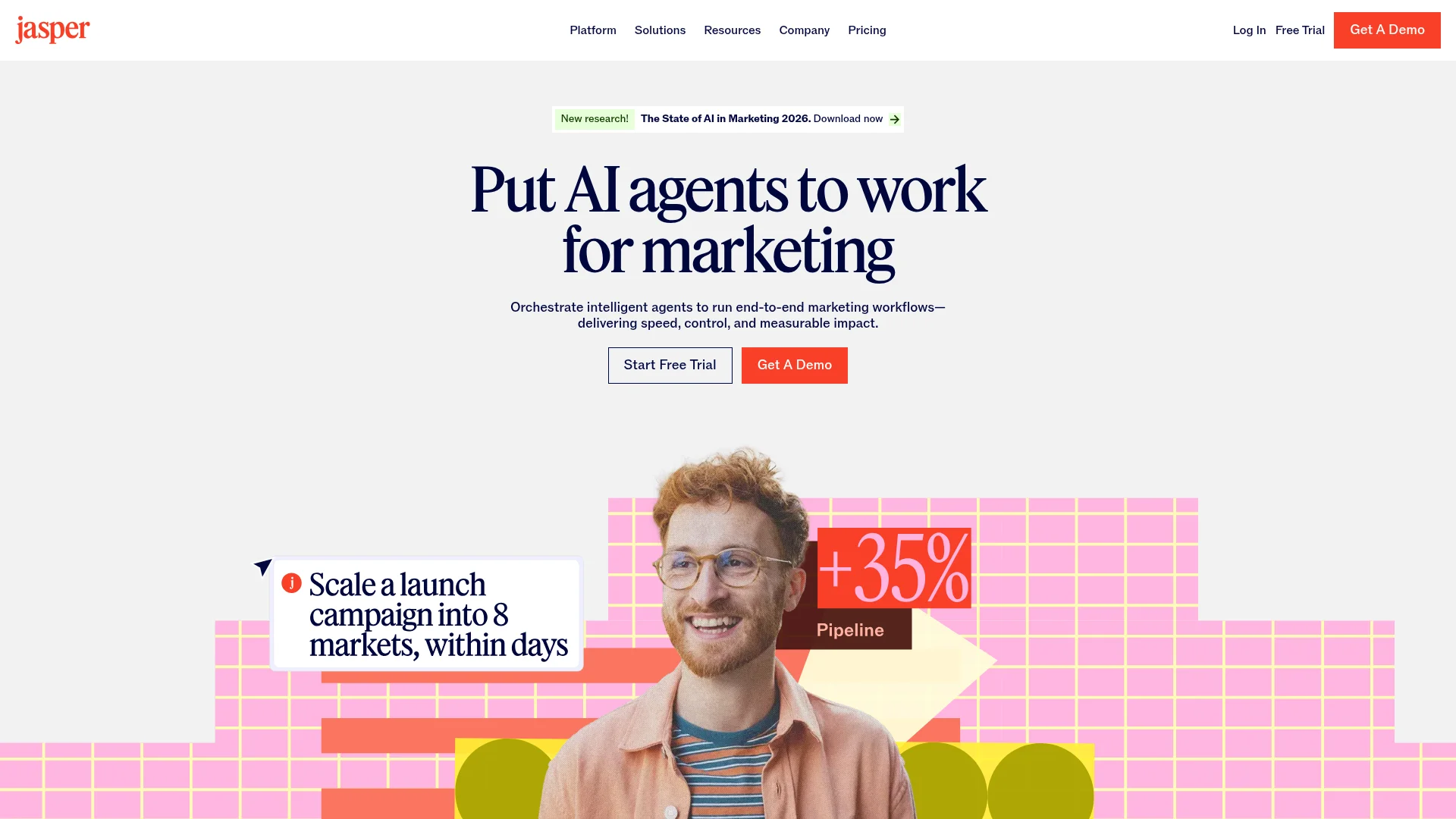
What it is: An enterprise AI marketing platform with 100+ agents, Content Pipelines, and the Jasper IQ brand context layer. One of the most established AI writing tools, with strength in marketing copy and brand voice.
Pricing: Pro at $59/mo on annual ($69 monthly) for a single seat. Business is custom (starts in the low five figures annually per third-party estimates). Pricing from jasper.ai.
Key strengths:
- Jasper IQ learns brand voice from sample URLs, producing consistent output across writers and formats. One of the most polished voice systems in this category.
- 100+ marketing agents covering blog posts, ads, email, social, and SEO briefs, so marketing teams whose work spans formats get broad template coverage.
- Enterprise governance on Business: SSO, SCIM, SOC 2 Type II. Matters for regulated buyers.
- Rated 4.7/5 on G2 from 1,269+ reviews and 4.8/5 on Capterra from 1,855+ reviews.
Key limitations:
- Pro is single-seat. Teams of 3 to 5 pay per seat, scaling into Business territory quickly.
- No native SEO scoring. Surfer SEO integration adds optimization but requires a separate $99+/mo subscription, so the all-in cost stacks.
- No CMS publishing, no automated internal linking, no full repurposing pipeline. Jasper produces drafts. The production workflow around the draft stays manual.
- Better suited to short-form marketing copy than long-form SEO content. Teams shifting from freelance long-form work sometimes find quality needs heavier editing.
Best for: Marketing teams that want AI content with strong brand voice and broad template coverage, and are comfortable running their own SEO, publishing, and distribution stack around it. A good freelance alternative if your primary frustration is inconsistent tone across writers and you want a polished voice layer without needing a full production pipeline.
3. Frase
Best for budget-constrained teams wanting SEO + AEO + AI writing
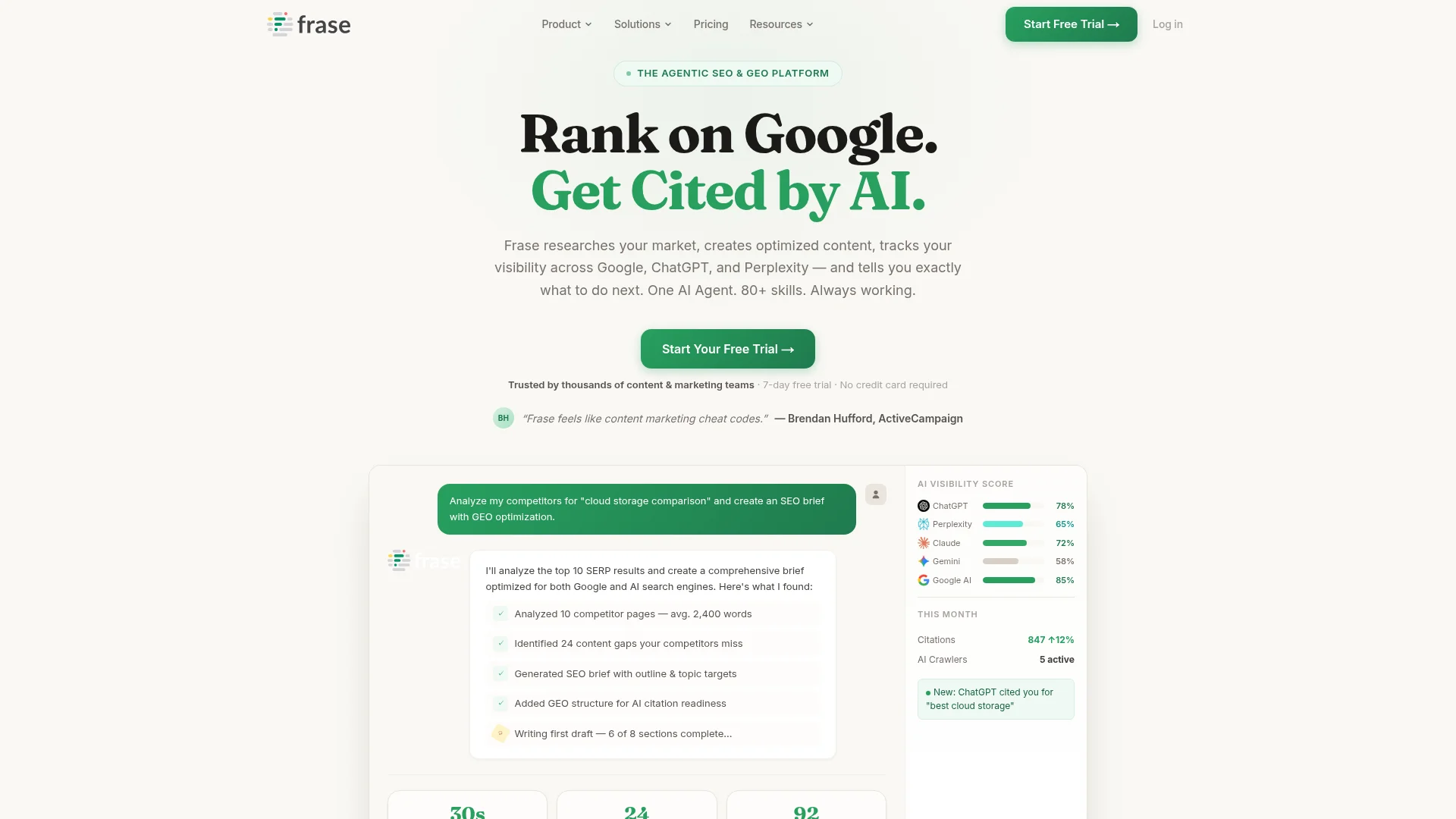
What it is: An agentic SEO and GEO platform with an AI Agent and 80+ skills covering research, briefs, SEO and GEO optimization, AI writing, visibility tracking, and site audits. Combines research, drafting, and scoring in one tool.
Pricing: Starter at $39/mo annual (10 reports, limited articles), Professional at $103/mo annual, Scale at $239/mo annual. Pricing from frase.io.
Key strengths:
- $39/mo Starter is one of the lowest entry points among serious AI content tools, a credible swap for teams previously spending $300 to $600 a month on 2 to 3 freelance articles.
- AI Agent with 80+ skills covers the research-to-draft-to-optimize loop in one workflow.
- AI Visibility tracking for AI search engines, which freelance writers do not address at all.
- Rated 4.8/5 on G2 from 301+ reviews.
Key limitations:
- 10 articles per month cap on Starter. Meaningful volume requires Professional ($103/mo) or Scale ($239/mo).
- No CMS publishing, no repurposing, no automated internal linking. Publishing and distribution stay with your team.
- Brand voice is basic compared with Jasper IQ or DeepSmith's Deep IQ. Teams that switched from freelancers over inconsistent voice may still need to edit.
- No distribution assets, so LinkedIn posts and newsletters remain a separate job.
Best for: Small teams and solo operators who want AI writing plus SEO and AEO scoring on a tight budget. A good freelance alternative if your primary frustration is per-article cost and your use case is primarily SEO content, not multi-channel distribution.
4. Writesonic
Best for teams prioritizing AI search visibility alongside content generation
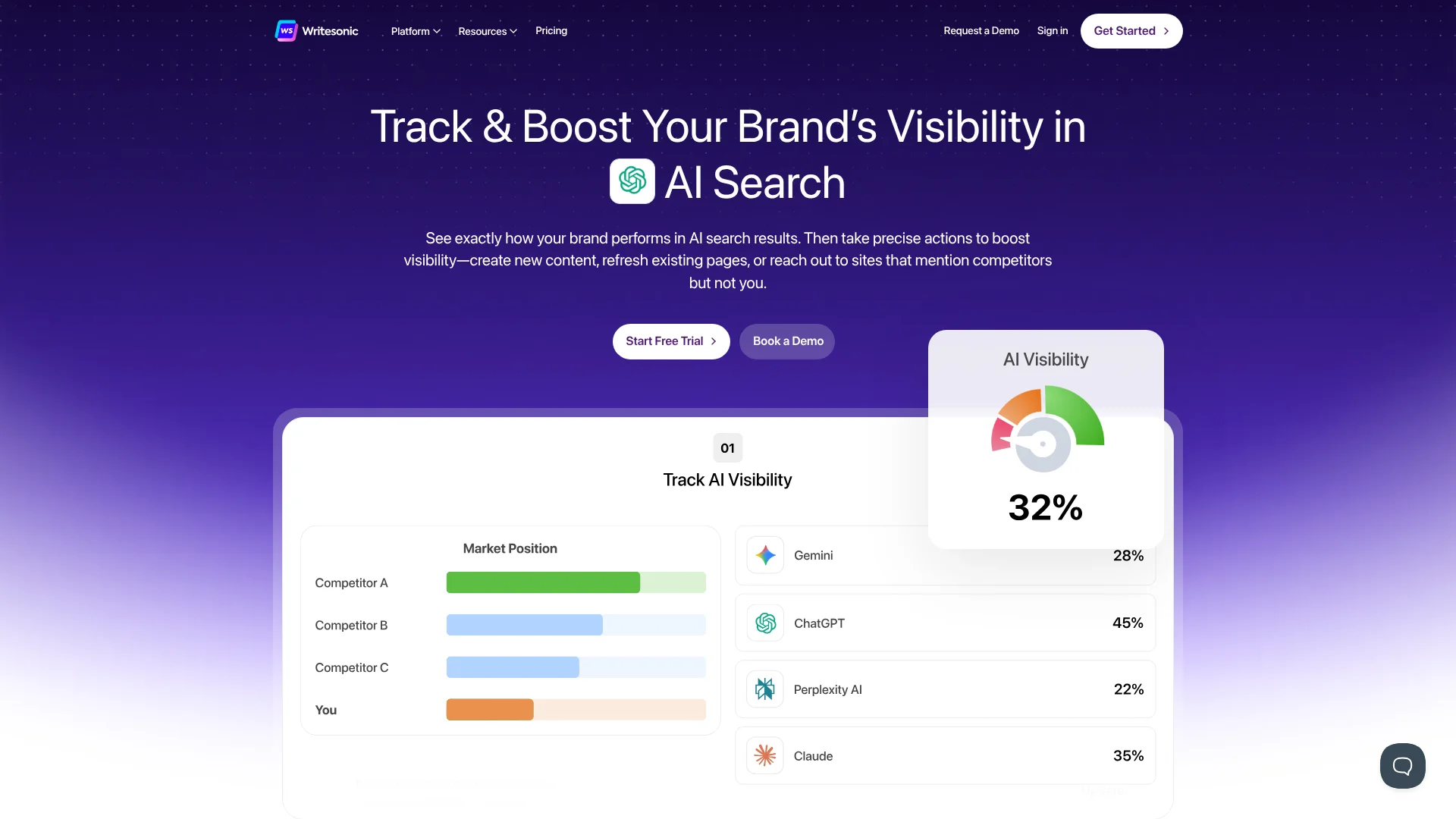
What it is: An AI Search Visibility (GEO) platform with integrated AI writing, SEO tools, and site audits. Tracks brand visibility across 8+ AI search engines, with a content generation suite alongside.
Pricing: Free tier, Starter at $99/mo ($79 annual), Basic at $249/mo, Growth at $499/mo. Pricing from writesonic.com.
Key strengths:
- AI Search Visibility tracking across 8+ AI platforms is broader than most competitors. For teams whose traffic is shifting to AI answer engines, this is a category freelancers cannot address.
- 120M AI conversation dataset underpins the visibility product, giving it a data moat over tools that just ping a handful of AI engines.
- Largest combined review base in this category: 4.7/5 on G2 from 2,093+ reviews, 4.8/5 on Capterra from 2,102+ reviews, and 4.6/5 on Trustpilot from 5,808+ reviews.
Key limitations:
- Starter at $99/mo caps AI articles at 15 per month, tight for teams replacing a full freelance roster.
- Content production pipeline is less structured than DeepSmith's 10-agent workflow or Jasper's Pipelines. More useful as a GEO + writing combo than a production system.
- Brand voice is basic. Teams needing strict voice consistency may still rely on editors.
- No CMS publishing, no repurposing, no automated internal linking as core features.
Best for: Teams whose traffic strategy is tied to AI answer engines and who want visibility tracking combined with AI writing. A good freelance alternative if your primary frustration is that freelancers do not address AEO at all, and you want content creation and AI search visibility in one tool.
5. Narrato
Best for teams keeping freelancers but adding AI, workflow, and payment management
What it is: A content workspace plus AI writing platform with 100+ templates, an AI Content Genie autopilot, SEO briefs, freelancer payment management, and white-labeling. The only tool on this list that does not position itself as a freelance replacement. It positions itself as a freelance-coordination layer with AI built in.
Pricing: Free tier, Pro at $36/mo yearly (4 seats, 400K AI characters), Business at $96/mo yearly. Pricing from narrato.io.
Key strengths:
- Per-workspace pricing at $36/mo yearly includes 4 seats, dramatically cheaper than per-seat tools if your team is bigger than one person.
- Built-in freelancer payment management consolidates briefs, revisions, and invoicing into one system.
- AI Content Genie for scheduled generation, so the workflow keeps running while freelancers handle the work that actually needs them.
- Rated 4.8/5 on G2 from 170+ reviews.
Key limitations:
- 400K character cap per month on Pro (roughly 60,000 to 80,000 words). Heavy producers may need Business or more.
- Brand voice is less structured than Jasper IQ or DeepSmith's Deep IQ. If voice consistency across AI output is your primary concern, Narrato is weaker.
- No integrated CMS publishing or full 14-channel distribution. You get the workspace, not the full production system.
- Smaller community and ecosystem than Jasper or Frase.
Best for: Teams that do not want to fire their freelancers but do want to add AI, a content workspace, and built-in payment management. A good freelance alternative if your primary frustration is coordination overhead across spreadsheets, Slack, and Stripe, and you want to systematize the relationship rather than end it.
6. Verblio
Best for teams wanting managed US writers on subscription pricing
What it is: A US-based managed content writing marketplace with Hybrid AI + Human, 100% Human, and Managed Services tiers. Roughly 3,000 vetted writers. A middle ground between raw freelance marketplaces (Upwork, Fiverr) and pure AI tools.
Pricing: Hybrid at $0.06/word plus a $49.50/mo platform fee, 100% Human at $0.16/word, Managed Services custom. Pricing from verblio.com.
Key strengths:
- Transparent per-word pricing, rare in managed content. You can model cost against article length without surprise invoices.
- US-based writer network matters for teams that care about cultural fluency and legal jurisdiction (contracts, W-9 tax handling).
- Hybrid AI + Human tier at $0.06/word sits between pure AI and pure freelance cost, giving teams a middle option when quality matters but full-freelance budget does not.
- Preferred writer lists let you build a consistent bench over time, reducing the voice inconsistency from rotating through cold freelancers.
- Rated 4.4/5 on G2 from 43+ reviews.
Key limitations:
- Writer quality variance is a spec-model reality. Preferred writer lists mitigate but do not eliminate it.
- No upfront writer selection by default. You submit the spec and a writer picks it up. Teams that want to hand-pick get less control than direct hiring.
- No AI-native production pipeline. Verblio consolidates freelance hiring. It does not replace the per-article economics with subscription pricing.
- No distribution, no publishing automation, no AEO tracking.
Best for: Teams that want managed human (or human + AI hybrid) writing at transparent pricing, without individual Upwork coordination. A good freelance alternative if your primary frustration is the time cost of finding and vetting writers, and you want a US-based bench without building it yourself.
7. Contently
Best for enterprise teams needing vetted SME writers at scale
What it is: An enterprise managed content marketing platform with a 165,000+ freelancer network, AI Studio multi-agent system, and managing editor services. Named customers include Marriott, American Express, Microsoft, and Dell.
Pricing: No public pricing. Enterprise demo-gated. Third-party estimates put it at $500 to $5,000+/mo depending on scope. Pricing from contently.com.
Key strengths:
- 165,000+ vetted creator network is the largest in this category, with deep coverage across finance, healthcare, tech, and B2B. For E-E-A-T-sensitive content, the SME pool is a real advantage.
- AI Studio adds a multi-agent AI layer on top of the human network, so teams can use the platform for both volume AI content and specialized human work.
- Managing editor services provide an oversight layer freelance marketplaces do not, reducing the quality-variance problem.
- Rated 4.6/5 on G2 from 96+ reviews and 4.6/5 on Capterra from 42+ reviews.
Key limitations:
- Enterprise-only pricing with no public rate card. Small and mid-market teams cannot easily budget or trial it.
- Long procurement cycle with custom contracts that do not match the tempo of a Seed-to-Series B content team.
- AI Studio is a recent layer. The AI production pipeline is less battle-tested than AI-native tools.
- Overkill for structurally-standard content. The value is in the SME network, not the volume layer.
Best for: Enterprise teams that need vetted SME writers at scale, with managing editor oversight, and have the procurement bandwidth for custom contracts. A good freelance alternative if your primary frustration is the inconsistency and vetting cost of ad-hoc Upwork hiring, and budget is not the constraint.
8. ChatGPT
Best for solo operators willing to prompt their own pipeline
What it is: OpenAI's general-purpose conversational AI. Not a content marketing tool, but widely used for drafting, research, and brainstorming with Custom GPTs and Projects as lightweight workflow containers.
Pricing: Free tier, Go at $8/mo, Plus at $20/mo, Pro from $100/mo, Business at $20/user/mo.
Key strengths:
- Cheapest credible option on this list. $20/mo Plus covers most solo-operator use cases.
- Strong raw LLM quality for drafting, research, and ideation, with multimodal image and file analysis.
- Custom GPTs and Projects let you encode repeatable workflows (brief templates, style prompts) without engineering.
- Rated 4.7/5 on G2 from 2,013+ reviews.
Key limitations:
- No SEO scoring, no keyword research, no AEO tracking. Everything SERP-related is on you.
- No CMS publishing, no automated internal linking, no distribution pipeline, no batch workflow. You are the pipeline.
- Brand voice consistency depends entirely on your prompt discipline. No structured context system like Jasper IQ or Deep IQ.
- Cannot reliably separate fact from hallucination without human verification.
Best for: Solo operators and small teams willing to invest in prompt engineering instead of platform features. A good freelance alternative if your primary frustration is cost, your volume is modest, and you are comfortable being editor, SEO specialist, and publisher yourself.
How to Choose the Right Freelance Writer Alternative
The right tool depends on where your real bottleneck sits.
You write 20 to 50 articles a month and manually turn each into LinkedIn posts, newsletter issues, and threads.
→ DeepSmith.
Turns every article into distribution assets without coordination.
You want consistent brand voice across marketing copy formats, and you don't need DeepSmith's full content production pipeline.
→ Jasper.
Covers 100+ marketing agents with IQ brand voice.
Your primary goal is sourcing bylined SME writers with demonstrated expertise, and pure AI volume isn't on your list.
→ Contently.
165K vetted creators with managing-editor oversight for compliance work.
You publish 30+ articles a month, and your team is too small to add a content coordinator.
→ DeepSmith.
Autowrite runs scheduled production without added headcount.
Your team is committed to your current writer relationships, and switching them out costs more than fixing the operational layer.
→ Narrato.
Per-workspace pricing plus freelancer payment management at $36/mo.
Ready to Move Beyond Per-Article Freelance Economics?
DeepSmith handles the full content production pipeline, from strategy to published article to distribution assets across 14 channels, on team-priced subscription tiers rather than per-article freelance invoices. Pro at $80/mo covers the volume layer of most SaaS content operations for less than a single mid-market freelance article.
→ Start your free trial at deepsmith.ai
7-day free trial. See how it compares in your first session.