
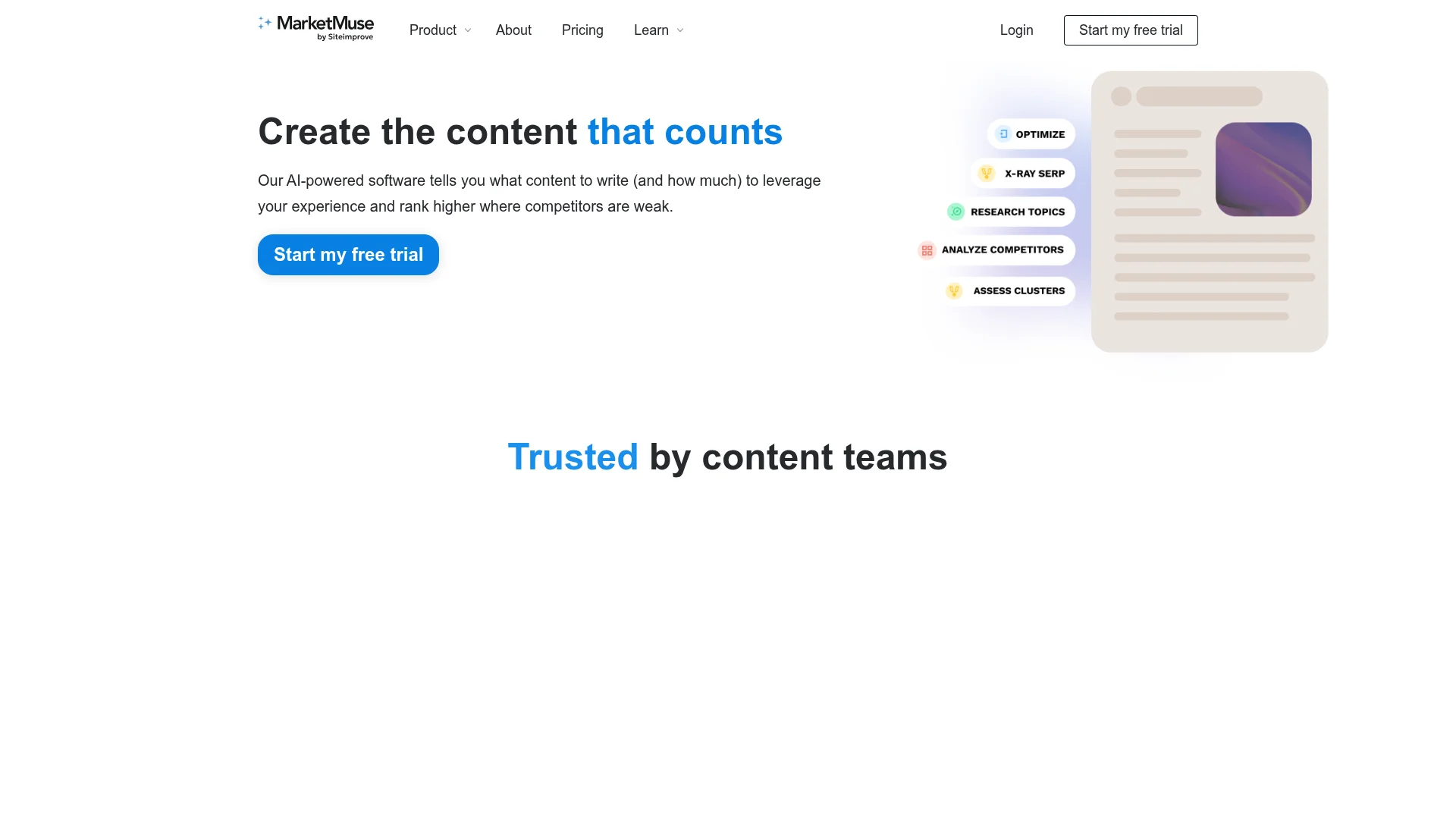
MarketMuse is one of the most respected content intelligence platforms on the market. Its patented topic modeling and Personalized Difficulty metric go deeper than most optimization tools, and teams with large content portfolios use it to find gaps competitors can't see. It holds a 4.6/5 on G2 (216 reviews) and 4.6/5 on Capterra (28 reviews).
It's still not the right fit for every team.
If you're evaluating alternatives, you've probably hit one or more of these friction points:
The Siteimprove acquisition creates product-direction uncertainty. MarketMuse has entered a definitive agreement to be acquired by Siteimprove. The acquisition page promises "integrated performance tracking" and "tech stack consolidation," but doesn't commit to specific product continuity timelines. G2 already lists Siteimprove as the seller. For buyers signing annual plans, that matters.
Pricing is opaque. Dollar amounts for Optimize, Research, Strategy, and Premium tiers aren't listed publicly. You have to book a demo to learn what you'd pay. Third-party articles cite historical figures in the $150 to $600+ per month range, but those are outdated and unverified. Surfer ($49 Discovery), Frase ($39 Starter), and Clearscope ($129 Essentials) all publish their pricing.
MarketMuse doesn't write content. From their own FAQ: "We do not write content for our customers. Our strength is helping you understand what to write (and how much)." The Optimize editor has scoped AI assistance for section expansion, but it's not a full drafting tool. Teams that bought MarketMuse expecting AI writing end up paying for Jasper or another writer alongside it, raising total cost of ownership.
All nine Content Brief types sit behind the Strategy tier. Optimize and Research tiers only offer Article-type briefs. Agencies producing varied content (Comparison, Listicle, How-to, Product Review) have to upgrade to Strategy even if they don't need the five users or 10K tracked topics it includes.
The interface shows its age. Independent reviewers (Rankability, Capterra) describe "acclimation required" and note it can feel buggy or glitchy compared to newer products. Teams used to Frase's agent-first UX or Surfer's gamified Content Score feel the gap.
This guide compares eight alternatives across full production systems, SEO optimization tools, integrated platforms, AI writers, and enterprise content infrastructure. We've included honest strengths, limitations, and verified pricing for each.
How We Evaluated These Alternatives
We analyzed pricing from each tool's website, features from product pages, and user feedback from G2, Capterra, Trustpilot, and independent reviews (Rankability, SE Ranking, Content Harmony). Evaluation dimensions: content production scope, SEO and AEO capabilities, topic intelligence depth, pricing transparency, ease of use, and integration ecosystem. DeepSmith is our product. We've included it because it fits the "content production, not just intelligence" gap, and flagged where other tools are the better choice in a "what to consider" section. All pricing and features verified as of April 2026.
Quick Comparison Table
| Tool | Best For | Starting Price | Scope |
|---|---|---|---|
| DeepSmith | Teams needing a full content system, not just intelligence | $80/mo | Full pipeline (idea to published, 14 channels) |
| Surfer SEO | Mature SEO optimization with transparent pricing | $49/mo (Discovery) | Optimizer + AEO tracking |
| Clearscope | Premium term-level optimization with intent analysis | $129/mo | Optimizer + AEO tracking |
| Frase | Integrated SEO + writing + AEO on a tight budget | $39/mo (annual) | Research + drafting + optimizer |
| Jasper | Dedicated AI writing with brand voice | $59/mo (Pro, 1 seat) | AI writing + Brand Voice |
| Writesonic | Budget AI writing plus broad AEO tracking | ~$16/mo (annual) | AI writing + broad AEO |
| AirOps | Enterprise agent-driven content at scale | Custom (gated) | Enterprise agent platform |
| Copy.ai | GTM workflow automation beyond content | $29/mo (Chat) | Short-form + workflow automation |
What MarketMuse Does Well
Before recommending alternatives, MarketMuse's strengths deserve recognition. These are well-documented capabilities.
Patented topic modeling produces more sophisticated recommendations than keyword-density tools. MarketMuse's topic model uses proprietary AI to calculate semantic relationships between subtopics, not simple TF-IDF or term-correlation analysis. For technical or domain-specific content, the recommendations feel less mechanical than tools that score by keyword frequency. Amy Aitman, a COO quoted on MarketMuse's homepage, put it directly: "I am a little bit of an SEO tool nerd. I try a lot of new tools out there and I'm quite disappointed with the quality of the outputs that I get. But MarketMuse continues to impress me." It holds a 4.6/5 on G2 from 216 reviews.
Personalized Difficulty is a real differentiator. Instead of generic keyword difficulty (the same score for every site), Personalized Difficulty calculates how hard a topic is for your specific site to rank, based on existing coverage, performance history, and site authority. Most competitors don't do this. Zoe Hawkins, Principal Content Manager at Sumo Logic, is quoted: "We see 4x to 10x more traffic with pieces we optimize with MarketMuse." A monday.com case study linked from G2 claims a 1,570% blog traffic increase in three months.
Content inventory and portfolio-level planning go deeper than page-by-page tools. MarketMuse's content inventory crawls a site and enriches each page with personalized metrics (topic authority, page authority, content score). That enables portfolio-level strategy rather than per-article optimization. Andy Crestodina, CMO of Orbit Media Studios, is quoted on the homepage: "It allows you to analyze specific search items, generate questions and associated keywords, and plan precisely how you can outmaneuver your largest competitors."
The Free tier is useful for evaluation. Unlike Surfer (no free tier) or Frase (7-day trial only), MarketMuse's Free tier provides 10 queries per month with access to Topic Navigator, SERP X-Ray, Keyword analysis, and Site Heatmap. Teams can test real data before committing. Most MarketMuse-alternative articles flag this as an evaluation advantage.
Nine specialized Content Brief types handle varied content structures. The Strategy tier opens up Article, Comparison, FAQ Collection, Guide, How-to, Listicle, Local, News/Event, and Product Review briefs. Each has structural templates tailored to the format, cutting manual customization for agencies producing mixed content.
These strengths are real. If they match your primary use case, MarketMuse may be the right tool. The alternatives below serve teams whose needs extend beyond what MarketMuse covers.
1. DeepSmith
Best for Teams Who Need a Complete Content System, Not Just Topic Intelligence
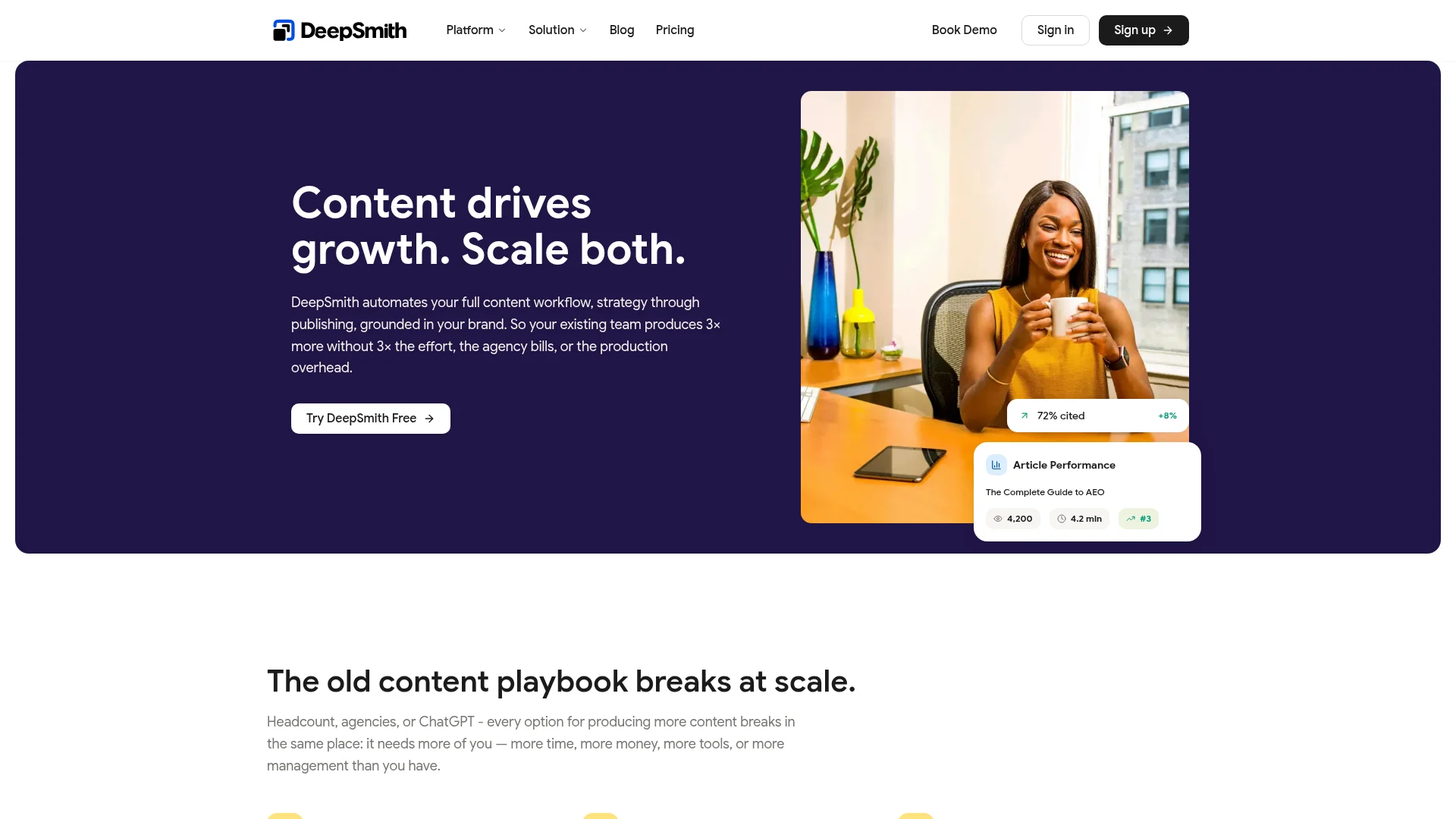
What it is: An AI content automation platform that handles the full production pipeline: topic intelligence, ideation, writing, QA, SEO and AEO optimization, internal linking, image generation, CMS publishing, and automated repurposing across 14 distribution channels.
Pricing: Pro at $80/mo, Scale at $299/mo, Enterprise custom. Team-oriented tiers, not per-seat pricing.
Why teams switch from MarketMuse to DeepSmith:
MarketMuse tells you what to write. DeepSmith writes it, optimizes it, links it to your sitemap, generates a cover image, publishes it to your CMS, and distributes it across 14 channels. Teams that buy MarketMuse for strategic intelligence often find the strategy layer alone doesn't produce content, so they stack it on top of a separate writer, CMS workflow, and manual distribution.
With MarketMuse, every article means: run content inventory, identify topic gaps, generate a Content Strategy Document (limited per tier), create a Content Brief (also limited per tier), hand the brief to a writer, have them draft in the Optimize editor against a target content score, copy-paste the result to WordPress, build internal links manually, create a cover image in Canva, publish, then write LinkedIn posts and newsletter versions by hand. Three to four tools and significant coordination time per article, beyond the writing itself.
With DeepSmith, you run Topic Explorer to generate keyword clusters and opportunity analysis, select an idea (or let the 5-agent ideation pipeline generate one), then trigger the 10-agent writing pipeline: research, brief, draft, editorial review, voice styling, internal linking, cover image, and publishing metadata. One-click publish to WordPress. Then the Agent Library turns the article into distribution assets across 14 channels. One tool, about 15 minutes of automated pipeline plus human review.
What DeepSmith does that MarketMuse doesn't:
- 10-agent writing pipeline that produces full publish-ready drafts. Research Analyst, Brief Architect, Article Writer, Editorial Reviewer, and Voice Stylist run sequentially with quality gates. MarketMuse has scoped AI assistance inside the Optimize editor but explicitly doesn't produce complete drafts.
- Sitemap-powered internal linking with AI-enriched metadata. DeepSmith crawls your sitemap, enriches every page with summary, primary topic, content type, angle, buyer stage, and key phrases, then matches article phrases to pages during writing. MarketMuse has a content inventory but doesn't use it for automated link placement.
- 14 distribution agents for channel-specific repurposing. LinkedIn, X, Facebook, Instagram, Reddit, Medium, Substack, newsletters, nurture emails, Slack/Discord, WhatsApp. MarketMuse has no distribution or repurposing layer.
- AI Prompt Tracking across 4 AI platforms. Monitors brand visibility in ChatGPT, Gemini, Perplexity, and Google AI Mode with twice-weekly refresh. MarketMuse doesn't offer AEO tracking as a core feature.
- Cover image generation aligned to brand visual guidelines. DeepSmith's Cover Image Prompt Builder parses visual guidelines and article content. MarketMuse doesn't handle images.
- Native one-click WordPress publishing with SEO metadata. DeepSmith publishes directly with slug, SEO title, and meta description. MarketMuse users copy-paste to WordPress.
- Autowrite scheduled production. Pre-configure articles to write automatically on planned dates, with Deep IQ snapshotted at plan time. MarketMuse has Content Strategy Documents but no scheduled auto-generation.
- Deep IQ brand context with 16 voice settings. Voice Identity plus 8 Tone Sliders plus 8 Voice Texture settings. MarketMuse captures brand context through briefs but has no structured voice configuration system.
What to consider:
DeepSmith isn't the right fit if your primary need is strategic content intelligence on a large existing portfolio. MarketMuse's Personalized Difficulty, content inventory analysis, and 10+ years of topic modeling refinement go deeper than DeepSmith's Topic Explorer for that specific job. If your team has 500+ published articles and wants a tool to analyze that portfolio and surface topical authority gaps, MarketMuse (or Clearscope for term-level optimization on top) is the specialized fit. DeepSmith is for teams whose bottleneck is producing content, not analyzing what to produce.
Best for: SaaS founders, content marketing managers, and lean growth teams who need the full content lifecycle handled in one system, and whose bottleneck is production and distribution, not portfolio-level topic strategy.
2. Surfer SEO
Best for Mature SEO Optimization With Transparent Pricing
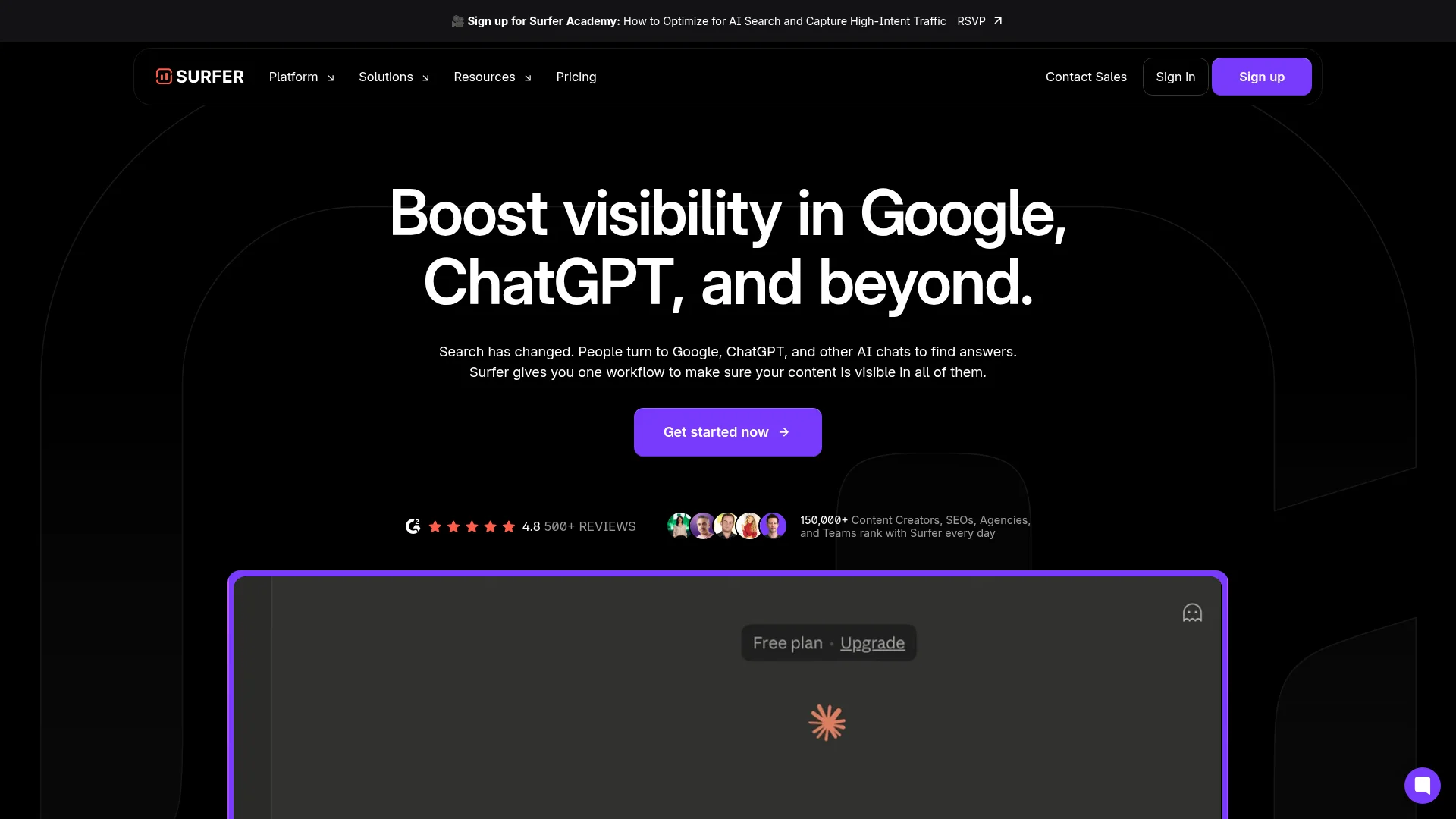
What it is: An SEO content optimization platform with an industry-respected Content Score, Surfer AI writer, AI Tracker across five AI platforms, site-wide audit tools, and keyword research. One of the most established tools in the category.
Pricing: Discovery $49/mo, Standard $99/mo, Pro $182/mo, Peace of Mind $299/mo, Enterprise $999+/mo (billed yearly). Pricing verified from surferseo.com.
Key strengths:
- Content Score is widely cited as the category benchmark, with reported 0.28 correlation to Google ranking performance
- 150,000+ customers per Surfer's marketing site, strong agency and in-house adoption
- AI Tracker covers ChatGPT, Perplexity, Google AI Mode, AI Overview, and Gemini, which MarketMuse doesn't offer
- Transparent pricing on every tier, unlike MarketMuse's demo-gated paid plans
- Rated 4.8/5 on G2 from 540 reviews and 4.4/5 on Trustpilot from 213 reviews
Key limitations:
- Topic modeling is less sophisticated than MarketMuse's patented approach. Surfer scores against SERP-ranking pages; MarketMuse models semantic topic relationships across your whole site.
- 360 documents per year cap on Standard and Pro, which adds up fast for active teams
- Not a production system: no CMS publishing, no content calendar, no automated repurposing, no sitemap-powered internal linking during writing
- Feature-heavy UI takes more onboarding than Frase or Dashword, and some reviewers describe learning curve friction
Best for: Teams that want mature SEO optimization with transparent pricing and a large active customer base. A good MarketMuse alternative if your main frustration is pricing opacity or the Siteimprove acquisition uncertainty, and your workflow centers on per-article optimization rather than portfolio topic analysis.
3. Clearscope
Best for Premium Term-Level Optimization With Intent Analysis
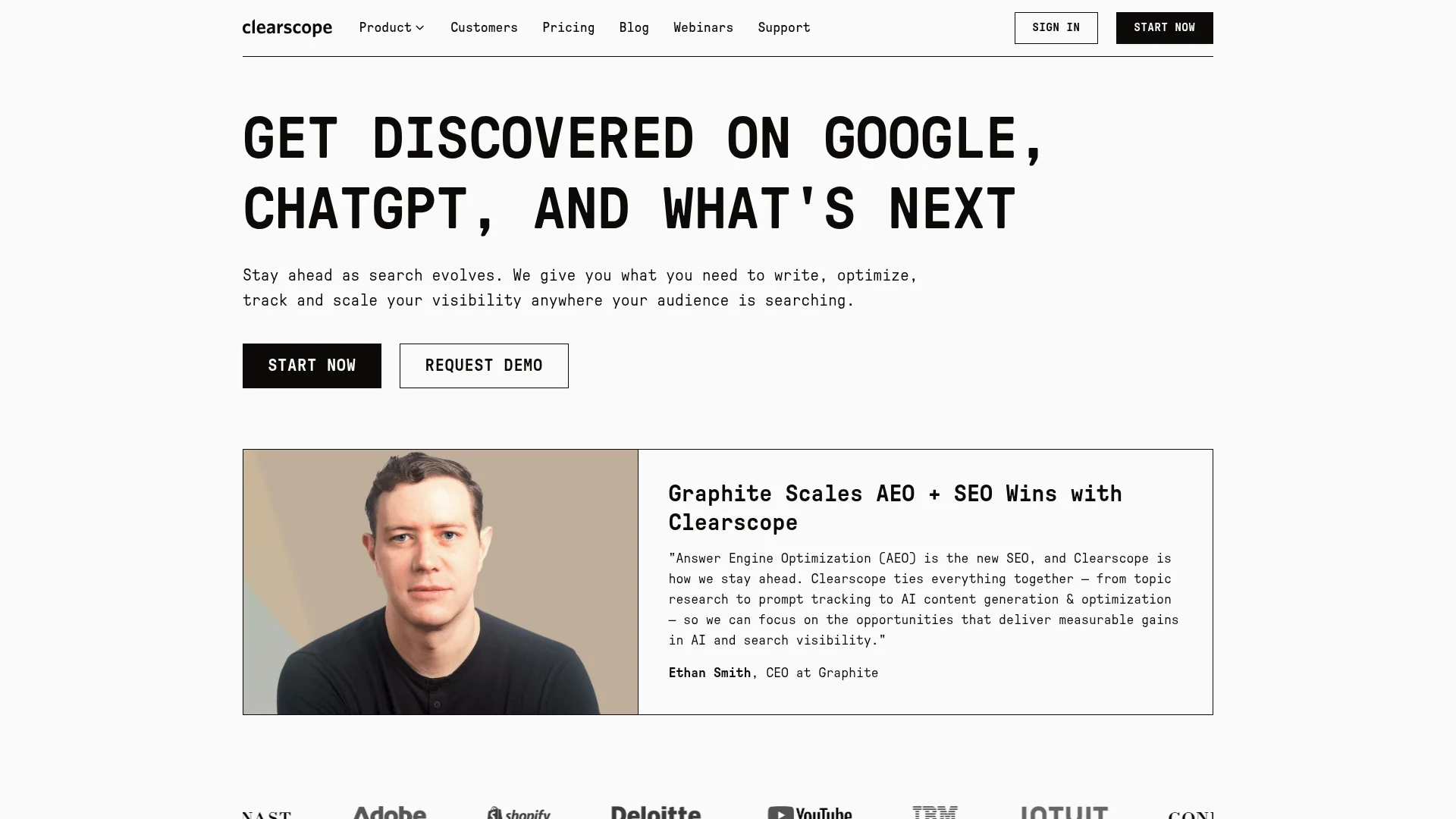
What it is: A premium SEO and AEO content optimization platform with intent-driven term recommendations, a Google Docs integration, and content inventory monitoring. The closest direct comparable to MarketMuse on term-level optimization depth.
Pricing: Essentials $129/mo, Business $399/mo, Enterprise custom. Pricing verified from clearscope.io.
Key strengths:
- Term recommendations are widely regarded as the most accurate in the category. Uses Google Cloud NLP, OpenAI, and IBM Watson for semantic analysis.
- Query fan-out awareness for AI search and new AEO features in the 2.0 update (Expand module tracks AI citations across ChatGPT, Gemini, Perplexity)
- Free training and onboarding on every plan, with reviewers citing direct access to founder Bernard Huang for strategy guidance
- Used by Graphite, Shopify, and TripAdvisor, which signals a similar quality-bar customer base to MarketMuse
- Transparent pricing published on the pricing page, unlike MarketMuse's demo-gated tiers
Key limitations:
- $129/mo entry is the highest starting price on this list, comparable to historical MarketMuse Optimize pricing
- 20 drafts per month cap on both Essentials and Business, constraining teams publishing more than weekly
- Strictly optimization: no content inventory analysis or topic authority modeling at MarketMuse's portfolio depth, and no AI writing at full-draft scope
- Email-only support, which reviewers flag as friction on a tool at this price point
Best for: Teams that want premium term-level optimization and intent analysis inside a Google Docs workflow. A good MarketMuse alternative if your main frustration is the Siteimprove acquisition uncertainty and you'd trade MarketMuse's portfolio-level topic modeling for cleaner per-article optimization.
4. Frase
Best for Integrated SEO Plus AI Writing Plus AEO on a Tight Budget
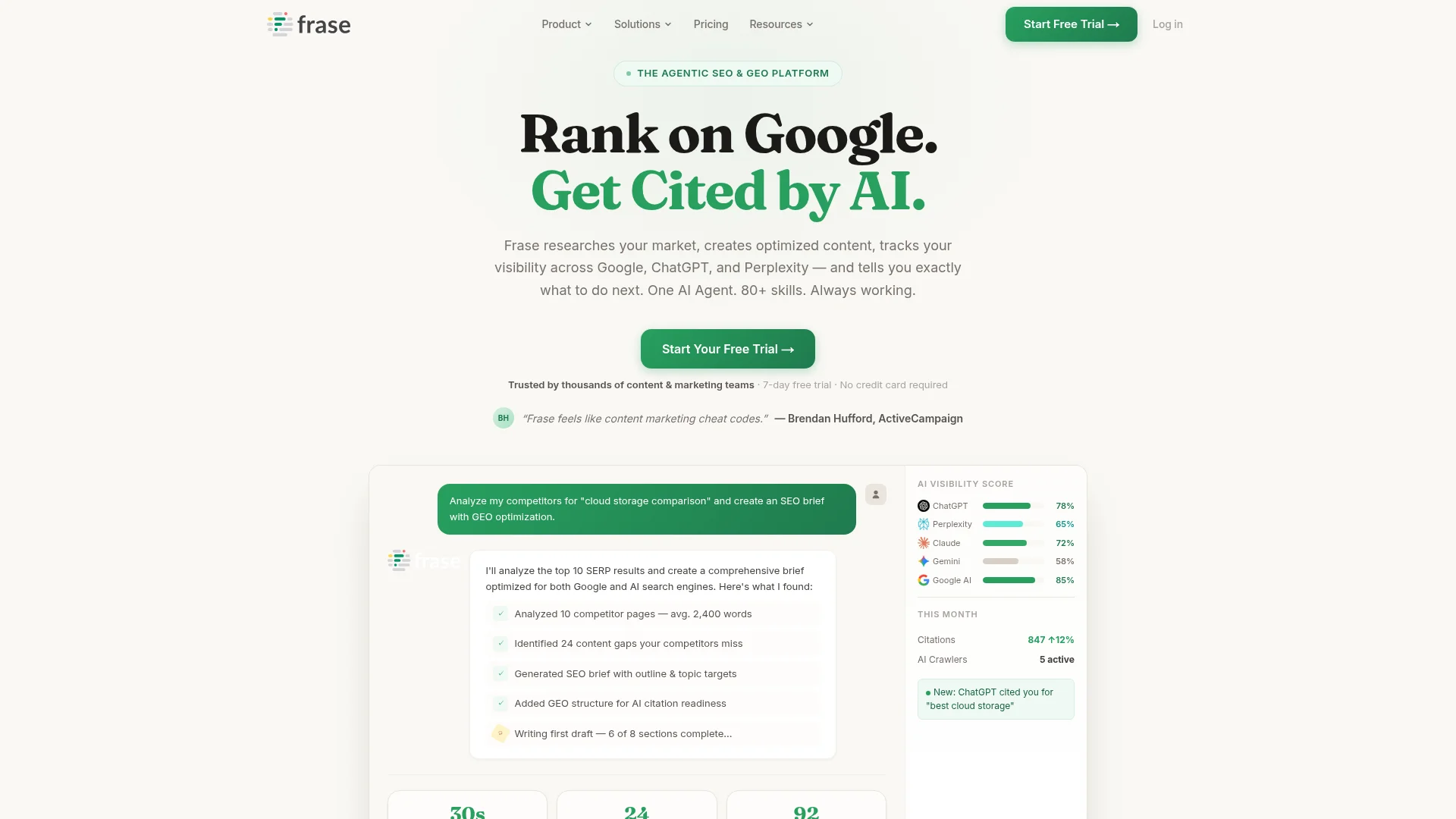
What it is: An agentic SEO and GEO platform with 80+ AI skills in one agent. Bundles SEO research, AI writing, optimization, AI visibility tracking, site audits, and publishing in one tool.
Pricing: Starter $39/mo annual (or $49/mo monthly), Professional $103/mo annual, Scale $239/mo annual, Enterprise custom. 7-day free trial. Pricing verified from frase.io.
Key strengths:
- Bundles SEO + AI writing + AEO tracking at $39 Starter annual, addressing the "MarketMuse + separate writer" cost problem directly
- AI Visibility tracking across 8 platforms on Enterprise
- Customer base includes GitLab, Under Armour, Oracle, and Thomson Reuters, signaling real enterprise use alongside the SMB pricing
- Auto internal linking included at Starter, which MarketMuse doesn't automate during writing
- Rated 4.8/5 on G2 from 301 reviews and 4.8/5 on Capterra from 335 reviews
Key limitations:
- Trustpilot reputation is weak (1.3/5 from 52 reviews, complaint-heavy on a small sample). Worth reading before committing.
- AI writing quality is less mature than dedicated writers like Jasper for long-form, so editorial passes are often needed
- Per-seat add-on pricing escalates team costs; a five-person team can hit Scale pricing quickly
- Topic modeling and content inventory analysis are shallower than MarketMuse's, so teams valuing portfolio-level strategy feel the gap
Best for: Solo operators and small teams that want integrated SEO, AI writing, and AEO tracking in one tool at a transparent price. A good MarketMuse alternative if your main frustration is paying for MarketMuse and a separate writer, and you want both bundled.
5. Jasper
Best for Dedicated AI Writing With Brand Voice
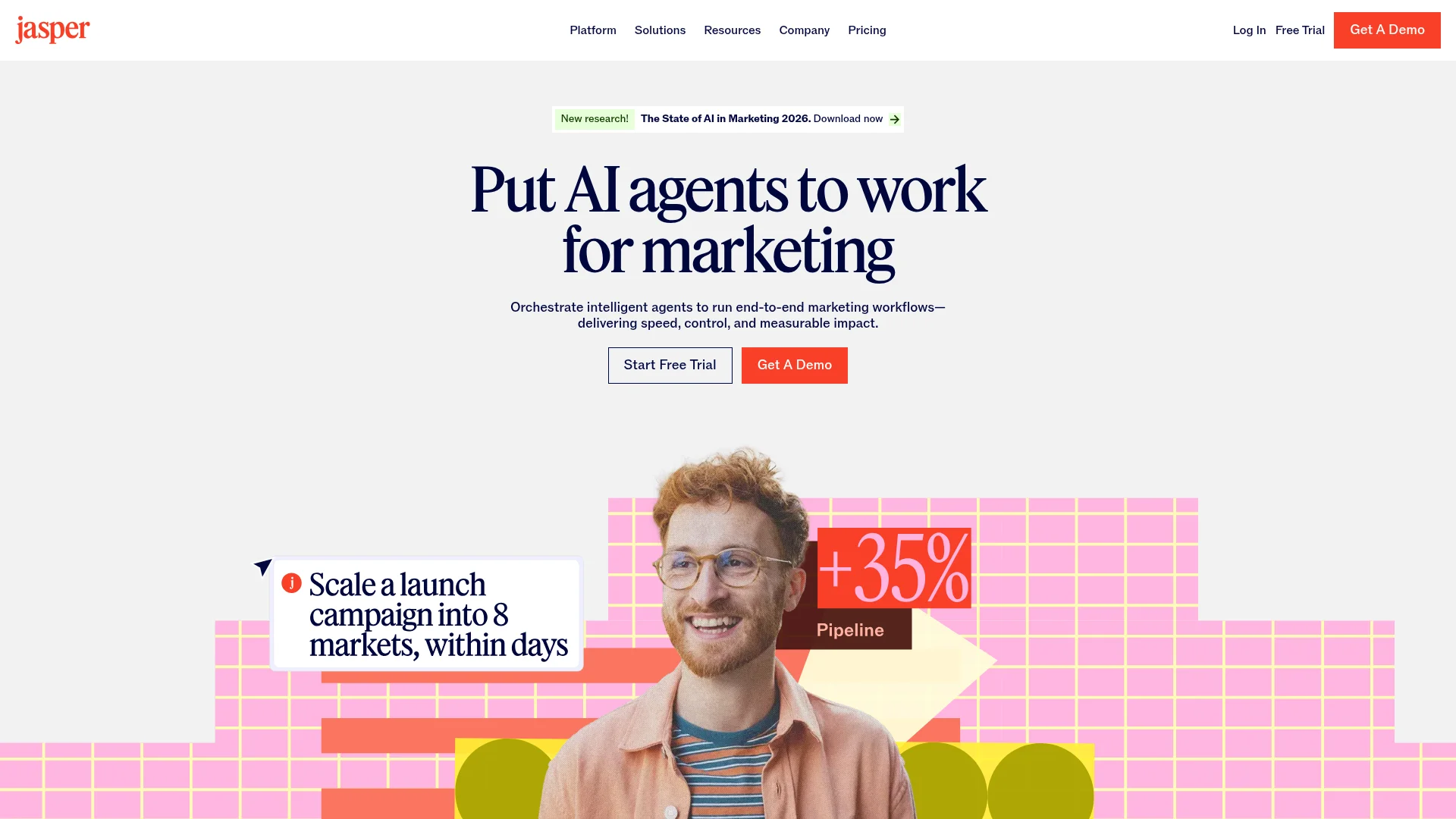
What it is: The most recognized AI content creation platform, with 100+ agents, Content Pipelines, Jasper IQ brand context, 50+ templates for short and long-form content, and enterprise governance features.
Pricing: Pro $59/mo annual (single seat, includes SEO mode via Surfer integration), Business custom (starts at roughly $5K/yr). 7-day trial. Pricing verified from jasper.ai.
Key strengths:
- Strong brand voice training from URL samples, keeping output consistent across writers and content types
- Extensive template library covering both short-form marketing copy and long-form articles
- Native Surfer SEO integration gives real-time optimization scoring while writing, combining what MarketMuse and a writing tool each do separately
- Enterprise governance features (SOC 2, SSO, SCIM) for larger orgs that MarketMuse doesn't match at the same tier
- Rated 4.7/5 on G2 from 1,269 reviews and 4.8/5 on Capterra from 1,855 reviews
Key limitations:
- Per-seat pricing gets expensive fast. A five-person team on Pro pays $345/mo just for writing, before adding SEO or AEO tools.
- No content inventory or topic authority modeling. Jasper fills the writing gap in MarketMuse's workflow, not the strategy layer.
- Hallucinations on long-form content still require editorial review; Trustpilot rating is 3.4/5
- SEO optimization requires the Surfer integration, which means a second subscription at $99+/mo
Best for: Teams whose MarketMuse use is missing the AI writing layer, and who want dedicated long-form AI output with brand voice control. A good MarketMuse alternative if your main frustration is that MarketMuse explicitly doesn't write content and you need dedicated writing.
6. Writesonic
Best for Budget AI Writing Plus Broad AEO Tracking
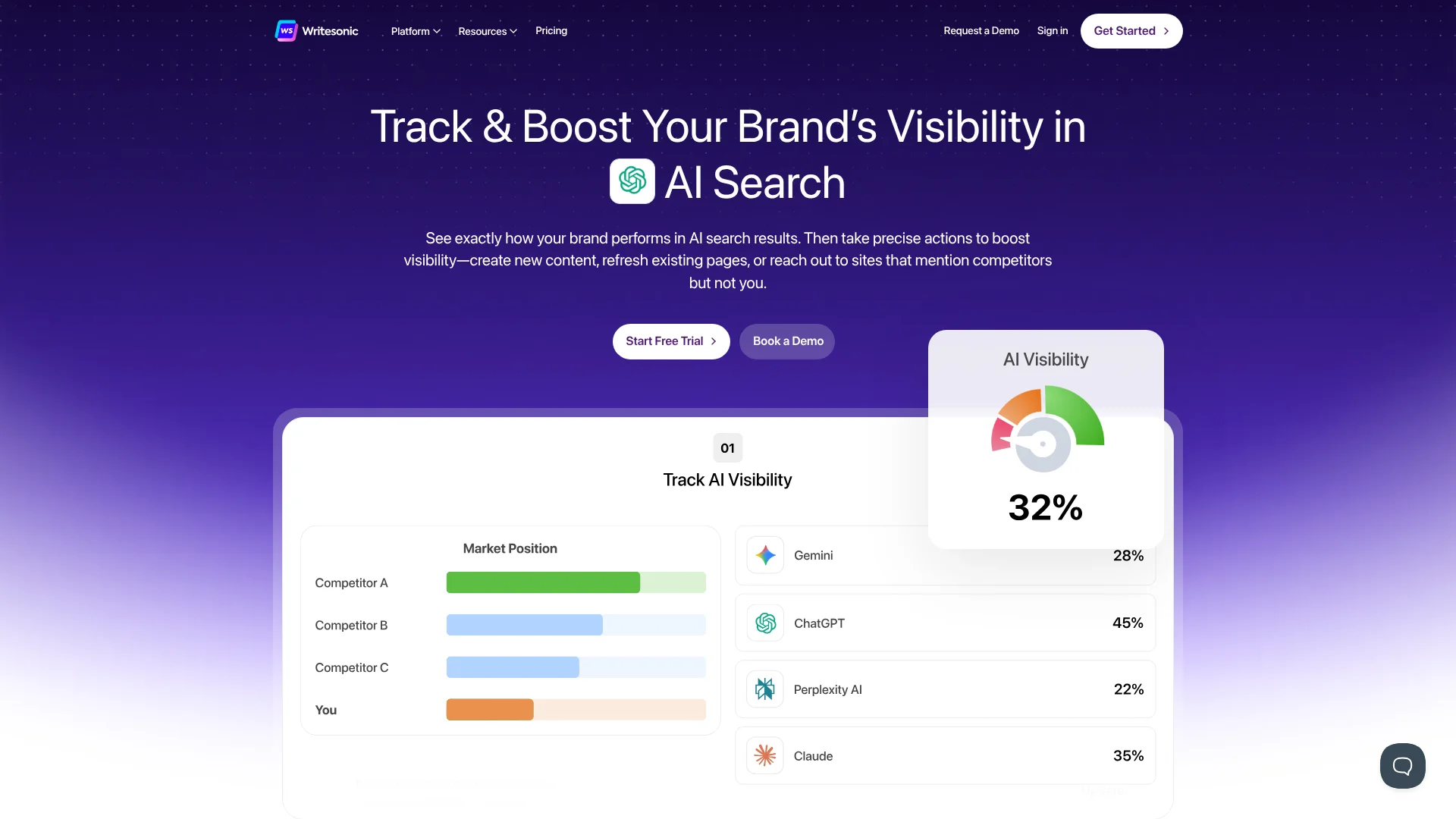
What it is: An AI search visibility, SEO, and content platform that tracks brand mentions across eight or more AI platforms and bundles AI writing, keyword research, and content gap analysis.
Pricing: Free plan, Starter from ~$16/mo annual, Growth ~$79/mo annual, Enterprise custom. Pricing verified from writesonic.com.
Key strengths:
- AI visibility tracking across 8+ platforms: ChatGPT, Gemini, Perplexity, Claude, Google AI Overviews, Copilot, Grok, and more. Broader coverage than most tools in this set.
- Chatsonic conversational AI plus built-in SEO tools (keyword research, content gap analysis) in one subscription
- Rated 4.7/5 on G2 from 1,990 reviews and 4.6/5 on Trustpilot from 6,000 reviews, the strongest Trustpilot reputation in this list
- Free tier plus low Starter price makes self-service evaluation easy, unlike MarketMuse's demo-gated paid tiers
Key limitations:
- Long-form content quality requires editorial passes; reviewers note inconsistency on technical topics
- Pricing page is feature-focused rather than cleanly tiered, which makes costs hard to predict as you scale
- No content inventory analysis or portfolio-level topic modeling at MarketMuse's depth
- No CMS publishing or internal linking automation, so the post-draft workflow is still manual
Best for: Budget-conscious marketing teams that want AI writing plus broad AEO tracking at a low price. A good MarketMuse alternative if your main frustration is paying MarketMuse plus a separate AEO tracker when you could get both (plus writing) for under $20/mo.
7. AirOps
Best for Enterprise Agent-Driven Content at Scale
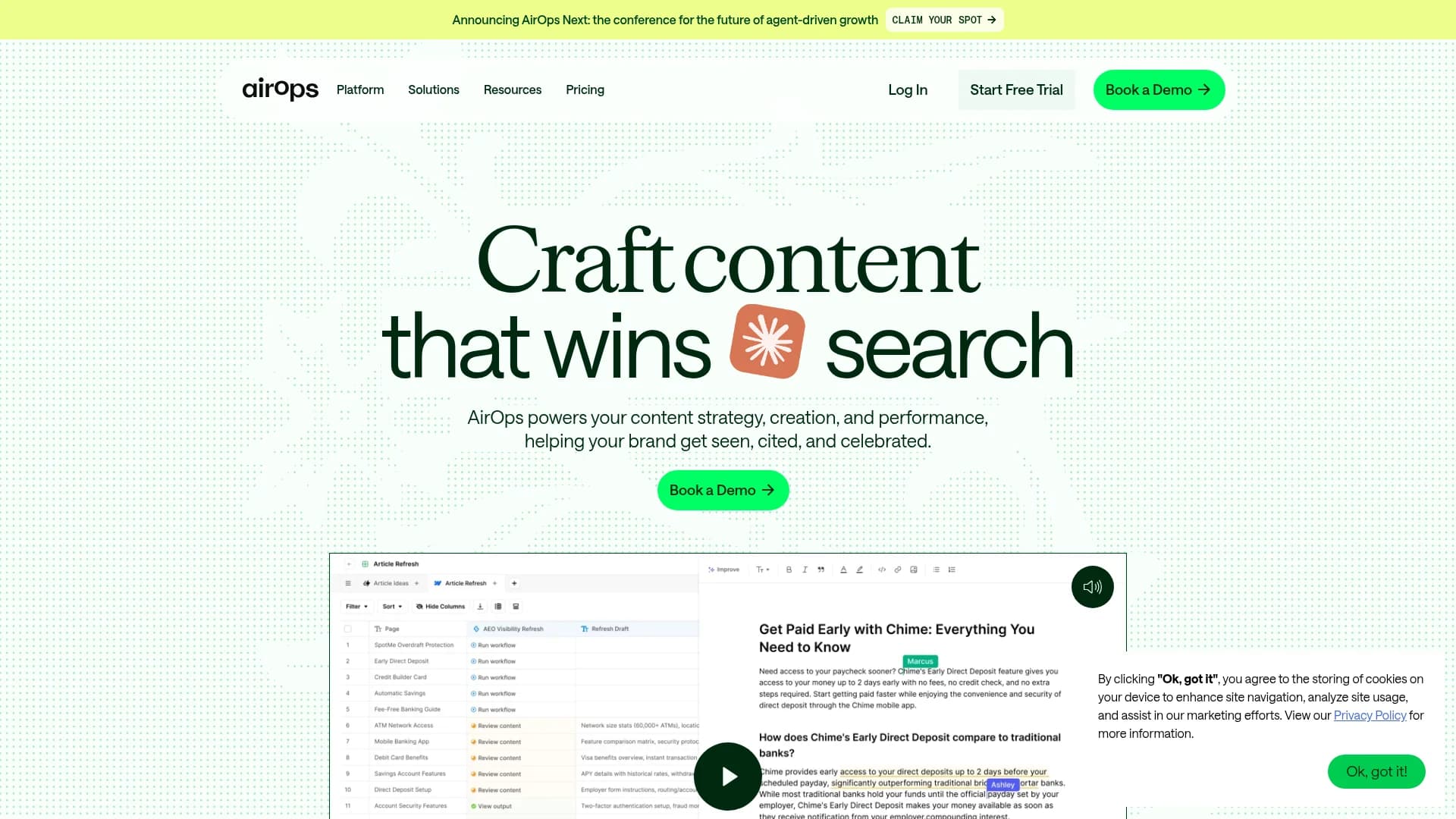
What it is: An agent-driven AI content platform for enterprise brands. Positioned around "content that wins search" with a focus on AI visibility, modular agent workflows, and integrations with 10+ CMS platforms.
Pricing: Insights free tier, Solo paid (gated), Pages custom tier. Paid pricing is demo-gated, similar to MarketMuse's top tiers.
Key strengths:
- Enterprise customer list includes Ramp, Carta, Webflow, Chime, LegalZoom, and Docebo
- 30+ AI models, 10+ data providers, and 10+ CMS integrations available on the free tier
- Modern agent architecture with cohort trainings that help teams build custom workflows, beyond what MarketMuse offers at the workflow layer
- Focused on AI search share of voice, which aligns with where enterprise content teams are investing in 2026
Key limitations:
- Paid tier pricing is gated, which recreates the same friction as MarketMuse's demo-only paid plans
- Enterprise-focused, so setup overhead and workflow design effort is heavy for small teams
- No portfolio-level topic modeling at MarketMuse's depth. AirOps handles production workflows; MarketMuse handles portfolio strategy.
- Thin review sample on G2 and Capterra compared to Surfer or Jasper, making due diligence harder
Best for: Enterprise content teams going after AI search share of voice with in-house resources to configure agent workflows. A good MarketMuse alternative if your main frustration is that MarketMuse's Strategy tier has capped out and you want modern agent infrastructure with deeper CMS integration.
8. Copy.ai
Best for GTM Workflow Automation Beyond Content
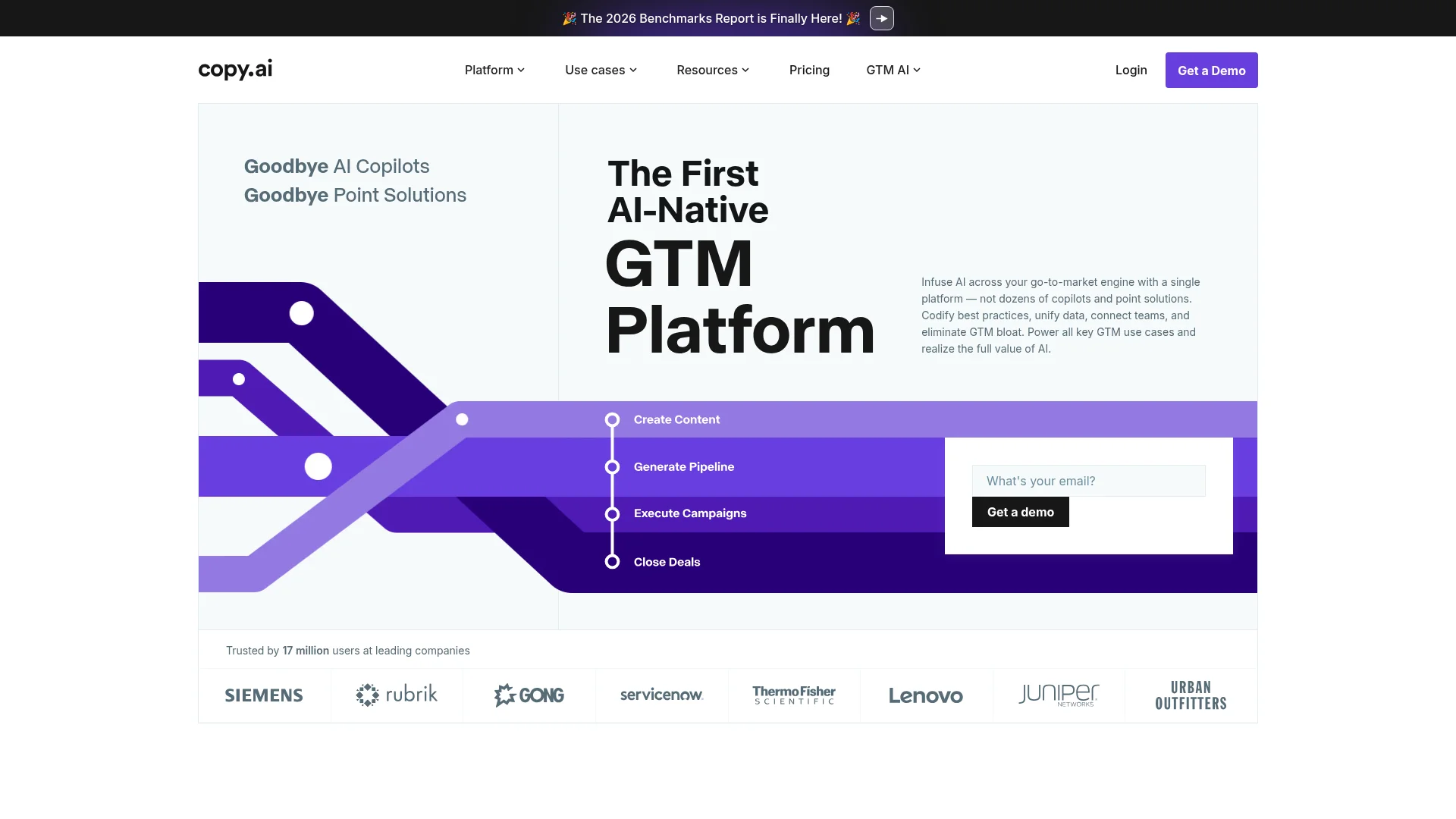
What it is: A GTM AI platform (post-Fullcast acquisition in October 2025). Workflow automation spanning sales, RevOps, and marketing use cases, with 2,000+ integrations and LLM-agnostic agents.
Pricing: Free, Chat $29/mo, Growth $1,000/mo, Expansion $2,000/mo, Scale $3,000/mo. Pricing verified from copy.ai.
Key strengths:
- 2,000+ integrations support workflow automation across GTM use cases, well beyond content production
- LLM-agnostic, which gives teams flexibility on model choice
- Workflow automation features can replace ad-hoc Zapier or Make chains when they touch content
- Rated on G2 and Capterra, though counts vary
Key limitations:
- Trustpilot 1.8/5 from 196 reviews, with recurring complaints about data loss and support issues. Read reviews before committing to annual plans.
- Post-Fullcast pivot to GTM workflows has confused original AI-writing users, and product focus is shifting away from pure content production
- No middle tier between Chat ($29/mo) and Growth ($1,000/mo), which makes scaling from solo use to team use a hard cliff
- No topic modeling, no content inventory, no AI search visibility tracking at the depth MarketMuse or Writesonic offer
Best for: GTM teams that want workflow automation across marketing and sales, with content as one use case among many. A good MarketMuse alternative if your main frustration is that MarketMuse is too narrow for your broader workflow needs, and your content use case sits alongside RevOps, sales, and marketing automation.
How to Choose the Right MarketMuse Alternative
The right tool depends on where your real bottleneck sits.
Each article currently takes hours of coordination across MarketMuse, a separate writer, CMS publishing, Canva, and manual LinkedIn posts, and that's your bottleneck.
→ DeepSmith.
Replaces the patchwork with one pipeline: topic intelligence, ideation, writing, editorial review, internal linking, publishing, and 14-channel distribution on team pricing at $80/mo Pro.
You're hitting an annual renewal cliff with Siteimprove-era pricing opacity, and the next-tier math doesn't work against production volume.
→ DeepSmith.
Autowrite runs scheduled production against Deep IQ brand context at $80/mo Pro or $299/mo Scale with published pricing.
You already have writers, CMS workflow, internal linking, and portfolio strategy handled, and your only remaining gap is term-level optimization accuracy inside Google Docs.
→ Clearscope.
Intent-driven term recommendations and the Google Docs sidebar cover that narrow job well at $129/mo Essentials.
Everything in MarketMuse fits your shape of work across 500+ pages and multiple topic clusters, and the migration cost outweighs any gain.
→ MarketMuse (stay).
Personalized Difficulty and portfolio-level content inventory analysis remain the topic modeling depth you're paying for.
Your primary goal is SEO scoring and AI drafting combined, and portfolio topic modeling isn't on your list.
→ Frase Starter.
At $39/mo annual it covers SEO scoring, basic research, AI drafting, and AEO tracking for that narrow shape of work.
Ready to Move Beyond a Content Intelligence Tool?
DeepSmith handles the full content production pipeline, from topic strategy to published article to LinkedIn post, so your team can produce more content without growing headcount. Pro starts at $80/mo with transparent pricing and no demo gating.
→ Start your free trial at deepsmith.ai
7-day free trial. See how it compares in your first session.