
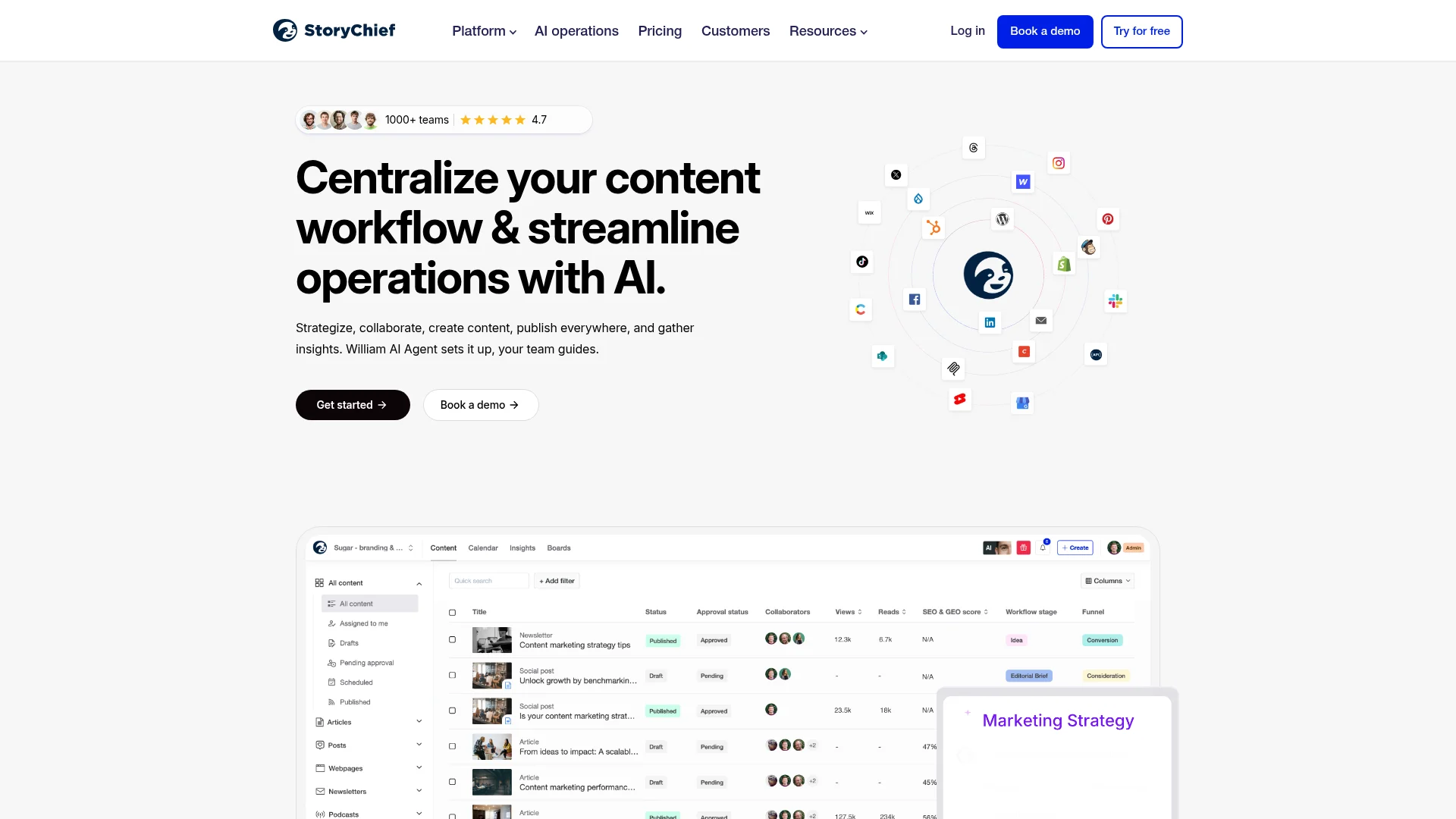
StoryChief sits at an unusual spot in the content tooling category. It combines AI writing, a structured approval workflow, and distribution to 100-plus channels (WordPress, HubSpot, Drupal, Shopify, Webflow, Wix, SharePoint, plus every major social platform) in one product. For marketing teams that live across blog, social, newsletter, and press, that breadth is rare. It holds a 4.6/5 on G2 from 32 reviews (84% five-star), with concrete homepage results: BESIX amplifying content through 15,000-plus employees, DoorLoop citing 200K-plus new organic visitors.
But it isn't right for every team. If you're evaluating alternatives, you've likely hit one of these:
Per-seat Team Editorial pricing scales faster than team-tier alternatives. $81/mo per seat means a 5-person team pays $405/mo before AI credit add-ons. Compare to Narrato Business ($96/mo workspace), DeepSmith Scale ($299/mo team), or Frase Team ($239/mo with the AI Agent). For in-house teams that scale headcount with volume, the math gets uncomfortable fast.
The 100-article cap on Team Editorial is a throughput ceiling. Teams publishing 150-plus articles per month (common for SaaS growth teams producing pSEO pages, or agencies covering multiple client calendars) hit the cap and need Team Discounts or Agency plans. Agency plans price per customer, awkward for in-house teams without a client structure.
AI writing is one module in a broader platform, not the main event. The William AI Agent sets up workflows and helps with drafting, but brand voice handling is thinner than dedicated AI writers. Jasper IQ learns voice from sample URLs. DeepSmith's Deep IQ stores 16 voice settings across 8 tone sliders and 8 texture dimensions. If voice consistency across a multi-writer team is your main quality concern, StoryChief's AI layer can feel shallow.
GEO scoring exists, but AEO tracking depth is limited. The 2025 upgrade added Generative Engine Optimization to the writing flow, ahead of many content platforms. But it scores content during writing, not brand visibility after publishing. Writesonic tracks 8-plus AI engines. DeepSmith's AI Prompt Tracking covers ChatGPT, Gemini, Perplexity, and Google AI Mode with twice-weekly refresh. Frase's AI Visibility module runs at every tier.
The AI credit system adds budgeting complexity. Team Editorial includes 8,000 AI credits per month, Team Social includes 5,000, and the AI Extension Pack ($57/mo) or AI Pro Pack ($119/mo) add more. Credit consumption varies by article length and features used.
The G2 review footprint is modest for a product with 1,000-plus teams. 32 reviews is small next to Jasper (1,269), Writesonic (2,093), or Narrato (170). The rating is strong, but at larger companies using review counts as a vendor filter, StoryChief can look less established than its customer base suggests.
This guide compares 8 alternatives across four categories: full production pipelines, content workspace platforms, AI writing tools with deeper brand voice, and SEO plus AEO platforms.
How We Evaluated These Alternatives
We analyzed pricing from each tool's website, features from product pages, and user feedback from G2, Capterra, Trustpilot, Tekpon, and independent reviews. Evaluation dimensions: content production scope, AI writing quality, SEO and AEO capabilities, multi-channel publishing, workflow, pricing, and integrations. DeepSmith is our product. We've included it because it fits the gap StoryChief users hit when they need a full production pipeline plus transformed distribution plus AEO tracking at flat team pricing. We've flagged where other tools are the better choice. All pricing verified as of April 2026.
Quick Comparison Table
| Tool | Best For | Starting Price | Scope |
|---|---|---|---|
| DeepSmith | Teams needing a full production pipeline with distribution and AEO | $80/mo (team) | Full pipeline (idea → publish → 14 channels) |
| Narrato | Content workspace at per-workspace pricing | $36/mo (4 seats) | Team content workspace + AI templates |
| Jasper | AI writing quality and brand voice | $59/mo (1 seat) | AI writing + Brand Voice |
| Writesonic | AI search visibility tracking | $79/mo | AI writing + broad AEO |
| Frase | SEO + GEO + AI writing at entry price | $39/mo | Research + drafting + optimizer |
| Scalenut | All-in-one with bundled add-ons | $59/mo | AI writing + SEO/GEO bundle |
| Surfer SEO | Industry-standard SEO scoring | $49/mo | Optimizer + AEO tracking |
| ChatGPT | Solo DIY at lowest price | Free / $20/mo | General LLM, DIY |
What StoryChief Does Well
Before the alternatives, StoryChief's strengths deserve credit. These are real capabilities backed by product usage and review data.
"Publish Everywhere" is genuinely strong multi-channel distribution. The 100-plus integrations span traditional CMS (WordPress, HubSpot, Drupal, Shopify, Webflow, Wix, SharePoint) and every major social channel. Most content platforms do blog or social. Few do both deeply inside one publishing flow. The BESIX case study (15,000-plus employees amplifying content) and the DoorLoop result (200K-plus new organic visitors) are outcomes that only surface when distribution works at scale.
The approval workflow is the most cited strength in reviews. G2 reviewers and the Tekpon independent review consistently call out the approval and collaboration layer. For teams with multiple stakeholders (marketing, legal, compliance, external agencies, client-side reviewers), structured approvals reduce last-minute rework. For regulated industries (healthcare, finance) or enterprise operations with formal review chains, this workflow is a real fit.
Agency per-customer pricing matches how agencies actually bill. Agency Social at $58/mo per customer and Agency Editorial at $93/mo per customer charge per client brand, not per seat. A 3-person agency managing 10 clients pays $930/mo on Agency Editorial regardless of internal team size. Most content platforms price per editor, which punishes agencies with lean teams serving many clients.
GEO is built into the writing flow, which most collaboration platforms haven't added. The 2025 upgrade added Generative Engine Optimization alongside traditional SEO scoring. Narrato, Contently, and most traditional content workflow platforms haven't added AEO or GEO yet. StoryChief's move places it alongside newer tools (Writesonic, Frase, DeepSmith) that treat AI search visibility as a first-class concern.
The 4.6/5 G2 rating reflects genuine user satisfaction. The review base is modest at 32, but the distribution is strong: 84% five-star, 9% four-star, 6% three-star. The Capterra listing and the Tekpon independent review echo the same themes.
If these strengths match your use case, StoryChief may be the right tool. The alternatives below serve teams whose needs extend beyond what StoryChief covers.
1. DeepSmith
Best for Teams Who Need a Complete Content Production Pipeline Plus Distribution and AEO Tracking
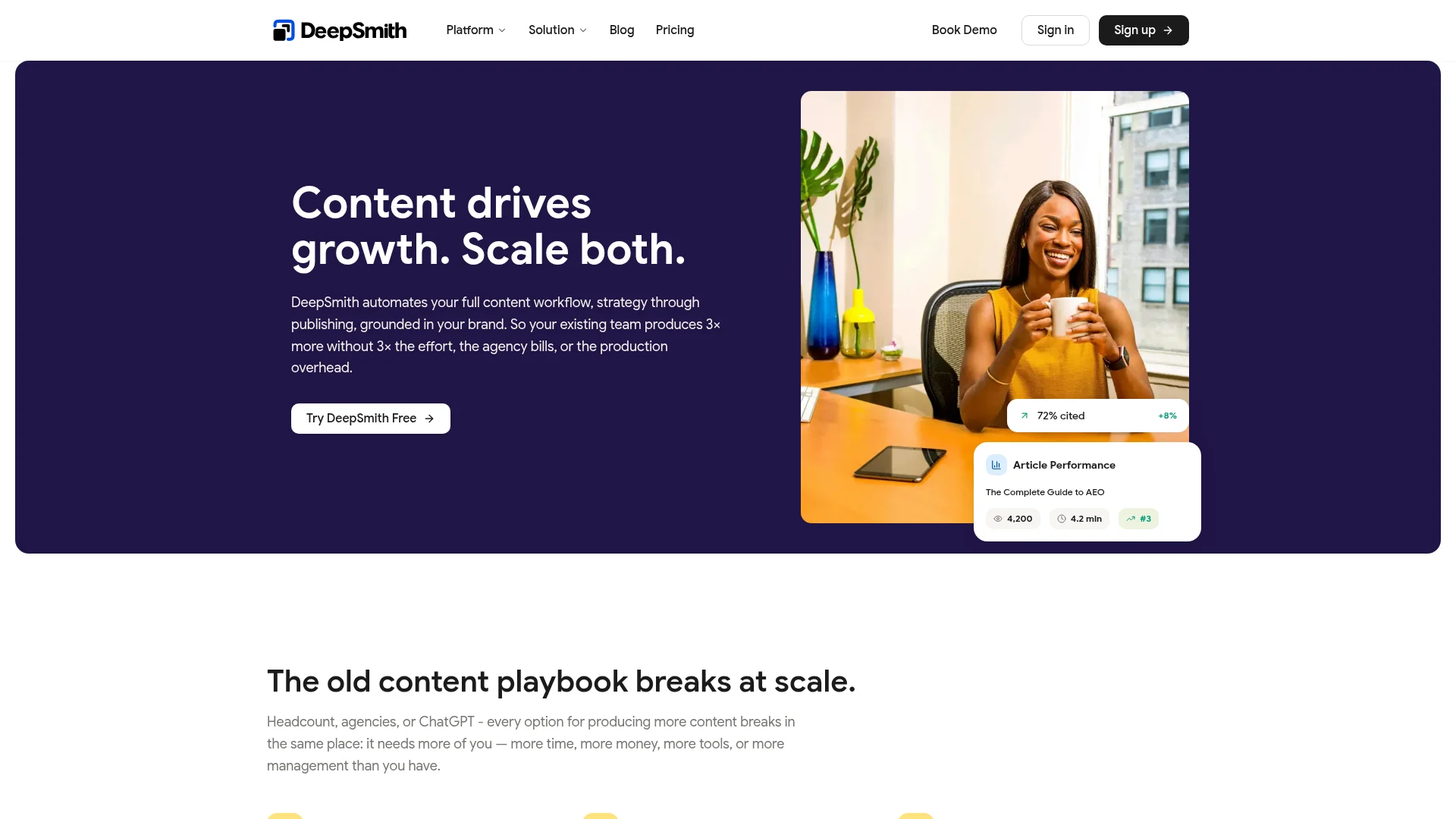
What it is: An AI content automation platform that handles the full production lifecycle. Ideation through a 5-agent pipeline. Writing through a 10-agent pipeline (research, brief, draft, editorial QA, voice styling, internal linking, cover image, publishing metadata). 14 distribution agents transform each article into channel-specific assets (LinkedIn post, X thread, newsletter email, Medium article, Substack post, Slack announcement). AI Prompt Tracking monitors brand visibility across ChatGPT, Gemini, Perplexity, and Google AI Mode.
Pricing: Pro at $80/mo, Scale at $299/mo, Enterprise custom. Team tiers, not per-seat.
Why teams switch from StoryChief to DeepSmith:
The switch isn't swapping one collaboration platform for another. It's replacing a multi-channel publisher (same article pushed to many destinations) with a production system that transforms each article into channel-specific assets, runs multi-pass editorial QA during writing, and tracks how finished content performs inside AI search.
With StoryChief, every article means: plan in the calendar, use William AI Agent to set up the workflow, draft with the AI writer and GEO scoring, route through the approval chain, publish across 100-plus integrations, use the employee advocacy module for amplification. Channel transformation (LinkedIn-native post, X thread structure, newsletter framing) happens outside the tool.
With DeepSmith, you open Topic Explorer, generate ideas from keyword clusters with search demand, difficulty, and coverage signals, then pick one. The 10-agent pipeline runs in about 15 minutes: research collection, research analyst, brief architect, article writer, editorial reviewer, voice stylist, internal linking agent (matched against an enriched sitemap), cover image agent, publishing metadata. One-button WordPress publish. The Agent Library then produces the LinkedIn post, X thread, newsletter email, Medium version, and Slack announcement, each brand-voiced from Deep IQ. AI Prompt Tracking shows how the brand appears in AI answers twice weekly.
What DeepSmith does that StoryChief doesn't:
- Multi-pass editorial pipeline with discrete agent stages. Editorial Reviewer audits structure, coverage, and claim validation. Voice Stylist applies 16 voice settings (8 tone sliders, 8 texture dimensions) from Deep IQ. StoryChief has human approval but not multi-agent editorial QA during writing.
- Deep IQ brand context across 6 structured dimensions. Company, products, personas, voice (16 settings), visual guidelines, content type templates.
- Sitemap-powered internal linking. DeepSmith crawls and enriches your sitemap with AI-generated metadata (summary, topic, buyer stage, key phrases), then matches article topics against it during writing.
- 5-agent idea generation pipeline with Opportunity Mapper and Editorial QA. Produces structured ideas with titles, angles, buyer stages, and keyword alignment.
- 14 distribution agents that transform format per channel. A LinkedIn post is written LinkedIn-native. An X thread is structured as a thread. StoryChief's "Publish Everywhere" distributes the same article without reshaping format.
- Cover image generation aligned to visual guidelines. The Cover Image Prompt Builder parses visual guidelines (color palette, illustration style, layout patterns) and article content to produce a brand-aligned image.
- AI Prompt Tracking across 4 AI platforms with twice-weekly refresh. Monitors brand mentions, citations, competitor mentions, and sentiment across ChatGPT, Gemini, Perplexity, and Google AI Mode.
- Flat team-tier pricing. Pro at $80/mo and Scale at $299/mo are team-tier. StoryChief Team Editorial is $81/mo per seat, so a 5-person team pays $405/mo before AI credit packs.
What to consider:
DeepSmith isn't the right fit if you're an agency managing 10-plus client brands where per-customer pricing matches your billing structure. StoryChief's Agency Editorial at $93/mo per customer is purpose-built for that, and DeepSmith has no agency equivalent. It's also not right if your primary need is employee advocacy at enterprise scale (BESIX-type deployments with 15,000-plus employees), or if you rely on native integrations with less common CMS systems (Drupal, SharePoint, Wix) that StoryChief supports out of the box. DeepSmith publishes natively to WordPress, with Markdown and HTML download for manual CMS insertion elsewhere.
Best for: SaaS founders, content marketing managers, and lean growth teams (Seed to Series B) who need the full content lifecycle in one system, where pipeline depth and AEO tracking matter more than client-billing economics or legacy CMS integrations.
2. Narrato
Best for Content Workspace Plus AI Writing at Per-Workspace Pricing
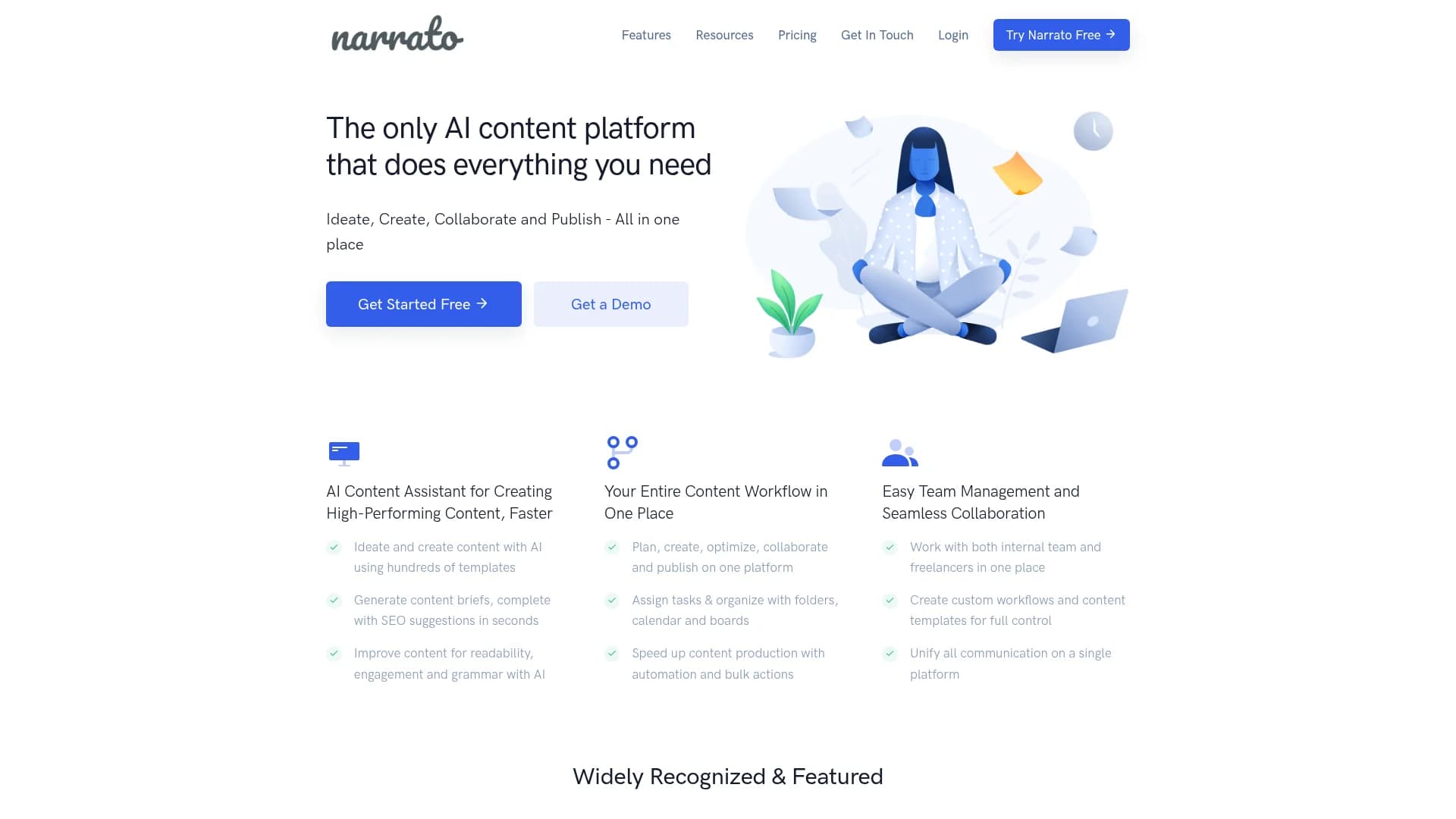
What it is: A content workspace that combines content ops workflow (calendar, folders, task management, in-doc comments, freelancer coordination) with 100-plus AI templates, AI Content Genie (weekly autopilot), SEO briefs, and WordPress plus Webflow publishing. The closest shape match to StoryChief on this list.
Pricing: Free, Pro at $36/mo yearly (4 seats, 400K AI characters per month), Business at $96/mo yearly (unlimited AI with fair-use cap, Brand Voices, white-labeling), Enterprise custom. Pricing from narrato.io/cws-pricing.
Key strengths:
- Per-workspace pricing, not per-seat. Pro at $36/mo includes 4 seats, much cheaper than StoryChief Team Editorial at $81/mo per seat.
- AI Content Genie auto-generates weekly blog and social content from themes and a website URL, with no operator involvement. Few workspace platforms offer autonomous recurring generation.
- Freelancer payment management and white-labeling on Business ($96/mo) are unusually deep for the category, and they address the agency use case without needing per-customer pricing.
- Rated 4.8/5 on G2 from 170 reviews, a larger procurement signal than StoryChief's 32.
Key limitations:
- Brand Voices, WordPress publishing, and custom AI templates are Business-only. A team needing just brand voice jumps from Pro at $36/mo to Business at $96/mo, a 2.7x increase.
- 400K characters per month cap on Pro, roughly 40 to 50 long-form articles. Heavier operations hit the ceiling.
- No AI visibility tracking across ChatGPT, Gemini, or Perplexity. AEO-first teams need a separate tool.
- Native publishing covers WordPress and Webflow on Business, narrower than StoryChief's 100-plus integrations.
Best for: Content marketing teams and small agencies managing internal plus freelance writers at per-workspace pricing. A good StoryChief alternative if per-seat Team Editorial pricing is your frustration and you can live with narrower multi-channel publishing.
3. Jasper
Best for AI Writing Quality and Brand Voice Depth
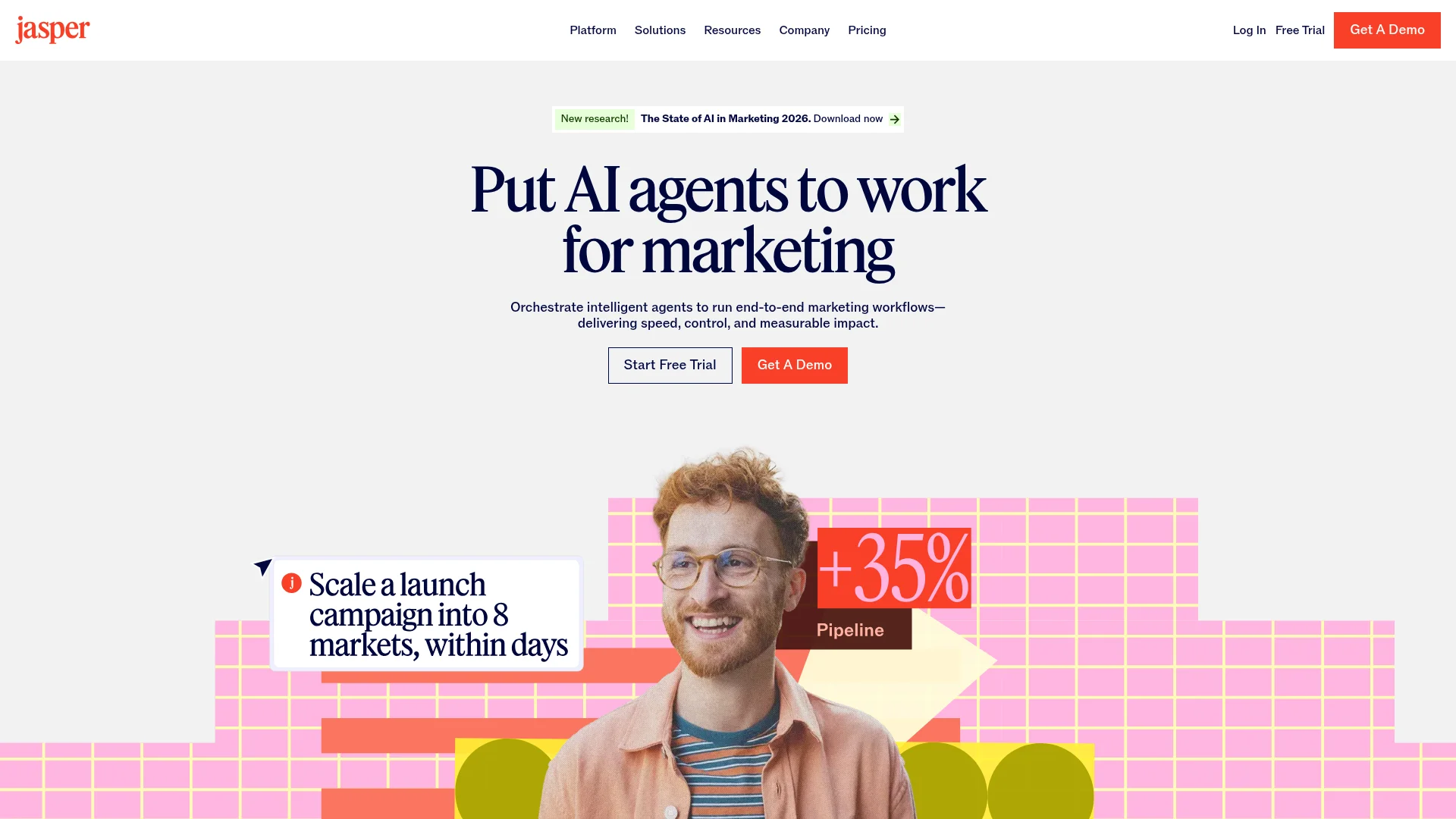
What it is: An enterprise AI marketing platform with 100-plus marketing agents (articles, ads, social, email), Content Pipelines, and Jasper IQ brand context that learns voice from sample URLs.
Pricing: Pro at $59/mo annual ($69 monthly, single seat). Business custom, typically starting around $5K per year. Pricing from jasper.ai/pricing.
Key strengths:
- Jasper IQ brand voice training from sample URLs is deeper than StoryChief's AI brand context. For teams whose main concern is voice consistency across writers and formats, this is the strongest single-purpose feature in the category.
- 100-plus marketing agents across articles, ads, social posts, emails, and campaigns, all grounded in brand voice.
- Enterprise governance on Business: SSO, SCIM, SOC 2 Type II.
- Rated 4.7/5 on G2 from 1,269 reviews and 4.8/5 on Capterra from 1,855 reviews.
Key limitations:
- Pro is single-seat. A 5-person team on Pro pays $295/mo for writing alone, before SEO tooling.
- No native SEO scoring. The common pattern is Jasper plus Surfer at $99/mo.
- No multi-channel publishing, no approval workflow, no employee advocacy. Jasper produces content. It doesn't manage the distribution or collaboration surface StoryChief covers.
- Trustpilot shows a billing complaint cluster (3.4/5 from 4,145 reviews). Worth reading reviews before committing to annual billing.
Best for: Teams whose real bottleneck is AI writing quality across formats (articles, ads, social, email) with consistent brand voice, and who have collaboration and publishing handled elsewhere. A good StoryChief alternative if StoryChief's AI layer feels thinner than a dedicated AI writer.
4. Writesonic
Best for AI Search Visibility Tracking Across 8-Plus Platforms
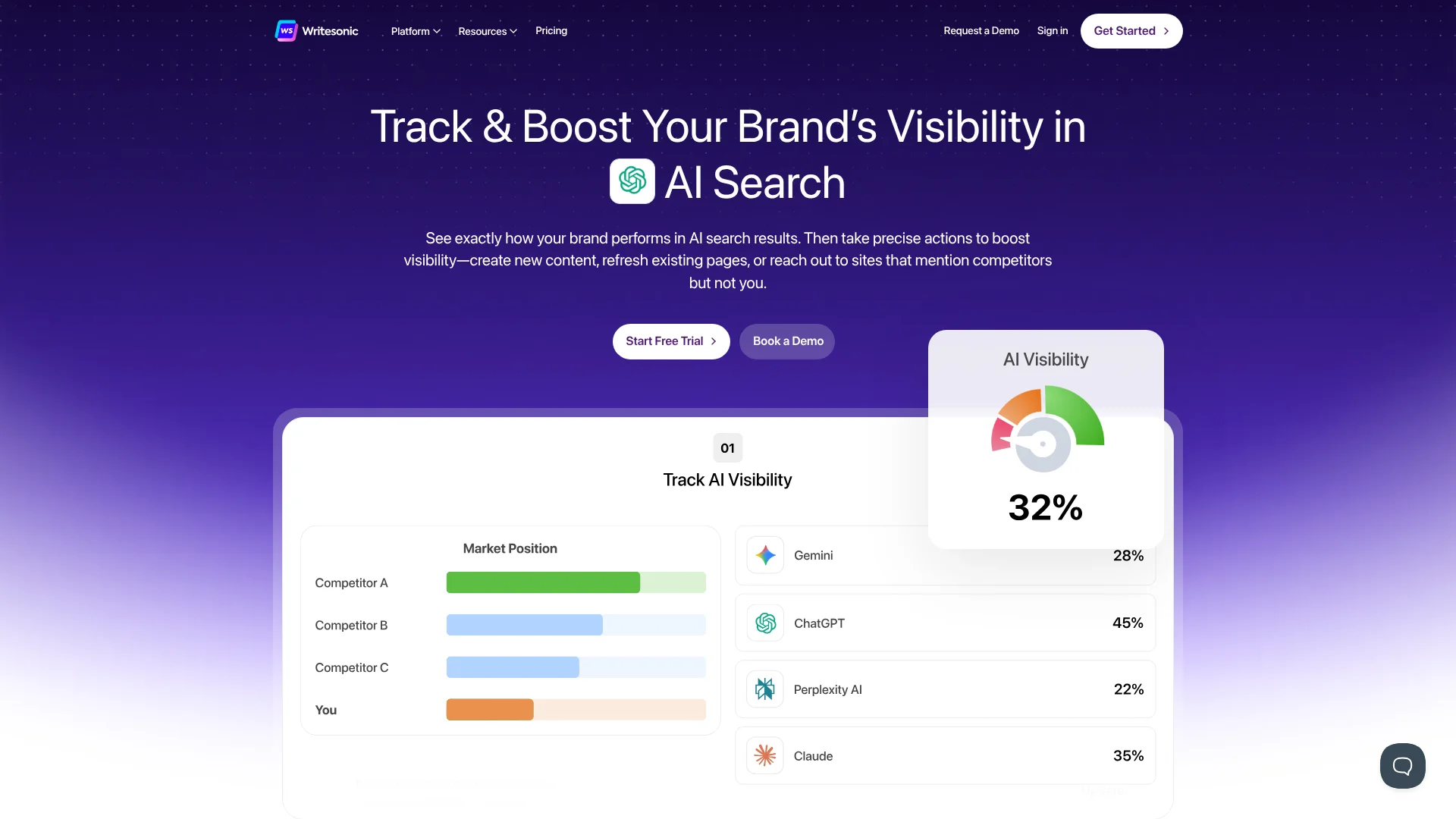
What it is: An AI search visibility (GEO) platform with integrated AI writing, SEO tools, and site audits. Tracks brand mentions and citations across 8-plus AI search engines: ChatGPT, Gemini, Perplexity, Claude, Copilot, Grok.
Pricing: Free, Starter at $99/mo ($79 annual), Basic at $249/mo ($199 annual), Growth at $499/mo ($399 annual). Pricing from writesonic.com/pricing.
Key strengths:
- AI Search Visibility tracking across 8-plus AI platforms is the broadest AEO coverage in this comparison, wider than DeepSmith (4), Surfer AI Tracker (5), or Frase AI Visibility (2 to 8).
- A 120M-plus AI conversation dataset informs visibility tracking signal quality.
- Content Engine combines SEO, GEO, and AI writing in one flow, closer to StoryChief's all-in-one shape than most AEO-first tools.
- Rated 4.7/5 on G2 from 2,093 reviews and 4.8/5 on Capterra from 2,102 reviews.
Key limitations:
- Starter caps at 15 AI articles per month, tight for teams publishing weekly.
- No collaboration or approval workflow comparable to StoryChief. Writesonic is an AI plus visibility platform, not a content ops layer.
- Multi-channel publishing is partial. It doesn't cover StoryChief's 100-plus integration breadth.
- Pricing tiers jump quickly: Basic at $249/mo and Growth at $499/mo. Budget planning for team use is less predictable than flat tiers.
Best for: Teams whose main concern is AI search visibility across many platforms, with AI writing as a secondary module. A good StoryChief alternative if you need tracking after publishing, not just GEO scoring during writing.
5. Frase
Best for SEO Plus GEO Plus AI Writing at Entry Price
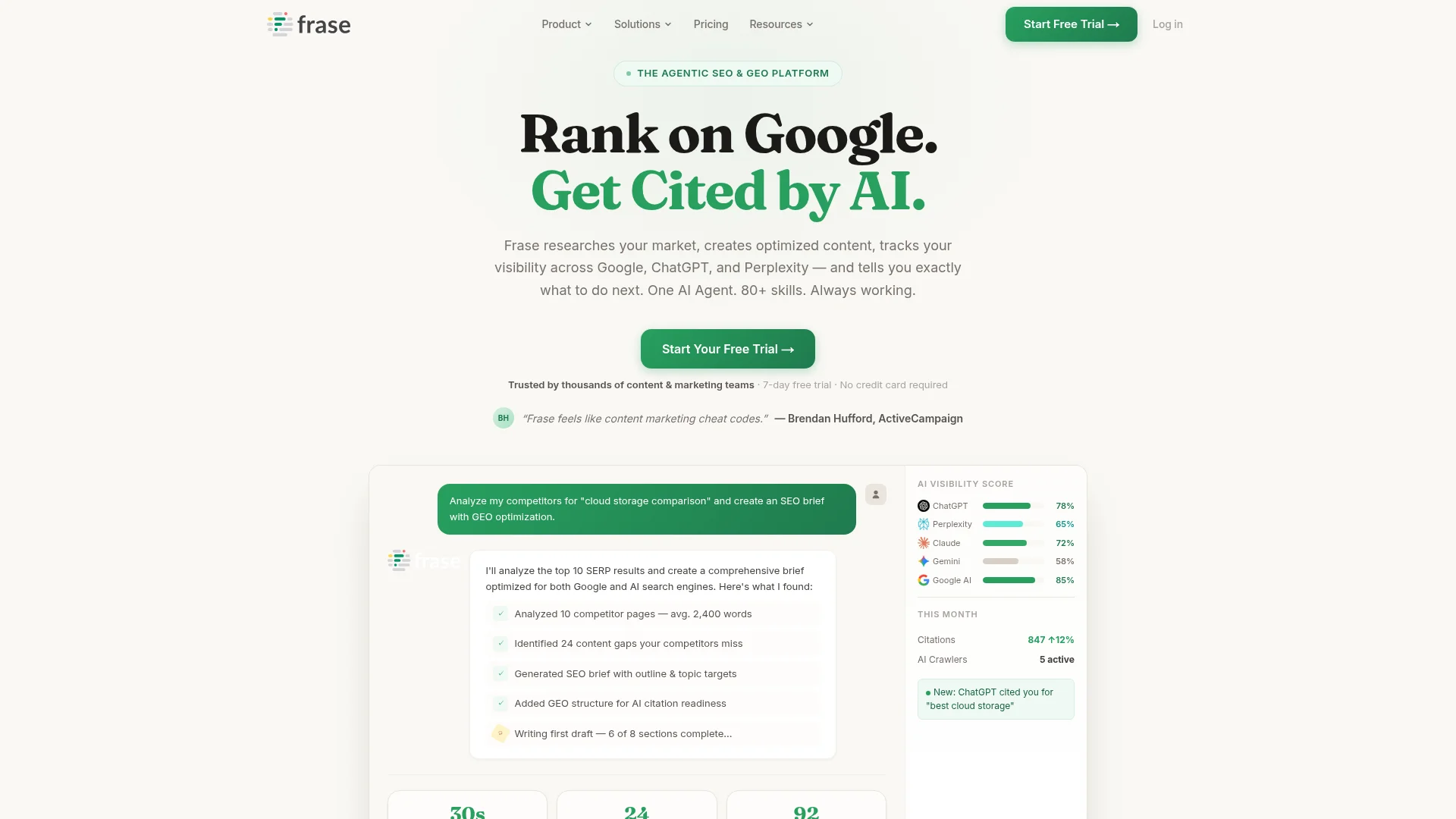
What it is: An agentic SEO plus GEO platform with an AI Agent and 80-plus skills covering research, briefs, SEO and GEO optimization, AI writing, AI visibility tracking, and site audits.
Pricing: Starter at $39/mo annual ($49 monthly, 10 articles), Professional at $103/mo annual, Scale at $239/mo annual. Pricing from frase.io/pricing.
Key strengths:
- $39/mo Starter covers SEO, GEO, AI writing, and AI visibility tracking. No other tool here covers all four at that price.
- AI Visibility tracking runs at every tier (2 to 8 platforms depending on plan).
- Auto internal linking is available at Starter, not gated behind a higher tier.
- Rated 4.8/5 on G2 from 301 reviews and 4.8/5 on Capterra from 335 reviews.
Key limitations:
- Starter caps at 10 articles per month. Beyond that, the $103/mo Professional tier is the realistic entry point.
- No collaboration or approval workflow. Frase is a writer plus optimizer plus visibility tool, not a content ops layer.
- No multi-channel publishing. Writers copy finished content to their CMS manually.
- UI density can be a learning curve for users coming from a workflow-first tool like StoryChief.
Best for: Solo operators and small teams wanting SEO, GEO, AI writing, and AI visibility in one tool at entry price. A good StoryChief alternative if you're paying for collaboration features you don't use while still needing optimization depth.
6. Scalenut
Best for All-in-One AI Content With Bundled Distribution and Backlinks
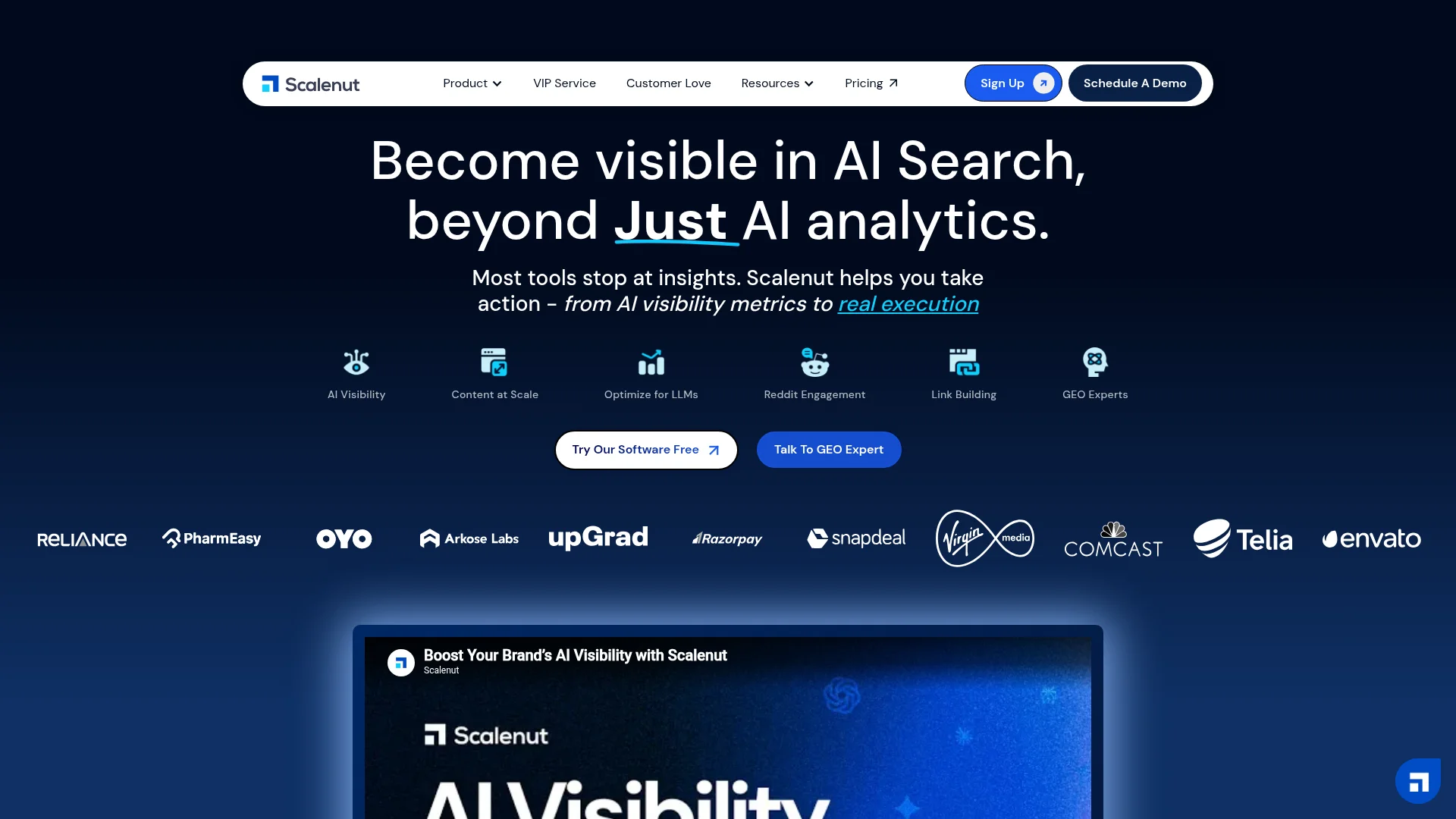
What it is: An all-in-one AI content plus GEO platform with Cruise Mode guided article creation, keyword clustering, SERP-based optimization, AI visibility tracking, auto-publishing, plus bundled Backlinks Marketplace and Social Upreach modules.
Pricing: Starter at $59/mo, Plus at $89/mo, Professional at $199/mo, VIP Service custom. Pricing from scalenut.com/pricing.
Key strengths:
- All-in-one entry price. $89/mo Plus covers AI content, GEO, social distribution (Social Upreach), and the Backlinks Marketplace, a broader bundle at that price than most competitors.
- AI visibility tracking available on the Starter tier.
- Cruise Mode walks users through article creation step by step, shortening time-to-first-article.
- Rated 4.7/5 on G2 from 315 reviews.
Key limitations:
- Trustpilot rating is 3.2/5 from 159 reviews, reflecting support friction reported by a minority of users. Worth reading reviews before committing.
- Cruise Mode is guided, so each article still requires per-article operator time. Less autonomous than scheduled autowrite or AI Content Genie.
- Collaboration and approval workflow are lighter than StoryChief's. For regulated or multi-stakeholder teams, this is a real gap.
- Multi-channel publishing via Social Upreach doesn't cover StoryChief's 100-plus integration breadth.
Best for: Small-to-mid teams wanting an all-in-one AI plus SEO plus GEO plus social distribution bundle at mid-tier price. A good StoryChief alternative if you're paying separately for publishing, social, and backlinks on top of writing and optimization.
7. Surfer SEO
Best for Industry-Standard SEO Scoring With AI Tracker
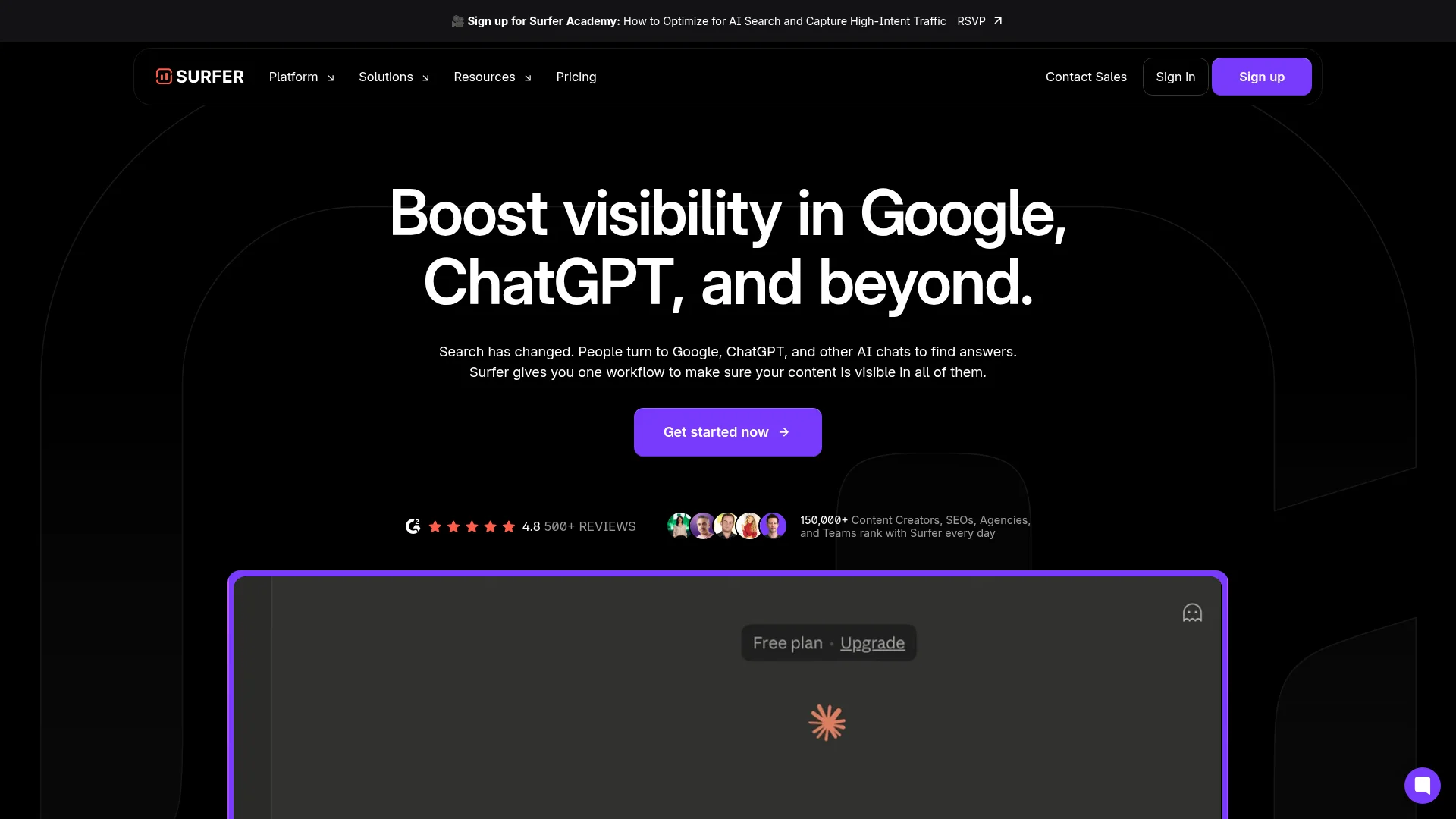
What it is: A mature SEO optimization platform with the industry-standard Content Score, SERP-based term recommendations, 1-click Internal Linking (Pro and up), and AI Tracker covering 5 AI platforms with Mention Gap and Sentiment Analysis.
Pricing: Discovery at $49/mo, Standard at $99/mo, Pro at $182/mo, Peace of Mind at $299/mo, Enterprise at $999-plus/mo. All billed yearly. Pricing from surferseo.com/pricing.
Key strengths:
- Content Score is the industry benchmark for SEO optimization scoring. StoryChief's built-in SEO scoring is useful but less granular.
- AI Tracker across 5 AI platforms (ChatGPT, Gemini, Perplexity, Claude, Copilot) with Mention Gap analysis helps teams spot where competitors are cited and they're not.
- 1-click Internal Linking on Pro and above automates what most tools leave manual.
- 4.8/5 on G2 from 540 reviews, 4.4/5 on Trustpilot from 213 reviews.
Key limitations:
- Document limits on lower tiers cap throughput for high-volume teams.
- Surfer AI output works as a first draft but requires humanization. It isn't a replacement for a dedicated AI writer.
- No multi-channel publishing, no approval workflow, no employee advocacy. Surfer is an SEO optimizer plus AI tracker, not a content ops platform.
- AI Tracker is a recent addition. The SEO scoring engine is what Surfer is known for.
Best for: Teams whose SEO optimization needs are deeper than StoryChief's built-in scoring, and who want AEO tracking as a second capability. A good StoryChief alternative if SEO scoring depth is your main gap and you have collaboration and publishing handled elsewhere.
8. ChatGPT
Best for Solo Operators at the Lowest Price
What it is: OpenAI's general-purpose conversational AI, used for content drafting, research, brainstorming, and custom workflow automation via Custom GPTs and Projects. Not a dedicated content platform, but the lowest-cost option for basic content work.
Pricing: Free (GPT-4o mini), Go at $8/mo, Plus at $20/mo (GPT-4o), Pro from $100/mo, Business at $20/user/mo. Pricing from chatgpt.com/pricing.
Key strengths:
- Cheapest option on this list. Plus at $20/mo is roughly a quarter of StoryChief Team Editorial single-seat cost.
- Strong raw LLM quality for drafting, research, and rewriting.
- Custom GPTs and Projects enable repeatable workflows and persistent context across sessions, partially compensating for the lack of built-in brand voice features.
- 4.7/5 on G2 from 2,013 reviews and 4.4/5 on Capterra from 339 reviews.
Key limitations:
- No workflow, no approval chains, no multi-channel publishing, no analytics, no employee advocacy. You are the pipeline.
- No SEO or GEO scoring built in. Even Frase at $39/mo outperforms a prompt-based approach with real SERP data.
- No content calendar, no task assignment, no multi-user collaboration. For a 3-plus person team, ChatGPT alone doesn't replace StoryChief's coordination surface.
- Facts can hallucinate. Every claim needs verification, which adds editorial overhead at volume.
Best for: Solo operators who want a DIY approach and are willing to invest time in prompt engineering and Custom GPT setup. A good StoryChief alternative if you don't need collaboration or multi-channel publishing as a single user. The tradeoff: you save money but take on every workflow stage StoryChief handles natively.
How to Choose the Right StoryChief Alternative
The right tool depends on where your real bottleneck sits.
You're stitching StoryChief + a separate AI writer + Ahrefs or Surfer + a LinkedIn and newsletter repurposing workflow, and the coordination takes longer than the writing.
→ DeepSmith.
Replaces the patchwork with one pipeline: ideation, 10-agent writing, internal linking, publishing, 14 distribution agents, AI Prompt Tracking at flat team pricing.
You publish 30+ articles a month, and your team is too small to add another editor or coordinator.
→ DeepSmith.
Autowrite runs scheduled production against Deep IQ brand context, and the Agent Library produces distribution assets without adding headcount or hitting per-article caps.
You're specifically an agency managing 10+ client brands, working on per-customer billing where per-user pricing never fit.
→ StoryChief (stay).
Agency Editorial at $93/mo per customer is purpose-built for this, and DeepSmith has no agency equivalent.
You already have publishing, approvals, and distribution handled, and your only remaining gap is on-brand AI writing across articles, ads, social, and email.
→ Jasper.
Jasper IQ voice training plus 100+ marketing agents handle that narrow job well.
You only need AI search visibility tracking across 8+ AI platforms as a standalone capability, nothing else.
→ Writesonic.
The AI Search Visibility module covers more AI engines than any other tool here.
Ready to Move Beyond a Multi-Channel Publisher?
DeepSmith handles the full content production pipeline, from ideation to published article to 14 distribution assets to AI visibility tracking, on team pricing that doesn't scale per seat. Pro starts at $80/mo, less than two seats of StoryChief Team Editorial.
→ Start your free trial at deepsmith.ai
7-day free trial. See how it compares in your first session.