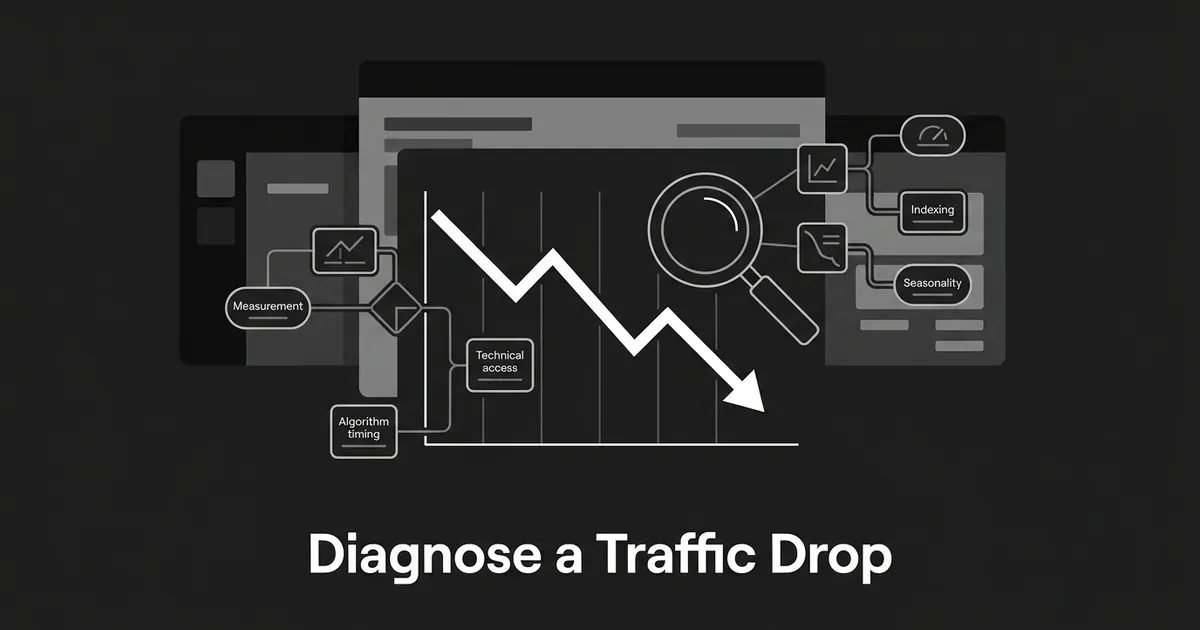
You open Google Analytics and organic sessions have fallen off a cliff. Before you touch a single page or panic in a Slack thread, there's a question that comes before "why did we lose rankings," and it's the tracking bug vs traffic drop question: is Google actually sending you fewer visitors, or did something in your measurement setup just stop counting them correctly. This piece walks you through the checks that rule out a fake traffic drop, one cause at a time, so you know whether you're looking at a real SEO problem or an analytics misconfiguration traffic drop before you spend a week chasing the wrong fix.
The short version: Search Console shows what happened in Google Search before someone clicked. Google Analytics shows what happened on your site after they landed. They're never going to match exactly, and Google says as much. What matters is whether the two tell the same story. If GA4 organic sessions fall while Search Console clicks and impressions stay flat, that's a strong sign the problem lives in your tracking, not in Search. If both fall together, you're probably looking at a real decline, and it's time to move to the broader SEO diagnostic work rather than staying in analytics. Everything below is built to help you verify traffic drop is real before you change anything about your content or your SEO.
Work through these in order. Each one tells you what it looks like, how to confirm it in a specific tool, and what to do about it.
The comparison window is stale, not empty
The first thing to rule out: you might be looking at a graph that hasn't finished filling in yet. GA4 processing can take 24 to 48 hours to fully settle, and standard intraday data usually takes 2 to 6 hours before it's reliable. Realtime is the freshest view you have, but it only covers a narrow set of dimensions and metrics, so it's not a substitute for a finished daily report. Search Console works on its own clock too. A dotted line on the chart means the data for that day is still preliminary, and the most recent day or two can keep changing after you first look at it.
How to confirm it. In GA4, check the data freshness status before you read anything into the newest days. In Search Console, check the report's last-updated date and treat any dotted segment as unfinished. Compare full days only, and remember that Search Console mostly reports in Pacific Time while GA4 uses whatever time zone you set for the property, so a day boundary in one tool can land somewhere in the middle of a day in the other.
The fix. Don't touch anything yet. Wait for a complete reporting window, align your date ranges and time zones, and compare the same weekday pattern instead of an arbitrary slice. If the drop is still there once the data has settled and both tools show it, keep working down this list.
The site is sending data to the wrong property or stream
A redesign, a CMS migration, a tag manager publish, or a domain change can quietly point your tracking at the wrong destination. This is one of the more disruptive versions of a ga4 tracking issue organic sites run into, because it can silently redirect all your data at once instead of just a page or two. Sometimes it's obvious because a brand new GA4 property starts showing traffic while your old one appears to lose it. Other times only some pages are affected until you check a specific template.
How to confirm it. Open Google Tag Assistant on an affected URL and on one that still looks healthy. Review every tag it detects and confirm the one you expect is actually present and connected to the right measurement ID. Check the Summary tab for whether it sent the events you'd expect from a normal page view. If nothing shows up, the tag either isn't installed or isn't pointed at the destination you think it is. Test the live production site, not staging, and check a handful of different templates rather than just the homepage.
The fix. Put the correct tag and measurement ID back on every affected template, publish the change, and retest with Tag Assistant. Confirm with GA4 Realtime and DebugView that events are now arriving. A fixed tag restores collection going forward. It does not bring back the history you missed while it was broken, so don't read a sudden recovery as proof the old numbers were wrong.
The tag is missing or blocked on some pages
This narrower ga4 tracking issue organic sites hit only touches one part of the site rather than the whole property. Instead of the whole site losing data, it's one template, one directory, one language version, or one device type. Search Console keeps recording clicks to those pages because Google is still sending people there. GA4 just isn't counting them once they land.
How to confirm it. Pick one URL from the affected group and one from a group that still looks normal, and run both through Tag Assistant. Confirm the tag fires on both and sends the events you expect. If the decline is concentrated on mobile or desktop, test both. Check for redirects too, since Search Console attributes a click to the canonical URL while Analytics measures whatever URL the tag actually loaded on. Then look at your deployment and tag manager history around the first day the drop started, because that timestamp usually points straight at the change that caused it.
The fix. Repair the shared template, the trigger, or whatever consent condition is blocking the tag on that group of pages. Retest several affected URLs, not just one, then give it a few complete days to confirm the fix held before you draw conclusions from the new numbers.
A consent change is blocking measurement
If you run a cookie banner or a consent management platform, a change there can cut off analytics collection without touching Google Search at all. The pattern tends to be uneven: heavier in one region, one device type, or among first-time visitors, because that's where consent behavior differs most.
How to confirm it. In Tag Assistant, look at the earliest consent event in a fresh session and check the initial state of ad_storage, ad_personalization, ad_user_data, and analytics_storage. Interact with the banner the way a real visitor would, then check whether the update event actually changed those values the way it should. Open the Tags tab and confirm each Google tag behaved the way the consent state says it should. Repeat this in whichever region or device category shows the biggest drop, because a tag that behaves correctly in one consent state can still misbehave in another.
The fix. Correct whatever's wrong in the CMP or the consent mode setup: default values set too late, an update event that never fires, or regional rules that don't match what the banner is actually showing. Test the granted state, the denied state, and any region-specific path separately, because passing one doesn't mean the others pass too.
The traffic didn't disappear, it moved to another channel
Sometimes organic sessions fall and total sessions barely move, because the visits are still landing, just under a different label. GA4 classifies a session as Organic Search only when the source matches a known search engine and the medium is exactly "organic." Change a campaign parameter, a redirect, or how a referral gets tagged, and those same visitors can land in Direct, Referral, Unassigned, or even Paid Search instead.
How to confirm it. Compare the period before and after the drop across session default channel group, session source, session medium, and landing page. If Organic Search fell by roughly the amount that Direct or Referral rose, that's your answer. Check your UTM setup, redirect handling, and anything custom you've done to the channel grouping rules, since that's usually where the reclassification is coming from.
The fix. Restore consistent source and medium values and fix whatever redirect or tagging change broke the classification. If the shift was deliberate, a real update to how you group channels, document the change and don't compare a historical report against the new definition as if nothing changed. If some of what moved is actually AI referral traffic getting folded into Direct or Referral, isolating AI search traffic in GA4 takes its own segment setup, separate from the organic channel work above.
A GA4 filter is quietly excluding real visitors
GA4 lets you exclude traffic by IP address or range, and a property can carry up to ten of these filters. If someone recently activated one, or an office or VPN network changed its IP range, real visitors can start getting filtered out without anyone noticing until the traffic chart moves.
How to confirm it. Check Admin for active data filters and note each one's condition, scope, and state. A filter set to Active is already changing your incoming data. One set to Testing lets you see what it would exclude without actually removing anything yet, which is the safer way to check a new one before it goes live. Compare the date the drop started against the date the filter was created or switched on, keeping in mind a filter can take 24 to 36 hours to fully apply.
The fix. Correct the IP range, the traffic type condition, or the filter's state. Test any new exclusion before activating it. This one matters more than most because an active filter permanently discards the matching data. It isn't sitting somewhere recoverable in Analytics or BigQuery, so if you only need to hide something in a report rather than throw it away, use a report-level filter instead.
You're reading Search Console at the wrong scope
Search Console has its own ways of quietly producing a number that looks worse than reality. The chart is aggregated by property, but a table broken out by page uses page-level aggregation, so totals can legitimately disagree without either view being broken. Low-volume queries get anonymized out of the query table to protect searcher privacy, so summing visible rows will usually come up short of the chart total. The interface only exports 1,000 rows at a time. And Search Console attributes performance to the canonical URL of a result, which can differ from the URL your Analytics tag actually measured.
How to confirm it. Double check which property you're viewing (domain property versus URL-prefix, the right protocol and host) especially if you've recently migrated anything. Break the numbers down by page, date, device, and country instead of reading the top-level chart alone. Check whether the drop only shows up in one search type, like Image or Video, or whether it includes non-HTML files such as PDFs that never had an Analytics tag on them to begin with.
The fix. Align the comparison to the same scope on both sides: same search type, same asset type, same property. Never reconstruct a total by adding up a truncated or anonymized table and treat that as your real number. If a whole cluster of pages looks like it vanished from Search rather than just from GA4, check whether they have no internal link pointing to them at all, since a page that isolated can quietly fall out of Google's crawl queue over time.
Thresholds and reporting settings are distorting the number
Two smaller GA4 quirks are worth ruling out before you trust a number completely. Data thresholds are privacy protections that can withhold data from a report that includes demographic or audience data, especially over a narrow date range with a small sample. This isn't something you can turn off, but a broader date range or removing demographic dimensions usually clears it. Separately, GA4's reporting identity setting changes how the platform deduplicates users across devices, which can make a user count look discontinuous if the setting changed between the periods you're comparing. Google is explicit that changing reporting identity doesn't touch collection or the underlying data, only how it's displayed.
How to confirm it. Watch for a data-quality indicator on the report you're reading. Widen the date range and strip out demographic or audience dimensions to see if the gap closes. Check whether the reporting identity setting is the same for both periods you're comparing.
The fix. Don't read a display setting as proof that traffic disappeared. Re-run the comparison with a broader window and consistent settings, and document any change to reporting identity so future comparisons account for it.
When none of these match, treat the decline as real
If you've worked through the list above and the mismatch still doesn't resolve, or Search Console itself is falling alongside GA4, stop looking for a bug and start preserving evidence. Export the affected GA4 and Search Console views with your exact date ranges and filters. Capture your current tag, consent, and filter configuration as a record of what's actually deployed right now. Note the first date and hour the decline appears in your release logs, your tag manager history, or your CMP settings, since that timestamp is often the fastest way to rule things in or out. It's also worth a quick check in Search Console's URL Inspection tool on a few affected pages, since a page that's dropped from the index or isn't crawlable points to something other than a measurement problem.
If nothing above explains the gap, you're probably past an analytics misconfiguration traffic drop and looking at something real in Search itself. Once you've confirmed the pattern is real, this is where the analytics side of the work ends. A genuine drop in Search Console clicks and impressions is a Search visibility problem, and diagnosing it means looking at rankings, content quality, and technical SEO, which is its own investigation and outside what this checklist covers. It's worth running a wider content audit that surfaces decaying pages elsewhere on the site too, since a real decline rarely affects only the one page you happened to notice first. Learning to spot content decay early makes the next drop far less of a surprise.

The escalation path
Working through the branches above in order is exactly how you settle a tracking bug vs traffic drop question without guessing, and the checklist exists to verify traffic drop is real before you touch anything on the SEO side. It's the same structured approach that helps when you need to diagnose why a metric moved anywhere else in marketing, not just here. The cheap checks rule out far more cases than people expect, and they take minutes rather than days. If GA4 is down while Search Console holds steady, you're very likely looking at a measurement or reporting issue, and the fix lives in your tag manager, your CMP, or your GA4 configuration. If both tools agree the numbers have dropped, treat that agreement as real evidence of a Search-side change and move into a proper SEO diagnosis rather than continuing to poke at analytics settings. If the signals still conflict, bring in whoever manages your implementation rather than guessing. Once the decline is confirmed, check which SEO fundamentals still actually matter for how you show up, since not every old habit carries the same weight anymore. From there, the next decision is usually whether to refresh, rewrite, prune, or redirect the page, not whether to panic about rankings. Before you decide, it's worth checking whether your internal linking is actually working the way you assume it is.
Once you've confirmed a decline is real, the value of catching it early only grows. Teams that track their AI and organic search visibility on an ongoing basis, rather than only when a chart looks alarming, tend to spot a genuine drop within days instead of weeks. DeepSmith's AI Search Visibility tracking works this way: it checks your brand's presence on a schedule so a real change in visibility shows up as a trend, not a surprise months later. It won't tell you whether your GA4 tag is broken. What it does is make sure that once your tracking is trustworthy again, you're watching the number that matters.