You have probably seen the claim somewhere: Google uses 200 ranking factors, and if you just knew what they were, you could check every box and watch your pages climb. It shows up in SEO courses, in agency pitch decks, and in blog posts with a checklist graphic that promises to reveal "all 200" at once.
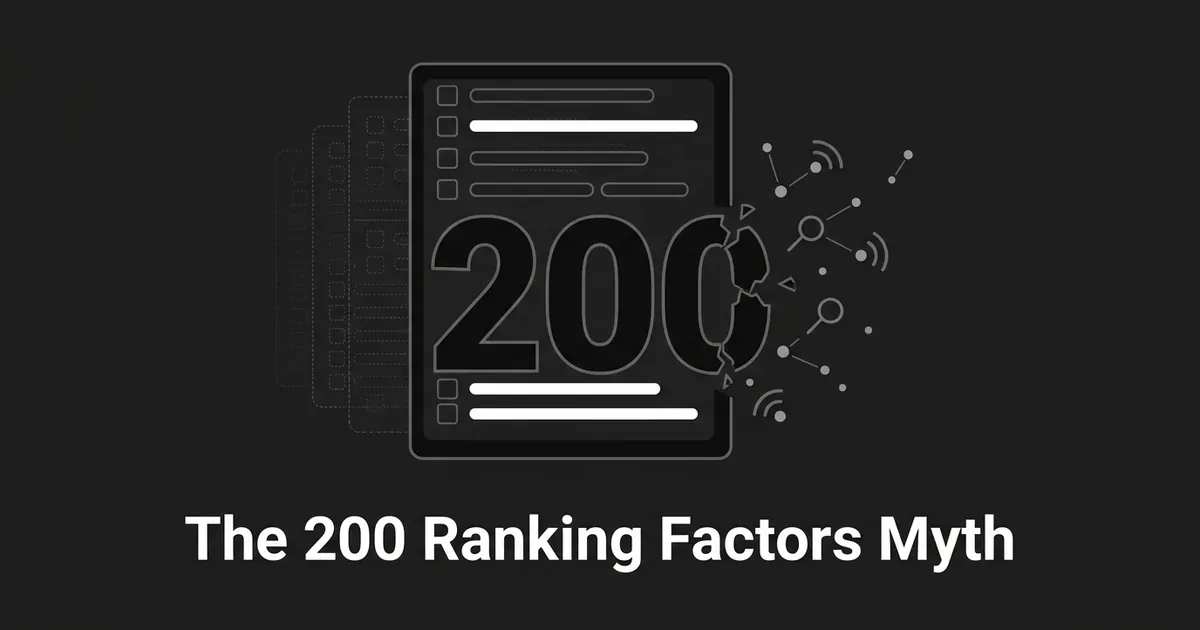
Here is the short version. Google really did say, publicly, that it used over 200 ranking signals. That part is not folklore. What is folklore is the idea that Google ever published a 200-item list, or that the number still describes anything exact today. Google's own spokespeople later said the figure had become misleading, and they stopped repeating it. Verdict: mixed. The number has a real origin, but it was never a checklist, and it is not a reliable description of how Google ranks pages now.
This piece is about where the "200 ranking factors" number came from and whether you should still trust it, not about grading individual factors one by one. A separate piece on confirmed Google ranking factors covers what is actually proven versus speculation, factor by factor.
The "200 ranking factors" claim is one of the longer-running SEO myths, and it is a useful case study for how SEO myths get built in general. A real, dated statement from Google gets repeated, simplified, and eventually treated as a static fact long after the context around it has changed. Walking through exactly what happened here is a good way to see that pattern at work, not just to settle this one number.
Where the "200 ranking factors" number actually came from
The number did not come from a leak or a guess. It came from Google itself, at a public event, years ago.
On May 10, 2006, at Google Press Day, a Google engineer named Alan Eustace gave a talk called "A Search Technology Overview." According to a contemporaneous account of that event, Eustace said Google used "over 200 signals" for ranking. That is the earliest traceable moment this research found where the number entered public conversation. Note the wording: over 200 signals, not exactly 200 factors, and not a published inventory anyone could check off.
That distinction gets lost almost immediately once a number like this starts traveling through SEO blogs and conference slides. "Signals" becomes "factors," "over 200" becomes "200," and a loose description of a complex system turns into something that sounds like a checklist. Once it reads like a checklist, people start asking which 200 things they need to do, which is a question the original statement was never built to answer.
If you are wondering how many ranking factors does Google use in some exact, countable sense, the honest answer is that nobody outside Google has ever had a verified list to count from. SEO writers have assembled their own lists of 200 over the years, built from testing, observation, and patent reading, but those are industry compilations, not a document Google published and said "here it is."
The evidence that the number was real, at least as a statement
Skip past the folklore layer and there is a real paper trail of Google saying this out loud, more than once, over almost a decade.
Eustace's 2006 comment was not a one-off. In September 2010, at an event called Google Zeitgeist, reporters asked then-CEO Eric Schmidt why Google would not simply list its 200 ranking factors. According to a report on that exchange, Schmidt said Google changes the factors regularly and treated the full list as a business secret. He did not deny the number. He explained why Google was not going to hand it over.
Five years later, the number was still part of Google's public language. In May 2015, Google's John Mueller addressed a claim floating around that Google used 500 signals. According to a report on his comment, Mueller said he did not think he had ever said 500, and that Google tended to stick with its "over 200 signals" line. The same report noted something worth sitting with: Google had added, removed, and modified signals over the years, and it can be genuinely hard to say what counts as one distinct signal versus a variation of another.
So for most of a decade, "over 200" was the number Google itself kept repeating when asked. A related claim, Google's top 3 ranking factors, followed almost the exact same arc a few years later: a real quote, stretched into something more definitive than the people who said it intended. That is the part of the Google ranking factors list myth that is not actually a myth. It is a documented, dated, repeated public statement.
Why Google later said the number was misleading
The story does not end with Google confirming the number forever. In September 2021, Mueller was asked a natural follow-up: of the 200 ranking signals, which ones matter most? He declined to rank them, and according to a report on that exchange, he said Google had moved away from citing the over-200 figure because it was misleading.
His reasoning matters more than the number itself. Mueller said the figure can make people picture something like a spreadsheet: 200 rows, each one a separate, isolated signal that Google could sort by importance and hand over as a priority list. Coverage of the comment framed this as Google finally admitting the shorthand had outlived its usefulness. Many parts of ranking cannot be cleanly separated into standalone, countable items the way a spreadsheet implies. A page's perceived quality, for instance, is not one signal sitting next to 199 others. The same applies to narrower questions like whether click-through rate acts as a ranking factor on its own: isolating one piece of a blended system tends to overstate what that one piece can do by itself. It is closer to an output of many overlapping judgments working together.
That is an important thing to hold onto: Mueller did not say Google stopped using ranking signals, and he did not say the number was proven false. He said the number, as a public figure, was doing more harm than good because of what people assumed it meant. That is a statement about communication, not a retraction of the underlying system.
How a real statement turned into a checklist industry
It helps to see how a dated quote travels once it leaves the room it was said in. Eustace said "over 200 signals" at one event in 2006. SEO writers and course creators picked up that phrase over the following years and needed something concrete to sell, teach, or rank for themselves, and a numbered checklist is far easier to package than "a complex, changing system with no fixed count." So the number got detached from its original context and reattached to a new kind of content: the "200 ranking factors" listicle, often illustrated with an infographic that implies each item is independently confirmed.
Some items on those lists are genuinely well supported, things like page speed, mobile usability, and the presence of relevant content. Others are closer to educated guesses dressed up with the authority of a round number, and a few, like treating keyword density as a target to hit, have been directly contradicted by Google and still appear on lists today. The problem is not that someone compiled observations into a list. The problem is presenting that compiled list as if Google itself had published and verified all 200 entries, when the only thing Google ever confirmed was a loose, changing figure describing signals, not a numbered inventory anyone could audit line by line.
This is also why the number survives long after the original context faded. Once a figure gets repeated often enough, in enough confident-sounding articles, it starts to feel settled even without anyone checking the original source. That is exactly the mechanism behind most durable SEO myths: not a single fabrication, but a real fact stretched past what it was ever meant to support.
What Google's current documentation actually says
If the "over 200" line has been retired, the next question is obvious: does Google now say how many factors or signals it uses?
As of this research, no. Google's Search Central guide to its ranking systems, last meaningfully updated in December 2025, describes a set of named, notable systems that look at many factors and signals when ranking pages. The guide is explicit that it covers some of the systems involved, not a complete inventory of every mechanism at work. Google's own "How Search Works" page makes a related point: the weight given to any one factor is not fixed, it shifts depending on the nature of the query being answered.
Neither page gives you a number to count against, neither replaces the retired 200 figure with a new one, and neither describes anything that would let you check off items from an SEO checklist. It is also worth separating this from manual actions and reconsideration requests, which are a different mechanism entirely: a human reviewer's decision, not a scored signal in the ranking systems described above. What the ranking guides describe instead is a system where importance is contextual and where even Google is not framing this as a fixed, countable list anymore.
The honest verdict, and what it is not
Pulling the timeline together: Google said "over 200 signals" from at least 2006 through 2015, defended keeping the specifics private in 2010, and said in 2021 that it had stepped back from citing the number because it misrepresented how ranking actually works. Current documentation describes many factors and signals without assigning a total.
That supports a mixed verdict, not a debunking and not a confirmation. It is fair to say Google really did use that language for years. It is not fair to say Google has an exact, current, countable list of 200 factors, and it is not fair to say an SEO blog's list of 200 items is Google's own inventory just because the number matches. Google's guidance on 301 redirects followed a similar pattern of an early, cautious statement getting treated as permanent long after Google's own position had moved on. The absence of a current total from Google does not prove the real number is higher or lower than 200. It means nobody outside Google has a confirmed figure to report.
What should change, practically, is how you treat any content or course that promises "all 200 Google ranking factors" as a definitive, checkable list. Treat it as someone's organized compilation of patterns, patents, and observed correlations, which can still be useful, rather than as a document Google handed over and verified.

How this changes what you should actually do
Chasing a specific count is the wrong use of your time, because the count was never meant to be chased. What is worth your time is the small set of things Google has actually confirmed matters, applied consistently: content that answers the query well, pages that are technically accessible to crawl and reasonably fast, and a site that earns trust signals naturally rather than through tricks aimed at one supposed "factor."
A practical way to use any "200 factors" list you come across is to treat it as a sorting exercise rather than a scoreboard. Separate the items you can verify against Google's own documentation, things like mobile-friendliness, page experience, and structured data, from the items that are really just correlations someone observed and never confirmed. Work on the first group with confidence. Treat the second group as worth monitoring, not worth rebuilding your whole content plan around. The same sorting applies to a question like whether backlinks still matter: the underlying mechanism is real and confirmed, but the specific numbers people attach to it usually are not. That one habit does more for your actual rankings than memorizing which number a list assigns to each item.
It is also worth remembering that Google itself has moved the goalposts more than once. A factor that mattered under one algorithm update can shrink in importance under the next one, and a list compiled in 2018 is already describing a system that no longer exists in that exact form. Treating any ranking factors list, even a careful one, as a permanent reference rather than a snapshot is its own quiet way of falling for the same myth this piece is untangling.
This is also where the line between SEO and newer AI-driven search starts to matter. A ranking factor checklist, even a perfectly accurate one, was built for a world where the main outcome was a blue link in a results page. AI answer engines like ChatGPT, Perplexity, and Google's own AI Overviews are not just ranking pages, they are deciding which sources to cite and quote directly, and that decision runs on a different, overlapping set of signals around clarity, structure, and demonstrated expertise. DeepSmith tracks how often your brand actually gets mentioned and cited across those AI engines, and pairs that visibility data with a writing pipeline that builds citation-ready structure into every article as it is produced, rather than asking you to retrofit a 200-item checklist after the fact.
What would change this verdict
This verdict would change if Google published a current, dated statement that defined exactly what counts as one ranking signal and gave a present-day total. It would also take a Google-authored list, explicitly described as complete and dated, to support the claim that any particular 200-item checklist is the real inventory. Neither exists in the sources reviewed for this piece, and nothing found here suggests one is coming.