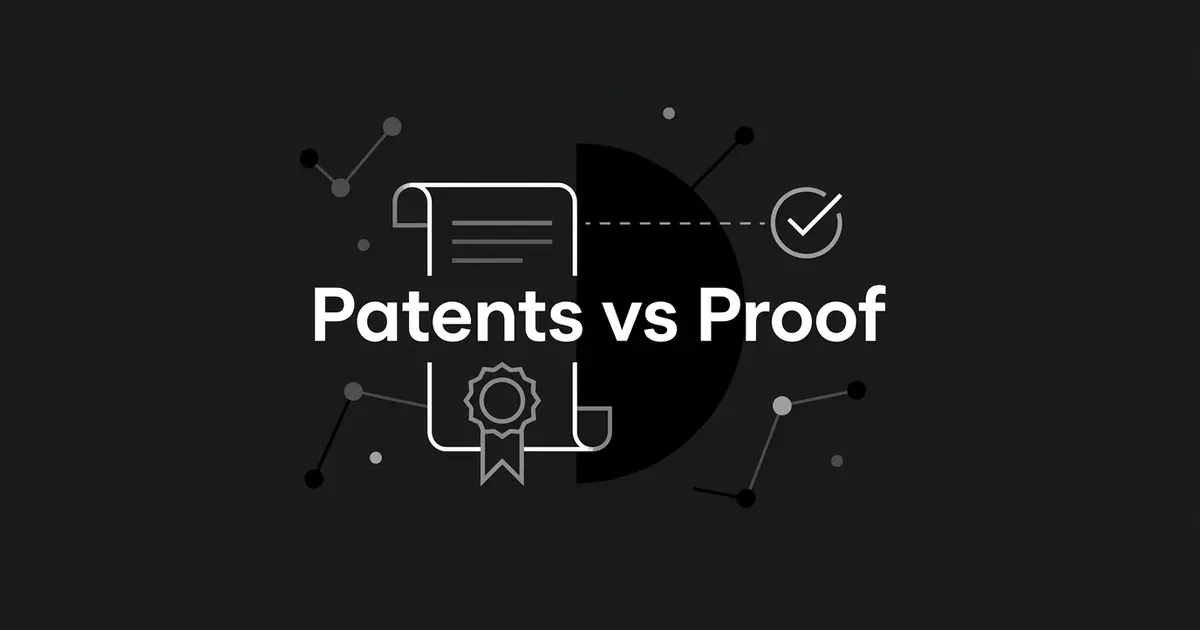
Someone on your team found a Google patent and now there is a slide deck about it. Before you approve the project, here is the short answer on Google patents SEO claims: a patent does not prove Google uses the thing it describes in live rankings. This comes up often enough that it is worth a plain answer you can point people to the next time a Google patents SEO claim lands in your inbox. A patent is a legal filing, not a launch announcement. On the evidence we have, the blanket claim that a patent alone proves a deployed ranking factor is debunked. A specific patent based ranking factors claim can still be weak, mixed, or in rare cases confirmed, but only when something beyond the patent backs it up.
Google has said this plainly. In a Search Central hangout recorded on February 5, 2021, John Mueller was asked whether Google could understand what is happening inside an image. He answered, "But just because it's patented from Google, and maybe even from someone who works on search, doesn't mean that we actually use it in search." He added that "there are lots of things that are patented that are out there that are theoretically possible." Matt G. Southern reported this in Search Engine Journal on February 8, 2021, under the headline "Google: Patents Are Not Always Used in Search." That is the anchor for everything below.
What a Google patent actually proves
A patent is a legal right, and the right it grants is narrower than most people assume. The USPTO explains it this way: "What is granted is not the right to make, use, offer for sale, sell or import the invention, but the right to stop others from doing so." In plain terms, a patent lets Google (or anyone else) stop a competitor from copying an invention. It does not say whether Google itself ever built the thing or switched it on inside Search.
A few distinctions matter here, and good SEO patent analysis keeps them straight:
- A patent application means someone filed for protection. It says nothing about whether the patent was granted or whether Search uses the idea.
- A patent publication means the filing became public. Most applications publish about 18 months after they were filed. That is a legal publication date, not the date anything launched.
- A granted patent means the rights were approved. It still does not mean Google implemented every embodiment described, or that it runs in organic ranking today.
- A patent description or example is a disclosed technical approach. It is not a production spec for the search engine Google runs right now.
- A Google statement confirming use is the only thing on this list that tells you Google actually uses something, and even that comes with limits, which we will get to.
The USPTO also requires applicants to separate "working examples," meaning experiments that were actually run, from prophetic examples, meaning predicted results from experiments that were not run. Applicants have to label which is which, and results can't be written up as real unless they really happened. That does not mean every patent is speculation dressed up as science. Patents still have to explain an invention clearly enough that someone skilled in the field could build it. It means you cannot treat an example in a filing as proof that Google tested it, let alone shipped it.
Why patents still have some value
None of this means patents are worthless to read. A patent can describe a technically specific approach to a real problem, and that can sharpen a hypothesis that would otherwise stay vague. Patents can also give you historical context for a system Google later confirms. The clearest example of that is PageRank, which we will come back to in a moment.
What a patent cannot do is turn a hypothesis into a fact just by existing. If a patent describes a plausible way to rank pages, you have a plausible mechanism, not a confirmed one. This is the same gap you see in long-running SEO debates about whether dwell time actually affects rankings. It also shows up in arguments about whether keyword density is a ranking factor, since a plausible idea and a documented one are not the same thing. Treat a patent the way you would treat a smart guess from a credible person: worth writing down, not worth building a roadmap around.
Why a patent is not a launch announcement
Here is the part that tends to get skipped when someone pitches a patent based ranking factors theory. Google runs a separate process to decide what actually ships in Search, and that process has nothing to do with the patent office.
Google's own page on testing describes it directly: proposed changes go through evaluation before anyone decides whether to implement them. Live traffic experiments then expose a change to a small slice of real users, usually starting around 0.1% of traffic, with a control group for comparison. Engineers, search analysts, and other reviewers look at the results before anything moves toward a wider launch. Google states the standard plainly: "If we can't show that a change actually makes things better for people, we don't launch it." In 2023, Google reported 4,781 search launches, 16,871 live traffic experiments, and 719,326 search quality tests, including 124,942 side-by-side experiments. Those numbers describe the scale of Google's own evaluation pipeline for that year. They are not a count of ranking factors and they are not a patent deployment rate, so resist the urge to do math with them.
The point is simple. Filing a patent and shipping a ranking change are two different events, run by two different parts of the company, on two different timelines. A patent publishing 18 months after filing tells you when the paperwork became public. It tells you nothing about whether, or when, the described idea ever reached a live experiment, let alone a full launch. That same discipline matters after the fact too: when traffic moves, the right first step is to confirm what changed after a Google update rather than reach for a patent as the explanation. It also means learning to diagnose an organic traffic drop with your own data instead of guessing at a cause.
What Google has actually confirmed
This is the comparison that makes the whole evidence question concrete. Google's own documentation, A Guide to Google Search Ranking Systems, says: "Among these is PageRank, one of our core ranking systems used when Google first launched." It adds that "how PageRank works has evolved a lot since then, and it continues to be part of our core ranking systems," and it links out to the original PageRank patent and research paper.
That original patent, Method for node ranking in a linked database (US6285999B1), was filed by Lawrence Page on January 9, 1998, and published on September 4, 2001. PageRank is useful here specifically because Google does not rest the claim on the patent alone. Google separately says, in its own words, that the system is still part of how it ranks pages. That is the difference between an inferred mechanism and a confirmed one. The safe way to describe it is that PageRank is a patent linked system Google independently confirms it still uses. It would be unsafe to say the original patent shows exactly how Google ranks pages today, because Google itself says the system has changed since 1998.
Confirmation does not have to involve a patent at all. In an April 19, 2023 Search Central post called "The role of page experience in creating helpful content", Danny Sullivan explained that Google's page experience update added Core Web Vitals as a new signal considered by its core ranking systems, alongside signals it already weighed, such as HTTPS. That is a direct Google statement about use, with no patent involved anywhere in it. The same post was careful to add limits: there is no single page experience signal, the update was not a separate ranking system on its own, and good Core Web Vitals numbers do not guarantee good rankings. Google's current documentation on Core Web Vitals, last updated December 10, 2025, still recommends good scores and says they line up with what its core ranking systems try to reward, while making the same point that a good score is not a ranking guarantee.
The same gap between a plausible idea and a documented one shows up elsewhere in SEO. Whether author bios and E-E-A-T signals actually move rankings gets argued the same way patents do. A good answer still depends on sorting out what E-E-A-T actually means for AI search before you treat a theory as a fact.
Even a confirmed signal, in other words, is a bounded statement. Google telling you it uses something does not hand you a fixed weight, a formula, or a promise about outcomes. It just moves the claim from "possible" to "documented," which is a real and useful move, just not an unlimited one.
The verdict for your SEO priorities
Here is where the different kinds of evidence sit next to each other, since does Google use its patents is really four separate questions wearing one trench coat. Any time a new patent surfaces in your feed, run it through this same SEO patent analysis before it ends up in a brief.
| Claim | Where it lands | Why |
|---|---|---|
| A Google patent alone proves a live ranking factor | Debunked as a blanket claim | Mueller directly rejected this inference in February 2021 |
| Google never uses any patented search technology | Incorrect | Google's own ranking systems guide confirms PageRank is still core |
| A patent can point to a technically relevant idea | Supported | Patents disclose real technical approaches worth investigating |
| A patent's grant or publication date is a ranking launch date | Unsupported | Publication and launch are separate events run by separate processes |
| Google confirming a system validates every detail of its original patent today | Unsupported | Google says PageRank has evolved since it launched |
| A confirmed signal guarantees better rankings | Unsupported | Google says good Core Web Vitals scores do not guarantee good rankings |
A patent based hypothesis, a correlation, and a confirmed Google statement are not interchangeable kinds of evidence, even when they get talked about as if they were. A patent based hypothesis says a disclosed technique could explain something you are seeing. A correlation says two things tend to show up together in a sample. A confirmed statement is Google telling you, in its own words, that it uses something, within whatever scope it names. If pages with some trait X tend to rank well, that alone does not tell you Google measures X directly, uses a patented formula built around X, or weighs X at all. It just tells you X and good rankings showed up together in whatever you looked at.
Grading evidence this way, confirmed, weak, or debunked, is not unique to patents. The same method is how you would settle whether schema markup actually improves AI citations, or decide which AI visibility metrics actually matter before you report them upward.
There are real unknowns here, and it is worth saying so plainly instead of papering over them. Nobody outside Google knows what share of its patents have ever run in Search, or are running now. Nobody knows which specific details of the 1998 PageRank patent still describe the system as it works today. Nobody has a reliable ranking lift figure for implementing a recommendation that comes from a patent and nothing else. None of that means every patent based theory is false. It means the evidence available does not support calling any specific one confirmed, so don't call it that in a client deck or a board update.
Unconfirmed is not the same thing as false, and that distinction matters when you are deciding what to fund. A technique can be real and simply undocumented. It can also be speculative and wrong. The patent alone cannot tell you which one you are looking at. What changes a specific claim's status is an explicit Google statement connecting the method to a deployed system, read with attention to its date and its stated scope, since an old confirmation does not guarantee every detail still holds and a new patent publishing tomorrow would not close that gap by itself.
So treat a patent only claim as a hypothesis worth a line in your research notes, not as a reason to greenlight an engineering project. Give real weight to a system or signal Google has separately and explicitly confirmed, while respecting the limits Google itself attaches to that confirmation. Keep your own results separate from your theory about the mechanics behind them: a page performing well is a fact you can measure, and it does not require you to know, or claim to know, the exact internal process that produced it. And when you write the brief or report to leadership, keep "this is a possible explanation" and "Google has confirmed this" as two different sentences, because once they blur together nobody downstream can tell which one they are building on.