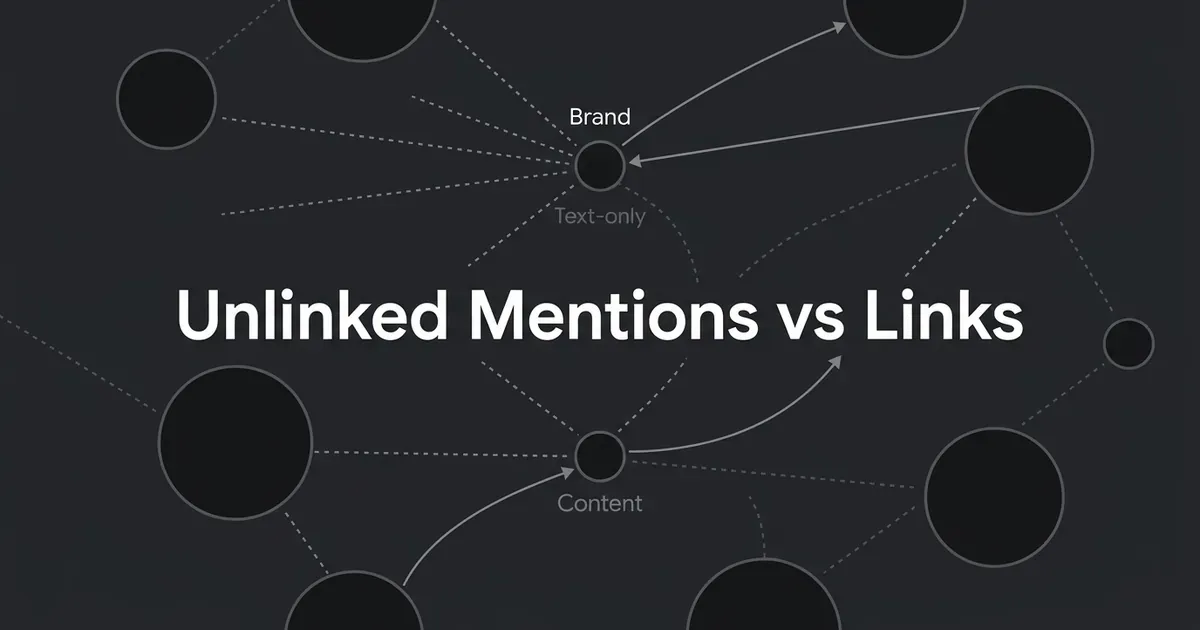
If a blog post names your brand but never links to you, does Google treat that the same way it treats a real backlink? Short answer: no, not based on anything Google has actually confirmed. The evidence here is weak for a direct ranking benefit, and nothing in the record establishes unlinked brand mentions as link-equivalent. Google's own John Mueller has said the opposite directly. A mention can still help people recognize your brand later, which matters, but that is a different thing from a ranking signal, and the two get mixed up constantly in SEO writing about unlinked brand mentions SEO teams chase.
This matters because PR and content teams routinely get asked to defend "unlinked mention" campaigns as a ranking play, often under the banner of implied links Google is supposedly counting behind the scenes. Before you make that case to anyone, it helps to know exactly what has been said, what has been tested, and what is still just a guess dressed up as a mechanism.
Where this idea came from
The phrase that keeps this debate alive is "co-citation," sometimes "co-occurrence." Rand Fishkin raised it back in a November 2012 Moz Whiteboard Friday. There, he predicted that anchor text might weaken over time and that Google could start leaning more on brand and topic terms appearing near each other in text, link or no link. That was a prediction about where search might be headed, not a result from an experiment Google ran or confirmed. The transcript itself slides between "co-citation" and "co-occurrence," which is part of why the terms get used so loosely today.
That looseness matters for the co-citation ranking factor keyword specifically. When someone searches that phrase, they're usually hoping for confirmation that mentioning a brand without a link carries ranking weight the way a real link does. It does not carry that confirmation. The term describes a hypothesis from over a decade ago, repeated so often in industry content that it started sounding settled. It never was.
Before going further, it helps to pin down the vocabulary, because this is where most of the confusion lives:
- Hyperlink (express link): a clickable link from one page to another. Google's own documentation treats this as a distinct, named thing.
- Unlinked mention: your brand's name written on a page with no link attached. This is the claim under review.
- Branded or navigational search query: someone typing your brand name into Google's search box. This is a query, not text on someone else's page, and it gets conflated with mentions far too often.
- Co-occurrence: a brand or related phrase showing up near another term in text, link or no link. An association like that is not proof that Google is counting it as a ranking input.
This review stays on classic organic ranking. How an unlinked mention might feed AI engine citations is a separate mechanism, worth understanding on its own terms, and not something this piece settles either way.
What actually gave this idea legitimacy: a misread patent
A good share of the "implied links are real" argument traces back to one Google patent, US8682892B1, "Ranking search results," filed in September 2012 and granted in March 2014. It lapsed in 2022 for an unpaid maintenance fee, which on its own says nothing about whether Google ever used the method described inside it. Patents describe inventions a company might use, not confirmed production features.
Here's the part that gets skipped over constantly: the patent's "implied link" concept is about search queries, not webpage text. It defines a reference query as a search someone submits that the system classifies as referring to a specific resource, including branded and navigational searches. That is a person typing your brand into the search bar, not a journalist writing your name in an article with no link attached. Search Engine Journal's analysis of the patent makes this split explicit: the implied links described there live inside search behavior, not inside other people's unlinked web copy.
So the chain that gets repeated in SEO guides, the patent mentions implied links Google supposedly uses, implied links sound like unlinked mentions, therefore unlinked mentions are implied links, breaks at the second step. The patent never makes that leap. Neither does anything else in the record.
What Google has actually said, directly
This is the part that should settle more of the debate than it does. In a Google Search Office Hours session on December 17, 2021, John Mueller was asked point blank whether brand mentions without links help rankings. His answer: "From my point of view, I don't think we use those at all for things like PageRank or those link graph related things." He added that mentions can make people aware of a brand and might have some indirect effect over time, but he was explicit that it is not a link-graph signal. He also noted that judging the sentiment or intent behind a mention is genuinely hard: the same brand name could appear in a glowing recommendation or an angry complaint, and a spam site can spin content however it wants.
He said essentially the same thing again in an exchange reported in April 2022: "if there's no link to your pages then it's not really a link there." Not "kind of like a link." Not an implied one. Not one.
Two separate statements, roughly four months apart, from the person at Google most directly asked about this exact question. That's about as close to a direct answer as this topic gets, and it points away from treating mentions as backlinks. It leaves room for something softer: people noticing your brand, later searching for it, eventually clicking through, maybe even a different publisher deciding to link you after reading the mention. None of those downstream effects have been isolated or measured in a way that proves they move rankings on their own.
What Google's current documentation says about links
Google's Search Central link documentation and its ranking-systems guide were both last updated in December 2025, and both still treat links, real, crawlable, href-bearing links, as a signal for relevance and discovery. The ranking-systems guide confirms PageRank is still part of the core ranking systems today. That's the clearest statement available: links remain a thing Google uses. Plain-text mentions are not described anywhere in that same documentation as receiving equivalent treatment.
Google does talk about systems like RankBrain and neural matching that help it understand the relationship between words and the content around them. That's a real capability, and it's often the thing people point to when arguing mentions "must" count for something. But understanding what a page is about is different from passing ranking credit the way a link does. One is comprehension. The other is a graph signal with a specific mechanism behind it. Collapsing those two into the same claim is a mistake worth catching before it goes into a client deck.
The correlation studies people cite, and what they actually show
Two Moz studies get dragged into this conversation constantly, and neither one is evidence of unlinked mentions behaving like links.
The first came from Tom Capper in November 2021. It looked at the top 20 organic results for 10,000 keywords and ran a correlation analysis against metrics including link counts, domain authority, and branded search demand. Links came out as the strongest predictor in that dataset. Brand demand also predicted first-page rankings about as well as domain strength did. That sounds like support for the mention argument until you read Capper's own caveat: branded search volume is "anyone's guess" as an actual Google input, and correlation studies like this one cannot show causation. The study also never isolated unlinked webpage mentions as a separate variable at all. Branded search volume and text mentions are not the same thing.
The second, a smaller 2016 experiment from Tom Coad, directed people to search for one obscure-niche brand, click its homepage, and browse for a couple of minutes. Three of five tracked keywords hit peak rankings during that window, and referring domains grew 10% at the same time. The author himself said he couldn't rule out other causes and specifically warned against trying to replicate the tactic to manufacture rankings. Referring-domain growth during the test period is a confounder big enough to undercut the whole result on its own: that's actual link growth sitting inside a study people cite as evidence for mentions, not links, mattering.
Neither study tests what the question actually asks. They test branded search demand and directed traffic behavior. Those are real, measurable things. They are not unlinked webpage mentions, and citing either one as proof of a co-citation ranking factor stretches the data past what it was built to show.
It's worth sitting with why these two keep getting cited anyway. Both studies come from a credible source, both involve real data collection, and both produced a number that sounds like an answer. That combination is exactly what makes a correlation study dangerous to lean on: it feels like evidence because the methodology is visible, even when the thing being measured isn't the thing being claimed. A marketing lead repeating "Moz found brand demand predicts rankings" in a board deck is technically quoting the study correctly and still making a claim the study never supports.
The familiarity research, and why it's a different question
A couple of other studies come up often enough to address directly, because they measure something real, just not a ranking effect. A Page One Power survey reported in Search Engine Land in February 2025 found 59% of a 1,000-person sample click results for brands they already know, and fewer than a third click the top-ranked result. A 2018 eye-tracking study covered by Econsultancy found 82% of shopping-task participants picked a familiar brand regardless of where it sat on the page, scrolling as far as position 8 or 9 to find it.
Both are legitimate findings about human behavior on a results page. Neither one says anything about how Google's algorithm orders that page in the first place. A person choosing a familiar name out of ten blue links is not the same event as an algorithm deciding which ten links to show. Keep that line clear, because it's the exact spot where "brand mentions build awareness" quietly turns into "brand mentions improve rankings," and the second claim doesn't follow from the first.

The verdict, and what to actually do with it
Grade the claim honestly: weak to unestablished as a direct ranking mechanism, and explicitly contradicted by the one Google source who has answered the question directly, twice. What's left standing is the possibility of indirect value: a reader notices your name, remembers it, maybe searches for it later, maybe another writer decides to link you after seeing the mention somewhere credible. Real, plausible, worth having. Not a backlink.
For a team weighing whether to chase unlinked coverage, the honest version looks like this: pursue mentions for the audience, the recognition, and the referral traffic they can bring, and log a resulting hyperlink as a separate, additional win whenever one actually shows up. Don't count mentions in a backlink total. Don't promise a leadership team or a client a ranking lift from a mentions campaign, because nothing in the record supports forecasting one. And don't manufacture branded search traffic or clicks to try to simulate the effect artificially; it's not validated by Google's own statements, and the one study that tried it explicitly warned against the idea.
If a publication mentions you without a link and a link would genuinely help its readers, asking for one is reasonable. Just don't tell yourself the mention was already doing that job quietly in the background. It wasn't, at least not by any mechanism anyone has shown.
Teams that keep forcing ranking narratives onto every piece of SEO work usually spend their editorial calendar defending guesses instead of producing content that earns real citations and real links. Content built on verified claims, graded honestly against what the evidence actually shows, holds up better once someone asks "says who." That's the standard DeepSmith's writing pipeline applies to every evidence-backed piece it produces: facts sourced, claims graded, and nothing dressed up as settled when it isn't, including claims about unlinked brand mentions SEO teams are told to chase.
What would change this verdict
A current, explicit Google statement confirming that unlinked mentions feed a ranking system would change it. So would a reproducible study that actually isolates mentions from links, branded search volume, site changes, and every other variable that normally moves alongside a mention. Neither exists in the record right now. Until one does, treat the claim as open, not confirmed, and build strategy on the parts that are.