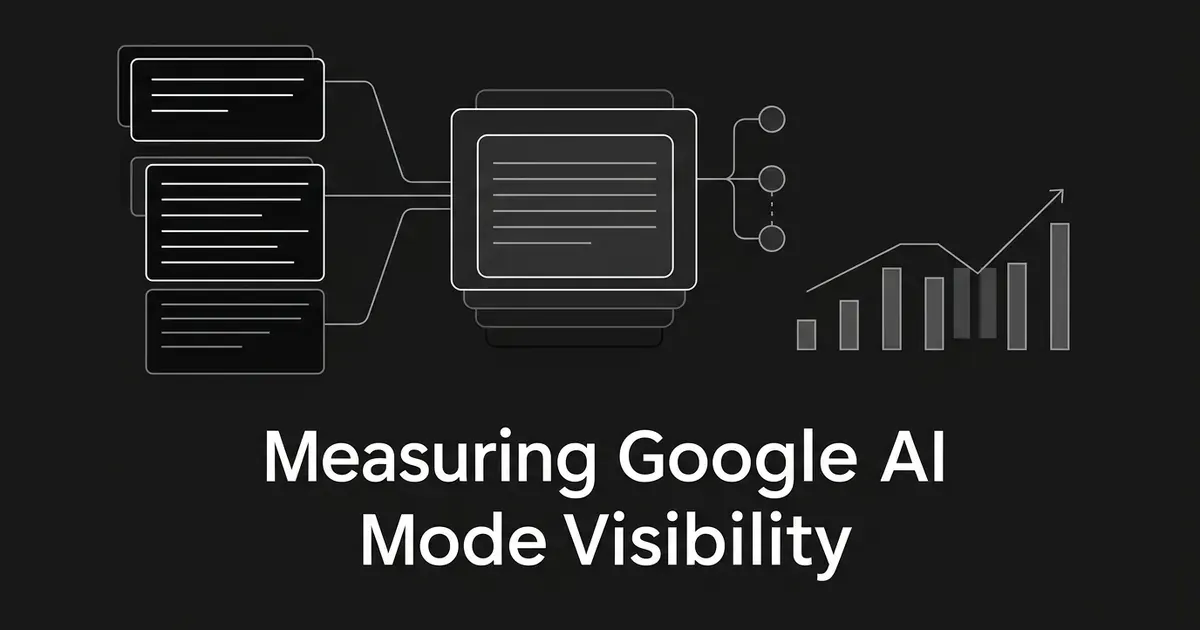
An ai mode seo software product measures visibility by running a chosen set of prompts under set conditions, capturing the AI Mode answers and the links shown with them, spotting your brand name and your pages in those answers, and turning those observations into percentages and trend lines over time. Those numbers describe what showed up in the tool's sample. They are not a count of everything real people saw, and they are not traffic.
If you have been handed a report with an AI Mode visibility score in it, it helps to know how that score was put together before you decide what to do about it. This guide goes in order: what is being measured, how answers are collected, how they are read, how the math works, what Google's own reporting adds, and why two checks of the same question can disagree. The research runs through November 18, 2026.
What does visibility in Google AI Mode mean?
AI Mode is an answer experience. Google describes it as useful for exploration, reasoning, and complex comparisons. You ask a detailed question, you get a generated response with supporting website links, and you can keep asking follow-up questions. Google also says AI Mode may use query fan-out, which means it runs several related searches across subtopics and data sources while it builds a response.
That changes what a tool is looking at. With a normal keyword check, a tool records where one page sits for one phrase. With AI Mode, it is looking at an answer, the sources shown beside it, and the conditions of that one interaction. There is no fixed list of ten blue links to rank against.
It helps to keep a few terms separate, because tools use them loosely:
| Term | What it means here | What it does not tell you |
|---|---|---|
| Prompt | The full question submitted to AI Mode | That this wording stands for a measurable share of real demand |
| Observation | One captured result for a prompt at a given time and under given settings | That it is independent, if the result was reused from storage |
| Brand mention | Your brand name or a known alias appearing in the answer text | A link to your site, a recommendation, or a positive description |
| Owned citation | A shown supporting link to a page on your own site | That your brand is named in the text, or that anyone clicked |
| Mention rate | The share of usable answers that contain a mention | The share of all AI Mode users who saw your brand |
| Share of voice | Your visibility compared with a stated set of competitors | A standard market-share number |
The most useful split in that table is between a mention and a citation. A brand can be named in the answer without any link to its site, and a page of yours can be cited without the answer naming your brand. Neither one means Google recommends you, that the page is accurate, or that the description was positive. You only learn that by reading the answer and the page behind it. For the wider picture, the guide to AI visibility measurement covers auditing and tracking across engines.
How do SEO tools collect AI Mode answers?
The first job is deciding which questions to check, and the second is getting a real AI Mode result for each one. Both choices shape every number that comes later.
Where the prompts come from
Tools tend to work in one of two ways, and some offer both. A broad discovery database keeps a large collection of prompts and captured answers, and you search it for your brand, a competitor, or a topic. A custom prompt campaign lets you pick the questions, the market, and the other supported settings, and the tool checks them again on a schedule. A discovery database tells you where a brand appears in the provider's collected universe, and a custom campaign tells you how the brand does on your chosen questions over time, so their headline percentages do not have to match.
Two published examples show how this looks. Ahrefs' Brand Radar methodology page, updated February 26, 2026, says its queries come from Google's People Also Ask corpus and its keyword database, then get expanded through PAA and fan-out systems. Ahrefs calls its metrics directional visibility signals rather than exact traffic counts, and says coverage leans toward common questions and is strongest in English. Semrush separates its large AI-analysis database from custom Prompt Tracking, and its documentation says Prompt Tracking queries your selected prompts on the chosen platform and location each day. Semrush's methodology article from November 10, 2026 adds a point worth keeping: the number of prompts you can track is a measurement budget, not a coverage guarantee.
Most surprises in a visibility report trace back to the prompt list:
- Branded prompts inflate results. A question that names your brand is not the same as an open question from someone who has never heard of you, so a high mention rate built on branded prompts does not show that AI Mode picks you on its own.
- Near-duplicates get extra weight. Twenty small rewrites of one buying question give that one intent a lot of pull on an unweighted score.
- Changing the list changes the score. Adding harder prompts can pull a percentage down even when you improved on the original ones, and changing the competitor set can move share of voice without any answer changing.
A good sample covers distinct buyer questions from awareness through decision, your target languages and markets, and branded and unbranded questions reported on their own. It keeps a stable core set for trends and reports exploratory prompts separately. That is advice drawn from how measurement works, and it is not a claim that every vendor builds its panel this way.
Getting a real AI Mode answer
The collector needs to see the actual Google AI Mode experience, because asking some other model a similar question does not count. Ahrefs says its supported prompts run through publicly available web interfaces and that it stores raw responses, and Semrush says its prompt responses are captured from real requests, not LLM APIs. Those are the providers' own descriptions, and none of them proves a collection matches what every user would see.
Published API documentation shows what the controls look like. SerpApi's Google AI Mode API lets you set the prompt text, a country, an interface language, a location, and a device, and it has an option to force a fresh fetch instead of accepting a stored result. It warns that if you leave the location out, the proxy's location can decide where the search appears to come from. Support in a dashboard can be narrower than what the underlying service allows, and the Semrush Prompt Tracking documentation reviewed here covers desktop searches only. When you look at any google ai mode seo tool, ask which of these settings it actually exposes.
SerpApi also documents caching for matching queries, which raises a fair question for any tool: did two checks see two new answers, or the same stored answer twice? Collection frequency, database refresh frequency, and report delivery frequency are three different things, and an email that arrives weekly does not mean data was collected weekly.
AI Mode also supports follow-up questions and picking up earlier conversations. A single first-turn prompt cannot capture a conversation that has already settled on a budget, a location, or a shortlist. SerpApi and SearchApi both document a token for continuing a conversation, which shows it is technically possible, though it does not mean every SEO product does it. A report should say whether it measures fresh conversations, continued ones, or a mix.
Last, a collector should record different outcomes separately. Google's help documentation says AI Mode may show a set of web links when confidence in an AI response is not high enough, which is different from a technical failure. A careful system keeps apart a captured answer, a captured answer with no mention of you, a links-only result, an unparsed response, and a collection error. If failures are quietly counted as "your brand was absent," the score is wrong in a way no one can see.
How do mentions and citations become visibility scores?
Once an answer is captured, the tool has to read it, and this is where counting rules start to matter.
Reading the answer
An AI Mode answer can include headings, lists, expandable content, comparison blocks, and source references. SerpApi's documentation describes text blocks and a collection of references, where blocks and list items carry reference indexes that tie a piece of the answer to a specific source. It also makes the raw HTML available, which helps when you need to check a discrepancy between the original result and a parser's reading of it.
To find mentions, a parser looks through the answer text for your brand name and any aliases you approved. Ahrefs describes mentions in its searchable corpus as string matches, and Semrush says its mention measurement uses the brand name you selected in campaign settings. The public documentation does not show a shared matching method or accuracy benchmark, so it is fair to ask any tool whether matches are case-sensitive, whether product names and translated names count, how common-word brand names are handled, and whether one answer counts once or once per appearance.
Citation analysis takes the shown links, attributes each one to a publisher or one of your own properties, and groups them by page or by domain. At the answer level you ask whether a response cited any owned page. At the page level you ask which exact pages were cited and how often. At the domain level you ask which publishers showed up across the sample. A domain can stay visible while the exact page changes, which is why page trends and domain trends can tell different stories.
The math, with a made-up example
Every metric needs a top number, a bottom number, a scope, and a time window. Here are plain definitions for explaining the category, and they are not the formulas of any one vendor.
| Metric | Calculation | Caveat |
|---|---|---|
| Mention rate | Usable observations with at least one mention, divided by usable observations | Counting every appearance of the name gives a different number |
| Owned citation rate | Usable observations with at least one owned citation, divided by usable observations | An answer with three owned links still counts once |
| Mention-based share of voice | Your mention observations, divided by mention observations for all included brands | Depends on who is in the competitor set |
| Visibility trend | Change in the same metric between comparable periods | Changing prompts, settings, or parsing rules can move it |
Now an example with made-up numbers, and none of it is real data. A tracker schedules 100 checks. It gets 90 usable answers and logs 10 collection failures separately. Of the 90 usable answers, 27 mention the fictional brand, 18 cite at least one owned page, and 12 do both.
| Outcome | Answers |
|---|---|
| Mention and owned citation | 12 |
| Mention without owned citation | 15 |
| Owned citation without a mention in the text | 6 |
| Neither | 57 |
| Total usable answers | 90 |
The mention rate is 27 out of 90, or 30%. The owned citation rate is 18 out of 90, or 20%. The failure rate is 10 of 100 scheduled checks. If someone divided by 100 instead, they would get 27% and 18%, which mixes up how complete the collection was with how visible the brand was in the answers that came back.
Share of voice is a separate calculation. Say the same set of observations has 27 mentions of your brand, 36 for one competitor, and 45 for another. Your share of voice is 27 out of 108, or 25%, which is a different number from your 30% mention rate. A beginner's explanation of share of voice in search and content covers the idea in more depth.
Scores and positions are defined by each vendor. The Semrush Prompt Tracking documentation lists AI Visibility, Mentions, Owned Sources, Topic Volume, and Average Position for Google AI Mode, and treats the AI Mode response area as position 1 with citations as positions 2, 3, and so on. For more on picking numbers worth tracking, the guide to AI visibility metrics and KPIs is a good next step, and so is a walk-through of how to audit the data quality of a tracker.
What can Google's own reporting confirm?
Google changed what it offers in 2026, and many older articles still describe the earlier setup. In June 2026, Google announced dedicated generative AI performance reports in Search Console, and says the insights had reached all websites worldwide by August 31, 2026. The Search report includes impressions for AI Overviews and AI Mode, with views by pages, countries, devices, and dates. A blanket statement that Search Console has no dedicated generative AI reporting is out of date.
Native impressions and third-party mention rates measure different things. A synthetic check in a tracker is not a real user impression, a native impression is not a count of how often your brand was named in the answer text, and an estimated impressions figure built from search volume weights is not the same as impressions Google recorded. The reporting documented so far also does not describe a prompt-by-prompt database of competitor answers, so it does not replace a custom prompt panel's mention, competitor, and answer-history analysis. It gives you something a panel cannot, which is Google's own count of exposure for your site.
Some aggregation details explain why numbers can look off when they are not. If two results from the same site appear in one generative AI result, they can count as one impression in the chart total, and a URL filter changes the chart to URL-level counting. Country, device, and date groupings are counted per property while page groupings are counted per page, so chart and table totals can differ without either being broken.
Traffic and business results are separate again. A linked appearance does not guarantee a visit, and a visit does not guarantee a conversion. Google recommends using tools such as Google Analytics alongside Search Console to see behavior and conversions. A sensible way to think about it is three layers: prompt visibility from a tracker, site exposure from Google, and outcomes from your analytics. If you want to bring those together, the list of AEO tools that connect to Search Console and analytics shows how some products do it.
Why can AI Mode visibility results disagree?
You may check AI Mode yourself, not see what the report says, and wonder which one is right. Both can be correct, because they were probably collected under different conditions.
Personalization, place, and format
Google's Personal Intelligence documentation says AI Mode can use previous searches and activity saved in Search Services History to tailor suggestions, and can remember details a user asks it to remember. It also describes optional connections to Workspace apps such as Gmail and Calendar, and to Google Photos. The remembered-preferences experience is described as available in the United States in English, with age and settings requirements, so it should not be assumed to apply to every user or market.
The practical result is that a standard tool session cannot be assumed to reproduce a particular customer's history or connected apps. That is an inference from the documented inputs, and nobody has put a number on how much it changes visibility. A fresh-session result is a useful baseline under stated conditions, and it should not be described as what everyone sees. Google's help documentation also supports questions using text, voice, images, and files, so a text-only first-turn panel covers only part of what people do in AI Mode.
Repeat checks do not always match
SE Ranking's first AI Mode study collected data on June 20, 2025. It used 10,000 keywords from the United States and ran the set three times on the same day, and AI Mode responded to 9,451 keywords in all three rounds. The study reported an average exact-URL overlap of 9.2% across its three result sets, and its method included independent parses with different account settings, including logged-in and logged-out contexts.
The fair reading is that the sources AI Mode chose varied a lot across the conditions tested. The study does not isolate pure randomness while holding every account setting the same, so it should not be turned into a claim that AI Mode swaps out most citations on every search. A June 2025 study is also not a promised benchmark for November 2026.
AI Overviews is not a stand-in either. Ahrefs analyzed September 2025 US data with 540,000 query pairs, each holding one AI Mode response and one AI Overview response, and reported 13.7% citation overlap. The narrow lesson is that a page's visibility in AI Overviews cannot stand in for its visibility in AI Mode. If you want to compare the two features on your own pages, see how to analyze featured snippet and AI Overview performance. The piece on day-to-day noise in AI visibility scores goes further into how much movement to expect.
Things inside the tool
Repeating checks gives you stronger evidence than a single answer, but the repeats are not an independent random sample of what users see. They share prompts, timing, settings, and sometimes stored results. The sources reviewed here do not establish a minimum number of prompts, repeats, or days that works for every business, so be careful with anyone who offers one with confidence. Visibility is also not cause. If citations rise after you update a page, that fits with an improvement, but other pages, source selection, or the system itself may have changed, so describe it as an observed trend.
How to read a report
Some common patterns and a sensible first reading:
| What you see | A reasonable reading | What not to conclude |
|---|---|---|
| Brand mentioned, no owned citation | The answer names you but the sampled result has no link to your site | That you have no influence |
| Owned page cited, brand not named | Your content supports the answer without being named in the text | That measurement is broken |
| Score changes after adding prompts | The mix of prompts may explain part of the movement | That performance on the old prompts got worse |
The thread through all of it is simple. Use steady, segmented trends to decide where to look, use the stored answers and cited pages to understand what happened, and use Google's reporting and your analytics to see exposure and results. With any ai mode seo checking software, a good place to start is to review which buyer questions and markets your current report actually represents, and write down what is missing.
DeepSmith tracks per-prompt mentions and citations, keeps the answer history, and attributes citations to pages, and Google AI Mode is part of its Enterprise and Custom coverage. The reading habits above apply to any ai mode seo checking software, including that one. For a wider look at the category, see how AI SEO software covers the jobs beyond keyword research and whether you need different SEO tools for each AI engine. If you are comparing platforms for a client roster, the roundup of best AI SEO tools for agencies shows how four of them differ.
Related guides
- What to Look for in SEO Tools With Perplexity Support: Use a checklist of Perplexity features to look for in an SEO tool, including citation tracking, prompt coverage, source reporting and refresh frequency, and test them in a.
- How to Spend a Small AI SEO Budget: What to Pay for First: Rank what to buy first on a small budget, from basic tracking and an audit tool to content support, with a decision rule for each step and what.
- How to Choose an AI SEO Platform for a Local Business: Choose an AI SEO platform by criteria that matter locally, such as location pages, listings, reviews, map presence and AI answers for near-me queries, and rule out tools.
- How to Connect SEO Tools to Your Engineering Team's Workflow: Connect your SEO tool to engineering by sending findings into tickets, setting priority rules, pairing fixes with release cycles and confirming changes after deploy.
- How Copilot Picks Sources and What SEO Tools Can Actually Measure: Understand how Copilot appears to choose and cite sources, and separate what SEO tools can reliably measure, like citations and mentions, from what stays opaque.