When Microsoft Copilot uses web search, it grounds its answers in high-ranking web content that comes through Bing's search foundation, and the tools you use for Copilot SEO can record the citations and brand mentions that show up in the answers they collect. What they can't do is show you the full list of pages Copilot looked at, why it picked some and passed on others, or how many people actually saw an answer. If you've been handed a Copilot dashboard and asked what it means, this piece walks through what is documented, what a tool can really count, and where the honest answer is that nobody outside Microsoft knows.
It helps to keep five things apart from the start: discovery, retrieval, citation, mention, and traffic. A tool can observe one of them without seeing the others, and most of the confusion around seo for Microsoft Copilot comes from treating them as the same event.
This piece covers the consumer Microsoft Copilot and the public web. Copilot in Microsoft 365, organizational Copilot Chat, and custom agents in Copilot Studio use different sources and controls, so none of it should be applied to them.
How does Copilot find sources?
Copilot decides first whether a request needs fresh information from the web at all, and only web-grounded answers come with source links. Microsoft's transparency note for Copilot, updated November 10, 2026, describes a step where the system decides whether a request needs grounding data from the web and which language model should respond. It then builds the answer from your prompt and the recent conversation, and when search is appropriate, search results supply the grounding information. That note applies to people signed in with a personal Microsoft account, so it shouldn't be stretched to cover every Copilot product.
The practical meaning is that not every Copilot answer is a search result with citations attached, and an answer with no sources is a normal outcome.
When Copilot does search, Microsoft says it centers the response on high-ranking content from the web. Bing's webmaster guidelines go further and say that Bing and Copilot search experiences rely on the same core crawling, indexing, and ranking as traditional search. That's the strongest documented link between Bing and Copilot, and it's why Bing discoverability matters. It still doesn't give you a formula. Microsoft hasn't published anything that turns an organic position into a probability of being cited, and a manual Bing search for your prompt won't show you every page Copilot considered.
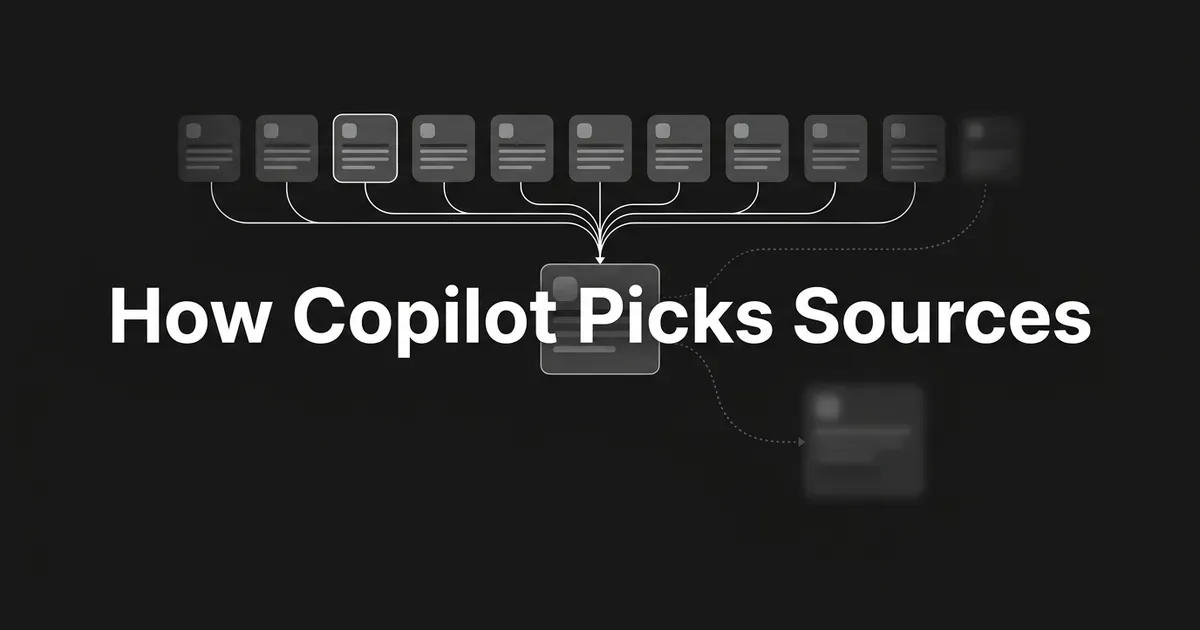
In simple terms, someone sends a request, Copilot decides whether web grounding is appropriate, relevant pages come up through Microsoft's search foundation, the model writes a response from the request, the conversation, and the grounding information, and the interface shows the answer with source links for web-grounded responses. That's a simplified model, not a published specification, so don't add a fixed number of candidate pages, a reranking formula, or a citation quota to it.
The citations themselves are a visible output, not an audit trail. Microsoft says web-grounded text responses provide hyperlinked citations so people can visit the sites used to ground the answer, and it describes Copilot Search in Bing as showing prominent citations and links at the sentence or passage level. A source link tells you a page was shown as a source. It doesn't tell you which pages were rejected, how much each source shaped each sentence, or whether the linked page supports the claim next to it, and Microsoft warns that generated answers can misrepresent even well-regarded pages.
So the takeaway for this section is that search availability comes before citation selection, and the full selection process isn't public.
What makes a page eligible to be cited?
A page is eligible when Microsoft's search systems can find it, read it, and judge it to be useful and trustworthy, but eligibility is not the same as being picked. Bing's explanation of how it delivers search results names the parameters it uses, and these are documented Bing ranking factors, not separately published Copilot citation weights. Here is what Microsoft describes and what you can reasonably do with it.
| Documented Bing parameter | What Microsoft describes | What it means for Copilot SEO |
|---|---|---|
| Relevance | Matching the intent behind a search, including meaning, not only exact words | Answer the real question clearly. Repeating a keyword has not been shown to earn citations. |
| Quality and credibility | Purpose, usability, presentation, and authority, including reputation and ownership transparency | Make authorship, sourcing, and what is original about the page easy to see. |
| User engagement | How people interact with results, including clicks, time on results, and reformulated searches | Usefulness to searchers matters, but nothing public ties engagement to citation directly. |
| Freshness | A general preference for content that stays up to date | Keep the information current. Changing a date by itself isn't a tactic that has been shown to work. |
| Location and language | The user's location, language, hosting, and similar signals | Write down the market and language whenever you compare observations. |
| Page load time | Slow pages can make a result less useful | Keep pages fast and usable, without assuming a speed threshold for inclusion. |
Bing also says it uses search history, location, language, and device information, so record the conditions around any observation and don't draw a universal conclusion from one manual answer.
Beyond that table, the guidance Microsoft publishes comes down to a short list of foundations.
Make important pages discoverable. The Bing webmaster guidelines recommend XML sitemaps that list canonical URLs, reflect the current site structure, drop deleted or redirected URLs promptly, and include freshness information. They also recommend crawlable internal links and IndexNow notifications for URLs that are added, updated, or removed. Microsoft says timely notifications help refresh its index and cut down outdated URL references in Copilot responses and grounding results. A notification is still not a citation guarantee. If you want the longer version of how sitemaps fit in, do XML sitemaps help AI crawlers covers it.
Keep the content accessible and consolidated. Bing advises allowing efficient crawling and rendering and using canonical URLs so duplicate pages are treated as one, which also matters for measurement because an apparent loss at one URL may be a redirect or canonical change.
Write pages that stand on their own. Bing recommends original, authoritative content that satisfies the intent behind a search and makes sense without outside context. In practice that means clear definitions, a stated scope, descriptive headings, and supported facts. The research behind this piece found no preferred paragraph length, word count, or FAQ quota for Copilot citations, so be wary of anyone who quotes one.
Treat structured data as supporting context. Bing says structured data may support clearer grounding but doesn't guarantee visibility, and the markup has to match what's visible on the page. Whether schema markup improves AI citations looks at the wider evidence, and the Microsoft guidance reviewed here doesn't require an llms.txt file.
Skip the manipulative stuff. Bing's guidelines cover cloaking, keyword stuffing, misleading structured data, and prompt injection aimed at AI systems, so hidden instructions meant to force a citation are not something to try.
So the real starting point for Copilot SEO is to make useful, trustworthy content available to Microsoft's search systems, and to accept that being available is not the same as being selected.
What can Copilot SEO analysis tools measure?
Copilot SEO analysis tools can measure what appeared in the answers they collected, and that is a narrower thing than it sounds. The most reliable way to read any of them is to ask what event it counted and what it divided by.
Here is where a tool is on solid ground and where it needs a qualification.
| Signal | What a tool can establish | The qualification |
|---|---|---|
| Brand presence | Whether your brand name or an alias appears in a captured answer | Ambiguous names, quotes, negative context, and parsing rules all change the count. |
| Visible owned-site citations | Whether a captured answer visibly cites one of your URLs | The tool should say how it treats subdomains, redirects, and repeat appearances. |
| History over time | How collected answers and sources change | A change can come from Copilot, from the sample, from the interface, or from collection trouble. |
| Share of voice | A comparison under the tool's own formula | The competitor set and denominator have to be stated. |
| Referral visits | Attributed visits and conversions in your analytics | Downstream results, not a census of everyone who saw the answer. |
The terms underneath those rows are easy to blur. A brand mention means the answer names your brand, whether or not it links to your site. A citation means the answer visibly links to a page as a source, so a citation to an independent review of your company is a mention of you and a citation to the review, not to your site. A citation rate is a proportion from a declared set of observed answers under a declared counting rule, not a market-wide visibility rate. Share of voice has no single standard, because its meaning depends on the denominator, the competitors, and the weighting.
A Bingbot request in your server logs is evidence of crawling, not evidence that a particular answer used the page. Some things stay hidden from every outside tool: the full set of candidate sources for one answer, the pages rejected and why, exact selection thresholds, how much a page shaped each claim, and any guaranteed link between a content edit and a later citation change. A citation tracker observes what Copilot showed under particular conditions, and it doesn't inspect every reason Copilot showed it.
What does Microsoft's own reporting reveal?
Microsoft now gives publishers first-party citation reporting, so an article saying there is none would be out of date. AI Performance in Bing Webmaster Tools went into public preview on February 10, 2026. Intents, Topics, Citation Share, and Compare followed in a global preview rollout announced June 16, 2026, and a Topics Portfolio beta was announced October 13, 2026.
The most important detail for a Copilot article is that the report isn't Copilot-only. The current AI Performance documentation describes activity across Microsoft Copilot, AI-generated summaries in Bing, and select partner AI integrations. The documentation reviewed doesn't describe a breakdown that isolates every metric to Copilot, so an aggregate total shouldn't be reported as a Copilot total. That's a limit of the documentation today, not a permanent claim about what Microsoft could add.
The core metrics, and what not to read into them, look like this.
| Metric | What it means | What not to infer |
|---|---|---|
| Total citations | How many times your content was shown as a source in the selected range | Not placement, rank, clicks, or engagement |
| Page-level citation activity | Which of your URLs were cited and how often | Not an explanation of each selection |
| Grounding queries | Short phrases associated with retrieving content that was cited | Not full prompts or transcripts |
| Citation Share | Your percentage of the citations shown for a given grounding query | Not traffic share, a quality score, or a list of competitors |
Grounding queries deserve a careful read. Microsoft describes them as grouped representations tied to retrieved and cited content, so they reflect aggregate activity and not individual questions. One grounding query can map to several pages, and one page can map to several grounding queries. A row in the report is not one buyer's prompt, and the report doesn't tell you exactly what people typed into Copilot.
Citation Share has a specific denominator too. It's your share of all citations shown across sites for that same grounding query, not of all Copilot answers and not only of the competitors you chose in some other tool. Microsoft says it doesn't expose competitor domain names or identify who holds the rest of the share. That makes it different from a tracker's share of mentions or an impression-weighted share of voice.
Intents and Topics group grounding queries into categories and themes, and Compare overlays an earlier period. Microsoft notes that citation activity can move with models, competing content, freshness, and demand, so a rise after an edit isn't proof the edit caused it.
The data refreshes daily with a short processing delay, isn't a complete log of every reference, and is sampled. Grounding-query data and page data can be sampled over slightly different windows, so filtering by query first and page first can give different counts for what looks like the same pairing. You can export grounding-query data, page-level data, and time-series metrics to CSV and Excel.
For this section the takeaway is that Microsoft's reporting is good evidence of citation activity, but it is sampled, spread across supported experiences, and not a traffic or ranking report.
Why do Copilot visibility metrics disagree?
Two dashboards can both be right and still show different numbers, because they answer different questions. It helps to sort them by what each one actually looks at.
Native publisher reporting asks where Microsoft's supported experiences visibly cited your site. It's first-party, and its limits are sampling, aggregation, the dimensions on offer, and no trail for any single answer.
Collected-answer panels ask what happened when particular prompts were run under particular conditions. You get answers you can inspect, with visible sources and history, but the limits are the choice of prompts, the collection conditions, and whether the sample represents real use.
Site analytics and technical diagnostics ask whether attributed visits happened and whether search systems can reach your content. They connect visibility work to outcomes, but neither explains why a specific answer picked a source.
One documented example shows how much method matters. Ahrefs' Brand Radar methodology page, updated February 26, 2026, says its queries come from People Also Ask material and its keyword database, that prompts run through free public web interfaces including Copilot, and that raw responses are stored and searched for linked citations and brand-name matches. It says the broad Copilot set refreshes monthly on a 90-day reporting window, and it listed roughly 13.3 million Copilot queries per month at that update. That number describes Ahrefs' own collection volume, not Copilot's audience or the number of real user questions. Ahrefs also says its Estimated Impressions weight mentions by Google search volume, which it describes as a modeling choice and not a validated relationship. Its help documentation adds that several cited pages from one domain can count as one domain citation in a response, which alone can make a raw link total differ from a domain-level total.
This is only a methodological example. Two dashboards can also differ in prompt wording and topic mix, the Copilot surface and account conditions, language and geography, collection date and window, whether source links or only answer text get parsed, how answers with no sources and collection errors are handled, brand aliases, whether pages or domains are counted, and whether the numbers are observed counts or modeled exposure. None of these mean a dashboard is wrong, only that you should ask before you compare scores.
Citation instability is the other big reason numbers move, and one Copilot-specific study shows how much the counting rule matters. In a study published October 29, 2026 by Mateusz Makosiewicz, with research contributions from Xibeijia Guan, Ahrefs followed source appearances over 20 days across five AI systems. The Copilot part of that study tracked 823 questions and recorded 1,447 websites cited on day one. The headline figure of about 37,500 citations covers all five systems combined, so it isn't a Copilot number.
Within the Copilot sample, 53% of observed answers contained no citations. Counting those answers, 83% of tracked citations were gone by day two, and after the researchers skipped answers with no citations that figure fell to 58%. Also, 52% of apparent Copilot comebacks were cases where the system simply started citing sources again, which isn't the same as a publisher winning a spot back.
This is vendor research on its own question sets, not an independent audit of Microsoft, and it isn't a representative sample of all Copilot use. What it supports is a modest habit: before you call a daily drop a competitive loss, check whether the answer cited anyone at all. Why AI citations keep changing goes deeper on that.
The takeaway is that before comparing scores, you compare what was collected, how it was counted, and what the denominator was.
What should marketing leads do with the data?
Treat citation data as evidence for deciding what to work on, and don't treat it as a map of Microsoft's algorithm. A few principles hold up.
Keep a stable prompt panel. If you change the prompts, the market, or the collection conditions between runs, you can't tell whether Copilot changed or your sample did. Keep the prompt, the collection time, the surface, the language and market, the complete answer, the visible source URLs, and a status that separates a success, a valid answer with no citations, and a collection failure.
Report a few rates, defined plainly. These are working definitions, not claims that every vendor calculates them the same way.
- Mention rate is the valid answers that name the brand divided by all valid answers in the sample.
- Owned-citation rate is the valid answers with at least one citation to your site divided by all valid answers. An answer with three of your pages cited still counts once.
- Source-bearing answer rate is the valid answers with any visible external source divided by all valid answers.
- Conditional citation rate is the answers citing your site divided by the answers that show any sources.
Here is a made-up example, with invented numbers and not a benchmark. A panel holds 20 valid Copilot answers. Eight name your brand, four cite one of your pages, and six show no external sources. Mention rate is 40%, owned-citation rate is 20%, fourteen answers carry sources, and the conditional rate is about 28.6%. If the next run has more answers with no sources, the unconditional rate can fall even though nothing changed in the answers that do cite sources, which is why the conditional rate belongs next to the plain one.
Sort a decline before you explain it. If a rate drops, the possibilities worth checking include a different page or domain being cited, no sources being shown at all, your URL changing or being counted differently, the answer describing you without linking, a changed prompt set or collection setup, and a collection or parsing failure. That's a list of things to rule out, not a ranking of likely causes.
Use more than one layer of evidence. Collected answers, native citation trends, technical checks, and attributed site outcomes each answer a different question, so reconcile them and don't force them to match.
Say what you actually know in a leadership update. A fair one sounds like this: "Our owned-citation rate went up on the same tracked Copilot prompt panel. This is better visibility in the monitored sample, not a measured rise in total Copilot audience." Lines like "Copilot now trusts us 30% more" claim more than the data can support.
Where DeepSmith fits is small. It tracks Microsoft Copilot as one of ten AI engines, alongside ChatGPT, Gemini, Perplexity, and others, with Copilot coverage on its Enterprise and Custom plans, so the same panel logic above applies to what it reports. If you want to go further on the Copilot side specifically, how to get cited in Microsoft Copilot and how to track Microsoft Copilot visibility are the practical companions to this one.
A good place to start is to separate whether Copilot names you, cites you, and sends an attributable visit. Those are three different questions, and each needs its own evidence.
Related guides
- Best AI SEO Tools for Agencies: Compares four tools built to survive a client roster: DeepSmith, Surfer, Scalenut, and Semrush.
- How to Spend a Small AI SEO Budget: What to Pay for First: Rank what to buy first on a small budget, from basic tracking and an audit tool to content support, with a decision rule for each step and what.
- How Content Optimization Scores Work and Whether They Predict Rankings: Understand how optimization scores are generally built from competitor term coverage, length and structure signals, and weigh what evidence exists on whether a higher score leads to better.
- How to Generate Ecommerce Product Descriptions at Scale and Keep Them Current: Generate product descriptions with an AI platform and keep them current as catalog data changes.
- Can Programmatic SEO With AI Work Without Thin Content Problems?: Judge whether programmatic SEO with AI can avoid thin content by checking data uniqueness, page usefulness, template variation and review sampling, and see which setups tend to fail.