Getting cited in AI Overviews really just comes down to three things. First, having citation-ready writing blocks (passages structured so an AI can easily extract and quote them). Second, building ecosystem source signals (a fancy way of saying third-party mentions that tell AI you're a trusted source). And third, publishing verifiable evidence formats, the specific content types like comparisons and case studies that AI engines are already programmed to treat as quotable.
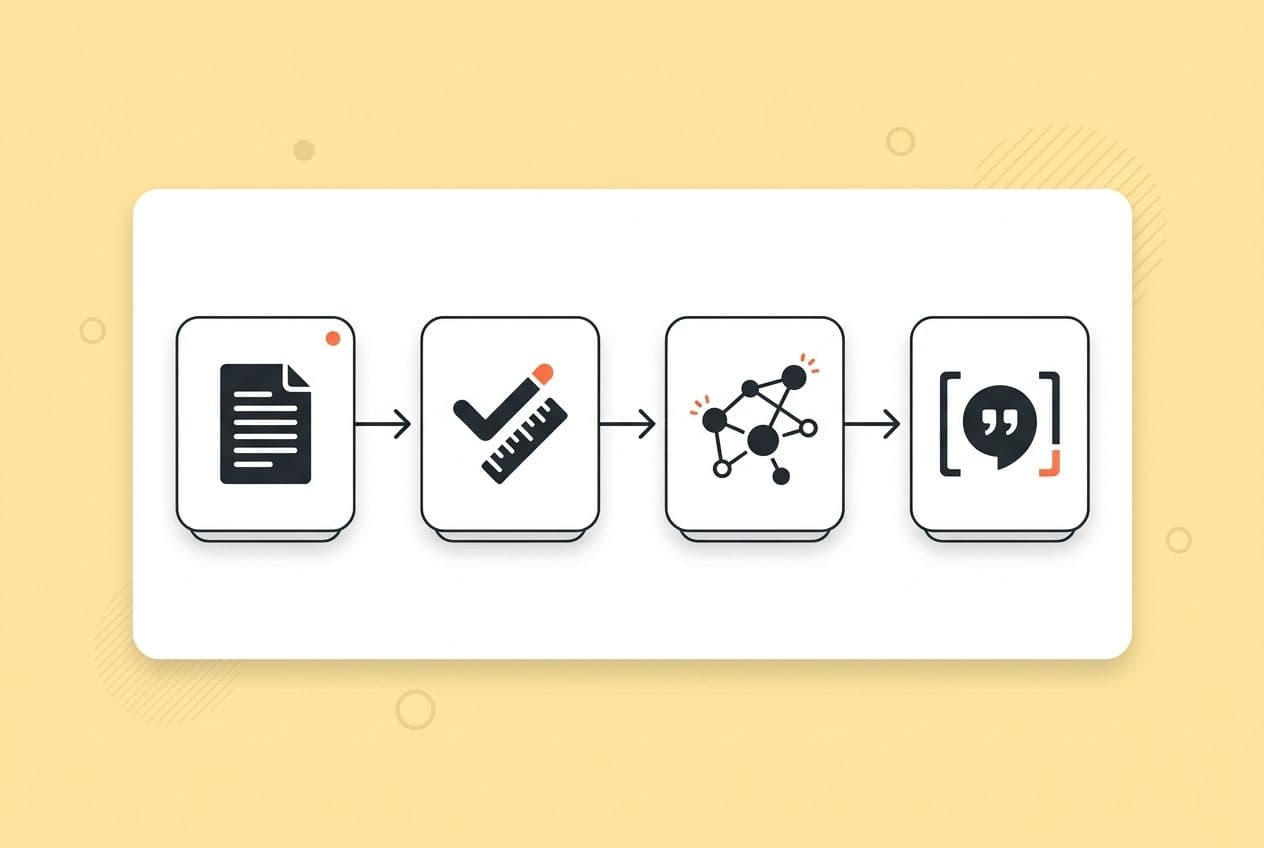
Here’s the practical playbook I use: (1) write for extraction, (2) build off-site citation breadth, (3) publish evidence AI can reuse, (4) track and iterate.
If you've ever manually searched your brand's core use case in ChatGPT or Perplexity and watched a competitor get cited instead, you know the frustration. Your pages rank. You have a keyword strategy. You use Surfer or Clearscope. But ranking and being cited are different games, and honestly, most content teams haven't updated their playbook for this new one. I see it all the time. Your boss is asking for an "AI search strategy," and your honest answer is "we're working on it." We've all been there.
Here’s what that actually looks like in the real world, when you have a small team, a tight budget, and a publishing calendar that doesn't wait for anyone.
What does it actually mean to "optimize for AI Overviews"—and what's the biggest misconception?
AI Overviews don't reward the best-ranking page. They quote the most extractable passage from a trusted source. This is a critical distinction. Missing it is why so many solid SEO programs produce zero AI citations.
Let me break down how these systems think. Generative search models synthesize answers from multiple sources, pull passage-level content (not full pages), and attribute citations based on what they can cleanly quote. A single clear paragraph can earn a citation even if the page isn't ranking #1.
The biggest misconception is that more traffic or better rankings automatically translate to more AI citations. They don't. A page can rank on page one and never get cited because its structure makes extraction a nightmare. We’re talking vague headers, rambling paragraphs, no direct answers, and claims that can’t stand alone without the rest of the article for support.
Citation eligibility is driven by four things: clarity (the passage answers a specific question), extractability (it can be lifted without losing meaning), factual support (it contains verifiable claims, not vague assertions), and source trust (your brand appears across multiple credible surfaces, not just your own blog).
| Traditional SEO | AI Overview / AEO Optimization |
|---|---|
| Page-level ranking signals | Passage-level extractability |
| Backlinks, authority, traffic | Source diversity, mention breadth |
| Keyword density, topic coverage | Answer density, claim verifiability |
| Targeting ranked positions | Targeting citation eligibility |
| One-time optimization | Ongoing passage-level maintenance |
And one more thing to keep in your back pocket: different AI models pull from different source types. Google AI Mode leans heavily on indexed web content and structured pages. Perplexity cites forums, reviews, and video transcripts more than most SEO-focused teams expect. ChatGPT pulls from its training data plus browsing (when enabled). There is no single checklist that covers all of them, but there are principles that improve your probability across the board.
How do you write content that AI Overviews can quote without rewriting your whole style?
This isn't about changing your writing style. It's about changing your information packaging. Your voice stays. Your takes stay. What changes is how you open every section, how you structure claims, and how you handle enumerations.
Here's the simple spec I give my team. It’s a checklist you can steal:
-
Question-based H2/H3 headers that match how buyers actually phrase decisions: "How do I choose between X and Y?" not "Overview of Options."
-
An answer capsule immediately under each header, a direct 1–2 sentence response that stands alone.
-
Short paragraphs (2–4 sentences). If it runs longer, it usually needs a list or a split.
-
Explicit entities: tool names, roles, metrics, frameworks, not "solutions" and "approaches."
-
Lists for enumerable items, tables for comparisons, bold for the single-sentence takeaway (not sprinkled throughout).
Before/After 1 — Section opening:
❌ "There are many factors that determine how well your content performs in search. Understanding these factors can help you create better content for your audience."
✅ "A page earns an AI citation when it contains a direct answer to a specific question, structured so the answer can be extracted without losing meaning."
Before/After 2 — Long paragraph converted:
❌ "Content should be specific, include real examples, and avoid vague language that could apply to anything. Writers often make claims that are too general to be useful and miss the chance to include facts or numbers that make a point concrete."
✅ Concrete claims that earn AI citations share three traits:
-
They include a specific number, range, or condition
-
They name an entity (tool, person, framework, process)
-
They can be lifted from context and still be true
A quick note on your own terminology: pick one name for your product category and use it consistently. That "synonym soup" where you call your product a "solution," "platform," "tool," and "engine" all in the same article? It just confuses extraction models. AI systems look for consistent entity signals.
What is an "answer capsule" and how long should it be?
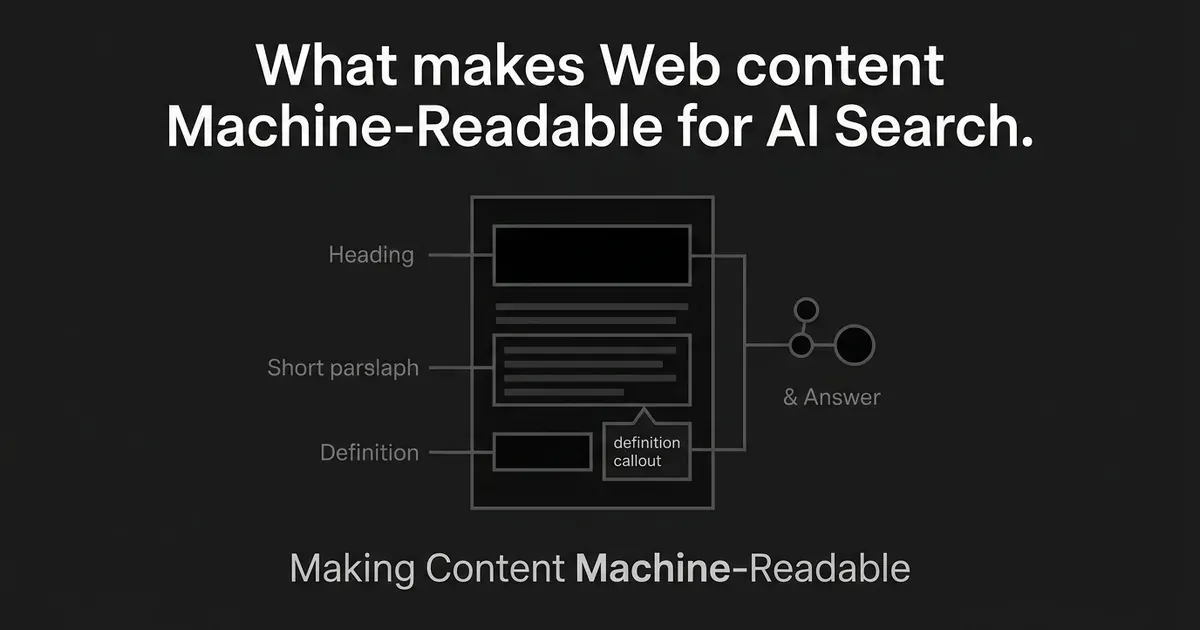
An answer capsule is the 1–2 sentence direct answer you put right under a question header. Get straight to the point, before you add any context, backstory, or caveats. Think of it as the answer you'd give a colleague who stopped you in the hall and asked the question in the header.
Aim for 20–30 words. This is about being complete, not clever.
Template: "[Direct answer to the question in the header]. [One sentence of the most important condition or constraint.]"
Example: "An answer capsule is the direct, self-contained response that opens a section. It should be short enough to quote on its own and accurate enough to be true without the rest of the paragraph."
What headings should you stop using if you want to be cited?
Please, stop using "Key Takeaways," "Overview," "Introduction," and "Conclusion" as H2s in your article body. I see this everywhere. They’re navigation labels, not answer surfaces. An AI scans headers to see if the section answers a specific question, and a generic label like "Conclusion" tells it nothing.
Replace them with the real question the section answers. "Conclusion" becomes "What should you do first?" "Overview" becomes "What is [concept] and when does it matter?" Every header is a prompt the system can match.
What editorial signals make AI engines trust and reuse your claims?
AI systems prefer claims that are specific, attributable, and low-ambiguity. The more checkable a fact is, the more reusable it becomes, because a model can quote it without worrying it'll be wrong.
High fact density is a real differentiator. A page with 15 specific, scoped claims outperforms a page with 500 words of well-written generalities. So what does "attributable" actually look like on the page?
-
Name the source when citing a stat: "According to [provider]" or "In [study name]," not "research shows."
-
Use numbers with conditions: "works well for teams under 10 people publishing weekly" rather than "works for most teams."
-
Include the "breaks when" clause. Constraints signal expertise and reduce the hallucination risk for the model quoting you.
Do:
-
"AI citations cluster around pages with direct answers, structured sections, and explicit comparisons that can be lifted as-is."
-
"This approach works best when your team publishes at least 4 pieces per month and has a defined buyer persona."
Don't:
-
"AI prefers high-quality content." (Unverifiable, circular, useless.)
-
"This strategy always outperforms traditional SEO." (Overstated universal, and AI systems are trained to flag these.)
And while we're at it, avoid that wishy-washy language. Phrases like "may potentially help" and "could possibly improve" don't just weaken your writing; they're a low-confidence signal that tells an AI not to bother quoting you.
Which off-site "source signals" influence whether your brand gets cited—even when your blog is good?
Your chances of getting cited aren't just about your website. They're a function of your entire ecosystem footprint, including reviews, directories, forums, video, and anywhere your brand gets accurately described by others.
So many small teams I talk to assume that just optimizing their blog is enough. It's a common mistake, but a costly one. Different models weight different source types. Perplexity regularly surfaces Reddit threads, G2 reviews, and YouTube transcripts. Google AI Mode pulls from structured web content but also factors in review aggregator data.
Here's a practical map organized by how much control you have:
| Control Level | Source Type | What To Do |
|---|---|---|
| Full control | Your website, blog, docs | Answer capsules, structured sections, FAQ markup |
| Some control | G2, Capterra, LinkedIn, Crunchbase | Audit and update: category, description, features, integrations |
| Limited control | Customer reviews, social mentions, UGC | Run a review program; respond consistently; seed balanced detail |
| No control | News coverage, forums, communities | Build credibility there organically; don't try to game it |
Here are some practical things you can do for each bucket:
-
Profiles: Audit your G2, Capterra, LinkedIn Company Page, and Crunchbase listings. This is basic blocking and tackling, but you'd be surprised how many companies have inconsistent info out there. Update category naming, your one-sentence positioning, and feature/integration lists. Inconsistent descriptions create ambiguity that AI systems resolve by citing someone else.
-
Reviews: Run a consistent ask-for-reviews program. When customers review you, respond. Remember, the text of the reviews themselves gets indexed. Reviews that describe specific use cases are more citation-worthy than "great tool, 5 stars."
-
Community: Pick 2–3 relevant subreddits or forums and contribute genuinely. Answer questions. Share your perspective. Drive-by promotional posts get flagged and ignored.
-
Video: YouTube walkthroughs and "how it works" comparisons get cited more than most content teams expect. Clean transcripts and descriptive titles matter.
What should you update first if your brand info is inconsistent across the web?
Okay, so your brand info is a mess across the web. I get it. Where do you start? Start with the highest-surface-area profiles: G2, Capterra, LinkedIn, and Crunchbase. These are indexed heavily and frequently pulled by AI systems as "what is this company."
Focus on these three things first: your product category label (use the term your buyers actually search), your one-sentence positioning (make it concrete, not a tagline), and your feature list (name integrations and use cases explicitly). This kind of inconsistency is the number one reason I see brands get mis-summarized by AI.
What kinds of content and evidence formats get quoted most—and how do you produce them with a small team?
AI Overviews quote content that already looks like a citation: structured, specific, and self-contained. The formats that win citations consistently aren't random. They're the ones that are easiest for an AI to lift and hardest to misread.
| Content Type | Why It Gets Cited | Minimum Viable Version | Refresh Cadence |
|---|---|---|---|
| Comparison pages | Parsable tables, named trade-offs | 3-option table + "who it's for" column | Every 6 months |
| Decision aids / checklists | Enumerable, discrete criteria | 5–8 item checklist with conditions | Annually |
| Pricing explainers | Specific, structured, low-ambiguity | Tier table + what's included + when each fits | When pricing changes |
| Original research | Unique, attributable, citable | Even 20-response survey with clear scope | Annually or quarterly |
| Case studies | Named outcomes, metrics, timeframe | Baseline → result + one concrete metric | As new wins come in |
| FAQ blocks | Matches natural language queries | 5–8 Qs with tight, self-contained answers | Quarterly |
Here's the small-team approach, because none of us has time to do everything at once: don't try to produce all six formats. Start with the 1–2 that map to your actual sales motion.
If buyers are comparing you to 2–3 competitors, a structured comparison page is your highest-ROI investment. If you're constantly getting the "can I trust these results?" question in your sales cycle, a case study with a real metric (even a modest one) beats a polished but vague success story.
Converting existing posts is faster than net-new creation. Take your top 10 money pages and add: one answer capsule per section, one comparison table where a choice is being discussed, and a 5-question FAQ at the bottom. That's a half-day sprint that can meaningfully change citation eligibility for your most important pages.
But let's be honest for a second: you can't fake authority here. A "research report" that's really just you Googling for three hours won't earn you any citations. In fact, it could actively harm your credibility if an AI surfaces it and it's obviously thin. Small-sample data with a clear scope beats invented authority every time.
How do you prioritize what to update first to win AI citations—without boiling the ocean?
Stop sorting your content backlog by age or traffic. Sort it by what I call "citation leverage." The pages you want to fix first are the ones that cover high-intent buyer questions, already have some structure, and can be improved quickly.
To find your high-leverage pages, score each candidate on these five dimensions (1–5 is fine):
-
Buyer importance: Does this page answer a question tied to a real purchase decision or active evaluation?
-
Current eligibility: Does it already rank or have partial answer-capsule structure to build from?
-
Evidence availability: Do you have stats, examples, case outcomes, or screenshots to add?
-
Competitive pressure: Are competitors being cited on this query set?
-
Remediation effort: Can you add answer capsules, a table, and a FAQ in under two hours?
Anything that scores an 18 or higher is a quick win. Start there. Don't overthink it.
Quick wins (this week):
-
Add answer capsules to your top 10 money pages
-
Insert a comparison table on any page where the reader is choosing between approaches
-
Tighten claims to include at least one number, range, or condition per section
Bigger bets (this quarter):
-
One original research piece scoped to a specific, answerable question your buyers actually ask
-
A comparison hub ("X vs. Y vs. Z") built around a real sales objection you hear every cycle
How do you measure AI Overview visibility and turn it into an operating loop—not a one-time report?
This isn't a one-and-done project. You need to track your prompts and citations regularly and let the data tell you what to work on next.
What to measure:
-
Prompt set: The 20–30 buyer questions you most want to be cited for
-
Mention rate vs. citation rate: Showing up in an answer vs. being explicitly cited as a source
-
Page attribution: Which specific pages are earning citations (and which aren't)
-
Competitor overlap: Who's getting cited on the queries where you're absent
Here's a simple operating cadence you can adopt:
-
Weekly: Check your top prompts. Is your brand mentioned? Is the description accurate? Flag any brand narrative drift.
-
Monthly: Refresh 3–5 pages based on movement data. Update FAQs. Add or improve comparisons on pages where competitors are being cited instead.
-
Quarterly: Publish one "citation magnet" asset—original research, a comparison hub, or a comprehensive FAQ cluster.
Now, this is where having a tool built for this stuff really changes the game. DeepSmith's AI Visibility module tracks prompt-level mention and citation rates across ChatGPT, Gemini, Perplexity, Claude, and Google AI Mode. It attributes citations to specific pages and surfaces which competitor pages are winning on your target queries. That gives you a data-driven input to your content queue rather than manual spot-checking.
Another honest caveat: AI interfaces vary. Results can be volatile. You have to treat citation tracking as trend analysis, not an exact science. A page that goes from "never cited" to "cited on 3 of 10 prompt checks" is a real signal, even if it's not cited every time.
The whole loop is simple: measure → diagnose (structure, evidence, off-site signals) → update → re-check. The teams I see actually making progress on AI Overviews aren't the ones who did a one-time audit. They're the ones who made this loop a standard part of their monthly routine.
What's the fastest way to operationalize this in your content workflow without becoming the bottleneck?
The only way this works without you becoming a bottleneck is to make it a production standard, not a checklist you run through after the fact. The goal should be for every draft to meet the quotability spec from the start. That frees you up to review strategy and ideas, not spend your day retrofitting headers and paragraphs.
AEO Definition of Done — Seriously, just copy and paste this into your content briefs:
-
Every H2 is a real question or decision frame (not "Overview" or "Introduction")
-
Every section opens with a 1–2 sentence answer capsule
-
At least one structured element (table, checklist, comparison) per section where a choice is being discussed
-
Claims include numbers, ranges, conditions, or named frameworks where possible
-
A 5–8 question FAQ is captured during drafting and placed at article close
-
Update timestamp and refresh notes added to the editorial calendar entry
Lean team roles:
-
Writer: responsible for answer capsules, evidence slots, and FAQ questions at draft time
-
Content lead: reviews for editorial stance, proof quality, and claim accuracy, not header formatting
-
SEO review: structural verification against the AEO Definition of Done, not a full rewrite
For those of you who want to scale this without personally becoming the QA bottleneck for every single article, DeepSmith's Content Studio runs a multi-agent pipeline: brief, draft, editorial QA, internal linking, and metadata. AEO formatting is built into the workflow, not bolted on after. Combined with Deep IQ for voice and positioning consistency and the AI Visibility module for tracking what's working, it connects topic selection through publishing and citation monitoring in one loop. It doesn't replace your editorial judgment or guarantee you'll get cited, but it does get rid of all the manual grunt work that sits between "brief" and "published."
One last thing on distribution: each article you publish is also a source-signal opportunity. Turn it into a Reddit answer, a LinkedIn breakdown, or a community post. These aren't just distribution plays. They're off-site presence signals that slowly build your ecosystem credibility over time.