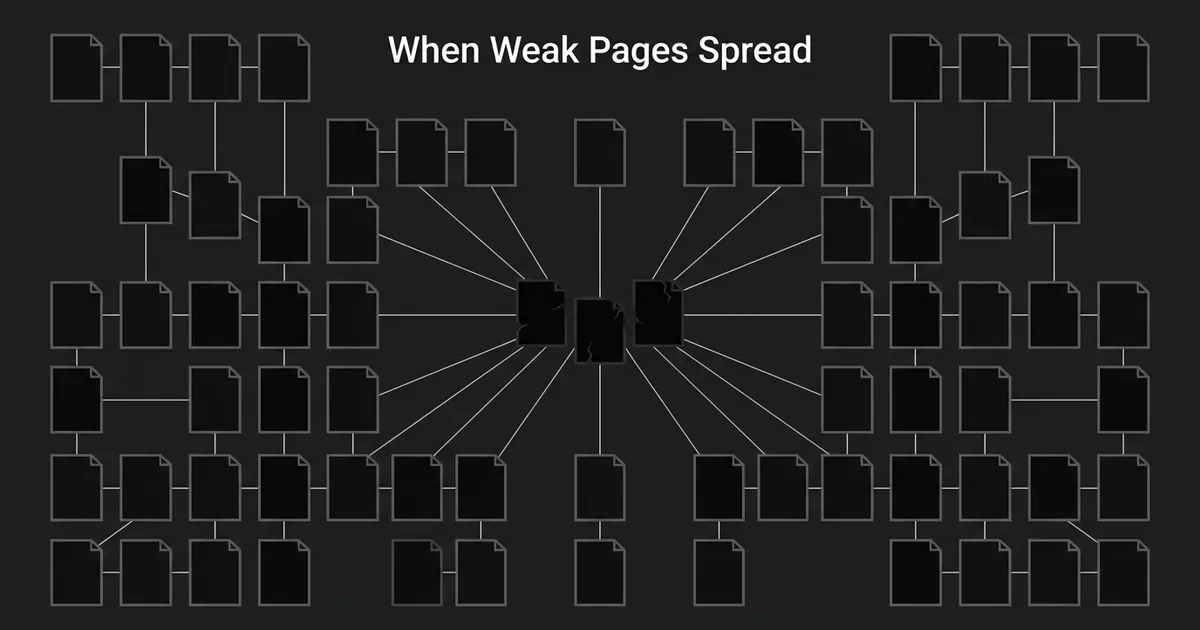
Google has confirmed that low-quality content on part of a site can affect the rankings of other content on that site. That part is not a rumor or an SEO myth. What Google has not confirmed is that every weak page drags down the whole domain, or that deleting a batch of pages guarantees a recovery. The sitewide quality ranking factor you have probably heard about is real as a possibility and much narrower than it sounds in most pruning pitches, and it's worth separating from a related question people ask in the same breath: does thin content hurt whole site rankings specifically, or only the thin pages themselves.
Evidence grade: confirmed, with limits. Google has said directly, more than once, that unhelpful content on part of a site can affect how other content on that site performs. It has also said, just as directly, that having some poor sitewide signals does not mean every page on a site will rank poorly. Both statements come from Google, not from an agency's theory about Google, and the article below keeps them separate instead of collapsing them into one tidy yes-or-no answer.
If you are deciding whether a pruning or consolidation project is worth the time, the honest answer sits between "it can't possibly matter" and "delete enough pages and the site recovers." This piece sticks to what the evidence actually supports, and it leaves the practical cleanup workflow for another day.
What exactly has Google confirmed?
The strongest and most current source is Google's own guidance on core updates, last updated December 10, 2025. It says plainly that deleting content is a last resort, something to consider only when you think the content can't be salvaged. Right after that, it describes sites with entire sections built for search engines rather than for people, and says that if that's the situation on your site, deleting the unhelpful content can help the good content on your site perform better.
That is not a 2011 quote taken out of context. It is current, dated guidance that supports a real, if conditional, business case: removing content that genuinely cannot be improved can help the rest of the site. The same source also tells you the condition does real work here. Google is not recommending deletion because a page is old or because it gets little traffic. It's talking about content that was built mainly to attract search visits rather than to serve a reader.
This idea has a longer paper trail than one recent document. Back on May 6, 2011, Google Fellow Amit Singhal wrote in a Search Central post that low-quality content on some parts of a website can impact the whole site's rankings, and that removing, merging, or improving those pages could eventually help the rankings of higher-quality content on the same site. Then, in an August 18, 2022 announcement about that year's helpful content update, Google's Chris Nelson said that content on sites with relatively high amounts of unhelpful content could perform less well, including content that wasn't itself unhelpful, and that removing unhelpful content could help the rankings of other content. Treat both of these as historical confirmation of the same underlying idea, not as a current technical description: the helpful content system itself became part of Google's core ranking systems in March 2024, so the 2022 post is describing a system that has since changed shape.
Line these three up and you get a consistent through line across fifteen years: Google keeps saying the same thing, in different words, at different points. Weak sections of a site are not sealed off from the rest of it.
Why that does not mean every weak page hurts the whole site
Here is the part that gets dropped in most pruning pitches. Google's own guide to search ranking systems, also updated December 10, 2025, states it almost as a warning: having some good sitewide signals does not mean all content from a site will always rank highly, and having some poor sitewide signals does not mean all the content from a site will rank poorly. "Can affect other content" and "drags everything down equally" are two different claims, and only the first one is confirmed.
That caveat matters because of how teams usually define "low quality" when they're building the case for a cleanup. This is really the same question in a different form: does thin content hurt whole site performance uniformly, or does it depend on what "thin" actually means. Three convenient proxies come up constantly, and Google has addressed every one of them directly.
Short does not mean thin. Google's helpful content guidance asks straight out whether a writer is hitting a preferred word count, and the answer given is no. A short page that fully answers a narrow question can be genuinely useful. A long page that mostly restates other sources without adding anything can still be unhelpful. Length was never the standard.
Old does not mean unhelpful. The same guidance asks whether a site is removing older content, or publishing new content, mainly to make the site look fresher for ranking purposes, and the answer is no, that approach won't work. This cuts both ways: refreshing dates without substance does not help, but it also means an old page is not automatically a liability just for being old. What matters is whether the information is still accurate and still useful, not the publish date on it.
Low traffic does not mean low value. This one is not a direct Google quote so much as a fair reading of the same standard. Google's guidance is about usefulness to the reader, not a published visits threshold. A narrow support answer or a reference page for a small segment of your audience can serve a real purpose without ever pulling meaningful search volume. Treating traffic alone as your quality filter will catch pages that never needed to rank for volume in the first place.
Put together, the standard you're actually being held to is whether content provides real value to the person reading it, not whether it clears an arbitrary word count, sits under some age cutoff, or draws enough visits to justify its existence on a spreadsheet.
What the content-pruning evidence actually shows
Case studies get cited constantly in this conversation, and they are worth looking at honestly rather than as proof of a formula. Most of the content pruning ranking evidence making the rounds in SEO circles traces back to three accounts, and each one is more useful for what it rules out than for what it proves.
One frequently cited account, covered by Everett Sizemore on Moz, describes agency Inflow's work for Auto Body Toolmart. Roughly 11,000 product pages were pulled out of search indexing while staying live in the catalog for shoppers. The account reports a 31% increase in organic traffic and a 28% increase in revenue following the change, alongside a separately reported year-over-year growth figure that should not be blended with that 31%. The catch: a small disavow file was submitted around the same time, and the work took place during an earlier era of Google's Panda and Penguin systems. A real reported outcome, with a real confound sitting right next to it.
A second case, reported by Ryan Law at Ahrefs, describes Belkins SEO lead Eugene Zatiychuk pruning around 400 low-quality pages, nearly two-thirds of the site, over January through March 2023, with monthly organic visits rising from roughly 3,000 to almost 10,000. About a month into that window, the team also reduced its reliance on JavaScript rendering. Two meaningful changes, one timeline, no way to cleanly separate how much came from pruning and how much came from the rendering fix.
A third example from the same Ahrefs piece cuts the other way. IBM, under an initiative led by Bryan Casey, pruned more than 1,000 pages from its main site navigation and shortened one product's buying journey from five pages to two. Traffic growth was never the goal, and the team reported no change in site traffic. Worth noting too: removing pages from navigation is not the same thing as removing them from Google's index, so this is a different kind of pruning than the search-indexing changes in the other two cases.
Read across all three, the honest takeaway is that pruning can be part of a project that goes well, and that it is not a guaranteed traffic lever on its own. None of these accounts isolate pruning as the one variable that changed, and none of them hands you a transferable percentage to put in a forecast. Treat the content pruning ranking evidence as directional color, not as a dataset you can run a projection against.
Why Google still treats deletion as a last resort
If removing unhelpful content can help, why does Google keep calling deletion a last resort rather than a recommended first move? The two ideas are not actually in conflict, even though they can look that way side by side.
In October 2017, Search Engine Roundtable's Barry Schwartz reported that Google's Gary Illyes, speaking at the State of Search conference, called pruning an unsafe tactic for improving overall site quality and said he'd rather see pages improved than simply pruned or noindexed. That's contemporary reporting of remarks at a conference, not a formal Google policy document, so hold it with the appropriate amount of certainty. But it lines up with what current guidance still says: improving genuinely useful or salvageable content comes first. Deletion is the move you reach for only once you've concluded a page cannot be fixed into something worth keeping.
So the sequence Google's own language supports looks like this: identify content that provides little real value, try to improve or consolidate what can still serve a reader, and reserve removal for what truly can't be salvaged. None of the sources reviewed here describe deletion as the default or the first step, and a rankings decline on its own is not proof that one weak section caused it. Google's current core-update guidance describes updates as broad changes, not actions aimed at specific sites or pages, and it notes that pages can also drop simply because competing results got better. A traffic chart pointing down is a reason to investigate, not a diagnosis.
Is this enough to justify a pruning project?
It's enough to justify looking seriously at content that provides little real value to readers, especially anything that reads like it was built mainly to attract search visits rather than to help anyone. It is not enough to justify a blanket deletion target set by page count, page age, or traffic volume. If you're still asking does thin content hurt whole site rankings enough to justify a project budget, the answer is: it depends on whether the content you're pointing at actually fails Google's value standard, not on how many URLs sit below a traffic line.
What the evidence supports: addressing content that cannot be salvaged, with the understanding that doing so may help the rest of the site perform better. What it does not support: promising leadership a specific percentage increase from a specific percentage of pages removed, assuming every page under a traffic threshold is a liability, or treating one agency's reported result as a forecast for your own site. Google's core-update guidance also says plainly that some changes can take effect within days while confirming sitewide improvement can take several months, and that there's no guarantee any change produces a noticeable improvement in search results at all. Build the business case around the actual content problem you can point to, not around a target number of URLs to remove.
One more boundary worth stating plainly: everything above concerns Google Search. None of it establishes that pruning weak pages increases how often ChatGPT, Perplexity, Gemini, or other AI answer systems cite your site. That's a separate question with its own evidence, and this evidence should not be stretched to cover it.
Before you take a deletion target to leadership, make sure the business case names genuinely unhelpful content, not simply content that happens to be unpopular. Those are different problems, and only one of them has Google's backing. However you label it internally, a sitewide quality ranking factor is a confirmed possibility to plan around, not a guaranteed lever you can pull on command.