Structured content is information organized into named, reusable fields and relationships, instead of being locked inside one page or document, so that people and systems can find, update, and assemble the right pieces for different places. Content modeling is the work of deciding what those fields and relationships should be. If your team is publishing more each month and it's getting harder to know where a fact lives or who last changed it, this is the idea that usually helps.
This piece explains what the idea means, how a model works, why it starts to matter as your volume grows, and where it can cause problems. It doesn't cover choosing a CMS or the tactics for repurposing one article into many.
What is structured content?
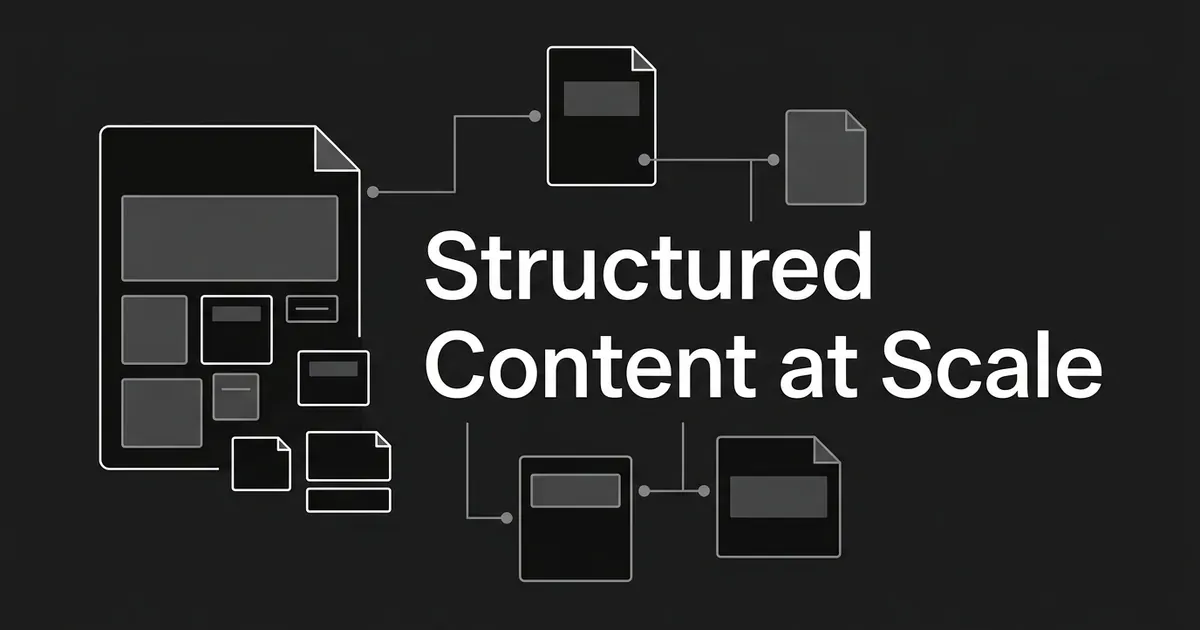
Structured content is content that has been broken into predictable, labeled pieces, with defined links between them, so each piece can be identified and used on its own. The article you publish is still ordinary prose that people read. The difference is that the information around the prose, like the title, summary, author, topic, and date, is stored as separate fields instead of being left for someone to figure out from a finished page.
Most teams start out with a page-first process. Each page or document is one big unit, and if you want to know who wrote it, what it's about, or which claim it makes, a person has to open it and look. That works fine when you have thirty pages. It gets slower when you have three hundred, because every question about your content turns into a search through whole documents.
Here's a small example. This is only an illustration, not a schema you need to copy.
- Article: title, summary, body, publication date, topic, and a reference to an author.
- Author: name, biography, and profile image, kept as its own item and linked to the articles they wrote.
- Topic: an agreed label that can be attached to any article that covers it.
Notice that the author is a separate item that articles point to. If the biography changes, you change it once. A sentence that says "By Maya Chen" inside a paragraph is still useful to a human reader, but a system can't easily treat it as a relationship to a maintained author record. A field that links to that record can be used by anything that needs it.
Structure also doesn't mean turning every sentence into a database field. A long body of prose can sit comfortably next to structured metadata and related items. The real question is which information needs to be separately identifiable, consistent, findable, or reusable, and which can just stay as prose.
A few terms worth keeping apart
These words get used interchangeably, and it causes confusion in planning conversations.
- Structured content is the organized content itself: predictable fields, types, metadata, and relationships.
- Content modeling is the process of deciding what those types, fields, relationships, and rules should be.
- A content model is the resulting blueprint. It is not the finished article, and it is not the page layout.
- A content type is a reusable definition for a kind of item, such as an article or an author. A content entry is one particular instance of that type.
- Reusable content components are discrete, meaningful pieces that can be referenced or assembled in more than one place.
- Intelligent content is a related, broader idea from content strategy. The Content Marketing Institute attributes the established definition of intelligent content to Ann Rockley: content that is structurally rich and semantically categorized, and therefore automatically discoverable, reusable, reconfigurable, and adaptable.
Intelligent content is about more than the content structure. The Content Marketing Institute describes it as an organizational approach too, which includes treating content as a business asset and having efficient processes, people, and technology behind it. The word "intelligent" doesn't mean the content thinks for itself, and modeling on its own doesn't deliver automation.
Structure is not the same as presentation
There are two layers here. The information layer describes what the content is, and the presentation layer decides how it looks. A headline, an author relationship, and a summary belong to the information layer. A card layout, a font, and a page template belong to presentation.
Keeping them apart is what lets you use the same information in different layouts. Structured content can still be published as a perfectly conventional web page.
How does content modeling work?
Content modeling starts with the recurring things your organization talks about, and it ends with a blueprint that says what each kind of thing is made of and how the kinds connect. It doesn't start with a list of the page templates you already have, because templates describe presentation and a model is meant to describe information.
A model usually covers five things.
- Content types: the recurring kinds of information, such as articles, authors, products, events, or eligibility requirements.
- Fields: the properties of each type, such as a title, description, date, image, or status.
- Relationships: the links between types, such as an article that refers to one or more authors, or a product that refers to a brand and a category.
- Metadata and classification: labels that support filtering, grouping, and retrieval, such as topic, audience, locale, or lifecycle status.
- Rules and workflow: conventions and validation that help authors enter consistent information and that support review and publication.
The rules are where a lot of the day-to-day value comes from. A model can insist on a real date field instead of a date typed in five different formats. It can ask for a reference to the canonical author record, so nobody types a new biography into every post. It can make a writer choose a topic from an agreed list, so the same subject isn't tagged three different ways. What validation a given tool supports varies, so treat specific field limits as a feature of the tool and not as a rule of modeling.
A simple way to start is to look at what you publish repeatedly and ask what's the same each time. If you run several event pages, for example, each one has a title, a date, a location, a description, and some speakers. If those are kept as identifiable pieces, a listing page can use the date and location, while the event page itself shows the description and speakers. It only helps if the details stay accurate.
What makes content reusable?
Content is reusable when a piece of information is kept in one trusted place and referenced from the others, instead of being copied by hand into each page. The author biography is the usual example. Store it once, link to it from every article, and an update shows up everywhere it's used.
This idea is older than most content platforms. DITA, a content architecture standard, has a formal mechanism for it called a content reference, where a reference acts as a placeholder that gets replaced with the referenced fragment when the content is processed. DITA also checks that reused material fits the place it's being used. That is one standard's way of doing it, and other platforms handle it differently.
It helps to be honest about when reuse is a bad idea. Plenty of repeated language shouldn't be centralized, because it needs to vary by audience, purpose, jurisdiction, or legal review. A shared component that nobody owns can also spread a wrong or unsuitable change to every page that uses it, and that's a bigger problem than the one you started with.
So reuse is a content and governance decision, not only a technical one. For each candidate component, it helps to answer four questions:
- Is this genuinely the same information everywhere it appears?
- Where is it allowed to be reused?
- Who can change it?
- When does a change need a contextual review before it goes out?
If you can answer those, the component is probably a good one. If you can't, it's likely better left as plain copy for now. The same questions of ownership and review come up in content governance for AI-produced content at scale.
Why does structure matter when output grows?
Structure matters at scale because more of your recurring production work can run on well-described, dependable inputs, so people stop rediscovering the same information in every document. The benefit isn't that a model writes more for you. It's that the work around the writing gets less repetitive and less error-prone.
Here are the mechanisms, one at a time.
- Less repeated maintenance. When a fact is genuinely canonical, you update it once and not in every copy.
- More consistent inputs. Shared fields, naming, classifications, and validation cut down on avoidable variation in how similar things are described.
- Easier retrieval. An editor or a system can ask for a known field or relationship, so nobody has to guess an item's meaning from a whole page.
- More flexible assembly. Reusable content components can be picked and combined for different pages, audiences, or channels, as long as your publishing workflow and presentation rules support those outputs.
- Clearer handoffs. When writers, editors, marketers, and technical teams agree on the content types and fields, it's easier to talk about what an item needs and who owns it.
- A better base for automation. Automation can use consistent fields and metadata to select or assemble content. That is an enabling condition, and it doesn't guarantee the automation will be correct or worth doing.
When you're small, these costs are easy to absorb because the whole library fits in somebody's head. Once you're publishing a growing body of related content, repeating the same facts in many places, or serving more than one audience or destination, the costs show up as slow updates and inconsistent pages. That's usually the moment teams start looking for ways to scale AI content production without losing quality, and it's a good time to look at how the content itself is organized too.
It's also worth being straight about the evidence. There's no well-established, independent percentage for how much structured content improves throughput, cost, or quality as a category, so a promise of a specific multiple of output isn't something this idea can back up. The Content Marketing Institute describes potential benefits like reduced development, review, maintenance, and translation effort, but it doesn't give a quantified outcome study for them.
A real example, with its limits
In a 2020 post on new approaches to GOV.UK content, the Government Digital Service described a site where individual pages were still the smallest component for much of the content. It talked about exploring more granular structured information so that pieces could be reused and accessed across and beyond GOV.UK, such as surfacing an eligibility criterion or prerequisite in the place where a user needs it.
It's worth being precise about what that shows. GDS framed much of the finer-grained work as exploration and potential, and it didn't report a measured productivity gain or a finished site-wide change. It also named governance, authorship, workflows, architecture, and future skills as challenges of applying new models at that scale. The "hundreds of thousands" of content items it mentions describes the size of the problem and not a measured benefit. So the example is useful for understanding why large organizations look at this, and not as proof of a specific payoff.
What does structured content not guarantee?
Structured content makes information easier to maintain, find, and reuse, and it does not by itself make a page rank, earn a rich result, or get cited by an AI engine. Teams sometimes hear "structured" and assume it's the same thing as search markup, so it's worth pulling the two apart.
Editorial structure and structured data are different things
"Structured content" in an editorial model and "structured data" in search markup are related, and they aren't synonyms. Google describes structured data markup as a standardized, in-page format that provides information about a page and classifies its content. It can help Google understand the page and make it eligible for enhanced search results when the requirements are met. That's markup applied to a page, and it isn't a reusable editorial content model.
The two can complement each other. A well-modeled back end can make accurate markup easier to produce, for instance. If you want to go deeper on the markup side, there's a guide to adding schema markup without a developer, and we've written about whether schema markup improves AI citations and what the evidence shows.
On AI search specifically, Google says its AI features have no additional technical requirements beyond Search fundamentals, and that publishers don't need special AI files or markup to appear in them. Crawling, indexing, and serving aren't guaranteed either. Bing's guidance leans on content that is clear, accurate, and focused, and written for people and not to trigger citations. Well-labeled information may be easier for people and systems to interpret, and that's as far as the claim can honestly go.
A related point about readers: a well-modeled back end doesn't automatically give you a well-structured page for a human. Meaningful headings and clear page structure still matter for accessibility and usability, and they're a separate job from the model.
Where it tends to go wrong
Most of the trouble comes from a few predictable habits.
- Modeling every page as its own type. This ties content to a single layout and leads to duplication and type sprawl. Model the recurring information and let presentation handle layout.
- Putting everything in one giant text field. Distinct facts become harder to find, validate, or reuse. Keep prose where the content really is prose, and separate the information that needs its own treatment.
- Splitting content too finely. Tiny fragments without a real retrieval, reuse, or assembly need add authoring and governance work for nothing. There's no universal right number of fields or component size, so choose granularity from actual use cases.
- Modeling without editorial ownership. Somebody has to define terminology, look after shared facts and taxonomies, approve changes, and review contextual use. Involving editors and subject-matter owners, and not just a technical team, helps the model reflect the real work.
- Assuming structure produces scale. A model doesn't create content, settle conflicting sources, write channel-specific versions, or publish anything. Those outcomes depend on workflow, technology, ownership, quality controls, and human review.
- Mistaking a machine-readable version for a reader-ready answer. The content still has to be accurate and understandable, and markup shouldn't describe information that isn't actually visible to users.
How do you decide whether more structure is worth it?
More structure is worth it when you have repeated information, a need to retrieve it, more than one place to show it, or a consistency problem you can see, and the modeling and upkeep cost less than what you're losing now. For a small, stable set of simple documents with little repetition, the case is weaker, since a richer model takes design work and ongoing governance.
A practical way to test this is to look at the work your team already repeats. Where do you retype the same fact? Where do you search through pages to find out what you've said about something? Where does one change need to be made in many places? Those spots are where structure pays for itself first, and they're a better place to begin than trying to model everything at once.
It also helps to start small. Pick one recurring type, such as authors or products, define its fields, and see how it behaves for a few weeks before you build the rest. If you're already thinking about how your team's content operations mature, a model is usually part of the move from ad hoc to repeatable.
The same thinking applies to how you brief writers and AI tools. When your product facts, voice, and audience are written down as separate, labeled pieces and not buried in a style guide PDF, they can be used the same way each time. It starts with how you document your brand voice and tone so both people and AI can follow it, and we cover the facts side in grounding AI content in your brand voice and product facts. Deep IQ in DeepSmith works like a small version of this idea: your products, personas, brand voice, visual guidelines, and content types are stored as separate items, set up once from your website, and every draft draws on them.
At scale, the point isn't more fields for their own sake. It's making content easier to maintain, find, and use responsibly, so that growing your output doesn't mean growing the amount of manual checking in the same proportion. If you'd like to see that kind of shared context shape real drafts, you can start a 7-day free trial of DeepSmith.