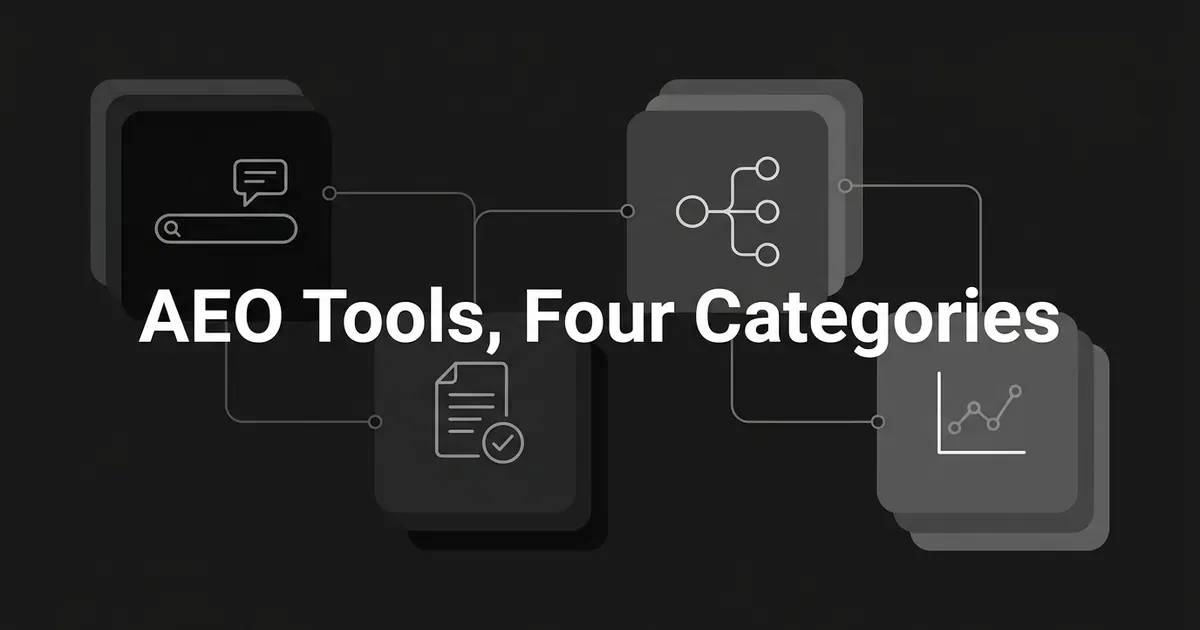
AEO tools are software that helps you understand how your brand appears in answer engines like ChatGPT, Gemini and Perplexity, improve the content those engines may draw on, and measure mentions, citations and the website activity that follows. If you're asking what are AEO tools, the short answer is that the label covers four different jobs: prompt research and tracking, content analysis and optimization, technical and schema checks, and reporting and attribution. One product can do more than one of them, and none of them can make an engine cite you.
That last part is worth keeping in mind from the start. Answer engine optimization software, whatever it's called, can show you what happened, point out what's weak on a page, find barriers to access, and summarize results. It can't reach into an engine and change which sources the engine picks. Once you see which job each kind of tool does, it gets much easier to tell what a given product is actually offering you.
What are AEO tools?
An AEO tool is any software that helps with one or more of four jobs: watching AI answers, improving content, checking technical access and structured data, and reporting results. The name comes from answer engine optimization, which some publishers use broadly for being visible in AI-generated answers and others use more narrowly for making content easy to pull out as a direct answer.
You'll also see GEO, which stands for generative engine optimization. It usually puts more weight on being referenced, summarized or cited inside a generated answer. The two terms overlap a lot. Shopify's explainer treats them as two labels for much the same thing, while Adobe's separates direct-answer extraction from generative synthesis and citation. So the boundary really does vary depending on who is writing, and it's fine to treat it as a difference in vocabulary. In this article, AEO means all of it.
It also helps to know that SEO hasn't gone away. Google says its existing SEO practices remain relevant to AI Overviews and AI Mode, and it doesn't describe a separate set of special optimizations for them. That's why some AEO functions look familiar if you've used SEO software, especially technical checks and content review.
Here's how the four categories line up.
| Category | Question it answers | Typical output | What the output doesn't establish |
|---|---|---|---|
| Prompt research and tracking | What do answer engines say for the questions we care about? | Prompt-level results, answer history, cited URLs, competitor observations | Total real-world demand, or a permanent ranking |
| Content analysis and optimization | What is missing, unclear or unsupported on this page? | Audit findings, content gaps, outlines, draft recommendations | That a model will retrieve, trust or cite the page |
| Technical and schema checks | Can systems reach the page and read its content and markup? | Crawl findings, access errors, markup validation results | That a successful fetch or valid schema earns a citation |
| Reporting and attribution | What changed, where, and what followed? | Dashboards, trend reports, page-level citation views, referral reports | That a visibility change caused revenue |
A simple way to hold it in your head is that tracking observes answers, optimization evaluates content, technical checks evaluate access and interpretation, and reporting evaluates patterns and outcomes you can see. If you want a view of how specific products sort across these jobs, the AEO tool market map groups them by capability. The best AEO tools comparison looks at how they differ.
Prompt research and tracking tools
Prompt tracking tools check a chosen set of questions over and over, and show you whether your brand appears, which pages get cited, and how the answers differ across engines and over time.
The problem they solve is a common one. You ask an assistant a question, you see a competitor, and you wonder how much that matters. That's a useful observation, but it doesn't tell you whether it happens every time, whether it happens across the other questions your buyers ask, or whether a different engine says something else. Tracking turns a one-off check into a defined set of observations you can compare later.
It also separates two problems that feel like one: your brand not being named, and your brand being named while your website isn't linked as a source. A tracker is how you tell which one you have. For a buyer's view of the products in this space, there's a roundup of AI visibility tools.
What goes in
You give a tracker a list of questions, the brand names and domains it should recognize, your competitors, and the engines and period you want covered. Providers don't all support the same engines, locations, languages or schedules, so ask about those. Prompt research decides which questions to watch. It can be typing them in by hand, or it can start from existing search data, as Gauge's documentation describes with connected Google Search Console queries. A search query isn't a full list of what people ask AI assistants, so treat suggested prompts as candidates and not as measured demand.
What comes out
A tracker can typically show whether a brand is named, whether one of your pages is cited, which other domains are cited, the exact cited URLs, the wording of the answer, and how that changes over a period.
The answer history matters, because a mention alone doesn't tell you whether the engine described you accurately. Some tools also cut off long answers (one documented implementation truncates at 10,000 characters). If you want the longer version, there's a separate guide on what prompt tracking is.
Here's a made-up example. Say you track "What should a small marketing team consider when choosing a content planning platform?" A tracker might show that an answer names your brand but links to an independent review, or that a competitor is cited for a comparison question. Those are two different situations, and neither explains why the engine picked that source.
What to keep in mind
The results describe the prompts you chose and the conditions they were collected under, not every AI conversation. A single response is a snapshot, wording and citations can change between runs, and being mentioned isn't the same as having your own page cited.
A 2026 arXiv paper, "Don't Measure Once: Measuring Visibility in AI Search (GEO)," looked at this. It used daily observations across four AI search engines and four Swiss-German campaign verticals, with 10 repeated runs for each of 128 engine-prompt groups. The authors recommend rolling aggregation over two to four weeks for steadier brand-level estimates. All the data came from servers in Switzerland, which may affect citation patterns, so it's a reason to measure more than once and not a benchmark for your market. You can read it in the paper on arXiv.
The takeaway is that this category reduces your uncertainty about the answers you measured. It doesn't reduce your uncertainty about the whole AI-search market.
Content analysis and optimization tools
Content optimization tools assess or generate material meant to make a page clearer, more useful and easier to reference, but their recommendations aren't proof that an engine will cite the page.
The problem here is on the page itself. A page can exist without giving a reader a direct answer, without explaining the distinctions that matter, or without supporting its claims. This category helps you find those weak spots before or after you publish. It's about the content, and it's separate from seeing whether an engine has already used that content.
What goes in
The inputs people document most often are a public page URL, pasted visible text, or raw HTML. An audit of pasted text only knows what you pasted, so it hasn't checked whether the live page can be crawled, indexed or rendered.
What these tools may do
Depending on the product, you might see answer clarity checks, structure suggestions for headings and sections, coverage gaps, briefs that turn a target question into an outline, drafting based on a brief, and checks for a visible update date or an author signal. These are possible features, not a list every product with an AEO label has to meet. A documented brief feature, for instance, returns an H1 recommendation, an H2 and H3 outline, FAQ question stubs, proposed JSON-LD markup and a target length based on competitor pages. Treat all of that as generated suggestions. A target word count isn't an engine requirement, and proposed markup still has to be validated and has to match what's visible on the page. For one kind of check in detail, there's a guide on how to check whether your articles are ready for AEO. Tools built around answer and snippet optimization are one example of this group.
A content score is not a citation forecast
Patrick Stox's free AI content audit is a clear example of a tool that knows its limits. It checks three local things: a direct answer near the start, a visible update date, and an author or reviewer signal. Its own explanation says a high score means those three are satisfied, and that it doesn't measure outside factors like rank, authority, indexation or model behavior that affect whether a page gets retrieved and cited. This isn't a recommendation of that audit or a ranking formula. It just shows how a score can be useful and still narrow.
The same audit can send up to 25 cited URLs to a status checker. A failed status can point to a broken citation. A passing status doesn't show that the source supports the claim, and the tool says it doesn't read the linked page to check. So a working link, a respected publisher, and real support for a specific claim are three separate questions.
What to keep in mind
Clean formatting can't make up for unsupported claims, and a visible date doesn't show the facts underneath were updated. There's no established word count, paragraph length or heading count that wins citations, so be careful with any tool that claims one.
The takeaway is that these tools help you improve a page, and an improvement recommendation is a different kind of output from measured visibility.
Technical and schema checking tools
Technical AEO checks look at whether systems can reach and read a page, and schema checks look at its structured data. Neither one shows that the page will be picked as a source.
An excellent answer doesn't help much if access is blocked, the page errors out, or important information isn't in the content the system receives. Structured data can also be wrong, or can describe something that isn't on the visible page. Keeping technical eligibility separate from editorial quality makes problems easier to diagnose.
The main questions
A technical check usually asks whether the relevant crawler can access the page, what status the server returns, whether the page is eligible for the search index, whether the important content is available as text, and whether the structured data is valid and agrees with the visible content.
Lumar's GEO reporting shows how wide this category can be, with report groups for AI Crawlability, AI Availability, AI Renderability, AI Indexability, AI Page Content and AI Structured Data. Those names show distinct areas to look at, not a universal scoring standard.
Crawl tests and real requests are different evidence
A crawler test checks access under test conditions, while server or edge logs show requests that really happened. Cloudflare's AI traffic documentation sorts requests into 2xx successes, 3xx redirects, 4xx client errors and 5xx server errors. A crawler request isn't a citation or a visit.
Search access and training access are separate
OpenAI's crawler documentation lists different bots for different purposes. OAI-SearchBot supports showing websites in ChatGPT search results, and GPTBot crawls content that may be used to train its models. The settings are independent, so a publisher can allow search crawling and disallow training crawling. ChatGPT-User is tied to actions a user starts, and robots rules may not apply to it in the same way. You can see the details in OpenAI's crawler overview.
The practical point is that a good technical assessment says which agent and purpose it's testing, and doesn't fold training access, search access and user-triggered fetching into one number.
What Google actually requires
For a page to show up as a supporting link in AI Overviews or AI Mode, Google says it has to be indexed and eligible to appear in Search with a snippet. There are no additional technical requirements, and indexing or serving isn't guaranteed. Important content should be available as text, and structured data should match the visible text. Google also says you don't need new machine-readable files, AI text files or special schema.org markup to appear in these features, and you can read that in Google's AI features guidance.
What schema testing does
Google describes two different testing purposes. General Schema.org validation checks structured data against the Schema.org vocabulary, without checking Google-specific features, so a valid result doesn't mean Google supports a rich result for that type. Google's rich-result testing shows which rich results the markup might produce, sometimes with a preview, and it doesn't promise the result will be displayed or that an AI answer will cite the page. Google points to the Rich Results Test for its supported features and the Schema Markup Validator for generic validation, both covered on its structured data testing page. For a walk through of tools in this area, see the guide to entity and schema tools.
A passing test is also incomplete, since Google's guidelines note that a test can miss some errors.
If you want to compare dedicated audit software, the AEO audit tools roundup covers it.
The takeaway is that these tools can find barriers and inconsistencies, and they can't give a page an "AI approved" status.
Reporting and attribution tools
Reporting tools summarize the visibility and website activity that was observed, and attribution assigns credit for actions that were recorded. Neither is a complete measurement of every time someone meets an AI answer.
A pile of answer checks is hard to read without some aggregation. You'll want to see which questions, platforms, topics and pages account for a change, and you'll want to tell visibility apart from visits you can identify and business actions. This is a function more than a separate product. A tracker can include reporting, and a general analytics product can measure some downstream activity without collecting any AI answers.
Useful views
Reports in this category tend to include trends over a set period, results split by engine, topic, prompt, competitor or cited page, frequently cited domains and URLs, identifiable website arrivals from AI sources, and exports. Some products also offer an open API for custom reporting.
Metric definitions worth getting right
The same word can mean different things in different tools, so it helps to pin down the terms.
| Metric | Plain-language meaning | Qualification |
|---|---|---|
| Brand mention | The answer names the brand | A mention need not include a citation to your site |
| Citation | The answer references a source URL or page | Check whether the measure counts links, pages, or responses that contain a link |
| Mention rate | The share of measured answers that name the brand | An example convention, not a universal definition |
| Citation rate | The share of measured answers that cite an owned page | The denominator and owned-domain rules need to be stated |
| Share of voice | Visibility relative to a defined set of brands | The numerator, denominator and weighting can differ |
Identical labels can disagree. AirOps documents a mention rate calculated as a brand's mentions divided by total mentions across all brands, which isn't the same denominator as answers containing the brand divided by all measured answers. It also documents sentiment on a scale from negative one to positive one, and that's one implementation, not a scale you can assume elsewhere. Different prompt sets, periods, engines, brand sets and collection conditions can all change a number too. So it's a good habit to read the formula before comparing the number.
An illustration, and not a benchmark, may help. Say a sample has 100 answers, and 30 of them name your brand while 20 cite one of your pages. Your mention rate is 30% and your citation rate is 20%. If your brand accounts for 30 of 120 total brand mentions across all brands, your share of those mentions is 25%, which is a different measurement. If competitors get mentioned more, your share of voice can drop even though the number of answers naming you hasn't changed.
Native platform reporting
Microsoft announced AI Performance in Bing Webmaster Tools as a public preview on February 10, 2026, covering Microsoft Copilot, AI-generated summaries in Bing, and select partner integrations. It documents total citations, average unique pages cited per day, page-level citation counts, a citation timeline, and grounding queries, which are phrases used when retrieving content referenced in AI answers.
The data is combined across supported surfaces, and the grounding queries are a sample, so they aren't a full log of what users typed. Microsoft says citation counts don't establish a page's importance, ranking, placement or authority, and describes trend changes as observations, not proof that one edit made the difference.
Google Search Console works differently. Google's documentation says appearances in AI Overviews and AI Mode are included in overall Search traffic and reported within the Web search type, so a site's overall Web performance can't stand in as a separate AI-visibility measurement.
Website analytics
On the analytics side, Google Analytics currently defines an AI Assistant default channel for arrivals from sources such as ChatGPT, Gemini, Deepseek, Copilot and Grok, and it explicitly leaves out Google's AI Overviews and AI Mode. This still measures arrivals. It can't replace a count of answers where your brand appeared, and attribution is a different task from detecting citations. If you're setting this up, a guide to AEO tools that work with Search Console and analytics is a good next stop.
The takeaway is that reporting is only useful when you understand what was observed, what was counted, and what the number can't prove.
What AEO tools cannot tell you
Most of these limits have come up already, and it helps to have them in one place.
- A single run is a snapshot. One answer is one sample. The repeated-measurement research above is why rolling views over a few weeks tell you more than one check.
- Scores can be opaque. A score is only as meaningful as the checks behind it. Ask what it tests and what it leaves out, as with the three-signal audit above.
- Causes are hard to isolate. A visibility increase isn't automatically the result of a content change. Reporting can show that two things moved together without showing why.
- Not every influence is visible. Some people read an answer and never visit.
There's also no established threshold for a good AEO score, a minimum citation rate or a guaranteed lift from schema changes. If a tool gives you one, ask where it came from.
The useful question isn't which product calls itself an AEO tool. It's whether the tool observes answers, evaluates content, checks access, or reports outcomes, and which of those you need right now. Start by naming the question you want the software to answer, then check whether its output actually answers it. If you'd like to try tracking with your own questions, you can start a free DeepSmith trial and see real answers for the prompts you care about.
Related guides
- Do Traditional Content Optimizers Help With AEO?: Judge whether traditional content optimizers help AEO and where they fall short.
- Page-Level Citation Diagnostics: What an AEO Tool Should Tell You About One URL: Learn what a good AEO tool should reveal about one URL: which prompts it appears for, which sections get cited, which competitors share the answer, and how that.
- Self-Serve vs Managed AEO: Which Fits Your Team?: Compare running AEO yourself with software against hiring a managed service on control, speed, in-house skill needed and workload, then pick the model that fits your team's capacity.
- What Are Agentic Marketing Platforms for SEO and AEO?: Understand what makes a platform agentic and what it does for SEO and AEO.
- White-Label AEO Reporting: What Agencies Should Include in a Client Report: Decide which sections belong in a client-facing white-label AEO report, such as visibility trend, cited pages, competitor share and next actions, and how to word them for non-specialists.