If someone on your leadership team has asked what your plan is for showing up in AI answers, you probably have two options in front of you. You can buy self serve AEO tools and run the work yourselves, or you can hire a managed AEO service and have outside specialists take on part of it. The software and the people are not really the question. What matters is who owns the work after you find out where you are missing from an answer, because finding the gap is the easy part.
This guide compares the two models on control, speed, the skill you need in-house, and the ongoing workload. It also covers where DeepSmith fits, since it is neither a pure dashboard nor an agency. If you are still building a shortlist of the best AEO tools, you can come back to that after you decide which model suits your team. We do not cover agency fees or tool prices here, because costs are a separate topic and they change from one provider to the next.
Self-Serve vs Managed AEO at a Glance
Here is the short version. Self serve AEO tools suit a team that can turn insight into action. A managed service suits a team that needs outside specialists to own a good part of the diagnosis and the execution. A software-supported model like DeepSmith suits a team that wants to keep strategy and editorial judgment, but wants less of the recurring production and measurement work.
| Decision factor | Self-serve AEO software | Managed AEO service | DeepSmith's software-supported model |
|---|---|---|---|
| Control | Your team sets up prompts, competitors, locations and reporting where the tool supports it, and decides what to change. | You work with the provider's specialists. Strategy and implementation can be delegated to different degrees, so approvals and ownership need to be written into the scope of work. | Your team sets the inputs and keeps editorial judgment. Content Studio produces editable articles that you review and publish, or schedule with Autowrite. |
| Getting started | You choose the domain, competitors, buyer questions, platforms and locations. Some tools help with prompt discovery. | A provider may begin with an audit and strategy work. Kickoff steps and length differ by provider. | Signup creates a brand profile, starts tracking buyer questions and generates first ideas. Enterprise adds 1:1 expert onboarding, a dedicated account manager and training. |
| Execution speed | You can act as soon as you have useful data, but you supply the content, technical and authority work. | Specialist capacity can take work off your plate. Published provider pages do not show a standard delivery schedule. | Opportunity Agents turn visibility or coverage data into content ideas, and Content Studio carries them from research through to publishing steps. |
| In-house skill needed | Someone who can read AI visibility data, pick priorities and coordinate the changes. | Less need to build every specialty yourself, but you still supply business context and coordinate with the provider. | Less routine research, briefing, linking, image and publishing work. You still provide accurate context, priorities and review. |
| Recurring workload | Your team maintains prompt sets, reads results, briefs writers, ships changes and reports. | The provider handles contracted work. Your input, approvals and implementation boundaries need to be agreed. | A shared visibility and content workflow cuts manual handoffs. Autowrite generates planned articles on schedule. Strategic oversight stays with you. |
| Best fit | A team with SEO, content and technical capacity that wants direct control. | A team with little specialist capacity that wants a partner to carry out a defined set of work. | A marketing team that wants to keep ownership but needs a joined-up path from visibility data to published content. |
Self-Serve AEO Tools: What You Run Yourself
With self-serve AEO tools, you use software to track how chosen AI platforms answer chosen buyer questions, look at the citations and competitors, and decide what to do next. The software does the checking. You or your existing writers and developers do whatever the software does not do. Self-serve does not mean manual, because many tools automate the tracking, surface opportunities and even generate content. It does mean you own the process and the follow-through.
A practical self-serve cycle looks like this:
- Choose buyer questions that reflect real use cases and buyer stages.
- Set up the brand, competitors, platforms, locations and how often to check.
- Review mentions, citations, answer history and the exact pages or domains cited.
- Decide whether the gap calls for improving a page, writing something new, fixing a technical problem, building authority, or changing how the brand is described.
- Hand the work to internal staff or contractors you already have.
- Check again, and treat a single answer check as a snapshot rather than a stable ranking.
The part that trips teams up is step four onward. Someone needs to be named as the person who moves from measurement to action. Without that person, a dashboard just makes you more aware of gaps that stay open.
Two well-known AI visibility tools show what the category covers. Semrush's prompt tracking is set up through Position Tracking. You pick ChatGPT Search, Google AI Mode or Gemini, add a location and language where available, and add prompts by hand, by TXT or CSV import, or from suggestions. It updates daily, keeps answer snapshots, and has a Sources report with the cited domains and URLs. Reports can be exported on a schedule. Its documentation also lists limits: the searches are desktop-only and it does not include Estimated Traffic. Semrush's own setup guide says the actual optimization work often happens manually or in other tools, which is a fair description of the self-serve deal.
Ahrefs lets you track custom prompts in Brand Radar alongside its wider prompt data. You save a Brand Radar report, add prompts one per line with one or more locations, and tag and group them. Refresh can be daily, weekly or monthly, and new prompt data can take up to 24 hours to show up. Its help material also says it cannot collect new Grok data for the time being. The same data can be pulled through its API. Both tools give you good control over the questions you track, and neither one changes your site for you.
So the honest strength of self-serve is control, and the honest limit is that control costs you time. Every decision and every follow-up is yours. If you want to see how many tools fit this description, the AEO tool market map sorts them by what each one does, and the categories of AEO tools explain which problem each type solves.
Managed AEO Service: What You Hand Off
A managed AEO service adds people to the picture. The provider brings expertise and does some agreed work on top of monitoring or recommendations. The word "managed" does not tell you which tasks are included, so that is the first thing to pin down. Ask whether the scope covers analysis only, strategy, content production, technical changes, digital PR or citation building, work inside your CMS, reporting, and revisions. Ask who approves changes, what you need to provide, and what AEO onboarding support looks like in the first weeks.
The providers we looked at describe audits, strategies, optimization, content, authority or citation work, account support and reporting. Their public pages do not consistently say how many hours you will spend, what the approval steps are, how long onboarding takes, or how fast they implement changes. Those are questions for the sales call, and the answers are not something to assume.
WebFX is a useful example. It describes an AEO and GEO service paired with its own OmniSEO visibility platform. The service includes a GEO audit, a strategy built around your goals, audience and existing visibility, SEO and content optimization, citation or authority work, and ongoing optimization with an account manager. Its enterprise version describes a dedicated account-management team, a customized action roadmap, brand-mention work, and a monthly strategy and results review call, with monthly reporting out of OmniSEO. The vendor calls its full-service enterprise offering "hands-free." That is its positioning. It does not tell you that every task leaves your desk, and its public materials do not define the approval stages, your required hours, or the split of CMS and technical responsibilities.
Go Fish Digital shows a different mix. It pairs a GEO service with its own tools, and describes mapping your site semantically, evaluating entities, topic coverage and structure, working on pages and passages, handling indexing, schema, IndexNow, sitemaps and internal linking, and using digital PR to earn mentions on authoritative sources.
The real advantage of a managed service is capacity. If nobody on your team can own both the analysis and the implementation, or if the gap spans technical work, authoritative content and digital PR, a provider can take a defined share of that off you. The real limit is that you still need to supply business context, approve changes and give access, and the details of all that live in the contract rather than in the marketing page.
This is also the model to look at if you run client work yourself. Teams in that position can start with the AEO tools for agencies, which cover multi-client setups.
DeepSmith: Software-Supported AEO for Teams That Keep the Work
DeepSmith is an AI search analytics and content production platform. It is not a managed AEO service, and we would rather say that plainly than have you find out on a call. What it does is put visibility measurement and content production in the same workflow, so the work that usually falls between two tools sits in one place.
On the measurement side, DeepSmith tracks mention rate, citation rate, share of voice, sentiment and visibility trends, along with which of your pages get cited and how competitors perform. It covers ten engines: ChatGPT, Gemini, Perplexity, Claude, Google AI Overviews, Google AI Mode, Grok, Meta AI, Microsoft Copilot and DeepSeek. Coverage depends on the plan. Pro tracks ChatGPT, Grow adds Perplexity, Scale adds Gemini, and Enterprise and Custom cover all ten.
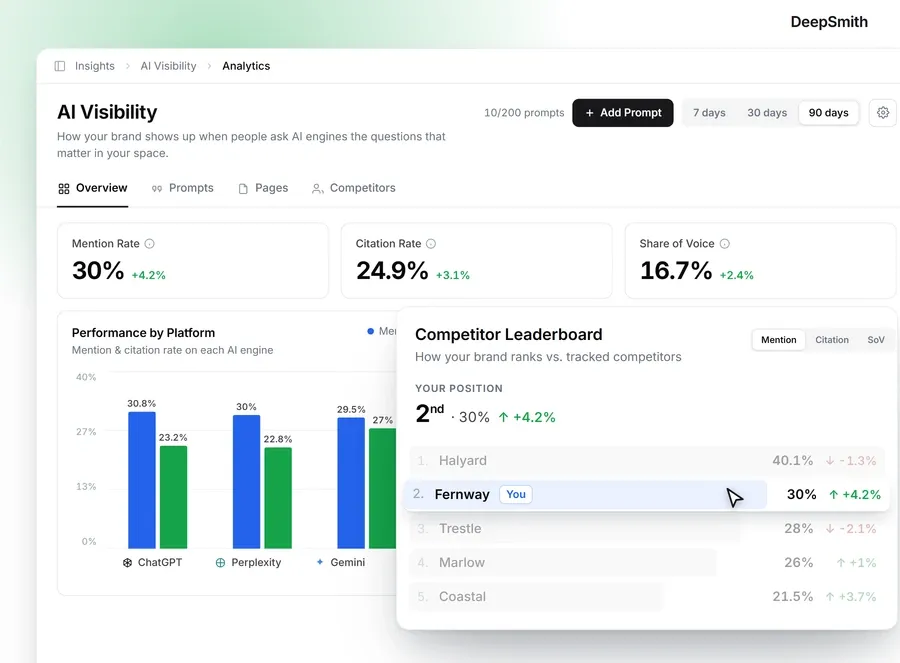
On the action side, Opportunity Agents read your visibility data or your Content Map and return content ideas, each one carrying the data point that justifies it. Content Studio then moves an idea through New Ideas, Planned Content and Produced Content. The Writer researches and produces an editable, publish-ready article grounded in your brand context, with internal and external links, a cover image and metadata. You can review, edit and publish to WordPress, Webflow, Strapi, Sanity or Contentful, or you can set Autowrite to generate a planned article on its scheduled date. Repurpose and the Apps Library handle the distribution versions, and Deep IQ holds your company, product, persona, voice and visual context so you do not re-brief every time.
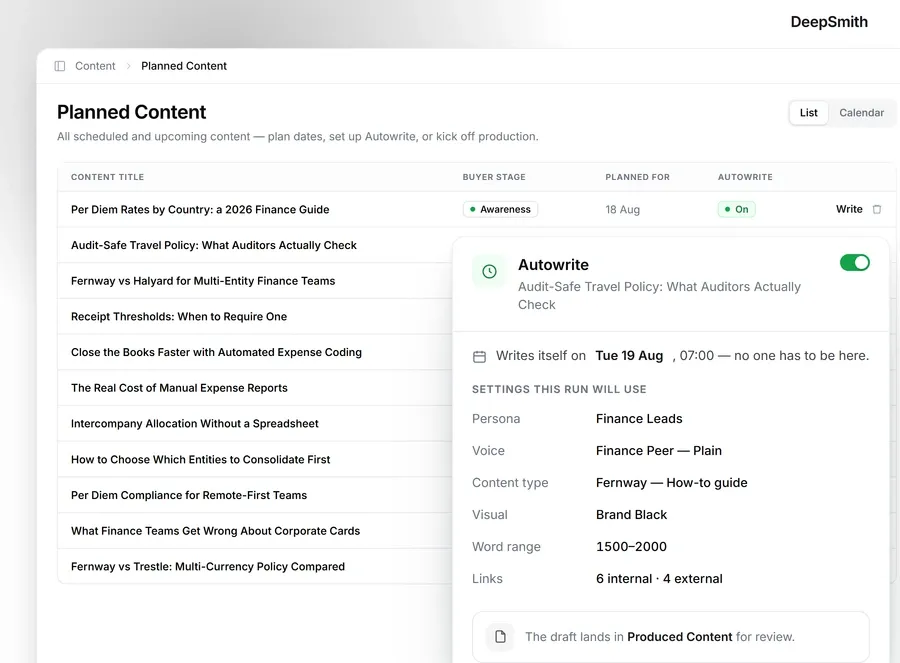
This speaks directly to the workload problem in self-serve. The recurring work of research, briefing, optimizing, linking, images and publishing gets done by the platform, and your team reviews and decides. You keep strategy, positioning and editorial judgment. It is a way to let an in-house team do more with a shared workflow, and it is not a replacement for every human role.
There is a boundary worth knowing about. DeepSmith does not take over your technical SEO changes, and it does not do digital PR or outside authority building for you. If what you need is an agency to own all of that, or a hand-built AEO strategy led by people, a managed service is the better match. The Enterprise plan's 1:1 expert onboarding, dedicated account manager and training give you real AEO onboarding support at the top tier, but that is help with getting set up and using the product, and it is not ongoing done-for-you AEO work. For teams who want to see how it feels before deciding, there is a 7-day free trial with real data and real drafts.
Who Does the Work: An Ownership Checklist
It helps to go through the actual tasks and mark who owns each one. The split below is a planning tool, and not every provider divides things the same way.
| Work item | Self-serve software | Managed service | DeepSmith-supported workflow |
|---|---|---|---|
| Define goals, audience and priority questions | Your team | Shared at strategy and onboarding, depending on scope | You supply the context, and Deep IQ and the visibility setup structure it |
| Set up prompts, brand and competitors | Your team, with tool guidance | The provider may do it as part of the service, so verify the scope | The platform supports tracking, and your context and priorities still matter |
| Read visibility and competitor gaps | Your analyst, SEO or content lead | Provider specialists, often with your input | AI Visibility and Opportunity Agents support the analysis, and you choose priorities |
| Create and optimize content | Your team or existing writers | The provider, only if it is in the agreed work | Content Studio generates optimized, brand-grounded articles that you review and publish or schedule |
| Technical SEO and site changes | Your team or developer | May be included, so confirm scope and access | Your team or developer, since content production does not replace technical work |
| Authority building or digital PR | Your team or an existing partner | May be included, so confirm the deliverables | Your team or an existing partner |
| Approvals and business accuracy | You | Agree sign-off responsibilities up front | You keep editorial judgment, and generated copy is editable |
| Reporting and next actions | You read the dashboards | Depends on scope, and WebFX's examples specify monthly reporting | The platform reports visibility metrics over time |
If you only take one thing from this table, let it be the rows for technical changes and authority building. Those are the tasks that neither a dashboard nor a content platform quietly handles, and they are where a managed service can add the most.
Speed, Measurement and What Nobody Can Promise
Speed is where people most often compare these two models, and it is also where the evidence is thinnest. We did not find a reliable, like-for-like comparison of time to results between managed and self-serve programs. It helps to split speed into three different things.
- Time to start tracking. With self-serve, this is as soon as the domain, competitors and prompts are set up. A managed provider may begin with an audit and strategy first.
- Time to implement the work. This depends on who has capacity. Software reports do not fix pages, approve claims, ship CMS changes or earn mentions on other sites unless the product or the provider is explicitly doing that work.
- Time until an AI platform changes its answers. Nobody controls this one, in either model.
On that last point, Google's guidance on AI features and your website is worth reading, with one caution. It applies to Google Search only. Google says a page needs to be indexed and eligible to show with a snippet to be a supporting link in AI Overviews or AI Mode, that there are no extra technical requirements and no special AI text files or schema needed, and that indexing and serving are not guaranteed. Do not stretch those statements to ChatGPT or Gemini.
Measurement has its own trap. AI answers shift from run to run. A preprint on measuring visibility in AI search, published in April 2026 and based on selected campaigns and four engines, found that answers and sources vary across runs, prompts and time. In that study, the error on per-brand detection fell below 0.10 at seven runs and below 0.08 at eight runs, and the authors suggest a rolling window of two to four weeks. It is one preprint with a limited design, so it is not a universal rule. The useful takeaway for either model is to check the same prompts repeatedly and compare like with like, meaning the same prompt set, platform, market and time window.
Be careful with the metrics too. A mention counts the brand appearing in an answer, and a citation counts a link to your page as a source. They are different numbers, and a report that mixes them will mislead you. Whichever model you pick, do not promise leadership rankings, citations or revenue. Neither a tool nor a service guarantees them, and a vendor's description of what it intends to improve is a claim, not a result. If you want to get more out of the data once you have it, the guide on Search Console and analytics connections shows which tools sit next to your organic data.
Which Should You Choose? A Recommendation by Team Situation
Start with capacity, because it decides most of this.
Choose self-serve when
- Someone on your team has the time and the authority to own AEO beyond setting up the dashboard.
- You can turn prompt and citation findings into content, SEO, technical or authority work.
- You value direct control over your question sets, tracking settings, analysis and execution.
- The program is still exploratory, or you already have specialist capacity and only need measurement and prioritization. A small team can look at AEO tools for founders to see what a no-sales-call setup looks like.
Choose a managed service when
- You have no available owner for both the analysis and the implementation.
- The gap crosses several disciplines, such as technical work, authoritative content and digital PR.
- You would rather have an external team deliver defined ongoing work and reporting than hand you a list of next steps.
- You can give business context and work together on goals, approvals and access, but you cannot execute the plan yourselves.
Before you sign, ask for a written split of responsibility: what is included, what you need to provide, who owns content and technical implementation, where the approval points are, how often they report, who is on the team, and how work gets prioritized. Do not infer any of this from words like "managed," "full-service" or "hands-free."
Choose DeepSmith when
- Your marketing team wants to own positioning, priorities and editorial judgment, but the manual production process is the bottleneck.
- You want visibility tracking and content opportunities connected to production, instead of spread across separate tools.
- You want to cut repetitive research, briefing, optimization, linking, image, metadata, publishing and distribution tasks.
- You want editable output, and a choice between review-and-publish and scheduled Autowrite.
Consider a hybrid when
You may want to keep strategy and brand control in-house but bring in specialists for particular gaps. For example, you could use software for ongoing tracking and content production, manage the editorial side yourselves, and contract a specialist for technical work or digital PR. This is a way of thinking about the split, and it does not mean any named provider sells that package. Pick one owner for prioritization, so that you are not paying several parties to produce recommendations that never connect. If you also want a page-level check before you commit to anything, the AEO audit tools comparison is a reasonable place to start.
If you are not sure the software-supported workflow fits, you can start a free trial of DeepSmith and look at real data and real drafts for your own brand before you decide. If budget is part of your decision, the affordable AEO tools roundup covers that side.
Related guides
- White-Label AEO Reporting: What Agencies Should Include in a Client Report: Decide which sections belong in a client-facing white-label AEO report, such as visibility trend, cited pages, competitor share and next actions, and how to word them for non-specialists.
- Cited.so Alternatives: 8 Best AI Citation Trackers for 2026: Eight Cited.so alternatives for tracking which prompts mention your brand and which sources AI engines cite: DeepSmith, Profound, Semrush AI Visibility Toolkit, Peec AI, LLMrefs, OtterlyAI, Rankscale, and.
- Foglift Alternatives: 8 Best AI Visibility Scanners for 2026: Compares eight AI visibility scanners against Foglift (DeepSmith, OtterlyAI, Peec AI, Profound, Scrunch, LLMrefs, AthenaHQ, Semrush) on engine coverage, refresh cadence, and pricing, for buyers who liked the.
- Getairefs Alternatives: 8 Best AI Visibility Trackers for 2026: Ranks eight AI visibility trackers as Getairefs replacements (DeepSmith, AthenaHQ, Profound, Scrunch, Peec AI, OtterlyAI, Rankscale, Semrush), comparing engine coverage, prompt limits, real pricing, and reporting, for teams.
- Getmint Alternatives: 8 Best Answer-Engine Visibility Tools for 2026: Compares eight answer-engine visibility tools as Getmint replacements, each with a best-fit use case, weighing engine coverage, prompt limits, pricing, and reporting cadence, aimed at buyers whose current.