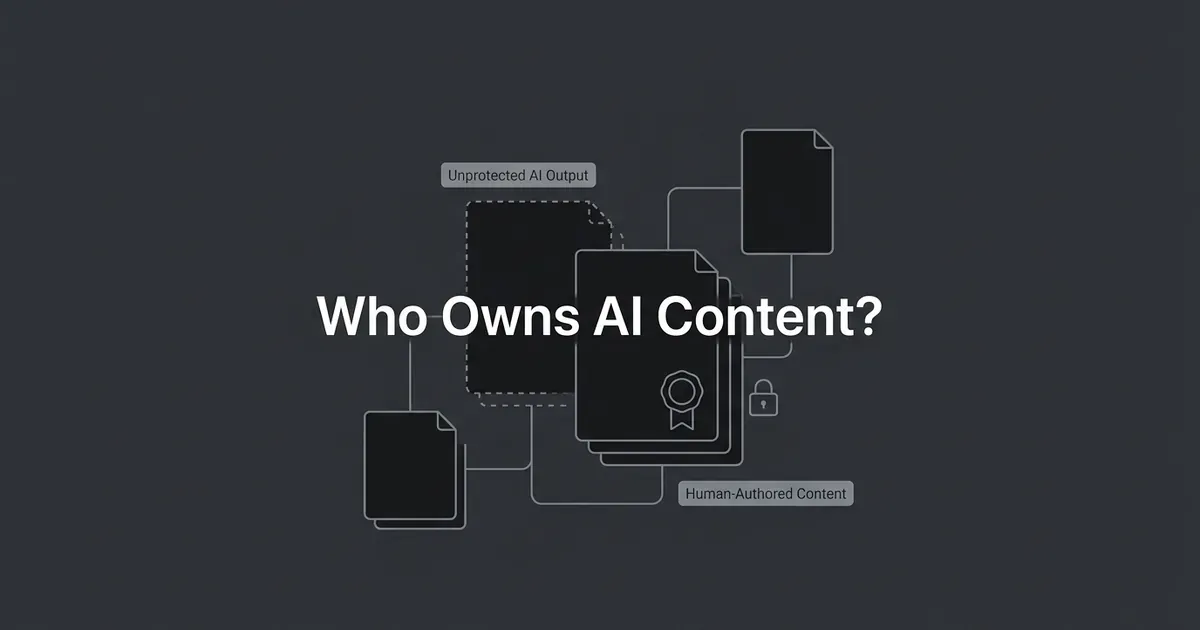
If you have asked "do we actually own the content our AI tool generates," here is the short answer. Owning the output under a vendor's terms and holding copyright in it are two different things, and most teams treat them as one. A vendor can let you use or even own the output, but under current U.S. Copyright Office guidance, that does not automatically give you copyright in material that is purely AI-generated. Copyright protects human authorship and the creative choices a person makes, not the words a system produces from a prompt.
That gap is what this guide walks through: what your AI tool's terms actually grant you, what the ai generated content copyright rules say separately from that, and where the ai content ip risk still sits for a content team or an agency that relies on AI output as a finished, owned asset.
What "owning AI content" actually means
Ask five people what it means to "own" a piece of ai generated content and you will get five different answers, because the word is doing five different jobs at once.
The first question is whether the vendor claims any ownership at all. Most of the major tools say they do not, or they assign whatever rights they might have in the output over to you. That sounds generous, and it usually is, but it answers a narrow contractual question, not the copyright one.
The second question is whether you have a license to use the output. A license can cover publishing it, running it as an ad, handing it to a client, or editing it further. What it covers depends on which service you used, which plan you are on, and which version of the terms was live that day.
The third question, and the one people skip, is whether the output is copyrightable in the first place. Copyright generally requires a human author. You can hold a perfectly good contractual right to use something that copyright law does not protect at all.
The fourth question is whether anyone else has a claim on the material. A vendor's promise about output rights cannot hand you rights that belong to a third party: a person's likeness, a competitor's trademark, a photo someone else took, or content a client uploaded without the right to share it.
The fifth question is whether the vendor will back you up if something goes wrong. An indemnity is a conditional promise to defend or pay out against specific kinds of claims. It is not a copyright, and every indemnity worth reading comes with conditions attached.
Keep those five questions separate and most of the confusion around who owns ai content clears up on its own.
What current copyright guidance actually says about AI writing and images
The U.S. Copyright Office published its Part 2 report on copyrightability in January 2025, and its position is the one that matters right now for anyone asking can you copyright ai writing. The Office says existing copyright law can handle AI output without a new category or a change in the law, and its conclusions are worth sitting with.
Copyright protects original expression made by a human author, even when a work also contains material a machine produced. It does not extend to material that is purely AI-generated, or to material where a person did not exercise enough control over the expressive details. Based on the tools generally available when the Office wrote its report, a prompt by itself does not give a person that kind of control. Writing "give me a 1,000-word article about accounting software for small businesses" tells the system what to produce, but the system decides the wording, the structure, and the phrasing. That is the part copyright does not reach.
What copyright does reach is the human part. If you write substantial original copy yourself and use AI only for limited help, if you select and combine specific AI passages into something you structured yourself, or if you rewrite and edit the output enough that the final wording reflects your own creative choices, that human contribution can be protected. The same idea applies to images: an original element you drew yourself, a creative arrangement of several generated assets, or a substantial change you made to the visual output can be protectable even when the raw generation underneath it is not.
This is not all or nothing, and it is the core of the ai generated content copyright question most teams get wrong. A piece of marketing copy can have a protected structure and argument sitting around AI-generated sentences that, on their own, are not covered. The Office's separate guidance from March 2023 tells applicants to identify the human-authored parts of a work when registering it and to leave out the AI-generated parts that are not protected, rather than listing the tool as a co-author. None of this is settled for every future dispute. It is the Office's current interpretation and registration policy, and how much human editing is "enough" is decided case by case, not by a formula.
What the major AI vendors' terms actually grant
Vendor terms and copyright law answer different questions, and reading the terms is still worth doing, because they set what you are contractually allowed to do with the output today.
OpenAI's current terms say the user owns the output, to the extent the law allows it, and that OpenAI assigns over any rights it might have in that output. The business terms for API and enterprise customers say the same thing about Customer Content, plus a separate, conditional indemnity for infringement claims tied to output. That indemnity does not apply if you knew the output was likely infringing, if you turned off the citation or safety features, if you modified or combined the output with something else, or if the underlying input was not yours to use in the first place.
Anthropic's commercial terms for Claude say the customer owns outputs to the extent the law allows, that Anthropic will not train models on that content, and that its commercial indemnity covers certain third-party IP claims, again with exclusions for customer modifications, customer inputs, and trademark claims tied to commercial use.
Google's terms say it will not claim ownership over content you generate, but the general terms also give Google a broad license to host, reproduce, and modify your content to run the service, and the Gemini API terms draw a real line between paid and unpaid use. On unpaid tiers, your prompts and outputs can be used to improve the product and reviewed by people. On paid tiers, Google says it does not use them that way, though it may log them briefly for safety and legal reasons.
Adobe's terms for Firefly say the customer owns the output as between Adobe and the customer, and warn plainly that the output may not be unique and may not be protectable at all. Its output indemnity is narrower still: it only covers certain plans and certain features, it caps damages at $10,000 per output, and it excludes anything modified, combined with other material, or used after Adobe tells you to stop.
Midjourney lets the customer own what they create, but a company doing more than a million dollars a year in revenue has to be on a paid plan to use the images commercially, and by default your generations are public and remixable unless you are on a plan with a privacy feature. Microsoft's Customer Copyright Commitment is not an ownership grant at all. It is a conditional defense promise for certain Azure OpenAI and Copilot services, and it only applies once you have implemented the required safety mitigations and can prove it.
Read across all six, and the pattern holds: the vendor usually lets you use or own the output, but almost every version of that promise is qualified by the law, by third-party rights, by your own compliance with the terms, or by the fact that the output might not be unique to you at all.
Where the ai content ip risk still sits for content teams
The word "own" in a vendor's terms is doing less work than it sounds like. OpenAI says the output may not be unique. Google says it can generate the same or similar content for someone else. Adobe says its output may not be protectable at all. If you are promising a client exclusivity in a specific AI-generated asset, that promise is on shakier ground than the vendor's ownership language suggests. This sits alongside the wider ai marketing risks and controversies a brand takes on when it scales AI output fast, not apart from it.
The input side carries its own risk. Nearly every vendor puts the responsibility on you to have the rights to whatever you upload: client copy, logos, photos, product documentation, even a client's own reference images. A client telling you "use this photo as a reference" is not the same as that client actually holding the rights to license it to you, and the vendor's output terms will not fix that gap after the fact.
Indemnity sounds like insurance, and it is not. Every one reviewed here comes with conditions: which plan you are on, which feature you used, whether you kept required safety settings on, whether the output was modified, and whether the claim is about copyright versus trademark or privacy, which are often treated differently. A vendor's promise to defend a claim can disappear the moment you combine the output with something else or use an input you were not authorized to use.
Data handling is its own variable, and it does not track neatly with price. OpenAI's individual plan allows content to be used to improve the service, with an opt-out; its business terms say the opposite unless you agree otherwise. Google's unpaid Gemini tier allows human review of your prompts; its paid tier says it does not use them to improve the product. A paid plan is not automatically a private, no-training, indemnified plan, so the exact tier and feature matter more than what the marketing page implies.
What to check before you rely on AI output as an owned asset
Before your team or your agency treats an AI-generated article or image as a finished, owned deliverable, work through a short list.
Start by recording exactly what you used: the vendor, the specific product and tier, paid or unpaid, the feature, the date, and the version of the terms in force that day. A general statement like "our AI policy says we own outputs" does not hold up if the team actually used a different product or a different tier than the one the policy describes.
Confirm the rights in every input before it goes into the tool, including anything a client or a freelancer handed you: copy, logos, photos, testimonials, confidential documents, or reference images. The output clause in a vendor's terms cannot retroactively grant you permission you never had for the input.
Keep a record of the human work that went into the final piece: the outline you wrote, the sections you drafted yourself, the editing and rewriting, the examples you added, the final calls you made on structure and argument. This record will not manufacture copyright by itself, but it lets you describe honestly what you made versus what the tool produced, which matters if anyone ever asks. A human review and QA gate in your production process is one practical way to keep that record consistent instead of relying on someone's memory of who touched what.
Check the commercial-use conditions on the actual account you used, not the vendor's general marketing claims: whether commercial use requires a paid or enterprise account, whether a revenue threshold pushes you onto a different plan, and whether the output came from your own generation or from remixing someone else's. Then check the indemnity separately from the ownership language: who is covered, which kinds of claims count, what gets excluded, and what the liability cap actually is. This is the same discipline behind how you fact check ai-generated marketing reports before you act on any of their numbers.
Finally, look at data handling on its own terms. Ask whether the specific service and tier you used logs or reviews your prompts and outputs, how long that data sits around, and whether the workspace is private or public by default. This matters most when the input includes anything a client marked confidential.
What to tell your client or your leadership
Once you have gone through the checklist, the honest version of what to say is more useful than a flat "we own it." A workable internal line looks something like this: the vendor's terms may give the team rights to use or own the output, but the raw output on its own may not be copyrightable or exclusive to us. Treat the finished piece as a mix of vendor output, the human work your team put into it, anything the client supplied, and whatever rights belong to other people. Before anything ships, check the account tier, the commercial-use terms, whether the inputs were cleared, how the data was handled, and how much genuine human work sits on top of the raw output.
That is a more defensible thing to put in front of a client than promising exclusive ownership of an unmodified AI draft or image. It is also the more accurate version of what is actually happening: the agency using a service whose terms permit the intended use, having the rights to what it fed into that service, and passing along the rights it can actually transfer, no more and no less. This is not a substitute for a lawyer reviewing an actual client contract. It is the baseline a content team should have straight before that conversation ever happens, and content governance for AI-produced work at any real scale should have this checklist built into it rather than left to whoever happens to ask.
If your client is asking about AI content specifically because of disclosure, not ownership, that is a related but separate question with its own evidence on reader trust worth reading on its own.
Working across several client accounts raises the same questions with more moving parts, since keeping brand voice and product facts distinct per client is already a production problem before ownership even comes up, and getting sloppy on either one tends to show up in the same review pass. DeepSmith stores each client's brand voice, product facts, and positioning as structured context so a strategist reviewing a draft is checking accuracy and judgment, not re-explaining the account from scratch, which is a smaller piece of the same discipline this guide is describing.
Most of what goes wrong here is not a single bad decision. It is scale: the same shortcut taken once is a minor risk, and taken across two hundred pieces a month across a dozen clients, it is a pattern that eventually surfaces. Ongoing guardrails on agent-produced content are built for exactly this kind of recurring, easy-to-skip check, which is what keeps this ai content licensing marketing question from becoming a real problem later.