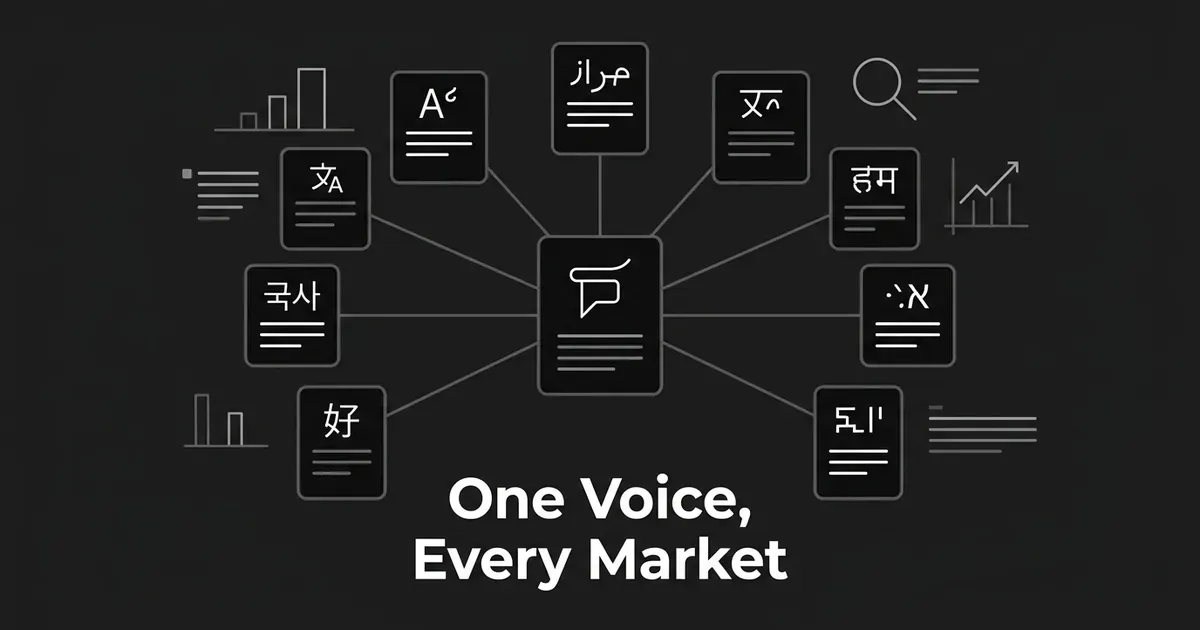
This guide walks you through how to localize AI generated content for a new market without losing the brand underneath it. It is for agency strategists and content leads who already produce marketing content with AI and now need a second, third, or tenth language version that still sounds like the brand and still gets picked up by the AI engines buyers use in that market. By the end you will have a repeatable seven-step workflow you can run on one page, then reuse for every client and every market after that. What you need before you start: an approved source draft, a client or brand who can name their target markets, and someone in-market who can review the result.
Step 1: Define the market and the questions buyers actually ask
Before anyone touches the AI draft, write a short brief for the market. A country is not a language setting. Spanish for Spain, Mexico, Argentina, and Colombia can call for different words, different formality, and different examples, even though a translation tool will happily produce all four from the same English source. Record the target country, the language and regional variant, the buyer role and stage, the channel, the commercial goal, and which facts are allowed to change versus which ones have to stay exact.
Then build a local question set. Do not translate your English keyword list and call it done. Ask what a real buyer in that market would type or say, in their own words, including the informal phrasing, the regional terms, and the comparison questions they actually use. Fifteen to twenty real customer questions per priority market is a workable starting size. Group them by buyer stage so you know which ones the localized page needs to answer.
You know the brief is done when another strategist could pick it up cold and answer who the content is for, what the reader wants to accomplish, which claims cannot move, what can be adapted, and which AI platforms and competitors matter in that market. If they have to ask you a clarifying question first, the brief is not finished.
Common mistake: treating one generic multilingual page as good enough for every Spanish-speaking or Portuguese-speaking market. Language changes which sources an AI engine pulls from and which competitors it recommends, so a single page tuned for no market in particular usually loses to a page tuned for one. Treat multilingual AI content marketing as a production system with a brief for every market, not a one-off translation project you do once and move on from.
Step 2: Lock your brand voice, terms, and claims before you touch the draft
This is the step people skip, and it is the one that causes the most damage later. Before you localize anything, write down what the brand sounds like and what it is allowed to claim, separately from any one market. Split it into two lists. Voice invariants are what has to survive every language: personality, positioning, the relationship the brand has with the reader, approved claims, and product facts. Market adaptations are what is allowed to shift: formality, rhythm, idioms, examples, humor, currency, and calls to action.
That is really a translate AI Content Brand Consistency problem before it is a language problem: fix the source of truth first, and the translation step gets much less risky.
Build a terminology glossary next. For every brand, product, feature, and category term that matters, record the source term, the approved local term, what it means in this product's context, and the rejected translations you never want to see again. Note which terms are legally protected product names that should never be translated at all, and which are generic category words that can flex by market. Add a short market-specific style guide on top: formality level, regional vocabulary, how numbers and dates should look, and which idioms should be replaced rather than translated word for word.
Here is how you check the framework actually works: give the same short source paragraph to two different writers, or two different AI runs, using the glossary and style guide. Their output can differ in sentence rhythm and word choice. It should not differ in what the product is, what it does, or what the brand promises. If it does, the glossary has a gap, not the writer.
Most AI translation brand voice failures happen before anyone opens a translation tool, at the point where nobody wrote down what the voice actually is. An agency running several client brands cannot hold all of that in someone's head. This is where DeepSmith's Deep IQ earns its place in the workflow: it stores each client's positioning, product facts, persona, brand voice, and content rules as structured context, and Multi-Workspace keeps every client's environment separate so one account's voice and claims never leak into another's draft. That solves the storage and separation problem. It does not replace the in-market reviewer who has to catch the idiom that reads wrong in Bogota but fine in Madrid.

Pro tip: treat the glossary and style guide as living production assets, not onboarding paperwork you write once and forget. Update them the moment the product, pricing, or positioning changes, or the same mistake will show up in every market you touch next.
Step 3: Build a local AI-search baseline before you publish anything
Before the localized page exists, find out what AI engines are already saying in that market and that language. Run your local question set, in the local language, against the platforms that matter there. For each answer, record whether the brand was mentioned, whether a page was cited and which one, which competitor showed up instead, what facts the AI stated about the brand, and whether those facts were even correct.
Keep two metrics separate here, because they are not the same thing. Mention rate is how often an answer names the brand at all. Citation rate is how often an answer actually links to one of the brand's pages as a source. A brand can be named without being linked, or linked without being named in the answer text. Track share of voice against competitors too, since a market where nobody mentions the brand and a market where three competitors get named ahead of it are different problems with different fixes.
This is one of the steps where DeepSmith genuinely does the work instead of just organizing it. AI Visibility lets you define the buyer prompts for a market, or use Discover Prompts to generate a starting set from the product, persona, and market context, then it runs those prompts on a schedule and reports mention rate, citation rate, and share of voice per platform, along with which pages get cited and which competitors are winning the ones that do not. Run a separate prompt set per language and market rather than one blended global number. A single combined citation rate can hide a market where the brand is completely absent.
You know the baseline is done when you can list which buyer questions you tested, which platforms you tested them on, which pages got cited, which competitor is winning the gaps, and which facts the AI got wrong. The most common mistake at this step is checking only traffic or traditional rankings. Traffic does not tell you whether an AI system trusted a page enough to cite it, and a page can rank well in classic search while never showing up in an AI answer at all. The whole point of this baseline is knowing whether the AI content international markets already see from the brand is any good before you spend time localizing more of it.
Step 4: Adapt the draft for local meaning, not just local words
Now you actually localize the draft, and this is where translation and localization split apart. Translation moves words from one language to another. Localization adapts the meaning, the examples, the idioms, the tone, the calls to action, and the cultural references while keeping the brand and the facts intact. For taglines, humor, and anything built to create an emotional reaction, you are looking at transcreation, which is the most creative end of localization and usually needs a human writing something closer to new copy than a translated one.
Give whatever system does the adaptation a full input package, not just the source paragraph: the approved draft, the market brief, the glossary, the style guide, examples of approved brand writing, the local buyer-question set, and an explicit instruction to flag anything it is unsure about instead of guessing. Tell it plainly that you want a localized version, not a literal translation, and that idioms, examples, structure, and calls to action may change while facts may not.
Some things are safe to adapt when the market brief supports it: idioms, humor, examples, formality, sentence rhythm, calls to action, currency, and the order supporting points appear in. Some things are not safe to change without sign-off from someone who owns the source: product capabilities, pricing, guarantees, legal language, performance claims, customer names in case studies, and anything that touches a competitor comparison. Ask for a short change log alongside the draft too, noting what changed, why, and whether the change is linguistic, cultural, or something that needs a reviewer.
Multilingual AI content marketing only works when translation and localization are treated as two different jobs, not one. A grammatically perfect sentence can still land wrong. It can preserve the wrong tone, drop a difficult idiom entirely, or use a word that reads fine in one country and awkward or even offensive in the next one over. Fluency is not proof that the localization worked, which is exactly why the next step exists.
Step 5: Run risk-based review before anything goes live
Not every sentence carries the same risk, but every market version needs one accountable reviewer who signs off before it publishes. Sort the content by risk first. High risk covers regulated claims, pricing, guarantees, legal language, safety statements, humor, taglines, and anything culturally sensitive. Medium risk covers product comparisons, feature explanations, and content built around local examples. Lower risk covers routine educational material where the facts and terminology are already settled. High-risk material needs full in-market review. Lower-risk material can lean on automated checks plus a lighter human pass, but it still needs an owner's sign-off, not a skip.
Run four checks in sequence rather than one blended read: fidelity (are the facts, numbers, and claims preserved), brand (does it follow the voice and terminology rules), cultural fit (does it sound natural and appropriate to a local reader), and compliance (does it satisfy legal, regulatory, and publishing requirements). Score each dimension as pass, revise, or block instead of forcing a single overall number that hides which part actually failed.
There is real evidence behind this step. A 2026 Appen pilot tested marketing copy full of puns, idioms, and figurative language across more than twenty languages, from Spanish and French down to Gujarati and Igbo, and found that leading multilingual models handled grammar and literal meaning well but routinely mistranslated the idioms and puns, even in the higher-resource languages. A separate evaluation covered by Slator tested seven named models across fifteen language and locale combinations with native-speaker reviewers scoring fidelity, style, and audience fit. The strongest systems only cleared a little past two-thirds of the maximum possible quality score, and idioms and puns scored the worst of everything tested. That is the translate AI Content Brand Consistency test worth remembering: does a reader in the target market recognize the brand as itself, without being told this used to be English.
Common mistake: assuming a fluent-sounding draft has passed review. The reviewer who matters here is someone who understands both the language and the market, not just someone who happens to speak the language.
Step 6: Make the localized page easy for AI systems to cite
Nothing here guarantees a citation, but a page can make itself easier to retrieve, understand, and trust. Use the target language consistently through the whole page, not a mix of translated and English terms for the same concept. Answer the market's actual questions near the top of the relevant section, in plain local terminology, rather than burying the answer under scene-setting. State the brand, the product, the audience, and the key claim plainly instead of implying them. Keep one idea per section, define unfamiliar terms, and separate stated facts from opinion.
Build the page around the local question set from step one rather than a generic template. Use descriptive headings that sound like the questions a real buyer would ask, not a repackaged English heading translated word for word. Make the page self-contained enough that an AI system can answer from it alone, without needing to stitch the answer together from several pages, some of them in a different language.
Local authority matters here too, not just local wording. Research comparing how Google, ChatGPT, Claude, and Perplexity handle the same query across languages found that the set of sites each engine draws from changes by language, and some engines are far more stable in which sources they trust than others. The practical takeaway is not to manufacture mentions. It is to make sure the brand's expertise and product facts actually exist in the language and information environment that market's AI systems are already pulling from.
Hreflang tags and other technical international SEO signals sit outside this workflow on purpose, and you should not treat them as a citation strategy. What actually earns AI content international markets recognize as native, not translated, is a page that answers the local question clearly in the local language, not a markup tag. Schema markup can help a page get parsed correctly, but a reported test found no meaningful citation lift from adding schema on its own, so do not oversell it either.
Step 7: Publish, measure, and keep the loop running
Publish only after the version has passed its risk-based review, and then treat it as an active asset instead of a one-time translation you can forget about. Set up a recurring loop: rerun the local question set, compare mentions, citations, and share of voice against the baseline, read a sample of the actual AI answers rather than just the metrics, and check whether any facts have gone stale. When the English source changes a price, a capability, or a legal claim, open a localization task for every market that page has, rather than quietly updating only the original.
This is the third step where the product genuinely carries load rather than the agency doing it by hand. DeepSmith's Content Studio turns a planned idea into a finished article researched, linked, and metadata-complete, and Autowrite can run that same production on a schedule so the queue keeps moving without someone starting each piece manually. Produced Content is still where a human reviews and publishes, which matters here: localization is not the kind of thing you want running fully hands-off before a market reviewer has signed off on the language and the claims. Pro is priced at $99 a month, Grow at $199, and Scale at $399, each covering more tracked prompts, seats, and AI engines than the last, so an agency can size the plan to how many markets and clients it actually runs.
For a scalable service, standardize the same short list per client: one workspace, one voice framework, one glossary, one market brief per locale, one prompt set per market, one risk matrix, and one release checklist. That turns localization from a one-off project into something the agency can sell and repeat, which is the difference between doing this once for one client and doing it as a line item on every renewal. Every agency that scales past one market runs into the same AI translation brand voice problem eventually, which is exactly why the framework from Step 2 is worth building before the second or third client asks for it.

What to do next
Pick one market and one page. Build its voice pack and glossary, run the local AI-search baseline, adapt the draft, put it through risk-based review, and publish it. Measure what happens over the next few weeks before you decide whether to roll the same seven steps out across the rest of the client roster. That one page is the whole exercise: once you can localize AI generated content this way without the brand slipping, repeating it for the next market is mostly a matter of time, not a new problem to solve. If you want to test this with real AI-visibility data and a real draft before committing, DeepSmith offers a 7-day free trial.