An enterprise team can go from one AI draft to hundreds of assets across markets and channels faster than its review process can catch what is wrong with them. A claim slips through without evidence, a customer quote gets reworded past what the customer actually said, or a page ships in a market where the wording needed a different disclosure. This guide is for the marketing lead who owns that pipeline and needs enterprise AI content governance that actually holds at volume, not a slower version of manual review. By the end you will have a working model for classifying risk, building the controls that matter, and keeping the record that proves what happened before anything goes out the door.
The fix is not to slow the agents down or read every sentence yourself. It is to classify risk, give the agent approved facts and boundaries to work from, attach evidence to every claim, route the exceptions to the right person, and keep a record you can produce later. Do that well and content governance at scale stops being a slogan and starts being a set of gates that actually run themselves. Volume stops being the thing that scares your legal team.
Step 1: Inventory every agentic content workflow you already have
Before you can govern anything, you need a full list of what is actually generating content. Most teams can name the main platform and miss the rest: a spreadsheet macro that drafts product descriptions, an agency using its own tools, a browser extension a writer installs without telling anyone, or an agent connected straight to the CMS with a publish button nobody unplugged.
Build a central register. For each workflow, record who owns it, which agent or model and vendor version runs it, and what it actually does: drafts, edits, summarizes, translates, personalizes, ranks, publishes, or repurposes. Note the input sources and what kind of data they contain, the output types and channels, which markets and audiences see the result, and whether the workflow can publish on its own without a person touching it. Record whether it can make product, performance, health, financial, legal, safety, or comparative claims, and whether it touches testimonials, personal data, copyrighted material, or someone's likeness. Assign a human owner with real approval authority, note where the audit log lives, and name who can hit the kill switch if something goes wrong. This inventory is also where brand safety AI agents get their first real constraint: you cannot bound what an agent is allowed to say until you know every place it is already saying something.
You know this step is done when every active workflow has an owner, a risk category, a data map, a publication path, and a documented way to stop it. The common mistake is inventorying only the approved central platform and missing the shadow workflows that grew up around it. Those are usually where the incident starts, because nobody was watching them in the first place.
Step 2: Classify content by risk and route it to the right approval path
Not every asset carries the same exposure, and format is a bad proxy for risk. A short social post can be riskier than a long educational article if it makes a regulated claim or uses a customer's likeness, so classify by what the content actually does, not by how long it is.
A simple four-tier structure works for most enterprises. Low-risk content, like internal drafts and generic educational copy, needs approved context, automated checks, and an accountable owner, nothing more. Medium-risk content, like public blog posts and ordinary social copy, adds a claim scan, a brand review, and a named approver. High-risk content, meaning comparative claims, regulated products, health or safety claims, financial claims, or anything using customer evidence or personal data, needs a subject-matter reviewer, legal or compliance sign-off, an evidence packet, and a documented publication decision. Restricted content, such as political or public-interest material, deepfakes, or anything touching sensitive personal data or unlicensed assets, needs legal approval before generation even starts, plus tighter tooling and an explicit owner or an outright prohibition.
Set the tier by potential harm and exposure: who sees it, which jurisdiction, what kind of claim it makes, how sensitive the data is, how far it will spread, whether it can be walked back, and whether it can publish without anyone reviewing it first. You are done when every content type on your calendar has a named tier, a required approver, an evidence requirement, a disclosure rule, and a publication setting. The common mistake here is treating "needs human review" as one queue for everyone. A legal reviewer, a product expert, a privacy specialist, and a brand editor are checking for different things, and a single generic reviewer will catch some of it and miss the rest.

Step 3: Build a claim, evidence, and prohibited-language layer
An agent that turns an internal talking point or a rough customer anecdote into a published claim is where most compliance exposure actually starts. This is the step that decides whether compliance AI generated content ever reaches a reader without evidence behind it. Advertising rules require a reasonable basis for an objective claim before it goes out, and that applies to both what you say outright and what a reasonable reader would understand you to mean. So the agent needs somewhere to check a claim before it writes one, not a policy document it never sees.
Build three linked libraries. The approved claims library holds exact wording, the evidence behind it, any required qualifiers, an owner, and an expiry or review date. The evidence library holds the authoritative documents, product records, test results, and approved customer evidence that back those claims. The prohibited-language library lists what the agent should never write unsupported: absolute words like best, only, guaranteed, or proven, unapproved comparisons, invented statistics, and claims that imply a certification or partnership that does not exist. Wire in automated checks that flag numbers without a source, comparisons without a named basis, and testimonials without a record of who actually said them.
A flag is not a verdict, and it should never be read as one. Getting compliance AI generated content right depends on treating a flag as a stop sign for a person to check, not proof the claim is false. It means the piece stops moving until someone who can verify the claim looks at it. You are done with this step when every objective claim in a finished piece links back to evidence, every required qualifier survived the edit, and every unresolved flag has an owner and a decision attached to it. As a pro tip, store the prohibited version right next to the approved one: "reduce review time" and "eliminate legal risk" sound similar but are not interchangeable, and the agent needs to know both what it can say and exactly what it cannot.
Setting this library up once, rather than re-explaining it in every brief, is exactly the kind of context DeepSmith's Deep IQ is built to hold: approved product facts, claims to make, and claims to avoid, stored as structured context the writing pipeline actually pulls from instead of a PDF nobody rereads. That is one real building block of enterprise AI content governance, but it still falls to your team to write the claim boundaries and keep them current. The tool holds the context; it does not decide what is true.
Step 4: Turn your brand and product boundaries into reusable context
A style guide sitting in a shared drive does not stop an agent from drifting after a model update, softening a qualifier, or inventing a customer quote that sounds plausible. It only works if the rules are structured enough for the agent to retrieve and follow, not just readable by a person browsing a PDF once a year.
Convert your brand governance into something retrievable: positioning and category, approved product names and descriptions, features versus outcomes, approved value propositions, claims to make and claims to avoid, audience and persona rules, tone and vocabulary, banned clichés, and examples of writing that is clearly on-brand next to writing that is clearly not. Add the visual palette, typography, and illustration restrictions, competitor naming rules, any regulatory language specific to your markets, and the triggers that should send a piece to a human before it goes any further.
Use your examples as a test set, not just as inspiration for the model. A useful set includes an ordinary piece of copy, a difficult claim, a competitor comparison, a customer quote, a sensitive topic, and a high-pressure call to action. You are done when an independent reviewer, someone who was not in the room when you wrote the rules, can tell why a given output is on-brand or off-brand just by checking it against your stored rules and examples. The common mistake is treating "make it sound more like us" as the whole control. That instruction is not testable, and it does nothing to protect product accuracy or the legal lines you actually need enforced. What brand safety AI agents actually need is not a vaguer instruction, it is a boundary they can check their own output against.
Step 5: Set up compliance and legal sign-off gates
Approval only works as a control if it is risk-based and evidence-based, not a single rubber stamp everyone applies the same way regardless of what the content actually does. A workable legal sign-off AI content process routes each piece to the review it actually needs instead of making everyone wait on the same queue.
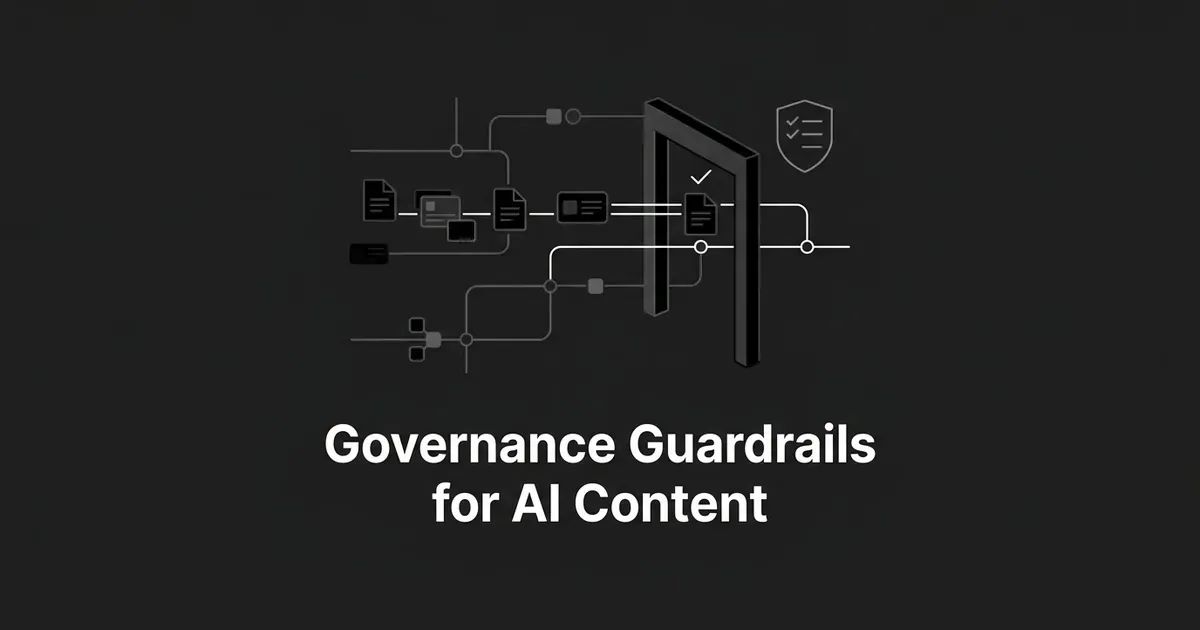
A workable gate sequence runs through several checkpoints. An intake gate confirms the brief, audience, jurisdiction, channel, and risk tier before anything gets drafted. A data gate confirms the input data is permitted and appropriately handled. A generation gate restricts the agent to approved tools, sources, and brand context. A substance gate verifies facts, claims, sources, and required qualifiers. A brand gate checks voice, positioning, and product naming. A legal or compliance gate routes anything high-risk to the right specialist and keeps a record of that decision. A publication gate checks metadata, disclosure, and the destination itself, and a post-publication gate keeps watching for complaints, corrections, or changes that make the piece stale.
Whoever is reviewing needs to see the actual output next to its source evidence, the agent and model version that produced it, any detected flags, and the approval checklist itself, not a hidden reasoning trail they cannot act on anyway. Each sign-off should record the asset and its version, the reviewer's name and role, what was checked, any exceptions accepted, the required disclosures, where it was published, and the decision itself along with a review date. You are done when your team can answer, for any published asset, who approved it, what they checked, what evidence they used, and where it went out. This is the point where a platform built for enterprise production earns its place: DeepSmith's Content Studio can route content into Produced Content for review before it publishes rather than pushing it straight out, and Autowrite can schedule production on a set date without that meaning the approval chain gets skipped. Automation should speed up how a piece reaches review, not replace the review itself.

Step 6: Keep a record of how each piece got made and approved
If your organization cannot reconstruct why a piece was published six months after the fact, you have a governance model that only works while everyone involved still remembers the details, which is not a governance model at all. This record is also what turns a legal sign-off AI content decision from a one-time click into something you can defend later, to a regulator, a customer, or your own leadership.
Record, for each asset, the original brief and the approved instructions used to produce it, the model and tool version, the input documents and sources, the retrieval date, the output versions and any material edits, who reviewed it and what they decided, the claim and rights evidence behind it, its disclosure status, and where and when it published. Provenance metadata and signed content credentials can help here: they record what changed and when, and a signature shows that someone attested to those facts at a point in time. What they cannot do is prove the underlying facts were true, so treat provenance as a complement to substantive review, never a replacement for it.
Protect this record the same way you protect any sensitive data. Audit logs can carry personal information, internal identifiers, or confidential prompts, so apply the same minimization and access controls you would to any other system that holds that kind of detail. You are done with this step when an authorized reviewer can reconstruct an asset's full production and approval history without relying on someone's memory or a chat session that is no longer accessible. A related trap worth naming directly: approving one article does not automatically approve everything made from it. A social post, an email, or an ad pulled from that article can shift the meaning, the audience, or the claim enough that it needs its own check, even though the source article already cleared review.
Step 7: Watch what happens after you publish, and know how to react
Governance does not end when a piece goes live. Claims expire, products change, regulations shift, and a model update can quietly alter how your agent phrases something it has written the same way for months.
Build a monitoring loop that checks for claims that have gone stale, product changes that make existing copy wrong, complaints or takedown requests, unapproved language creeping back in, broken source links, and content that somehow published without the approval or disclosure it needed. When something does go wrong, work through it in order: stop the workflow if it could keep causing harm, preserve the asset and its logs before anything changes, figure out the scope and who is affected, bring in the right owners from legal, privacy, and brand, fix or retract the content, notify anyone who needs to know, and then trace the failure back to the control that should have caught it. Update whatever broke, whether that is the claim library, the prompt, the context, or the approval path itself, and confirm the fix actually works before you consider the incident closed.
You are done when your team can disable an agent, identify every asset it affected, reach the right owners, correct what published, and show the specific change that keeps it from happening again. Do not treat a provenance credential or an AI-detection tool as proof that content is safe on its own; detectors can be wrong, and a signature only records that someone made an assertion, not that the assertion holds up.
What to do next
Do not try to govern everything at once. Pick your highest-volume workflow, inventory it fully, classify what it produces, build the claim and brand libraries it actually needs, and spend a month watching what gets flagged and why. Expand to the next workflow only once the approval path and incident process hold up under real use, not just on paper. That is how content governance at scale actually gets built: one governed workflow at a time, not a single policy rollout that tries to cover everything on day one.
If you want to see what governed production looks like in practice, DeepSmith's 7-day free trial gives you real data and real drafts before you pay, so you can see how shared brand context and a reviewable production workflow fit into a content operation like yours.