You opened a tab to build a content gap analysis. Twenty minutes later, you have a spreadsheet with 47 competitor URLs, a VLOOKUP that’s not quite working, and zero decisions made about what to write next.
Sound familiar? I’ve been there. We’ve all been there.
And let me tell you, the spreadsheet was never the real problem. The real problem is that we’ve been sold a lie that gap analysis is a data collection exercise. It’s not. It’s a judgment exercise. And judgment is something AI can help you with, massively, if you use it as a thinking partner instead of a keyword-dumping machine.
The right AI-assisted system doesn't just give you a list of missing keywords. It gives you a prioritized action list based on what your buyers need, what search engines are actually rewarding, and what only you can say.
Let's build that system.
The real reason spreadsheet-based gap analysis breaks (and what "gaps" mean now)
The old-school approach of crawling your site and your competitors' sites to find keywords you don't rank for was already painfully slow. Now, with AI changing the search game, it's just plain misleading.
Keyword gaps vs. intent gaps vs. format gaps vs. information gain gaps
After years of chasing phantom gaps, I’ve learned there are only four types that actually matter.
- Keyword gaps: Topics your content doesn't cover. This is the most basic gap and, honestly, the least important one for getting real traffic.
- Intent gaps: You cover the topic, but you completely miss what the reader actually needed. I see this all the time. A company writes about "API security best practices" when their reader just needed a simple checklist for a compliance audit. Same keyword, totally different job.
- Format gaps: You have the right information but in the wrong container. A buyer comparing prices needs a table, not four paragraphs of marketing copy. This also includes things like short video walkthroughs or interactive calculators when all you have is a wall of text.
- Information gain gaps: This is the big one. It's when your content exists and says all the same things as everyone else. You add nothing new. No original data, no hard-won experience, no specific point of view. This is the gap that will get you killed in AI-driven search.
Most tools only find keyword gaps. The ones that really move the needle, the other three, require your judgment.
Why AI answer engines raise the bar for “good enough”
When Google creates an AI Overview from your competitors' pages, it’s not just ranking you, it’s auditing you. If your content doesn't have a clear, citable answer to a question, you're not getting included. Period.
That’s a huge shift. The goal isn't just to rank on page one anymore. The goal is to be the source an AI engine quotes. To do that, you need content with real information density, clean structure, and an original perspective.
Even if you’re not seeing a lot of AI Overviews in your niche today, this is the direction things are heading. Adopting these principles now will help you win in both classic search and whatever comes next.
A no-spreadsheet AI gap workflow you can run in under an hour
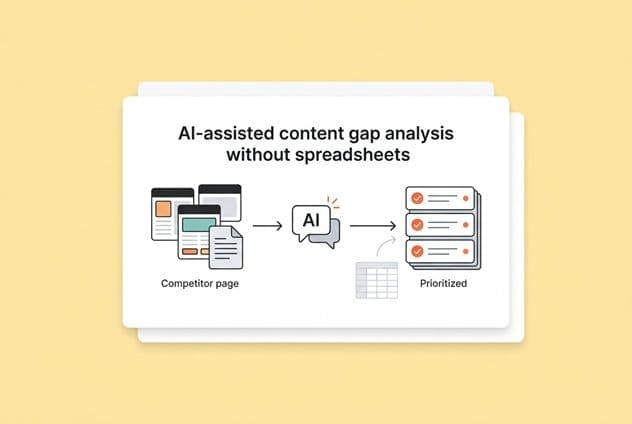
Okay, enough theory. Here's the exact loop I run. You can do this in under an hour for a single topic, and you won't have to export a single CSV.
Step 1 — Pick one "money" page/topic (don't start with your whole site)
Please, do not try to audit your entire site. You’ll just burn out. Pick one page that, if it performed better, would actually impact your business. For most of us, this is a pillar post, a comparison page, or that "what is [our category]?" article.
Step 2 — Capture what the SERP and AI summaries are rewarding
Search for your target topic. Take a screenshot of the AI Overview or featured snippet. What’s the exact question it answers? What format is it in? Then, look at the top three organic results. What do they answer that you don’t? How are they structured? What level of experience do they assume? Just copy and paste all this into a chat with an AI model.
Step 3 — Have AI classify competitor coverage into the 4 gap types
Now, give the AI your page's content alongside the competitor notes you just took. Here's a prompt frame I use all the time:
"Compare these two pieces of content on [topic]. For each gap you find, tell me if it's a topic gap (missing content), an intent gap (wrong job-to-be-done), a format gap (wrong structure), or an informational gain gap (same info, no new value). List them in order of likely impact on a buyer researching this topic."
This gives you a reasoned, sorted list instead of a useless word cloud.
Step 4 — Ask AI for a “query fan-out” map (what readers ask next)
A query fan-out is just the pattern of follow-up questions someone has. If they search for "how to price a SaaS product," they’ll probably ask "how to handle annual vs. monthly billing" next. You can map this out.
Prompt: "Based on [your topic], what are the 5–7 most common follow-up questions a buyer asks next? Rank them by how likely they are to represent purchase intent."
This gives you a map of sub-intents and shows you the internal linking opportunities your competitors are probably already using.
Step 5 — Convert findings into 3 actions: update, new post, or new format asset
Now you make a decision. Every gap you found gets one of three labels:
- Update: Your page covers the topic but is missing some depth or is in the wrong format. Easy fix. Add a section, sharpen an answer, fix the structure.
- New post: The follow-up question is big enough to deserve its own page. This will probably be a supporting article that links back to your main pillar.
- New format asset: You have the content, but it's in the wrong package. Turn that long guide into a quick checklist or a comparison table.
And that's it. You've gone from a vague idea to a concrete action plan in less than an hour.
How to prioritize gaps so you publish what matters (not just what’s missing)
Finding gaps is easy. The hard part is not letting the list of ideas paralyze you. A backlog full of unprioritized tasks is where content strategies go to die. So be ruthless.
The 4-question prioritization filter (impact, effort, uniqueness, intent fit)
For each gap, score it on four simple questions. Just use high, medium, or low. Don't overthink it.
- Impact: If we close this gap, will it actually help sell our product?
- Effort: Is this a quick update or a whole new project?
- Uniqueness: Do we have something truly original to say here? Some real data, a unique angle, actual experience?
- Intent fit: Is this a problem our buyers have right now, or is it something they might care about in the future?
A simple scoring table you can copy into any doc
| Gap | Impact | Effort | Uniqueness | Intent Fit | Do It? |
|---|---|---|---|---|---|
| Add pricing FAQ to pillar | High | Low | Med | High | Yes—this week |
| New post on compliance use case | High | High | High | Med | Yes—next sprint |
| Reformatting intro as definition | Low | Low | Low | Med | Maybe—batch it |
| Full competitor comparison page | High | High | Med | High | Yes—but after pillar update |
Fill this out for your top handful of gaps. Pick one or two. Ship those before you analyze anything else.
When to refresh an existing page vs. create a new one
Here's my rule of thumb.
Refresh if the page already has some authority and you're just adding depth or changing the format.
Create new if the sub-topic is genuinely distinct, has a different search query, or would make the original page feel bloated and unfocused.
When in doubt, update first. Improving a page that already exists is almost always faster than starting from scratch.
"Informational gain" in practice: how to add what AI can't synthesize from everyone else
This is the lever most teams ignore, and it’s the most powerful one you have. It’s how you create content that earns its spot instead of just taking up space.
The Informational Gain checklist (experience, specificity, proof, POV, constraints)
Before I hit publish or send a brief to a writer, I run it through this five-point check.
- Experience: Can a reader tell this was written by someone who has actually done the thing?
- Specificity: Are there real examples and numbers? Or is it all just "it depends"?
- Proof: Is there data, a test result, a direct observation, or anything that an AI couldn't just make up?
- POV: Does this content take a clear stand? Or does it just list options and refuse to offer a recommendation?
- Constraints: Does it tell the reader when not to use this advice? Talking about limitations builds huge credibility.
If you can’t check at least three of these five boxes, you’re probably just adding to the noise.
Anti-homogenization safeguards (so AI doesn't flatten your voice)
The risk with AI-assisted anything is that you start to sound like everyone else. If we're all running the same prompts on the same competitors, we'll all get the same editorial plan. Here’s how I fight that.
- Set source constraints: The only way I've found to do this at scale is to use a structured source of truth. At DeepSmith, our own system uses our positioning, voice rules, and product claims as guardrails on every output. This keeps the content grounded in what's true about us, not some generic version of our category. You can do this manually, too, it just takes discipline.
- Add one "only we could say this" requirement to every single brief. Before anything goes live, ask: what’s in here that our competitors couldn't publish?
- Human review on POV: AI is great for drafting structure and covering the basics. A human must own the angle and the recommendation. This isn't just a quality check, it's an ethical one. You have to stand behind the advice you give.
What to do if competitors all say the same thing
This happens a lot. When a topic is commoditized, you have two choices: go narrower or go deeper. Instead of writing "10 ways to improve retention," you write "Why churn spikes at day 14 for PLG tools and what to do about it." Narrow and deep almost always beats broad and shallow.
Optimize for AI citations without sacrificing human engagement (and conversion)
Citation-ready formatting that also improves skimmability
AI engines love structured, clearly labeled content: tight definitions, short paragraphs, and bulleted lists. The good news is, so do humans. Clear headers and front-loaded answers serve both your audiences. This should be part of your process from the start, not something you bolt on at the end. In our own tool at DeepSmith, we build this structural stuff right into the writing workflow because it's so easy to forget otherwise.
Zero-click realities: plan for visibility + downstream conversion paths
Let's be real, some of your target queries will get answered by an AI and won't generate a click. That's okay. Being cited in an AI summary is brand exposure. When that user is ready to buy, they'll remember your name. Your job is to make sure that the people who do click land on something that moves them forward, like a specific use case or a demo CTA.
Where E-E-A-T fits: credibility signals that strengthen both rankings and trust
Experience, expertise, authoritativeness, and trust (E-E-A-T) aren't just buzzwords. They show up as a named author with a real background, a specific example instead of a generic one, and a clear statement about the article's limits. Build this into your briefs from the beginning.
Turn gap analysis into an editorial operating system (so it doesn't die in a doc)
This is where most teams fail. A great analysis is useless if it never becomes published content.
The weekly loop: discover → brief → ship → refresh
This is the loop that actually works for small, busy teams.
- Discover (30 min/week): Run the 5-step workflow on one topic.
- Brief (20 min): Turn the top priority into a clear brief. Systems like our own Topic Explorer can help collapse this step, turning insights directly into briefs.
- Ship (main effort): Write and publish one great piece.
- Refresh (rolling): Check back in 90 days to see if you closed the gap.
Hand-offs and collaboration: what to store, what to standardize, what to automate
- Store: Your gap backlog and your prioritization scores.
- Standardize: Your brief format and your informational gain checklist.
- Automate: The cadence. This is the hardest part. It’s what separates a real content engine from a series of one-off projects. We got so tired of this being a bottleneck that we built automation for it in our own tool, but the principle is what matters: find a way to keep the line moving.
What to track over time (KPIs that indicate gap closure)
Skip the vanity metrics. Track these instead:
- SERP position movement on the queries you targeted.
- AI citation frequency: How often are you being cited in AI answers? Tools with citation tracking, like DeepSmith, can show you this.
- New organic entry points: Are you ranking for new queries?
- Engagement on refreshed content: Did time-on-page go up?
- Pipeline from organic: Is this content actually generating leads? If rankings go up but pipeline doesn't, you got the intent wrong.
Tooling options (lightweight to automated): what to use depending on your constraints
Manual + AI prompts (best for 1–5 pages)
You don't need a fancy tool to start. An AI model and a bit of curiosity are enough. This is perfect for founders who want to understand the process before they invest.
AI gap analyzers and competitor comparison tools (best for speed)
Dedicated tools can find gaps faster, but they rarely tell you why a gap matters or what to do about it. The judgment part is still on you.
Integrated production systems (best when execution is the bottleneck)
The real unlock isn't finding gaps faster, it's shortening the distance from insight to publication. If your backlog is full of ideas you never ship, your bottleneck is execution. This is where an integrated system (like DeepSmith's Content Studio) comes in, connecting research, briefing, and drafting so gaps actually get filled.
Your next step: run the 60-minute gap sprint
Reading about a system is one thing. Running it is another.
This week, pick one high-impact page on your site. Block 60 minutes and run the workflow. I promise you’ll end the hour with a prioritized list of actions you can actually ship, not a spreadsheet you’ll never open again.