I know how it is. You run a lean team. AI drafts save you hours on the first pass, but the output feels… generic. You see the same sentence shapes, the same abstract phrases, that same polished emptiness. Then leadership starts asking about AI search visibility. Your real fear isn't a detector flagging something. It's publishing content that sounds exactly like every other company in your category, quietly eroding the credibility you’ve spent years building.
By the end of this article, you’ll have a playbook. You'll know: (a) which signals readers pick up on before any tool does, (b) a checklist of the five human signals that build trust, (c) a 7-pass rewrite workflow you can run in under an hour, and (d) how to get your whole team on the same page without a single heroic editor burning out.
What Do Readers Notice First That Makes Writing Feel "AI-Generated"?
Here's a secret: readers don't run your content through a detector. They just stop trusting it, usually within the first two paragraphs. The technical term for what they're feeling is pattern fatigue. It's that mostly unconscious recognition that the writing is grammatically correct but totally empty.
Think of it as the uncanny valley of copy. The grammar is fine and the structure makes sense. But nothing commits to anything. There's no specific claim and no moment where you feel a real person made a real decision. It’s just a competent arrangement of familiar sentences.
Here’s the stuff that makes your readers’ eyes glaze over:
- Scaffolding phrases that do no work. Things like "It's important to note," "moreover," "in today's rapidly evolving landscape," or "as we navigate the complexities of." These are just filler transitions. They signal that the writer is stalling before saying something real.
- Templated sentence structures. You know the one: "It's not about X. It's about Y." That pattern can land with impact once. When it appears three times in an article, readers can feel the template underneath the words.
- Generic abstractions with no anchors. Words like "robust," "seamless," "powerful," "holistic," or my personal favorite, "tapestry." These words describe absolutely nothing. They are the linguistic equivalent of a stock photo.
- Monotone cadence. When every sentence is the same length and every paragraph has the same shape, it's a dead giveaway. Real human writing speeds up, slows down, and punches short for emphasis. AI drafts tend to keep the same rhythm no matter what they're saying.
- No lived perspective. This is the big one. There's nothing that suggests the writer has actually done the work. You don't see a moment where they chose one approach over another, a constraint they ran into, or an outcome they can describe from memory.
Detectors are just looking for statistical patterns. Your readers feel those same patterns, but they experience them as boredom, distrust, or that sinking "this could be any company" feeling.
Here's a practical self-test: swap your brand name for a competitor's. If the article still makes perfect sense, the content isn't human yet.
Which "Tell-Phrases" Should You Delete on Sight?
Cut these immediately: delve into, navigate complexities, it's important to note, in today's, moreover, seamlessly, robust solution, leverage, tapestry, empower your team, game-changer.
The fix isn't finding a fancier synonym. You have to replace these vague phrases with clearer verbs and specific nouns. Don't tell me to "leverage your content strategy." Tell me to "publish twice as many articles without adding headcount." Don't make me "navigate complexities." Help me "figure out which format Google's AI Overview actually cites." The specificity is the entire point.
What Are the Core "Human Signals" That Earn Trust Before Any Tool Gets Involved?
It took me years to figure this out, but human writing isn't quirky, it's specific and accountable. Here’s the five-signal model that separates content your buyers believe from the stuff they bounce from immediately:
1. Concrete language. This means numbers, named tools, specific job roles, and precise scenarios. Not "teams struggle with internal linking." It’s "you spend 45 minutes cross-referencing your sitemap manually, and half the time you skip it because you're already behind on the next brief." See the difference?
2. Perspective with stakes. What do you actually believe? What would you do if you owned the outcome? "We stopped producing weekly listicles because none of them had a clear editorial angle, and the traffic we got never converted" is infinitely more trustworthy than "quality matters more than quantity."
3. Rhythm and variation. Your sentences need to accelerate and slow down. Use short sentences for conviction. Use longer ones when you're working through a trade-off or adding nuance. We’ll get more into this below.
4. Honest trade-offs. You have to show the conditions where your advice breaks. "This works well for B2B SaaS content. It's harder to apply in e-commerce product descriptions where brevity is the entire game." Setting limits like this signals real expertise, not just cheerleading.
5. Evidence of thinking. This means showing your work. Talk about edge cases, counterarguments, and decision rules. For example: "If you're writing for an audience that knows this space cold, skip the definition and go straight to the edge case. They'll stay longer."
In a SaaS content world that's flooded with nearly identical posts, these signals matter more than ever. But a word of warning: "human" is not the same as "quirky." Please don't force jokes or casual slang into your B2B writing. Just aim for specific and true.
How Do You Add Specificity Without Adding Fluff?
It comes down to three moves I use all the time:
- Replace adjectives with measurable qualifiers. "Fast" becomes "cut the review cycle from 60 minutes to 15." "Significant" becomes "three additional articles per month with the same writer." If you can't measure it, it's probably fluff.
- Use observable moments. What does someone see on their screen? What happens in the meeting? "When the brief lands in the writer's inbox without a defined angle, the first draft almost always opens with a definition." Your reader will nod along because they've seen it happen.
- Name one or two examples per section. Don't use generic examples. Use actual tools, job titles, and artifacts from your world. Saying "If you're using Surfer or Clearscope to score drafts" grounds your claim in the reader's actual workflow.
How Do You Use First-Person Experience to Make Writing Feel Real (Without Making It Weird)?
Using first-person in B2B content isn't about telling long, meandering stories. It's about accountability. It’s saying: here’s what I did, here's what happened, and here's what I’d do differently now. That’s what makes it feel real and trustworthy.
It works because it signals ownership. A writer who says "when I audit a blog, the first thing I look for is pages with traffic but no internal links" is showing, not just telling, that they've run that audit before. That's a credibility signal a third-person construction just can't replicate.
Three safe patterns for using first-person in B2B content:
- The Process Confession. "When I review a draft before publishing, the first thing I cut is the intro. It's almost always the AI stalling before it says something useful."
- The Decision Rationale. "We moved away from weekly posts because the editorial lift per article was too high. Twice a month with real depth performed way better for us."
- The Scar Tissue. "This approach failed miserably when we didn't align the angle to a real buyer question. The piece ranked, but nobody converted. It was a painful lesson."
A few guardrails to avoid sounding like you're making it all up:
- Only claim what you can plausibly know. Don't invent a case study about a Fortune 50 company you've never worked with.
- Use "we" when you're talking about a team reality. Use "I" for your personal editorial judgment calls.
- Tie your first-person point to an observable artifact: a brief, an internal link audit, a content calendar, a keyword cluster.
First-Person Micro-Inserts You Can Paste Into a Draft
Feeling stuck? Drop one of these into any section that feels generic. I do this all the time.
- "If I'm editing this for publish, the first thing I cut is ___ because ___."
- "My rule of thumb here: if ___, then do X. If ___, just skip it."
- "We tried ___ and it worked great, right up until ___."
- "The version of this that fails usually looks like ___."
- "When this comes up in a content review, the question I always ask is ___."
- "I'd only recommend this if you already have ___ in place."
- "The first time I saw this work really well, the team had ___."
What Does "Rhythm" Mean in Business Writing, and How Do You Edit for It in 15 Minutes?
Rhythm is just controlled variation. It’s changing your sentence length, emphasis, and paragraph breaks to mimic how a person actually thinks and speaks. This isn't about literary flourish or poetic license. It's about pacing that creates emphasis when you need conviction and gives you space for nuance when you need to work through a trade-off.
AI drafts almost always have a "flat rhythm." The sentence lengths are uniform, the paragraphs are all the same shape, and the lists are perfectly symmetrical. Everything gets equal weight, which means nothing feels important.
A 15-minute rhythm edit pass you can run on any article:
- Add 2–3 short sentences for conviction. One idea. Full stop. It lands harder.
- Combine two sentences where you’re working through nuance. Trade-offs need a little breathing room.
- Break any paragraph over 4 sentences long into two smaller, single-idea blocks.
- Replace those clunky scaffolding transitions ("furthermore," "additionally") with simple, human ones: "but," "so," "here's why," or "the catch."
Before: "It is important to navigate the complexities of content production in a way that empowers your team to leverage their expertise seamlessly. By doing so, organizations can ensure that their content output remains both robust and impactful in today's digital landscape."
After: "Content production gets messy, fast. Briefs are vague. Drafts miss the angle. The SEO review always lands on one person's desk. The fix isn't a better template. It's a sequence that distributes the work before it all hits your desk."
Burstiness Without Chaos: How Much Variation Is Enough?
Here's the rule: vary for meaning, not for the sake of it. Short sentences work when you want to make a strong, confident point. Longer sentences work when you're walking the reader through a trade-off or a step-by-step process.
If you're explaining a numbered workflow, keep the steps clear and consistent. Don't sacrifice comprehension just to sound more rhythmic. Variation should always serve the reader. The moment it stops serving the reader, cut it.
How Do You "Show, Not Tell" in SaaS Content Without Writing a Novel?
"Telling" just labels the outcome. "Showing" gives readers something they can actually picture in their head.
"You're overwhelmed" is telling. "You have 18 open tabs open right now, don't you? GSC, Ahrefs, a Google Doc brief, Surfer, and a half-finished WordPress draft" is showing. The second version works because the reader sees their own screen. They feel seen.
A few more examples for SaaS content:
- "Internal linking is important" → "You hit publish, immediately remember you didn't add any links, and just skip it because you're already behind on the next brief."
- "Leadership wants an AI strategy" → "You get a Slack message from your CEO: 'Do we show up in Perplexity when someone searches for [your category]?'"
- "Teams struggle with voice consistency" → "Your freelancer writes in perfect AP style, your in-house writer uses parenthetical asides, and the AI draft sounds like a robot trying to imitate both of them."
A reusable "showing" checklist for any section:
- Name the role (head of content, freelancer, VP of Marketing).
- Name the tool or artifact (the brief, the content calendar, the Ahrefs cluster).
- Include a time cost or constraint ("with two writers and one freelancer on a two-week cycle…").
- Name the consequence of not doing the thing. What breaks?
How Do You Humanize an AI Draft Without Doing a Full Rewrite Every Time?
I get it. When a draft feels flat, the instinct is to just burn it down and start over from a blank page. That’s the slow path, and it leads straight to burnout.
The fast path is a structured sequence: you fix the structure first, then specificity, then voice and rhythm. Always in that order.
When teams try to fix the voice first, swapping out words or adjusting the tone, they end up polishing a paragraph that shouldn't even exist. If you fix the structure first, you make sure the right content is in the right place before you spend a single minute making it sound good.
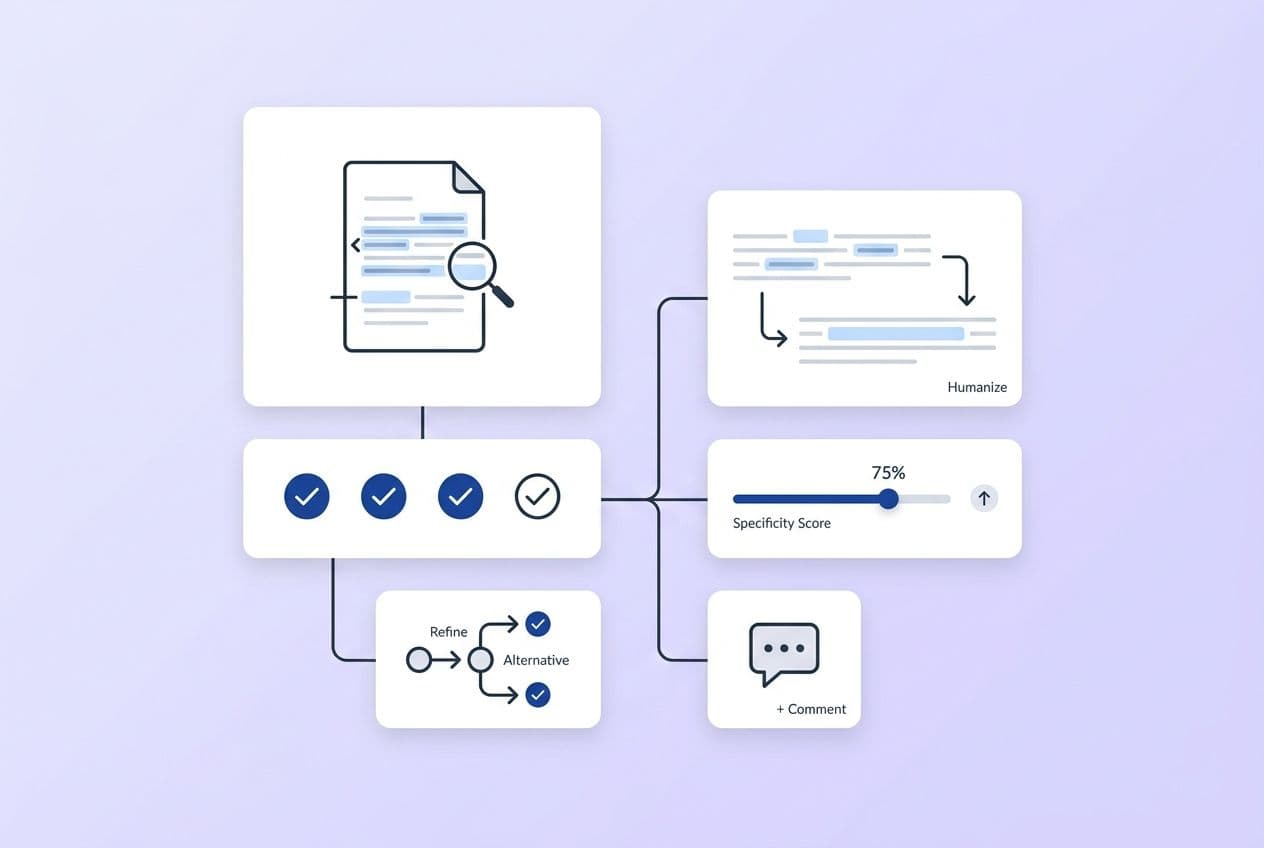
The 7-Pass Humanization Workflow:
- Angle pass. Add your actual stance to the intro and the opener of each H2. What do you really believe about this topic?
- Structure pass. Make sure each H2 opens with a direct answer to the question. Cut any throat-clearing that comes before the point.
- Specificity pass. Add numbers, named tools, and realistic scenarios. Hunt down and remove every abstract adjective you can find.
- Experience pass. Insert 2–4 first-person micro-inserts where credibility matters most.
- Trade-off pass. For every major claim, add a "when this breaks" caveat and at least one edge case.
- Rhythm pass. Vary your sentence length. Break up long paragraphs into punchy, single-idea blocks.
- Language pass. Delete all the robotic tell-phrases and transitions we talked about earlier.
Definition of done:
- Could a competitor publish this article without changing anything but the name? If yes, you're not done.
- Does every H2 have at least one concrete anchor (a number, a name, a scenario)?
- Do you have at least two explicit trade-offs or limits mentioned in the piece?
This is also where having a connected content pipeline really earns its keep. For example, tools like DeepSmith run a multi-agent workflow that handles the research, brief, draft, and initial QA, including a brand voice humanization pass. This is how Deep IQ feature works. It stores your positioning, persona, brand voice, and claim boundaries as structured data that shapes every draft the system produces. This doesn't replace an editor, but it does eliminate the brief-by-brief inconsistency that drives you crazy and compounds over time.
This is also where having a connected content pipeline really earns its keep. For example, tools like DeepSmith run a multi-agent workflow that handles the research, brief, draft, and initial QA. The editor can then focus on the truly human parts: the angle, the specificity, and the trade-offs, instead of worrying about whether metadata is filled in or internal links got added. That distinction is critical. The goal isn't to automate human judgment; it's to reduce the mechanical work so that human judgment gets more time and attention.
Automating those mechanical steps, the way DeepSmith handles internal linking, cover images, and CMS publishing, returns that time to where it matters most: editorial judgment.
The Fastest Edit: What to Cut (Not What to Add)
Cuts make AI drafts feel human much faster than additions do. Start here:
- Cut empty intros. If the first paragraph doesn't say anything the second paragraph doesn't also say (but better), just delete it.
- Cut repeated summaries. AI drafts love to summarize what they just said at the end of every single section. Cut them. Your readers are smart enough to keep up.
- Cut placeholder adjectives. Words like "comprehensive," "strategic," and "impactful." Delete them and see if the sentence still works. It almost always does.
- Cut any claim you can't explain. If you can't say why something is true or when it applies, it's not a real claim, it's just filler. Out it goes.
How Do You Scale "Human" Writing Across a Team (and Still Write for AI Answers)?
Scaling human-sounding writing isn't a training problem. It’s a standards and systems problem. Giving subjective feedback like "this doesn't sound like us" doesn't scale and just frustrates your writers. Shared, concrete standards are what actually work.
Claim-first writing is a great team standard to start with:
- Every H2 must open with a direct answer in one or two sentences. No exceptions.
- Every paragraph should contain one discrete claim plus its support.
- No paragraph can start with context-setting before making its point.
This standard also happens to be exactly what AI engines look for when they're extracting citable answers for their users. It turns out that structured, claim-first content performs better for human readers and earns more citations from AI platforms. It's not because it's "optimized for extraction," but because it's just plain clear.
Structured elements that AI engines love to cite:
- Comparison tables for trade-offs and options.
- Short, numbered checklists that can be lifted as standalone answers.
- Direct answer sentences right at the top of each section.
Operationalizing voice at scale:
Voice drift is inevitable when you're working with writers, freelancers, and AI tools. A giant style guide nobody reads isn't the answer. A "voice boundary" list is far more useful. This is a simple document outlining words you don't use, claims you won't make, the formality level for different content types, and how to use the first-person.
This is how DeepSmith's Deep IQ feature works. It stores your positioning, persona, brand voice, and claim boundaries as structured data that shapes every draft the system produces. This doesn't replace an editor, but it does eliminate the brief-by-brief inconsistency that drives you crazy and compounds over time.
And what about that AI visibility question? If your leadership is asking whether your brand shows up in ChatGPT or Perplexity, the answer needs to be better than just a few manual searches. DeepSmith's AI Visibility module lets teams track prompt-level citation rates across platforms, see which of your pages are earning those citations, and benchmark against your competitors. This gives you a real feedback loop between what gets cited and what you produce next. It's not a guaranteed win, but at least you're not flying blind.
Finally, there's the bottleneck nobody talks about enough: the human editing time that disappears into internal links, metadata, and CMS formatting. That's the tedious work that consistently crowds out the deep thinking, the example-finding, and the trade-off debates. Automating those mechanical steps, the way DeepSmith handles internal linking, cover images, and CMS publishing, returns that time to where it matters most: editorial judgment.
Human-sounding at scale: 3 operating models
You have three basic options for getting this done, each with its own pros and cons.
| Model | Pros | Cons | Where It Breaks | Who Owns Quality |
|---|---|---|---|---|
| Fully manual editorial | Maximum editorial control; consistent voice | Doesn't scale past 4–6 articles/month per editor | Writer turnover or a spike in volume collapses the whole system | The editor or content lead (the hero) |
| AI draft + humanization workflow | Faster first drafts; a structured editing pass | Relies heavily on editor skill; can be inconsistent across freelancers | When the editor is the bottleneck and there's no shared checklist | The editor (inconsistently) |
| Systemized pipeline with QA gates | Consistent output at high volume; voice is enforced structurally | Requires upfront setup; still needs human editorial judgment | When brand voice or product context isn't configured properly in the system | The system + a final review from the content lead |
One common misconception to clear up: typos don't make writing feel human. They just make it feel careless. You're aiming for naturalness and credibility, which come from specificity and perspective, not from deliberate errors.