A topic cluster strategy is how a lean SaaS team turns one core theme into a structured set of pages that compound in search authority and AI citations over time. The process has six steps: choose a pillar topic that maps to your product's core use case, build a 3-layer cluster map with AI, run a gap analysis against competitors, turn the map into briefs with an internal linking plan, govern for quality, and measure at the cluster level. AI accelerates every step - but only if you feed it real business context first, not a blank prompt.
Sound familiar? You open a blank doc, type "content cluster ideas for my SaaS" into an AI chat, and get back 20 perfectly formatted subtopics that could belong to any software company on earth.
That's not a cluster strategy. That's a content vending machine. It's the reason so many AI-assisted content programs feel like a waste of time after the first month. You get a ton of output, it's all painfully generic, and none of it actually helps you find customers.
I'm here to argue something specific: AI is a strategy accelerator, not a strategy replacement. When you use it right, it can help you turn one solid theme into a fully mapped, prioritized, ready-to-write cluster in a single afternoon. Used wrong, it just produces a pile of overlapping articles that confuse search engines and attract tire-kickers.
The difference is all in your workflow. It's about what you put in, how you check what comes out, and whether you've built a real system or just a long list of ideas.
This whole process can feel messy when your plan is in a spreadsheet, your prompts are in a chat tool, and your drafts are in a doc. We've all been there. As founders, we can fix this friction by using a single connected system that carries the plan (your clusters and gaps) into production (your briefs and drafts) without losing all the context along the way.
Here's the end-to-end process I use. It actually works for lean teams like ours.
The real problem: "AI can generate topics" isn't a strategy
Let's be honest about where most of us start. We ask an AI for content ideas, get a long list, and call it a content calendar. The problem isn't the tool, it's how we're thinking about it.
What a topic cluster is (and what it isn't)
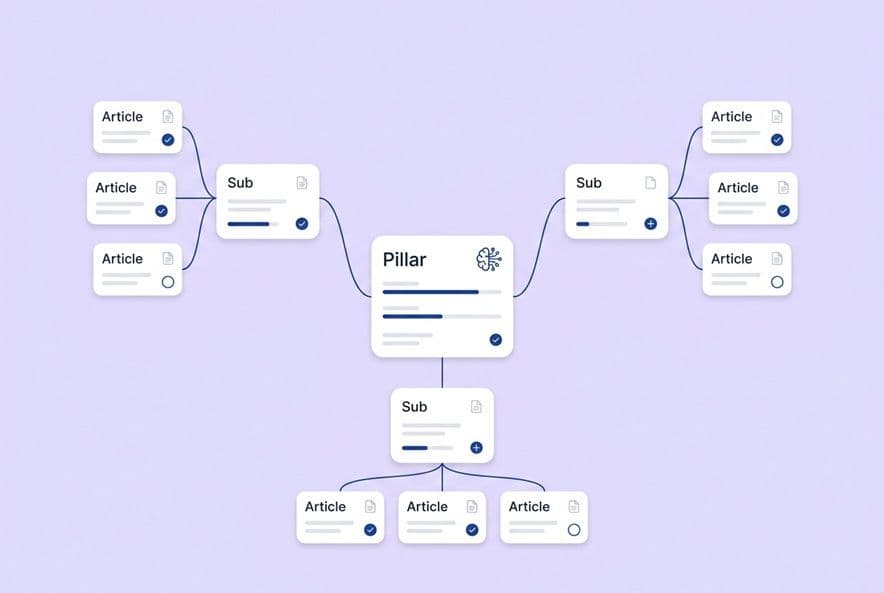
A topic cluster is a structured set of pages built around a single core theme. You have one pillar page (a big, comprehensive resource on the topic) and a set of supporting articles that go deep on specific subtopics. Each supporting piece links back to the pillar. As Search Engine Land's guide on the subject puts it, the approach works because it signals depth and authority to search engines through interconnected content — not just isolated posts.
Every page has its own job, a specific reader question it needs to answer, and a clear next step you want the reader to take. It's a system. A list of posts about a similar subject with no linking plan? That's just a blog category, not a cluster.
The failure modes of AI-first planning
When you jump straight to asking an AI for ideas without giving it any real direction, you run into the same three problems every time. I've made all these mistakes.
First, you get generic content. The AI defaults to what's most common online, not what makes your company special. Second, you get overlap and cannibalization, where two articles end up fighting for the same search query, splitting your authority and confusing Google. Third, you get off-positioning content that brings in the wrong audience or completely misrepresents what your product is for.
This workflow is designed to prevent all three.
Step 0: Gather the inputs AI needs
An AI only gives you back what you give it. Before you generate a single idea, you have to do the human work of preparing three layers of context.
Business goal + conversion target
Every cluster needs one main goal. Are you trying to get trials? Demo requests? Newsletter signups? Write it down: "The goal of this cluster is to move readers from being problem-aware to requesting a trial." This decision shapes which articles you prioritize and what your calls-to-action will be. A cluster without a conversion target just becomes a machine for generating traffic for traffic's sake.
ICP + pain narrative + "proof points" inventory
Grab your Ideal Customer Profile description, but focus on the actual words your customers use. What do they search for when they feel the pain your product solves? What result are they desperate for? Then, add your product's key differentiators and any proof you have (customer stories, specific data, unique features). This is what separates a cluster that sounds like you from one that sounds like your competitor.
Your existing content + competitors you must beat
Audit what you've already published so you don't write the same article twice. Then, find two or three competitors who are already ranking for your target theme. You're not going to copy them. You're mapping where their coverage ends so you can find your opening.
Step 1: Choose a pillar topic that can actually win (and convert)
This is the most important decision you'll make. Get it wrong, and you'll build a beautiful cluster that attracts students or enterprise buyers you can't even sell to. Get it right, and every article you publish will bring you closer to qualified customers.
Pillar selection criteria
A strong pillar topic for a SaaS company has to pass four tests:
- Relevance: Is this exactly what your ideal customer is searching for when they're ready to buy? Not something adjacent. The actual problem they have.
- Intent depth: Can you cover this topic in a way that's genuinely helpful? "What is CRM" is a bad topic for a startup because it's too basic. "How to build a sales process for a 10-person B2B team" gives you room to provide real value.
- Defensibility: Can you own an angle here that bigger, more generic competitors can't easily copy? Your unique insight is your moat.
- Expansion room: Can you spin off at least 8 to 15 supporting articles from this pillar? If you can only think of five before they start to blur together, your topic is too narrow.
A simple prioritization scorecard
If you have a few candidate pillars, rank them with this quick scorecard. Use a 1-3 scale (3 is best).
| Criterion | Description |
|---|---|
| Conversion proximity | How close is this topic to your product's main use case? (3 = core problem, 1 = far away) |
| Competitor moat | How weak is the competition for your specific angle? (3 = wide open, 1 = super crowded) |
| Team effort | How easy is it to create 8+ articles on this? (3 = easy, 1 = huge lift) |
Add up the scores. The highest-scoring candidate is your next cluster. It's simple, repeatable, and takes ten minutes.
Red flags: pillars that attract the wrong audience
Watch out for three common traps. First are trend topics that attract curious people, not buyers (like "what is generative AI" if you sell a DevOps tool). Second are category-defining terms so broad that you'll never outrank Wikipedia. Third are education-only topics that attract people who will never buy software. The goal is qualified attention, not just volume.
Step 2: Build the cluster map with AI
Once you've locked in your pillar, this is where AI can do the heavy lifting. A good prompt will generate a structured map in one pass, but only if you feed it the context you gathered in Step 0.
The 3-layer cluster model
For a 10–15 article cluster, this model works perfectly:
- Layer 1: Pillar page: One huge guide covering the whole topic (2,000-3,500 words).
- Layer 2: Sub-pillars: 3-4 deep dives on major subtopics.
- Layer 3: Supporting articles: 6-10 posts targeting very specific questions (how-tos, comparisons, templates, etc.).
Use this structure when you prompt your AI: "Map a topic cluster for [pillar topic]. Give me a pillar, 3 sub-pillars, and 8 supporting articles. For each, assign a working title, target query, content type (how-to, comparison), and intent tier (learn/evaluate/implement). Make sure no two pages target the same query."
Intent tiers to include
A cluster fails if it's all one-note. If it's all educational "learn" content, you never nudge people toward a decision. Aim for a mix: about 40% learn (understanding the problem), 40% implement (how-to guides, templates), and 20% evaluate (comparisons, "X vs. Y"). The "evaluate" tier is where your ready-to-buy customers are hanging out. Don't skip it.
Anti-cannibalization rules
Before you write a single brief, check every page in your map. Is the target query unique? Is the content angle distinct? Does the CTA match the reader's intent? If two articles feel too similar, merge them now. Fixing this after you've published is a nightmare.
Step 3: Do AI-assisted cluster-level gap analysis
You don't need to publish the whole cluster at once. You need to find the articles that will deliver results the fastest. This is where you find your opportunities, but it's slow to do by hand. Some tools automate this step (our Topic Explorer at DeepSmith does this), surfacing keyword gaps and AEO prompt opportunities in one view. It lets you push that plan directly into production so it doesn't just die in a Google Doc.
Gap types to look for
When you look at what your competitors have already published, look for four kinds of gaps:
- Missing subtopic: A key question your customer asks that nobody is answering well.
- Weak intent match: A page that ranks but doesn't actually solve the searcher's problem.
- Outdated angle: Content that was right two years ago but is irrelevant now.
- Missing proof/steps: Articles that explain what to do but never show how to do it.
Prioritization: quick wins vs. moat-builders
Your quickest wins are articles targeting lower-competition keywords with high conversion potential. Publish these in the first month. Your moat-builders are the big sub-pillar pieces that take more effort but become defensible assets over time. Plan those for months two and three. Start publishing, link as you go, and use the early data to guide the rest of the plan.
AEO opportunities inside a cluster
AI-powered search engines are starting to cite specific passages, not just whole pages. Every article in your cluster should have at least one section that cleanly answers a direct question in two to four sentences. No fluff. Find five to seven questions your ideal customer would ask an AI about this topic, and assign one to each supporting article. Research from Princeton University found that content with specific statistics and cited sources earns 30–40% more AI citations — so ground your answers in real data wherever you can. This is like future-proofing your content.
Step 4: Turn the map into briefs and an internal linking plan
A strategy that lives in a doc isn't a strategy, it's a wish list. The handoff from planning to writing happens at the brief stage.
Brief template essentials
I learned this the hard way: a bad brief guarantees a bad article. Every brief needs a clear promise, a section-level outline, a list of "must-answer" questions, and specific "do/don't" guidelines for the topic. Without that last part, AI drafts will always drift toward being generic.
Internal linking blueprint
Plan your internal links before you start writing. The rule is simple: every supporting article links up to the pillar and across to at least one other supporting article. The pillar links down to every sub-pillar. And don't just use the same anchor text every time. Vary it based on the context.
Step 5: Govern quality, ethics, and originality
The faster you publish, the more damage one bad article can do. Set these rules before you hit the gas.
Accuracy rules
Make a list of claims that always require a source, like market stats or competitor comparisons. Anything an AI generates about your own product must be checked against your documentation. AI likes to guess confidently when it's unsure. Google's own helpful content guidelines are clear on this — content needs to demonstrate real expertise and accuracy to earn trust from both search engines and AI models. Teach your team to be skeptical.
Bias, privacy, and transparency basics
Don't feed customer data (names, emails, company info) into public AI tools. That's a huge privacy violation. Watch for bias in AI-generated personas; they often default to an enterprise view that might not fit your early-stage reality. If you use AI heavily, a simple disclosure in your editorial standards is a good idea.
Keeping creativity alive at scale
The fastest way to make boring content with AI is to let it draft from a blank page. Before you prompt, write two or three sentences from your own experience. Use your own stories or a counterintuitive opinion as the seed. The AI can structure it, but the spark has to come from you.
Step 6: Measure cluster performance and run a refresh cycle
The first article in a cluster is a bet. The sixth, properly linked and maintained, is an asset. Clusters compound, but only if you pay attention.
The metrics that matter
Track performance at the cluster level, not just the article level. You're looking at aggregate organic impressions for all cluster URLs, click-through rate by intent tier, and assisted conversions (articles that were part of a customer's journey, not just the last click). Don't expect a clear signal in the first 30 days. It usually takes 60-90 days to see what's working.
When to refresh vs. merge vs. prune
| Signal | Action |
|---|---|
| Traffic is declining, but the content is still accurate | Refresh: update examples, add AEO answers, improve links. |
| Two articles are ranking for the same keywords | Merge: pick the stronger one and redirect the other. |
| Article gets traffic but has zero conversions for 6+ months | Prune or change the CTA and intent. |
| Article is performing well | Leave it alone. Don't mess with what's working. |
Operating cadence: monthly checks + quarterly re-mapping
Check in monthly to review trends and flag any big changes. Every quarter, pull up the full cluster map, see what you've actually published versus the plan, and run a new gap analysis. This is when you decide to expand the cluster, start a new one, or double down on a winner. A lean team can do this in half a day.
Your next step: Build your first cluster plan in one session
You have the workflow. Now you just have to run it.
Pick one pillar topic that passes the four tests. Write down your conversion goal. Generate a cluster map using the 3-layer structure. That's your first-pass plan. From there, you're executing.
If you want a system to manage this whole workflow without hopping between five different tools, DeepSmith's Topic Explorer and Content Studio are built for this. Our platform helps you find gaps and then enforce your product's unique positioning in every draft. The entire chain, from strategy to published article, runs in one place.
But you can start right now with a doc and the process above. The goal is to stop generating random content and start building an asset that compounds. That's the whole game.