You published three articles last quarter. Your competitor, somehow, published thirty. So you wake up, type your category into ChatGPT, and their name pops up twice in the first response. You’re not mentioned once.
That stings. I know it does, especially when you know your product and your customers better than anyone on the planet. The problem isn’t your expertise. It’s that your whole content operation is built around you as the single point of failure.
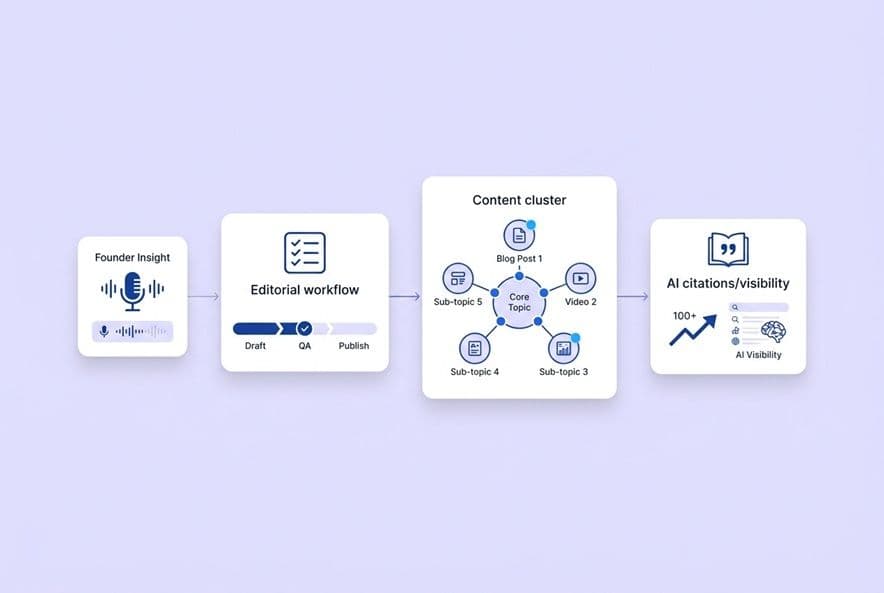
Let’s get right to it: Your expertise is your most valuable raw material. But you, as a production system, are killing your visibility. The fix isn’t to write less or to flood your blog with generic AI filler. It’s to build a system that extracts your insight once, scales it into a content ecosystem, and signals to AI answer engines that your brand is the authority, consistently.
The Uncomfortable Truth: AI Rewards Systems, Not Heroes
I remember when publishing one brilliant, 3,000-word essay a month was a winning strategy. Those days are over.
AI answer engines like Google AI Overviews, ChatGPT, and Perplexity don’t reward the single best piece of writing. They reward the brand that shows up reliably across multiple relevant angles. They look for consistent messaging and external validation. That’s the outcome of a system, not a last-minute heroic effort.
What “visibility” means now (think citations, not just clicks)
The scoreboard has completely changed. Old-school SEO was all about ranking #1 and getting the click. In the AI era, winning looks different. Your brand gets cited inside an AI-generated answer. Your name gets recalled when someone asks “what tool should I use for X?” And you appear in the third-party lists that AI models use for their research.
A user might never even visit your site. They just see your name as part of the answer they were looking for. This is the new reality of zero-click search, and being present in the answer matters just as much as getting a click.
Why your competitor looks bigger than they are
Content ecosystems have a powerful compounding effect. I’ve seen smaller competitors look like giants because they consistently publish clusters of interconnected content. They’ll have a pillar page, a few comparison guides, and a handful of FAQs all pointing to each other. This trains AI models to see them as the go-to authority on a topic.
Add a few mentions from review sites or industry roundups, and suddenly they look twice their size in an AI’s eyes. The AI isn't evaluating your headcount; it’s evaluating the density of your signals.
7 Ways Founder-Led Content Fails (And How to Spot It)
This is the diagnostic part. And if you’re like most founders I know (myself included, in the early days), you probably have two or three of these happening right now.
1. Narrative drift (you explain the product differently every time)
Be honest. Does your homepage, your last blog post, and your LinkedIn bio all describe what you do in the same terms? If not, you’re actively confusing AI models about what your brand is. AI’s understanding of your company depends on consistent signals. When your positioning shifts from post to post, it can’t confidently recommend you as a definitive answer.
2. Inconsistent publishing (you ship when you have time)
We’ve all been there. The intention is to publish weekly, but reality is closer to "when I have time." Sporadic publishing just doesn't build topical authority. AI models look at your coverage depth and how recently you’ve talked about a topic. One great article isn’t the same as a whole ecosystem that covers a subject from every angle. "When I have time" is a cadence that AI ignores.
3. “Thought leadership” that doesn’t answer questions
This one hurts because it feels like you’re doing the right thing. Nuanced takes and big-picture reflections are great for human readers, but they are nearly impossible for an AI to pull from and cite. AI answers are built from structured, specific content like definitions, step-by-step guides, and comparison tables. If your content is all story and no structure, it’s practically invisible to generative search.
4. No content architecture (just a pile of posts)
Every post you publish as a standalone island is a huge missed opportunity. Internal linking and content clusters are what signal to search engines which topics you own. Think of it as a hub-and-spoke model. A central pillar page links out to supporting articles, and those articles link back. This creates a powerful authority signal that a bunch of random posts never will.
5. Your voice becomes a bottleneck (the dreaded rewrite cycle)
You feel like you have to approve everything because freelancers just don't get the product right. I get it. But that’s a governance problem, not a writer problem. The result is a pile of drafts sitting in your inbox for weeks. You end up rewriting so much you might as well have written it yourself. You need a system with documented rules, not founder oversight on every single sentence.
This is exactly why we ended up building a tool for ourselves, DeepSmith's Deep IQ layer. It stores our positioning, product facts, and things we never say, and checks every piece of content against it. This removes the founder from the review process without sacrificing accuracy.
6. Distribution gets skipped (publish and pray)
You hit publish, share it once on LinkedIn, and move on to the next fire. But the off-site brand mentions on review sites, directories, and industry lists are a massive input for AI models. If your content never earns those external signals, the AI has no way of knowing it matters to anyone but you.
7. No measurement loop (you’re flying blind)
If you're not tracking how often you’re cited in AI answers or if your brand is recalled in prompts, you have no idea what’s working. You can't improve what you don't measure. And you certainly can’t prove the ROI of your content to your board without it.
What AI Answer Engines Actually Reward
Think of Answer Engine Optimization (AEO) as SEO's more demanding sibling. The foundations are the same, but the execution has to be much stricter.
Owned signals: Crawlable, structured, and up-to-date pages
First, your site has to be technically sound. It needs to be fast, mobile-friendly, and easy for bots to crawl. Beyond that, AI models reward content with clear entity signals (using consistent product and category names), structured headings, and fresh content. Using schema markup is a simple way to help crawlers understand your content better, increasing the odds it gets cited.
Off-site signals: Brand mentions, reviews, and consistent messaging
Third-party validation is incredibly powerful for AI visibility. AI models are trained on the web, and the web's consensus about your brand shapes how you appear in answers. This means you need to be listed on relevant software comparison sites, earn genuine reviews, and have a consistent brand description everywhere.
Platform differences that change your tactics
ChatGPT and similar models favor sources that are mentioned frequently across the web. Google's AI Overviews, on the other hand, pull from Google's own index, so traditional SEO signals like expertise and authority are still highly relevant. You don’t need a completely different strategy for each. A strong content ecosystem and a healthy footprint of off-site mentions will serve you well on both.
The Fix: A Founder-Led Insight Engine
The goal is simple. Your expertise feeds the system; the system does the work.
Define what only you can do (and timebox it)
There are a few things only you can contribute. Your unique point of view, proof points from customer calls, specific product nuances, and the "forbidden claims" that would mislead buyers. That’s pretty much it. Put a two-hour box around your content contribution each week. Use that time to approve topic ideas, record a quick voice memo on a subject, or review a simple checklist, not to rewrite entire drafts. Everything else should be delegated or systematized.
Build your "source of truth" document
Writers and AI tools get things wrong because they don't have documented truth. So, create one. Build a simple document that captures your exact product descriptions, the right category language, who your ideal customer is, and the competitor comparisons you're comfortable making. When this source of truth lives inside a content platform, it frees you from being the accuracy police.
Turn your knowledge into reusable pieces
A single conversation with you probably contains enough material for twenty pieces of content. Your job is to extract it once into reusable pieces. Think FAQs from sales objections, "best for" statements for each buyer, definitions of key terms, and customer win stories. These small pieces feed into your content briefs and become the specific, structured answers that AI models love to cite.
A Repeatable Editorial Workflow for AI Citations
Here's the operating system. Your job is to validate the inputs at the start, not rewrite the outputs at the end.
Step 1 — Select topics that build an ecosystem
Stop thinking in terms of random posts. Start with topic clusters. Pick a core area your customers care about, build a pillar page that covers it, and then map out smaller articles that answer specific questions. We use our own Topic Explorer to find these clusters and content gaps, which turns our strategy directly into briefs for the team.
Step 2 — Write briefs that force specificity
A good brief for this new era is very specific. It should include the target question, the key terms to use, comparison angles, "best for X" positioning, and which internal pages to link to. This has to be tailored to your buyer. A brief for a technical buyer in a regulated industry might require links to data sheets, while one for an SMB owner should focus on ease-of-use examples. Generic briefs produce generic drafts.
Step 3 — Structure drafts for easy extraction
Structure every draft with AI in mind. Use a clear H2/H3 hierarchy. Open sections with direct definitions. Use numbered lists for processes. Add comparison tables and FAQ blocks. Our Content Studio builds these checks right into the drafting process, so what comes out is already 90% of the way there and doesn't need a huge SEO overhaul.
Step 4 — Use a lightweight QA to protect accuracy
Your quality assurance process should be a checklist, not a reliance on your gut feeling. Check for a few simple things: Are all product claims within the documented bounds? Are the right terms used consistently? Does the content actually answer the question? This should take fifteen minutes per article, not two hours of painful line edits.
Step 5 — Follow a distribution checklist to earn mentions
For every piece you publish, have a plan. Share it on LinkedIn. Pitch a summary to a relevant newsletter. Update your directory listings. Add the article's core claims to your sales enablement library. Using something like an Agent Library can help you generate these different assets automatically, so distribution isn't another manual job.
Measurement and Correction: Tracking Your AI Share-of-Voice
You can't grow what you can't see. Measuring your AI visibility requires a consistent routine.
A simple AI visibility scoreboard
On a weekly basis, run a standard set of 10-15 questions your ideal customer would ask (I call this a "prompt pack") across ChatGPT and Google AI Overviews and just log who appears. Monthly, tally up how often your brand gets cited versus your competitors and watch for new third-party mentions. We built prompt tracking and citation tracking into our platform so this becomes a simple, systematic task.
How to run a prompt pack
Build your prompt pack once and just reuse it. Include questions like: "What is the best tool for [your use case]?", "Compare [you] vs [competitor]", and "What should I look for when buying [category]?". Run them every month, log what you find, and use the gaps in your visibility to decide what to write about next.
What to do when AI gets your brand wrong
It will happen. When an AI model hallucinates your positioning or repeats an old description, fix it in this order. First, update your own website (homepage, about page, product pages) with the correct language. Second, update your third-party listings like G2, Capterra, and Crunchbase. Third, publish a new piece of content that directly answers the question where the wrong information appeared.
Decision Support: Where to Invest First
With limited time and budget, the order you do things in really matters.
A prioritization matrix for early-stage teams
If your site has major technical problems (it's slow or can't be crawled), fix those first. If your technicals are solid but you have very little content, focus on building out your content ecosystem. If you have content but no one is talking about you, shift your effort to earning those third-party mentions. Most early-stage teams I talk to are in that second bucket.
Questions to ask a vendor or new hire
Whether you're evaluating a freelancer, an agency, or a new tool, ask them these questions point-blank:
- Does this system have a source of truth that I control?
- Does it check what it produces against my actual product facts?
- Does it include distribution and measurement?
- How does this approach future-proof our strategy? The answer shouldn't be about chasing algorithms. A good system is built on fundamentals that are adaptable, not reactive.
- Does it require me to rewrite outputs or just review them? If the answer is "rewrite," you're just buying the same bottleneck with a different name.
How to align marketing and sales
Your AI visibility content is your best sales enablement material. Comparison pages, articles that handle common objections, and "best for X" guides are exactly what your reps need for follow-up emails. Share your content calendar with the sales team. Let the objections they hear every day drive your next topic cluster. When a prospect asks "how do you compare to your competitor?", there should be a published, AI-indexed page with the answer.
Your Next Step: Remove Yourself from the Production Path
Look at that list of seven failure modes and pick the one that made you wince. Then, make one change this week. Just one. Write a source-of-truth document, map out your first content cluster, or run your first prompt pack and see what you find.
You don't need a full content team to build AI visibility. You just need a system that extracts your expertise once and scales it without you having to touch every single output. That's the whole shift: from founder-as-writer to founder-as-input. Start there. The bottleneck isn't your knowledge; it's your process.