You published a handful of blog posts, checked your rank tracker every day, and… nothing. Crickets. I’ve been there. You see a big competitor ranking for everything and start to wonder if SEO is a lost cause for a small team like yours.
It’s not. But the standard SEO playbook is.
Chasing keywords with decent volume is a volume game, and you will lose to companies with bigger content teams. Let them play that game. We’re going to play a different one. We’re going to go so narrow and deep on one specific problem that your company becomes the only answer that matters.
That’s what a topic cluster is when you use it right. It’s not just an SEO tactic; it’s a system for owning your niche. I’m going to show you how to build that system without it turning into a soul-crushing, months-long project.
Why founders lose at "keyword SEO" (and how topic clusters change the game)
The real enemy: being generic in a market where incumbents can outpublish you
Let's be honest. Chasing a keyword like "project management best practices" means you're picking a fight with Asana and Monday.com. You’re not going to win that fight today. It isn't that your content is bad. The problem is you're fighting on their home turf, where they have more domain authority and a decade's head start. Spreading your efforts that thin is a recipe for burnout.
Topic clusters aren't an SEO tactic—they're a niche positioning system
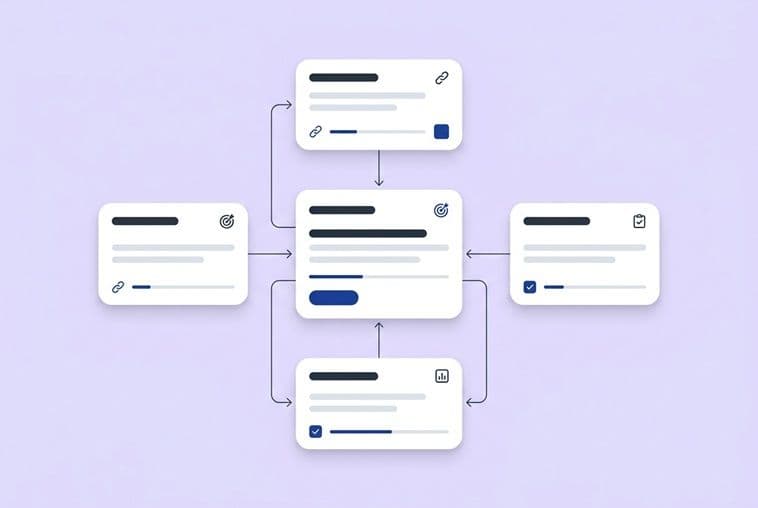
A topic cluster connects a main pillar page to a set of related articles, showing search engines (and people) that you are the expert on this one thing. But here's the part most guides skip: the topic has to come from your gut, from your strategy, not from a keyword tool. When your cluster is about a real problem your best customer is trying to solve, it does more than earn traffic. It drives pipeline. This is the move from just "doing SEO" to actually building authority where it counts.
Pick a niche wedge you can actually own (before you map a single keyword)
Seriously, don't skip this part. I used to. It’s why my early content efforts were a mess of generic posts that went nowhere. Start here, before you even think about opening an SEO tool.
The wedge formula: ICP pain × high-stakes job × your unique mechanism
Your perfect content wedge is where these three things meet:
- A specific pain your customer feels. Not "scaling content," but "how do I publish consistent blog content without hiring a full team?" Get specific.
- A high-stakes job they need to get done. This is the problem that keeps them up at night, the one they will happily pay to make go away because it’s tied to revenue or survival.
- Your unique way of solving it. How does your product or your approach solve this problem differently?
For a founder selling an AI content tool to lean teams, the wedge might be: AI-assisted content production for SaaS teams who don't have a content department. See how specific that is? You can own that. It’s tied directly to a real buyer, and it’s honest about how your product helps.
Write that sentence down. Every single piece of content in your cluster should help a buyer struggling with that exact thing.
"Big market" vs. "ownable niche": how to avoid the too-broad pillar trap
"Content marketing for SaaS" is a market. You can't own that. "AI-powered content production for early-stage SaaS teams" is a wedge. You can.
I see founders fall into the "too-broad" trap all the time because they’re afraid of being too niche. Don’t be. A pillar page trying to be the "ultimate guide to content marketing" is just donating budget to Google’s ad business. A pillar page that promises to show how lean SaaS teams build a content engine without a big department has a real chance to win.
Here’s the test: Can you picture your best customer reading every page in this cluster and thinking, "Wow, they wrote this just for me"? If the answer is anything but a loud "yes," your wedge is still too broad.
A quick sanity check: will this cluster create sales conversations?
Before you marry a pillar topic, ask yourself these three questions:
- Would someone searching for this have a problem my product solves?
- Would they trade their email for the answers on this page?
- Could a well-placed CTA get them on a demo call?
If you can’t say yes to all three, it’s the wrong cluster. You’ll get traffic, but it won’t be the kind of traffic that pays the bills. Trust me, vanity traffic is worse than no traffic. It just wastes your time and clouds your data.
The founder-friendly cluster blueprint (pillar → clusters → target pages)
What the pillar page must do (and what it should not try to do)
Your pillar page is the big one, usually 2,000 to 3,500 words. It covers your topic at a high level. It's the "how you should think about this problem" guide. It should NOT try to cover every little detail. That’s what the cluster pages are for. The pillar frames your unique approach and then links out to the deeper articles. Think of it as a hub that gets the reader started and points them in the right direction.
Cluster pages by intent, not by "keyword variants"
This is where I see people create a lot of extra work for themselves. They write five articles that are basically slight variations of the same thing. Don't do that. Map each cluster page to a distinct question or a different stage of the buyer's journey. For a pillar on building a lean content engine, your cluster pages could be about briefing writers, auditing content, measuring ROI, or using AI. Each one serves a separate, clear purpose.
From cluster to "target pages": decide create vs. merge vs. optimize
Before you write a single new word, look at what you already have. You might have some old blog posts that could be polished into perfect cluster pages. You might have two or three posts on the same topic that should be merged into one monster page. Only write what's actually missing. This audit gives you a real plan. You’ll have a list of pages to create, optimize, or merge. Start with the pillar, then work on the cluster pages closest to a sale.
A step-by-step workflow a small team can run in 2–4 weeks
Okay, this is where most guides wave their hands and say "good luck." We're just getting started.
Week 1: map the niche and your gaps (without boiling the ocean)
Grab your wedge sentence. Now, spend a few hours (no more!) figuring out the real questions your customers are asking. Forget the massive keyword spreadsheets for a minute. Look at Google's "People Also Ask," your own sales call notes, Slack communities, Reddit, and review sites. You're just looking for 10-15 subtopics that represent real questions.
Then, do a quick competitive check to find the easy wins. Look at what’s already ranking and find where the content is:
- Thin: A 500-word summary where your buyer needs a real playbook.
- Outdated: The advice is from 2019, before the world changed.
- Generic: The top results are all saying the exact same thing with no real point of view.
- Missing: Nobody is answering a specific question you hear in sales calls all the time.
Those gaps are your entry points. You can win by being more specific, more current, or more opinionated.
Week 2: draft the pillar + first cluster set (MVP cluster)
Your first goal is a Minimum Viable Cluster. That's one pillar and four to six cluster pages. Not twenty. Four. To. Six.
Draft the pillar first. It sets the tone and maps out your internal links. Then, draft the cluster pages, starting with the ones closest to a buying decision. For each one, write down the goal: who is this for, and what will they know when they're done reading?
Week 3–4: publish, interlink, iterate, expand (depth before breadth)
Don’t wait for perfection. Get the pillar and a couple of cluster pages published and indexed. Watch the early signals, like clicks and time on page. Then publish the rest. Make sure all your internal links are set up before you even think about the next cluster.
Depth before breadth. This is my mantra. A cluster with six amazing pages will always beat a cluster with fifteen thin ones. This rhythm also keeps things manageable for a small team.
Where AI helps vs. where humans must decide
AI is a great assistant. It can speed up research, spit out a first draft, and suggest topics. It should not be deciding your strategy. Your editorial angle, your unique point of view, and whether a page actually helps a real person are human decisions. They require context that only you, the founder, have. The biggest risk with AI is that it creates a ton of generic content that sounds vaguely like you but doesn't have a soul. The fix is a strong human editor with a clear vision for the cluster.
Internal linking that actually builds authority (advanced tactics founders can use)
The generic advice is "use descriptive anchors." True, but that’s like saying "use good ingredients" when baking a cake. Here's the rest of the recipe.
The three link types every cluster needs (pillar ↔ cluster, sibling, and "money page" paths)
- Pillar ↔ Cluster Links: This is the backbone. Every cluster page links up to the pillar. The pillar links down to every cluster page.
- Sibling Links: Your cluster pages should link to each other when it makes sense. This keeps readers on your site and shows Google everything is connected.
- Money Page Paths: At least a few cluster pages need a natural, in-text link (not a loud, obnoxious banner) pointing to your demo page, pricing page, or whatever your key conversion page is. This is how you turn readers into leads.
Anchor text optimization without looking spammy
Use your main keyword as the anchor text only when it feels completely natural. Most of your links should use phrases that make sense in the sentence, like "how we structure our content briefs" instead of just "content briefs."
My one hard rule: never use the exact same anchor text to link to two different pages. That just confuses search engines and makes your own pages compete with each other.
Prevent cannibalization with link signals + clear page roles
Every page needs one job, one primary keyword. If two pages are doing the same job, they'll both fail. You have to pick one. Either merge them or use your internal links to signal which one is the "real" page for that topic. The primary page gets more internal links with better anchor text.
A simple internal link audit checklist you can run monthly
Do this for 30 minutes once a month. It’s worth it.
- Does every cluster page link back to the pillar?
- Does the pillar link out to every cluster page?
- Are there sibling links between related cluster pages?
- Do you have money paths from your content to a conversion page?
- Are you using the same anchor text to link to different pages? (Find and fix!)
Measuring ROI: how to know your cluster is working (beyond rankings)
Define success per page type: pillar vs. cluster vs. conversion pages
Different pages have different jobs. Track impressions and clicks for your pillar page. For cluster pages, measure organic clicks on long-tail keywords and time on page. For pages with a CTA, the only thing that matters is conversions.
The metrics that matter to founders: leads, conversions, sales-assisted influence
You need to connect this work to revenue. Use UTMs, set up goals in your analytics, and tag leads in your CRM. Every quarter, ask: how many leads did we get from the blog? How many of them turned into customers? You don't need a perfect attribution model. If organic leads are going up and they're turning into real money, the system is working. If traffic is high but leads are flat, you have a conversion problem, not a content problem.
When to expand breadth vs. deepen content you already have
Always default to depth. Before you get excited and start a new cluster, make sure your first one is actually working. Is the pillar ranking? Are cluster pages indexed and getting some clicks? Are you seeing any conversion signals? Only expand when the first cluster is stable and you've run out of important subtopics to cover.
Make the cluster compound: updates, distribution, and multi-format reuse
Update strategy: what to refresh, what to consolidate, what to retire
Look at your cluster pages quarterly. If impressions are dying, the page might need a refresh with new data or examples. If two pages are fighting for the same keyword, merge them. If a page has zero clicks and no purpose after six months, kill it and redirect the URL to a related page. Be ruthless.
Cross-channel amplification: turn each cluster page into a distribution asset
Publishing is not the last step. Every article should be turned into a LinkedIn post, a section in your newsletter, and a social media thread. This is not optional. It’s how you get early traction and signals that help you rank faster.
If you want to streamline the repurposing step, turn each cluster page into a distribution asset.
Build an operating rhythm you can sustain as a founder
Here’s a realistic pace for a small team: publish one new or updated page per week, do one internal link audit per month, and one performance review per quarter. Consistency at a sustainable pace will always beat heroic sprints followed by burnout. You're building an asset, not just running a one-time campaign.