Leadership just asked what your AI search strategy is, and you realized you cannot answer with data. That is a stressful place to sit. It is also more common than you think, and you are closer to a real answer than it feels right now.
Here is the good news. The work of choosing the best LLM monitoring tools for enterprise teams comes down to a short, honest checklist, not a six-month evaluation. You need to know where your brand shows up when buyers ask ChatGPT, Gemini, Copilot, and Perplexity, where you are invisible, and what you can do about it without adding headcount.
Buyers are already there. Roughly 94 percent of B2B buyers used a generative AI tool during their most recent purchase, and a growing share now prefer generative AI over traditional search when they research vendors. Zero-click searches keep climbing, which means a smaller slice of demand ever reaches your site the old way. If a competitor is the one AI names, you are losing deals you never see. The point of enterprise LLM monitoring is to make that invisible loss visible, then fixable.
You do not have to solve all of it this week. You need one tool that lets you monitor brand across LLMs enterprise buyers actually rely on, and then a clear next move. That is what a good shortlist gives you.
This guide compares four tools that handle enterprise LLM monitoring: DeepSmith, Profound, Mentionable, and maxAEO. Take it one section at a time. By the end you will have a shortlist you can defend to your CEO.
How we picked these tools
AI search is not a side channel anymore. AI-driven search traffic has grown fast over the past year, pulling attention away from the classic blue links. A growing share of buyers now research vendors inside AI answers instead of a search bar.
A "best tools" list is only useful if you know how the ranking was built. Here are the five criteria we used, so you can weigh them against your own situation.
- Multi-model coverage. The tool tracks brand presence across at least three major LLMs at once, including ChatGPT, Perplexity, and at least one of Gemini, Claude, Google AI Mode, or Copilot. Single-engine trackers did not make the list.
- Enterprise controls. It supports the things procurement asks about: SSO or SAML, audit trails, role-based access, a recognized security standard like SOC 2, and multi-workspace or multi-brand support.
- A path to action. It either ships content production tooling or offers a clearly bounded service layer, so insight turns into published work instead of another dashboard nobody acts on.
- Transparent pricing. It publishes real numbers or a named enterprise tier with a stated starting point, not a black box.
- Stack integrations. It connects to your marketing stack (analytics, search console, CMS, cloud, or warehouse) through native connectors or webhooks at minimum.
Multi-model LLM tracking enterprise buyers can trust starts with breadth of coverage, then adds governance. Keep those two criteria at the top as you read. Everything else is a tie-breaker.
Comparison at a glance
DeepSmith leads the table because it is the only option here that pairs cross-model monitoring with publish-ready content production in one workspace. The rest earn their place for real reasons, which we cover honestly below.
| Tool | Category | Engine coverage | Entry price | Content production | Governance | Best for |
|---|---|---|---|---|---|---|
| DeepSmith | Analytics plus production | ChatGPT on Pro, scaling to all 10 supported engines (adding Gemini, Perplexity, Claude, Copilot, Grok, Meta AI, DeepSeek, Google AI Overviews and AI Mode) on Enterprise | $99/mo Pro ($80/mo annual) | Built-in Writer and Autowrite; publishes to WordPress, Webflow, Strapi, Sanity, Contentful, webhooks | Multi-workspace isolation, Deep IQ brand governance, audit-friendly history, custom Enterprise limits | Content teams wanting analytics and production in one place |
| Profound | Analytics plus agentic workflows | Up to 10 engines on Enterprise | $99/mo Starter (annual billing) | Agents and Agent Templates; no in-product writer | SOC 2 Type II, SSO via SAML or OIDC, RBAC, REST API | Large enterprises with formal security review |
| Mentionable | Analytics plus agency reporting | All seven engines on every paid tier | ~$85/mo Growth (EUR 79) | Recommendations and audits only | Multi-tenant RBAC on every plan, white-label reports | Agencies needing shareable audits at low per-engine cost |
| maxAEO | Done-for-you GEO service | Eight referenced platforms | $29/mo Basic (service) | Strategists execute on your behalf | Engagement-based SLAs | Brands that prefer to outsource strategy |
A few notes before the deep dives. Profound's lower tiers bill annually, so the monthly figure is what you owe up front for a year. Mentionable prices in euros, so convert before you compare against a dollar budget. maxAEO is a service engagement, not seat-based software, so its "price" buys strategist time rather than logins. We call these out again where they matter, because a fair comparison depends on lining up like with like.
The tools
1. DeepSmith

Best for: mid-market and enterprise content teams that want LLM monitoring and content production living in a single workspace, scaling from one engine to all 10 supported engines as the program grows.
DeepSmith is an AI search analytics and content production platform in one. It tracks how AI engines answer questions about your brand, surfaces the gaps where you are invisible or losing, and produces publish-ready articles in the same place, all from the same context. Here is the part worth repeating: the output is publish-ready, not a first draft to rescue. That distinction is the whole reason a monitoring tool and a production tool belong together.
Think about how the alternative usually goes. One tool tells you that ChatGPT never cites you for your core buying question. Then you export a list, brief a writer, wait a week, review a draft, fix the structure, add internal links by hand, and hope the new page earns a citation. DeepSmith collapses that loop. The gap you spot on Monday can be a scheduled article by Friday.
Here is what you get.
- Visibility metrics that mean something. DeepSmith reports mention rate, citation rate, share of voice, sentiment, page-level citations, and visibility trends across all 10 supported engines: ChatGPT, Gemini, Perplexity, Claude, Google AI Overviews, Google AI Mode, Grok, Meta AI, Microsoft Copilot, and DeepSeek. Coverage rises with your plan: Pro tracks ChatGPT, Grow adds Perplexity, Scale adds Gemini, and Enterprise covers all 10.
- Prompts with the receipts. Every tracked prompt shows per-prompt mention and citation rates, full answer history, and the actual answers behind the numbers, so you can see why AI said what it said.
- A Pages view that ranks your own content. See which of your pages AI actually cites, each page's share of your total citations, and the prompts driving them.
- Competitor citations. Find out who wins citations for your prompts, on which exact pages, and how each competitor performs per platform.
- Deep IQ brand governance. Positioning, differentiators, claims to make and avoid, tone, voice, palette, and reusable content formats live in one place and shape every draft, so your brand stays consistent as volume goes up.
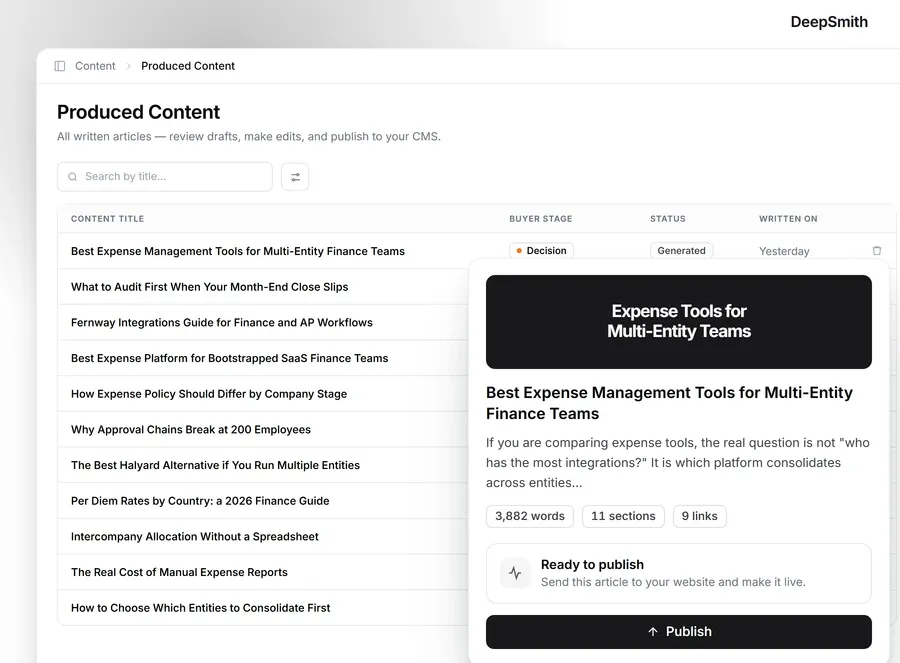
- Content Studio and the Writer. Ideas move from New Ideas to Planned to Produced. The Writer turns one planned idea into a finished, brand-grounded article that is researched, internally and externally linked, with a cover image and publish-ready metadata.
- Autowrite. Configure an article at planning time and it writes itself on its scheduled date, landing in Produced Content with no one in the app. This is what turns content from a task you run into a system that runs.
- Distribution built in. Repurpose and the Apps Library turn one finished article into LinkedIn, X, newsletter, Reddit, Slack, and more, each adapted to the channel.
- Publishing where you already work. Push directly to WordPress, Webflow, Strapi, Sanity, and Contentful, or export Markdown and HTML through webhooks to any custom CMS.
- Multi-workspace by design. Isolate brands or clients with separate context, content, and plan limits, and invite teammates as owner or member.

On price, DeepSmith is refreshingly legible. Pro is $99 per month ($80 annual), Grow is $199 ($160 annual), Scale is $399 ($299 annual), and Enterprise is custom with 1:1 onboarding and a dedicated account manager. There is a 7-day free trial with real data and real drafts, and no long-term contract, so you can see your own visibility numbers before you spend a dollar.
One honest limitation. DeepSmith is monitoring and production, not a heavyweight compliance suite. If your procurement cycle gates on published SOC 2 documentation, deep SSO and SCIM provisioning, or on-prem deployment, confirm the current compliance posture with the DeepSmith team before you promise it in a security review. For teams whose deciding factor is a cadence of published, on-brand content tied to live AI visibility, it is the strongest fit here.
2. Profound

Best for: large enterprises that need a formal, documented security posture and agentic workflow orchestration sitting on top of broad engine coverage.
Profound is an enterprise-grade LLM monitoring platform that pairs prompt-level brand tracking with demand intelligence, agentic content workflows, and AI crawler analytics. It is sold through a sales-led motion, and it does not advertise a public self-serve trial, so expect a demo rather than a signup form.
What stands out:
- Broad engine coverage. Profound tracks brand presence across ChatGPT, Perplexity, Claude, Gemini, Grok, Microsoft Copilot, Meta AI, DeepSeek, and Google AI Overviews, with up to ten engines on Enterprise.
- Prompt Volumes. Aggregate demand signal for the prompts AI engines actually receive, so your strategy is grounded in what buyers ask, not what you assume.
- Shopping Agent Analytics. Monitors how AI shopping agents surface products and prices, which matters if you sell through those surfaces.
- Agents and Agent Templates. These execute AEO content workflows autonomously inside the platform.
- Agent Analytics. Tracks how often ChatGPT, Gemini, Claude, Perplexity, and other bots crawl your site, with trend graphs.
- Serious governance. SOC 2 Type II, SSO via SAML or OIDC, role-based access control, REST API access, daily backups retained one week, and premium Slack and email support on Enterprise.
If a security questionnaire is the thing standing between you and a purchase, Profound's published posture is the most complete in this comparison, and its integration list (Akamai, AWS, Cloudflare, Fastly, Google Analytics, GCP, Netlify, Vercel, WordPress) is built for enterprise infrastructure.
One honest limitation. There is no native in-product article writer. Content production runs through Agents and Templates that connect to external systems, so if you want drafts and publishing inside one workspace, plan to pair Profound with a separate content tool.
3. Mentionable

Best for: agencies and lean in-house teams that need shareable, white-label audits across every major LLM at the lowest per-engine price.
Mentionable is a monitoring-first visibility platform. It runs daily prompts across every supported LLM on every paid plan, tracks share of voice and citations, and packages the results into client-ready GEO audits. It tells you where you stand and what to do next, without producing the content itself.
The features worth knowing:
- Every engine on every tier. All seven engines (ChatGPT, Claude, Gemini, Perplexity, Copilot, Google AI Mode, and Google AI Overview) are available on every paid plan, including entry-level Growth. That is unusual, and it is why the per-engine price is so low.
- Share-of-voice analytics. Compare your visibility against competitors across all monitored LLMs.
- Source and citation tracking. See which websites each LLM cites in your niche, with authority scores per domain.
- Audience personas from prompt data. Identify who is asking the prompts driving each brand's visibility.
- Fast onboarding. Automatic prompt generation produces 15 to 20 starter prompts from a URL, so you skip manual keyword research.
- Client-ready audits in minutes. GEO audits run in under 10 minutes on any domain, delivered as white-label reports.
- MCP integration. Connect Mentionable data into Claude Desktop, Cursor, ChatGPT, and any MCP-compatible agent.
- Agency-friendly access. Multi-tenant RBAC on every plan, unlimited team members, and white-label reporting on the Agency tier.
Pricing runs about $85 per month for Growth (EUR 79), roughly $160 for Pro (EUR 149), and about $320 for Agency (EUR 299), with a free trial that needs no credit card. For an agency pitching new logos, that combination of full engine coverage and white-label reports is hard to beat on cost.
One honest limitation. Mentionable is monitoring and recommendations only. There is no built-in writer or scheduler, so closing the gaps it finds means pairing it with a separate content production and publishing workflow.
4. maxAEO

Best for: brands that would rather outsource GEO and AEO strategy and execution to a service team than operate a platform in-house.
maxAEO is a done-for-you service, not a self-serve dashboard. It sells Generative Engine Optimization and Answer Engine Optimization engagements built around four deliverables, backed by a live AI visibility dashboard. If your team has budget but limited in-house GEO expertise, this is the model that asks the least of your people.
What the engagement includes:
- Generative Engine Optimization. Content and brand engineering to earn citations in Google AI Overviews, ChatGPT, Perplexity, Claude, and future engines.
- Answer Engine Optimization. Structured, authoritative content and schema to win AI answer boxes and conversational results.
- Authority Signal Engineering. Citations, mentions, data quality, and knowledge-graph work to build the trust signals AI looks for.
- Full-Funnel Query Mapping. Discovery of high-intent buyer questions mapped to opportunities you can realistically own.
- A live visibility dashboard. Tracks share of voice and citations across eight referenced platforms, including ChatGPT, Perplexity, Claude, Gemini, DeepSeek, Grok, Mistral, and Google AI Overviews.
- Strategist-led delivery. Senior strategists turn the data into prioritized action plans, rather than handing you a dashboard to interpret alone.
The trade is simple. You give up hands-on control and get expert time in return. For a lean team with no GEO specialist, that can be the fastest path to results. It is the one option here that does not ask you to learn multi-model LLM tracking enterprise teams usually build in-house, because the strategists do that part for you.
One honest limitation. maxAEO is a service, not software. Published pricing tiers exist ($29, $69, and $199 per month), but per-tier deliverables are not enumerated, there is no self-serve trial or login, and onboarding starts with a sales conversation. You are buying strategist time, so treat those tiers as engagement levels rather than software seats.
How to choose
Most B2B buyers now lean on generative AI somewhere in their purchase, so picking the wrong tool is not just wasted budget, it is missed demand. You do not need all four. You need the one that fits how your team works. Here is the honest version.
Pick DeepSmith when monitoring and content production should live in one workspace, you publish through WordPress, Webflow, Strapi, Sanity, Contentful, or webhooks, and a steady publishing cadence matters more than a compliance binder. If reducing tool count and closing the loop from gap to published article is the goal, this is the best fit for enterprise LLM monitoring paired with production.
Pick Profound when a security review is the gating decision. If SOC 2 Type II, SSO or SAML, and RBAC have to be checked before anything else, and you want demand and crawler analytics on top of monitoring, Profound is built for that procurement path. It is the better choice for the largest, most compliance-driven enterprises.
Pick Mentionable when you run an agency or a lean in-house team, you need shareable white-label audits across every major LLM at the lowest per-engine price, and you are comfortable pairing it with a separate content workflow. When client-ready reporting and price-per-engine matter most, it wins.
Pick maxAEO when you would rather hand GEO strategy and execution to a service team than run a platform yourself. For brands with budget but no in-house GEO expertise, outsourcing is a legitimate answer.
Not sure which describes you? Start with the two questions at the top of this guide: how many engines do you need to monitor brand across LLMs enterprise buyers actually use, and do you need governance-grade controls on day one. Your answers narrow four tools to one fast.
Ready to see your own numbers?
The hardest part is not choosing a tool. It is looking at your real visibility for the first time. That is also the most clarifying thing you can do this quarter.
If you want monitoring and publish-ready content in the same workspace, start a free DeepSmith trial and watch your mention and citation rates come in on real data, with real drafts, before you pay. One small step this week beats another quarter of guessing.