Writesonic starts from AI answers and acts on the gaps through an Action Center and AI agents, while Surfer SEO starts from what ranks in Google and scores drafts in its Content Editor, with a five-engine AI Tracker added on. Writesonic suits teams that want to find AI visibility gaps and act on them, and Surfer suits writers who optimize pages against the search results. DeepSmith is a strong alternative to both on how the work gets done, because it tracks AI answers, plans articles in bulk, and publishes them on schedule through Autowrite.
If you are weighing Writesonic vs Surfer SEO, the first thing to settle is where your content work begins. Writesonic begins with AI visibility, checking how AI assistants mention and cite your brand and then acting on the gaps with agents and an article writer. Surfer begins with the search results page, where its Content Editor grades a draft against the pages that rank. The split follows how AEO differs from SEO, and each tool has moved toward the other. DeepSmith covers both halves and is placed here as a third option.
Writesonic vs Surfer SEO: the short answer
- Choose DeepSmith if you want AI answer tracking and finished articles in one self-serve plan, with Autowrite planning in bulk and publishing on schedule. Plans run $99, $199 and $399 a month ($80, $160 and $299 billed annually), with 20, 40 and 90 articles a month.
- Choose Writesonic if you want to start from AI visibility and can move to an Enterprise contract for the full Action Center and all ten engines, since the self-serve plans track three.
- Choose Surfer SEO if your writers work against the SERP every day and you want the Content Editor and Content Score, with AI tracking added on the AI Search Analytics, Pro or Peace of Mind plans.
| DeepSmith | Writesonic | Surfer SEO | |
|---|---|---|---|
| Entry plan, billed annually | $80/mo (Pro) | $79/mo (Starter) | $49/mo (Discovery, no AI tracking) |
| Content allowance, entry plan | 20 articles/mo | 15 AI articles/mo | 120 documents, create or optimize |
| Prompts tracked, entry plan | 50 | 50 | 0 (25 on Standard, ChatGPT only) |
| Engines, entry plan | ChatGPT | ChatGPT, Gemini, Google AI Overviews | None (ChatGPT on Standard) |
| Most engines on any plan | 10 (Enterprise) | 10 (Enterprise) | 5 |
| Free trial | 7 days | 7 days, no card | 7 days of Pro |
| AI visibility tracking | Yes | Yes | Yes |
| SERP-based content scoring | - | Not listed | Yes |
| Brand voice and knowledge grounding | Yes | Yes | Yes |
| Internal linking | Yes | Not listed | Yes, Pro and up |
| Scheduled publishing | Yes | Not listed | Partial, via Zapier |
| SOC 2 | Yes | Yes, claims Type II | Not listed |
| G2 rating | 4.8/5 | 4.7/5 | 4.8/5 |
Pricing and features as of September 2026, from each vendor's site and public reviews.
Writesonic
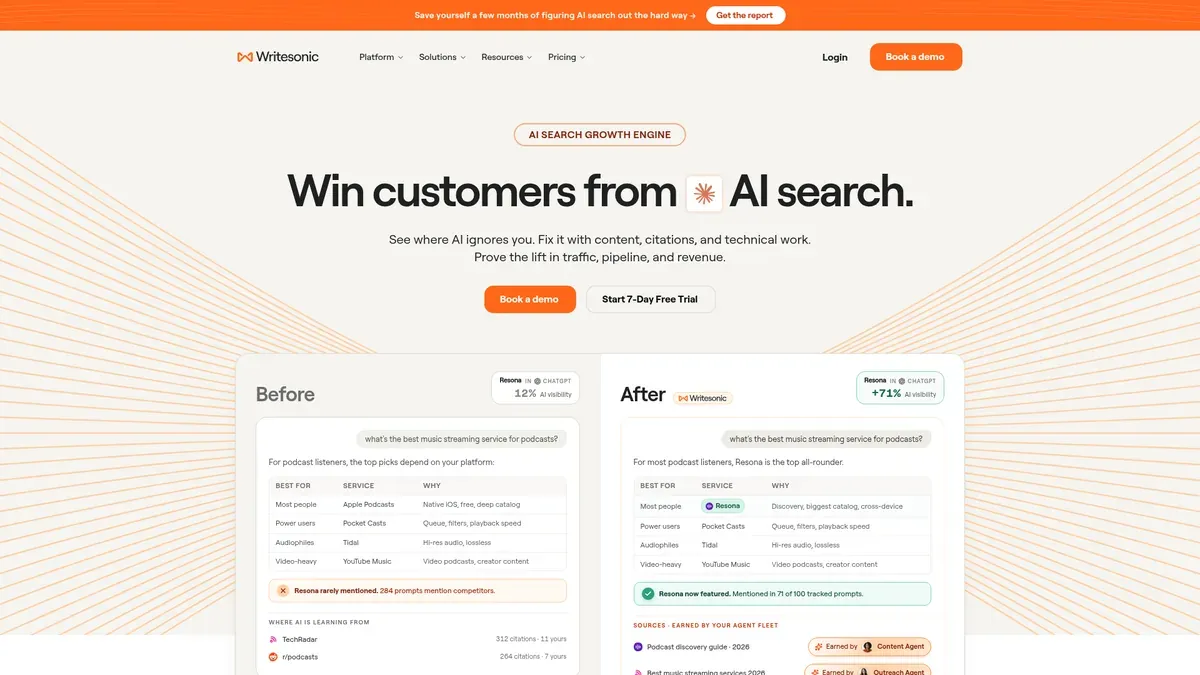
Writesonic began in 2021 as an AI writing tool and now calls itself an AI search growth engine. It tracks prompts daily and reports brand mentions, citations, share of voice and sentiment across AI assistants. Around the tracker sit AI crawler analytics, AI ads tracking, site audits, an Action Center that ranks on-page, off-page and technical fixes, and an Article Writer that Writesonic says produces long-form articles with citations, FAQs, schema and images. It is built for marketing, SEO and content teams and for agencies that want tracking and execution in one tool.
The standout is how much sits next to the tracker. A team can see a gap, get a ranked fix and generate a page from the same account. The real limit is plan gating. The self-serve plans (Starter at $79 a month billed annually, Basic at $199 and Growth at $399) list three engines, which are ChatGPT, Gemini and Google AI Overviews. All ten engines, the full Action Center and most execution features sit on custom Enterprise plans. Month-to-month prices are not shown on the pricing page.
Review volume is large, and most of it comes from the older writing product and not the AI visibility platform. G2 shows 4.7/5 across 2,133 reviews, checked on 2026-09-30. Capterra shows 4.8/5 across 2,102. Reviewers who used the AI visibility side mention a learning curve and some unclear scoring.
Surfer SEO

Surfer is a content optimization platform from Wroclaw, Poland, founded in 2017 and acquired by Positive Group in October 2025. Its center is the Content Editor and Content Score, which grade a draft in real time against the top-ranking pages and the pages AI answers cite. The score is now split into an SEO half and an AI Search half. Around it are Keyword Research, Topical Map, Surfer AI for drafting, Auto-Optimize, Content Audit and an AI Tracker. It is built for SEO and content practitioners, in-house teams and agencies who write or refresh articles against what ranks.
The standout is the editor, which reviewers keep praising for guidance that is easy to act on. The AI Tracker checks five engines (ChatGPT, Perplexity, Google AI Mode, Google AI Overviews and Gemini), and Surfer says it collects answers from the consumer interfaces and averages several runs a day. The real limit is gating. Discovery has no AI tracking, Standard tracks 25 ChatGPT prompts weekly, and Topical Map, internal linking and Custom Voice need Pro. Reviewers call the pricing and document limits tight for small teams, and some find the suggestions formulaic.
Review volume is smaller, and the scores are high. G2 shows 4.8/5 across 546 reviews, checked on 2026-09-30. Capterra shows 4.9/5 across 422. Reviewers mostly praise the Content Editor.
DeepSmith: the alternative that tracks, writes and publishes on schedule

Both tools can now track AI answers, so the useful difference is how a gap becomes a live page. Writesonic reaches content through agents and an Article Writer, with the full Action Center on Enterprise. Surfer reaches it through the Content Editor, where a person works one document at a time, and its record shows no native scheduled publishing. Both are real strengths, and neither record lists a hands-off, scheduled path from a tracked gap to a published article.
DeepSmith tracks and produces in one platform. AI Visibility reports mention rate, citation rate and share of voice for each engine, and Opportunity Agents turn the gaps into ideas that each carry the data point behind them. Ideas land in New Ideas, and giving one a date plans it, one at a time or in bulk. The Writer then turns each planned idea into a researched, internally and externally linked article with a cover image and publish-ready metadata. It is grounded in Deep IQ, the brand context you set up once from your website, so voice, persona and product facts stay the same from article to article. Autowrite writes each article on its scheduled date and can take it all the way to published with no one in the app. Produced Content publishes to WordPress, Webflow, Strapi, Sanity or Contentful, or to your own webhooks.


Pro is $99 a month ($80 billed annually) with 50 tracked prompts, ChatGPT tracking and 20 articles a month. Grow is $199 ($160) with 100 prompts, adds Perplexity and gives 40 articles. Scale is $399 ($299) with 200 prompts, adds Gemini and gives 90 articles. Enterprise is custom, covers all ten engines and adds onboarding and a dedicated account manager. There is a 7-day free trial and no long-term contracts. DeepSmith is SOC 2, GDPR and ISO certified and rated 4.8/5 on G2.
Starting point: AI answers or the SERP
In Surfer SEO vs Writesonic, this axis is a tie, because the two tools begin in different places and the better one depends on where your buyers find you.
Writesonic's loop runs from AI answers outward. It finds prompts where your brand is missing, ranks the on-page, off-page and technical fixes by an ICE score of impact, confidence and effort, and measures each fix afterward at day 14 and day 28. That fits a team whose main worry is being left out of ChatGPT answers. Surfer's loop runs from the SERP inward. Its Content Editor builds guidelines from the top 10 Google results plus the top-cited pages in AI answers, and since August 2026 its Recommendations list also takes in signals from the AI Tracker. That fits a team whose pages already rank and who want each new draft to cover what the winners cover.
Each vendor frames the other approach as the weaker one. Writesonic's comparison pages say agents that act beat dashboards that only report, and Surfer says a linked workflow beats separate tools. Neither claim was tested independently, so it is fair to read both as positioning. Most teams end up needing some of both halves, and the real question is which half you want the main tool to own. There is more on why high-ranking pages still miss AI citations in a separate guide.
Engine coverage and tracking depth
Writesonic wins on depth at the top end, and Surfer covers more engines on its self-serve plans.
Writesonic tracks prompts daily on every plan, with 50, 100 and 200 prompts on Starter, Basic and Growth and 50, 300 and 600 answers a day. It adds sentiment from Growth up, AI crawler analytics and AI ads tracking on every plan, and shopping tracking on Enterprise. The catch is that a self-serve plan covers three engines. Surfer's AI Search Analytics and Pro plans each track 50 prompts daily across five engines, and Peace of Mind tracks 100. It shows mention gap, sentiment, sources and fan-out queries, and it says plainly how it collects answers. It does not publish sample counts, model versions or how long answer history is kept, and Claude appears in its marketing but not in the tracked engine list.
What DeepSmith does: DeepSmith tracks ten engines, with ChatGPT on Pro, Perplexity added on Grow, Gemini added on Scale and all ten on Enterprise. Each tracked prompt has its own mention and citation rate and a full answer history, and the Pages view shows which of your pages AI cites. The competitor view shows who wins the citations for your prompts and on which exact pages.
Writing and optimization
Surfer wins on optimizing a page against the SERP, and Writesonic bundles article generation into every plan.
Surfer's Content Score is built for this job. It grades terms, entities, structure and length as you type, Auto-Optimize can rewrite an article in one click to lift the score, and Surfer AI can write a full article from a keyword inside the editor. Surfer AI draws on AI credits sold in bundles, and reviewers report factual errors in AI drafts, so a human still needs to check the output. Writesonic's Article Writer claims 3,000 to 8,000 words with citations, FAQs, schema, internal links and images, at 15, 25 and 50 articles a month on the three self-serve plans. Reviewers of its writing product also mention generic output that needs editing.
What DeepSmith does: DeepSmith's plans don't include SERP-based content scoring. The Writer instead builds keyword coverage, heading structure, schema markup, internal linking and metadata into each article as it is produced, and Deep IQ keeps the brand voice and product facts consistent, so the finished article arrives ready to review and publish.
Pricing and value
Writesonic gives more tracking and content for its entry price, and Surfer is the cheapest way in if all you need is the editor.
At the entry level, Writesonic's Starter is $79 a month billed annually for 50 prompts, three engines and 15 articles. Surfer's Discovery is $49 a month billed yearly for 120 documents, with no AI tracking. To get AI tracking at Surfer you move to Standard at $99 for 25 ChatGPT prompts checked weekly, AI Search Analytics at $82 for 50 daily prompts across five engines with no document creation, or Pro at $182 for both. Peace of Mind is $299 with unlimited documents under a fair-use policy. Writesonic's Growth plan is $399 for 200 prompts and 50 articles, and it sells 20 extra articles for $100 a month. Neither vendor shows month-to-month prices on its page, and Surfer's AI credit prices are not published.
What DeepSmith does: DeepSmith publishes one price for tracking and writing together, with a fixed monthly article allowance on each plan. Pro is $99 a month for 50 prompts and 20 articles, and the three plans step up to Scale at $399 for 200 prompts and 90 articles. You can start on a 7-day free trial, and there are no long-term contracts.
From insight to action
Writesonic wins this axis, with the caveat that the full version sits on Enterprise.
Writesonic connects the gap to the fix inside one account. The Action Center ranks the work, agents run playbooks such as content refresh and third-party outreach, and the Article Writer produces pages that export in one click to WordPress, Sanity, Contentful, Webflow or Ghost. On Growth the Action Center is limited to five on-page and five off-page actions a month, and Starter and Basic have none. Agentic workflows come as trial runs of 10, 50 and 100 on the three self-serve plans, with the full set on Enterprise.
Surfer links its steps inside the product too, since Recommendations feed tasks between Content Audit, the editor and the AI Tracker. It has no native workflow builder and no native scheduled publishing. Automation runs through Zapier on Peace of Mind or through its MCP server, which is in beta, and an agent that would write and publish at scale is announced as coming soon.
What DeepSmith does: DeepSmith runs the whole loop in one platform, from turning AI visibility gaps into a content backlog to a published page. Opportunity Agents return ideas with their evidence, Planned Content holds the dates, the Writer produces the article, and Autowrite does the scheduled run with nobody in the app. Internal links come from the Content Map, which means automated internal linking happens during writing and not as a separate pass. Developer access is there when you want it, with a read-only API, a 23-tool MCP server and signed webhooks.
Which should you choose
- DeepSmith fits a content or marketing team that wants to see where AI engines leave the brand out and have the articles to close those gaps planned, written and published on a schedule, from one self-serve plan with a published price. It also fits agencies running several brands, since each workspace keeps its own context.
- Writesonic fits teams that start from AI visibility, want ranked fixes, shopping or ads tracking and crawler analytics, and are ready to buy Enterprise for the full set. At the self-serve level it fits a smaller team that is happy with three engines.
- Surfer SEO fits writers, SEO practitioners and agencies who optimize pages against the SERP every day, and who want AI tracking as a second view next to the Content Score. It fits best when the team already has the writers and mostly needs guidance and refresh work.
Whether you land on Writesonic or Surfer SEO, there are separate pages that set each tool against ours. The page on DeepSmith vs Writesonic goes through that pairing in detail. The page on DeepSmith vs Surfer SEO does the same for the other. For a wider list, you can browse Surfer SEO alternatives. The same goes for Writesonic alternatives. A Surfer AI Tracker review covers the tracking side on its own.
Start a 7-day free DeepSmith trial to see tracking and scheduled articles on your own site.