Profound is a venture-backed AI search visibility platform, founded in New York in August 2024, that measures how often a brand appears in AI answers, what it is cited for, and how sentiment reads across the major answer engines. This Profound review evaluates the platform on five dimensions: engine coverage, data depth, the agentic layer, pricing, and buyer fit. The short version is that Profound suits enterprise and well-funded growth-stage teams that need audit-grade data across many engines, and it is a poor fit for solo operators, agencies running multiple client brands, and teams operating under roughly a 2,000 USD per month budget for answer-engine work. The platform is strongest on analytics and weakest on production: it can brief and orchestrate content, but it does not write and publish finished articles on a calendar.
What Profound Does, and Who Builds It

Profound positions itself as a marketing platform for the AI era rather than a single-purpose rank tracker. The core of the product is answer-engine analytics, wrapped in an emerging layer of automation. Two co-founders lead the company: James Cadwallader as chief executive and Dylan Babbs as chief technology officer, both alumni of South Park Commons founder fellowships. The company operates out of New York City.
The funding arc is worth noting because it shapes the roadmap and the pricing. Profound raised a 20M USD Series A in August 2025, a 35M USD Series B led by Sequoia Capital that same month, and a 96M USD Series C led by Lightspeed Venture Partners in February 2026 at a valuation of 1B USD. It is widely described as the first answer-engine optimization software to reach unicorn status. The Series C is earmarked for the automation layer and an ecosystem of training and certification, which explains why the product has expanded well beyond tracking in 2026. On external validation, Profound earned the inaugural G2 Leader badge in the answer-engine optimization category in the Winter 2026 reports, and it holds a 4.5 out of 5 rating across approximately 1,122 G2 reviews as of mid-2026.
Profound Answer Engine Insights and the Core Tracker

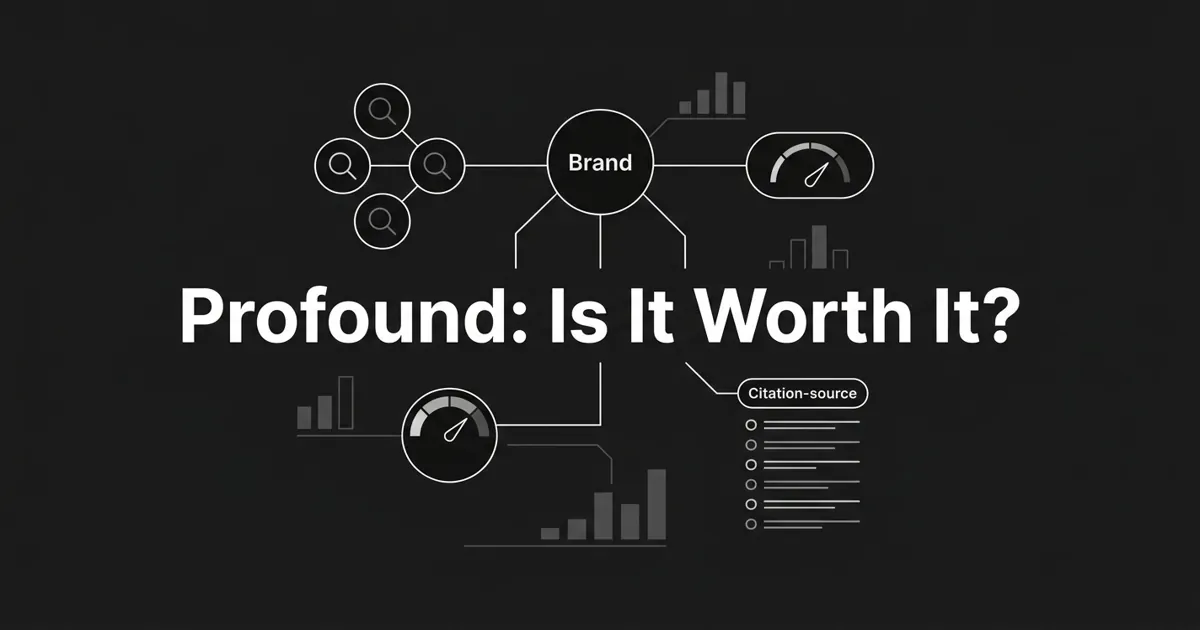
The product most reviewers mean when they refer to Profound is Answer Engine Insights, the module that monitors how a brand appears inside AI-generated answers. Profound Answer Engine Insights tracks a composite visibility score, share of voice relative to tracked competitors, raw mention counts, brand sentiment and the descriptive themes AI uses, citation sources with an authority score, and competitor rankings per prompt and per platform.
Two technical choices separate it from lighter trackers. The platform captures responses from the consumer-facing browser surfaces of each engine rather than sampling developer API outputs, so the data reflects what real users see. It also ships a panel dataset called Prompt Volumes, drawn from real consumer queries with regional and demographic breakdowns, which grounds tracking in questions buyers actually type rather than prompts a marketer invents. The operational envelope is broad: the product page names more than eleven answer engines, including ChatGPT, Perplexity, Claude, Microsoft Copilot, Google AI Overviews, Google AI Mode, Google Gemini, Grok, Amazon Rufus, Meta AI, and DeepSeek, with coverage across more than 150 regions and 30 languages, and daily re-runs on every tracked prompt.
Where Profound AI visibility genuinely shines is depth. Third-party reviewers consistently describe this module as the deepest in the category, and several single out Prompt Volumes as category-defining. For a team whose primary need is answer-engine visibility data with audit-grade rigor, this is the strongest offering in the niche. The trade-off is complexity. Reviewers describe the dashboard as data-heavy and, in the words of more than one, overwhelming for new users, with occasional complaints about load times and inconsistent status updates on watched pages. Extracting value from Profound AI visibility assumes at least one analyst-level operator on the team.
Agent Analytics: The Crawler Layer Most Trackers Lack

Agent Analytics is Profound's server-log view of how AI systems crawl and interpret a site. Its job is to answer a question most trackers cannot: whether AI engines are actually reading a brand's pages. It tracks AI crawler visits, traces bot behavior and frequency per URL, records how AI systems pick up and cite content, and attempts to connect crawler activity to downstream human traffic. Rather than a client-side pixel, it ingests server logs through secure forwarding, and it includes a verification filter that distinguishes real AI bots from spoofed crawlers.
Reviewers describe this as the part of Profound that an in-house engineering team can validate against its own content-delivery-network logs, and as the capability that most competing trackers simply do not offer. The caveat is that crawler data sits largely on the Enterprise tier, with limited self-serve exposure at lower price points, and Profound does not publish a named list of the crawlers it detects.
The Agentic Layer: Agents, Workflows, Sheets, and Aim
Through 2025 and 2026 Profound layered automation on top of the analytics. Agents is a node-based builder that connects visibility, citation, and sentiment data to downstream actions, with templates for content audits, briefs, competitive analyses, and health reports, and the ability to publish into connected content management systems such as Webflow and Contentful. Workflows, in public beta since December 2025, codifies recurring checks and insights into automated routines, with named early customers including Plaid, Stripe, Deel, and MongoDB. Sheets is a spreadsheet-style interface for running an agent across many rows at once, positioned as orchestration at scale and available on the lower tiers. Aim, launched in mid-2026, is a background agent that watches the brand's AI-search data and knowledge base and converts detected gaps into project briefs.
The consistent theme across these features is that they are optimizers and brief generators, not a publishing pipeline. The node library is scoped narrowly to the answer-engine and content-audit lifecycle; reviewers describe it as narrow, without native connections into broader marketing operations. Profound can tell a team what to write and route a brief to a writer, but the writing and shipping of the finished article happen elsewhere. This distinction matters because it defines the boundary of what the price actually buys.
Profound Pricing

Profound pricing is published for the lower tiers and custom for the top one. The public tiers are Starter, Growth, and Enterprise, with a separate Agency Growth option for resellers. Annual billing removes two months of cost on the self-serve tiers.
- Starter, 99 USD per month: 50 unique prompts, 100 credits per month, a single seat, one region and one language, and ChatGPT as the only tracked engine. Advanced features such as the REST API, single sign-on, and ChatGPT Shopping are gated out.
- Growth, 399 USD per month: 100 unique prompts, 400 credits per month, three seats, and three tracked engines, named as ChatGPT, Perplexity, and Google AI Overviews, plus a weekly set of surfaced opportunities. This tier lists a free-trial entry point on the pricing page.
- Enterprise, custom pricing: custom seats and limits, up to ten tracked answer engines, ChatGPT Shopping tracking, single sign-on with SAML, SOC 2 compliance, REST API access, and a dedicated specialist with a 24-hour support commitment.
- Agency Growth: a reseller option that allocates 400 credits per client workspace and supports multiple client workspaces from one account.
Two contradictions in the public record deserve a plain reading. First, Profound pricing for Enterprise carries no sticker; independent reviewers consistently estimate a practical floor near 2,000 USD per month, which should be treated as a reviewer estimate rather than a company figure. Second, although the pricing page advertises a Growth free trial, some independent reviewers in the spring of 2026 described the realistic onboarding path for a serious deployment as sales-led. Both states appear to be live, which suggests Profound is in a transitional packaging moment. On value, the honest read is that the money buys data depth and orchestration rather than prompt volume. A buyer who needs only basic mention checks on ChatGPT will find cheaper tools, and a buyer tracking many prompts across every buyer stage will reach the ceiling quickly.
Where Profound Falls Short
Every strength here has a matching limitation, and an objective review names both. The pricing structure works against mid-market buyers, who sit above the cheap trackers but below the budget that makes Enterprise defensible. The learning curve is real, and the dashboard rewards teams with a dedicated operator more than it rewards generalists. Insight depth outpaces execution depth: the platform is precise about what is happening and where to act, and comparatively thin on shipping the content that closes the gap. The single-account architecture is a structural constraint for agencies and multi-brand teams, since a multi-workspace model comparable to agency-first platforms is not part of the self-serve lineup. Finally, user-generated threads surface reliability friction, including reports of slow support, duplicate entries after prompt edits, unreliable updates on watched pages, billing failures, and reports that load slowly. These complaints are real, though they sit alongside a 4.5-star average, which indicates the platform broadly meets expectations for its target buyer despite friction at the edges.
Is Profound Worth It, and for Whom
Whether Profound is worth it depends far more on buyer shape than on price alone. Profound is worth it for enterprise and well-funded growth-stage brands that run a dedicated answer-engine strategy, employ at least one analyst-level operator, and already draw, or expect to draw, meaningful inbound from AI search, so the cost can be backed by pipeline. It is also the standout choice for teams that specifically need server-log crawler intelligence, since Agent Analytics has few genuine peers.
The question of whether Profound is worth it turns to no for a different set of teams. Solo operators, freelancers, and micro-businesses will find the price floor too high for the typical spend in this category. Agencies running multiple client brands will run into the single-account architecture. Brands whose AI citations are currently flat gain little from deep data that confirms they are flat, when cheaper tools report the same fact. Most consequentially, teams that need one platform to both analyze visibility and write and publish content will find that Profound does not produce publish-ready articles; its agents brief and orchestrate, and the production step lives outside the product.
That final gap is where an adjacent category sits. Profound answers where a brand stands, briefs the work, and orchestrates through agents. DeepSmith is built around the next step, writing publish-ready, on-brand articles on a content calendar with internal linking, answer-engine formatting, brand-voice enforcement, cover images, and distribution outputs to channels such as LinkedIn and newsletters, alongside its own visibility tracking across ten engines: ChatGPT, Gemini, Perplexity, Claude, Google AI Overviews, Google AI Mode, Grok, Meta AI, Microsoft Copilot, and DeepSeek. DeepSmith plans run from 99 USD per month, where tracking starts with ChatGPT and widens by tier, up to a custom Enterprise tier that covers all ten, with a 7-day free trial and no long-term contracts. The right framing is not a switch: if the goal is answer-engine analytics only, Profound is the deepest tool available. If the goal also includes turning each citation gap into a finished, on-brand publication at volume, the production layer is the part Profound leaves open.
For a marketing lead weighing that decision, the most useful move is to separate the two jobs before comparing price tags: measuring AI visibility is one job, and producing the content that earns citations is another. Teams that can articulate which job is the binding constraint will spend accurately. Those evaluating the production side can start a DeepSmith free trial to see how the analytics-plus-production model reads against a tracker-only stack.