A content center of excellence is a shared hub that concentrates content standards, tooling, training, review, and measurement so that different teams can produce and maintain content consistently, without routing every single piece through one central bottleneck. If you run an agency, you already know the problem it solves. Every client account has its own positioning, voice, approval chain, and reporting needs, and you cannot rebuild your whole process from scratch each time a new logo signs. A company, or an agency managing many client accounts, needs this kind of operating model once content starts crossing team boundaries and the informal way of coordinating it starts to break down.
This piece is about the operating model itself: how the hub is structured, what it owns, who holds which decision, and the signals that tell you it is time to set one up. It is not about why AI search has raised the stakes on governance. If you want that argument, it lives elsewhere. Here, the job is to explain how a content center of excellence actually runs.
What a content center of excellence actually is
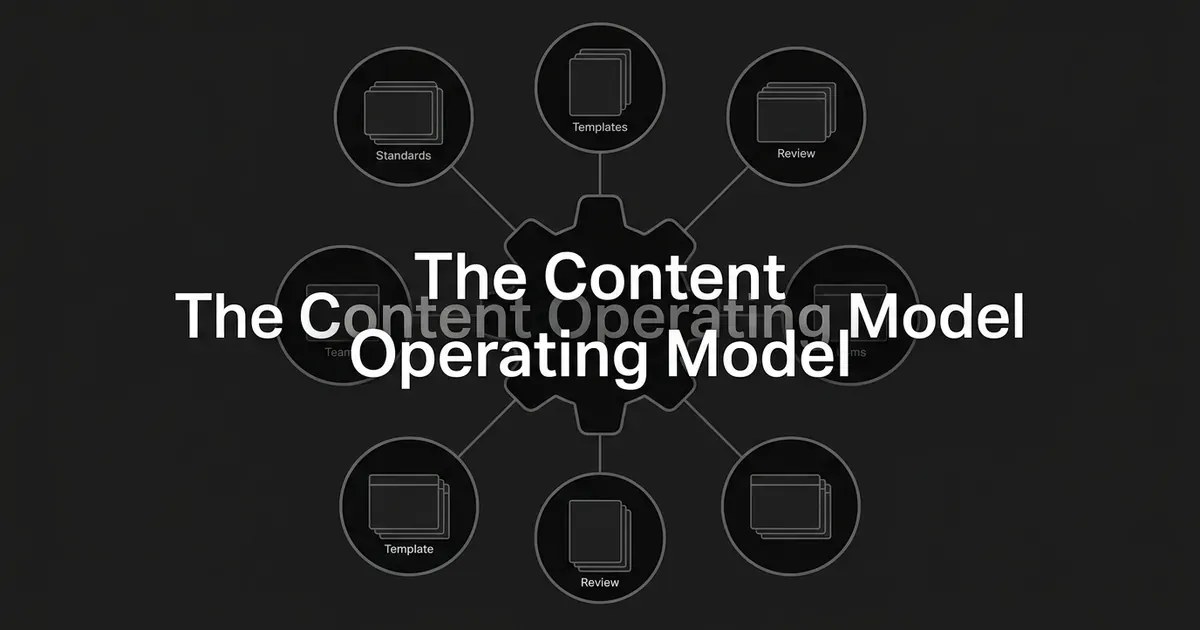
A content center of excellence, often shortened to CoE, concentrates people, tools, standards, and decision-making around content so that the capability to produce good work is repeatable across departments, brands, regions, or client accounts. It does five connected jobs: it sets the system (principles, templates, taxonomies, approval rules), it enables the teams (training, playbooks, onboarding), it coordinates the work across functions, it governs the tooling, and it measures and improves the whole thing over time.
It can be light or heavy. At the light end, it is a community of practice run by a few volunteers who meet monthly and keep a shared playbook current. At the heavy end, it is a dedicated unit with its own staff, budget, and executive sponsor. Which one fits you depends on how much coordination complexity and risk you are carrying, not on a headcount you cross.
A few things it is not, because the confusion is common and it changes what you build:
It is not your content strategy. Strategy decides what content should exist and for whom. The CoE turns that direction into a repeatable system of people, process, and standards that makes the strategy executable across more than one team.
It is not your content team. A content team produces or commissions work for a function or a channel. A CoE serves the whole content ecosystem across teams, and while it might produce some shared assets, its real job is making many teams capable of consistent work inside one system.
It is not the governance policy. A policy states the rules, something like "every asset needs a named owner." The CoE is what makes that rule usable: the fields, the workflow, the training, and the escalation path that turn a sentence in a document into something people actually do.
It is not a new platform. A CMS, a project-management tool, or an AI content platform can support a CoE, and a good one removes a lot of the manual work around running it. But none of them is the CoE by itself. Without ownership and adopted workflow behind it, a platform just becomes another place where work gets dumped and forgotten.
How the operating model actually works
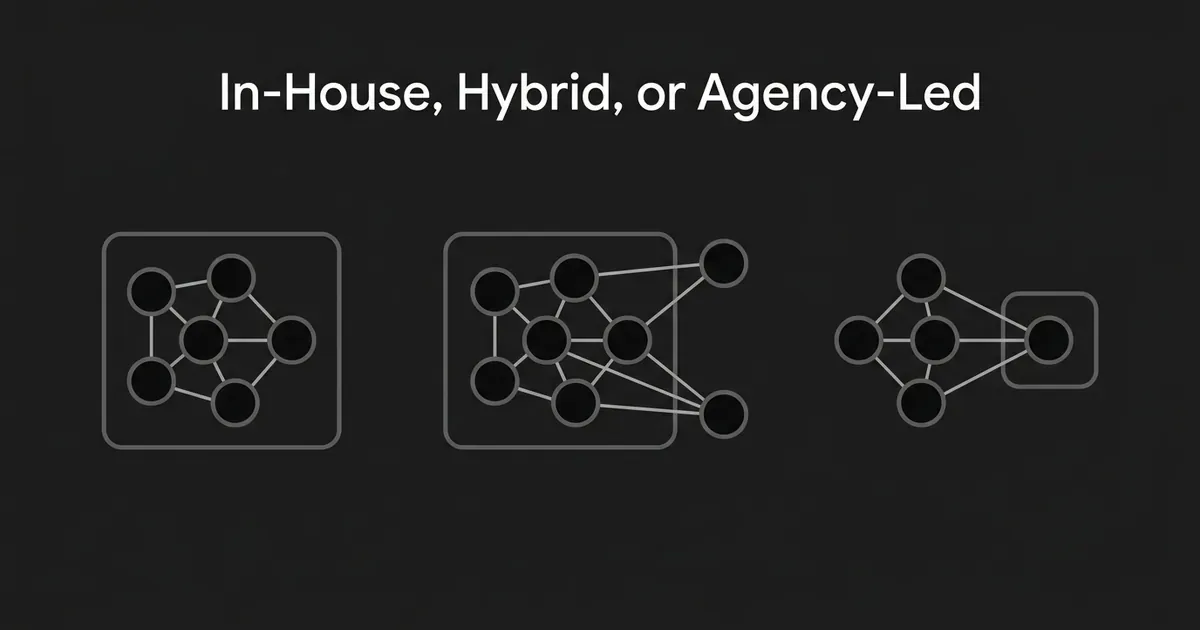
Once you know what a CoE is, the real design question is how centralized it should be. There are three shapes worth knowing, and most growing companies land on the third.
A fully centralized model puts one core team in charge of the whole content lifecycle, from creation through publication. It gives you consistent standards and clean accountability, and it fits well when content is high risk, tightly regulated, or produced by a small number of teams. The cost shows up fast once you add more teams: a queue forms around the central group, the people closest to the subject matter are furthest from the actual writing, and local teams stop feeling any ownership over work that is nominally theirs.
A fully decentralized model lets each department, region, or account create, approve, and publish on its own. Decisions move faster and subject-matter ownership stays strong, but you lose consistency, you get duplicated work and mismatched terminology, and reporting across the whole content estate becomes close to impossible. Nobody owns the standards that are supposed to apply everywhere.
A federated, or hybrid, model is the one that fits most organizations doing content across more than one team. A central hub owns the things that benefit from being consistent: standards, reusable templates, tooling principles, training, measurement, and cross-team coordination. Local teams, whether those are departments, regions, or client accounts, keep ownership of subject expertise, day-to-day production, and the judgment calls that only someone close to the audience can make. Content champions connect each local team back to the hub, and decision rights are written down explicitly so nobody has to guess who gets the final say when something needs to be consistent versus when it needs local judgment.
For an agency, this maps almost exactly onto how you already run client work. Your central hub can own research standards, editorial and SEO quality controls, a repeatable review model, reporting templates, and the tool configuration underneath it all. Each client account stays its own spoke, with its own positioning, voice, approval contacts, and calendar. The content governance operating model you are building standardizes your delivery system, not your clients' brands, and getting that boundary right is most of the job.
What the hub owns, and what stays local
The hub should own a short list of things that genuinely need to be consistent, not an exhaustive policy library nobody reads. That list usually includes brand voice and editorial standards, an approved glossary of terms, product and claims guidance, a small set of content types and templates, tagging and naming rules so things can be found later, and the legal or compliance requirements that apply above a certain risk level.
Workflow is the next thing the hub defines. A general lifecycle runs from intake, to an assigned owner, to a brief, to drafting, to review, to approval, to publication, and finally to maintenance or archive. Not every asset needs to walk through every stage. A recurring low-risk blog post might only need a creator, an editor, and a sign-off from the account owner. A regulated claim or a client's public announcement might need subject-matter, legal, and executive review on top of that. The hub's job is defining which route applies to which kind of content, so a strategist is not guessing case by case.
Tooling comes after the workflow is defined, not before. The mistake most teams make is buying a platform first and figuring out the process around it later. Decide first where work enters the system, which fields are mandatory, how ownership gets recorded, and which approvals are required by content type. Only then pick the systems that support that design. Something like DeepSmith's Deep IQ, which stores each account's brand voice, product facts, and persona context as structured data, or its Multi-Workspace setup, which keeps client accounts isolated with their own content and plans, can carry a lot of that workflow once the operating model behind it is actually defined. The platform supports the system. It does not replace the decision about what the system should be.
The last thing the hub owns is enablement: a searchable playbook with the charter, the role definitions, workflow diagrams, examples of work that met the bar and work that did not, and a place to escalate a question. Training should explain the reason behind a rule, not just the rule, because the goal is making the right path easier than improvising one.
Who holds which decision
A CoE needs named accountability even when most of the roles are part time. An executive sponsor gives the hub the authority to coordinate across teams and resolves conflicts nobody below them can settle. A CoE lead runs the charter, the roadmap, and the operating rhythm day to day. A content operations manager owns the actual workflow, tools, and publishing cadence. An editorial or standards lead keeps the style guide, templates, and glossary current. Business or account representatives bring local priorities into governance decisions and are accountable for adoption inside their own team. Legal, compliance, and brand reviewers apply high-risk checks, but only where the workflow says their sign-off is required, not on every single asset by default.
A simple decision-rights matrix, the kind built on a RACI structure, answers a short list of questions for each content type: who does the work, who is accountable for the outcome, who has to be consulted, who can approve publication, and who owns the asset once it is live. The rule underneath all of it is that every approval needs a named owner, and every published asset needs a named person responsible for keeping it accurate after the fact.
When does a company actually need one
There is no headcount or revenue number that tells you it is time. The real signal is recurring coordination failure, and it shows up the same way whether you are a 40-person company or a 400-person one.
Watch for these patterns: multiple teams share ownership of something and handoffs keep getting dropped, the same asset gets recreated because nobody can find the version that already exists, review queues stall for days with no one able to unblock them, every team has its own terminology or approval rules, and one writer or strategist leaving stalls several pipelines at once because the process lived in their head rather than in a system. On the agency side, this often looks like every client having a slightly different intake form, a different definition of "done," and a different person you have to chase for sign-off.
Structural signals point the same direction: multiple brands or client accounts with separate content ecosystems, several disconnected publishing platforms, growing demand for third-party tools nobody has fully adopted, and content volumes that need to move fast without dropping quality.
Practitioners offer rough volume heuristics too, worth knowing but not worth treating as a rule: somewhere around 10 to 15 pieces a month or a 3 to 5 person content team is a reasonable point to check whether informal coordination is starting to strain, and a dedicated function starts to make more sense past roughly 20 contributors or 50 pieces a month. The gap between producing 10 solid pieces a month and 50 while holding the same bar is the real operational challenge these numbers are pointing at. None of these figures should override what you are actually seeing: risk, number of teams, and how long content stays relevant matter more than any single number.
You are probably not ready for a formal CoE yet if one person can already coordinate the whole lifecycle, your content estate is small enough to inventory in an afternoon, and there is no recurring duplication or ownership confusion. In that case, a named fractional owner and a short playbook beats standing up a department nobody needs yet.
How to build one without overengineering it
Start with sponsorship and a short charter that states the problem, the teams involved, the decision rights, and what the CoE will not own. Then inventory what already exists: the sites, content types, owners, tools, and approval steps, so you know where duplication and stalled work are actually happening instead of guessing.
Pick the lightest operating model that solves the actual problem. For most organizations with more than one team or account, that is a federated model with a small central hub, not a fully centralized one. Name an owner for workflow and tooling, and add representatives from the teams that create, approve, and maintain content. Authority matters more than title here.
Build the first version of the playbook around the standards that remove the most repeated confusion: ownership, briefing fields, review stages, and terminology. Pilot it on one content type or one account rather than rolling it out everywhere at once, and measure where work still stalls before you expand it. Configure your tools around that workflow, not the other way around, and set a simple operating cadence: a weekly check on stuck work, a monthly look at the pipeline, and a quarterly review of the standards themselves. Turn what works into reusable templates and checklists, and the CoE should get easier to use over time, not more bureaucratic.
Where the model breaks
A few failure patterns show up often enough that they are worth naming ahead of time. The hub becomes a central approval queue when it starts reviewing everything instead of the things that actually need it, which recreates the exact bottleneck the federated model was supposed to avoid. The safeguard is centralizing standards and high-risk review only, and delegating routine, low-risk work to the local team that owns it.
Sometimes the hub writes a policy nobody can actually use, because it lives as a long document instead of a workflow, a template, or a checklist inside the tools people already touch. Sometimes the federated model becomes optional in practice, because sponsorship is weak and every team quietly interprets the rules its own way. And sometimes nobody owns what happens after publication, so content sits there getting stale while everyone assumes someone else is watching it.
The common thread in all of these is that the CoE stops measuring whether the system is actually working and starts measuring activity instead, counting documents produced or meetings held rather than review time, first-pass approval rate, or whether standards are actually being followed. A small, honest scorecard beats a long one nobody trusts.
Getting the operating model right
None of this is about adding another layer of approval. A content governance operating model, done well, is the thing that lets many teams work fast with a shared set of standards, while the people closest to each audience keep the judgment that makes the content actually useful. Get the federated boundary right, name the decision rights clearly, and measure the few things that tell you whether the system is working, and the CoE stops being overhead and starts being the reason your content function can grow without falling apart. Whether that shows up as a genuine web governance growth lever for you depends on tying the system back to real business goals, not on the system alone.
If you are trying to hold this kind of shared context, per-client or per-department, across a growing content operation, a platform like DeepSmith that stores brand voice, product facts, and workspace separation as structured data can carry a good part of the mechanics once you have decided what the operating model itself should be. You can try it free for seven days at DeepSmith to see how that fits your own setup.