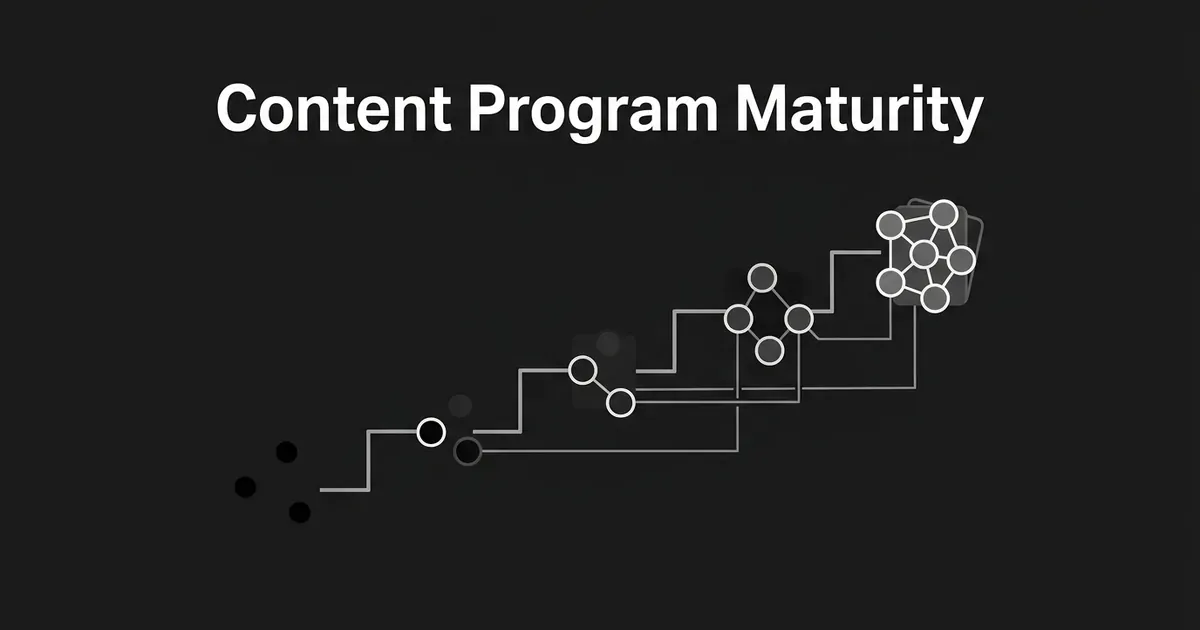
If you have ever sat in a meeting where someone asks "are we good at content?" and nobody can answer with more than a shrug, you already know why content program maturity is worth thinking about on purpose. It is not about how many posts you have published or how big your team is. It is about whether the way you make content decisions can be repeated, handed to someone new, measured, and improved, or whether it only works because one person happens to be holding it together in their head. This piece walks through five stages, from a single person publishing when they get a spare hour to a fully coordinated editorial operation, so you can place your own program on the spectrum and see what usually breaks at each step up.
The five stages here pull together a few different ways people have tried to measure this: content operations maturity models that look at people, process and technology, a content marketing maturity model that looks at strategy and measurement, and content-led marketing models that look at governance and media coordination. None of them is the one true scale, and none of them lines up perfectly with the content marketing program stages laid out below. They overlap enough that a single spectrum is more useful than picking one and ignoring the others, so that is what you get.
One more thing before the list. You do not have to be at the same stage everywhere. A team can have a genuinely mature production workflow and a completely undocumented measurement practice at the same time. So as you read, do not just ask "which stage am I." Ask "which stage am I in on this specific thing," because the honest answer is usually not one number.
Ad hoc publishing
This is where content happens because someone had an idea, a campaign needed a supporting post, or a founder had a free afternoon. There is no agreed reason content gets made beyond "this seemed worth writing," and topics get chosen because someone asked for them, not because there is a defined audience or business reason behind them.
You will know you are here if there is no consistent brief, no set review path, and no real publishing calendar, just a rough sense of "we should post more." The process lives in someone's inbox, a shared doc, or a group chat, and quality swings depending on who wrote that particular piece. Nobody has clear authority to say no to a request, so whoever pushes hardest usually wins, and there is rarely an agreed style or accuracy standard that everyone follows.
What breaks next is almost always the same thing: dependence on one person. The moment that person gets busy, changes roles, or leaves, the whole thing stalls or looks completely different a month later. A second thing that tends to surface here is realizing that one strong article is not the same as a program. You can write something genuinely good and still have no way to reliably do it again.
To check where you stand, ask yourself a few plain questions. Could someone new figure out how content gets made here without asking you directly? Does every piece have someone who owns it, reviews it, and knows who it is for? If your main writer disappeared for a month, would anything still get published? If most of your answers are no, you are probably here, even if you have technically been publishing for years.
A repeatable content lane
At this stage you have something real: a blog, a newsletter, or a resource hub with an actual owner, not just a folder of documents. The team has started to name who the content is for and what it usually covers, even if that is not written down formally anywhere else in the company. Basic project management has shown up too, things like briefs, deadlines, a calendar, and a rough approval step.
The catch is that this only holds up for familiar work. A blog post in the usual format goes fine. A new format, a new audience, or an urgent request from another department still breaks the process, because the team is really running a request queue with better paperwork. Someone may be coordinating, often an editor or a manager, but they do not have real authority to say no. Metrics get tracked, usually traffic or engagement, but the reporting tends to describe what happened rather than explain why or what to do differently.
The next break shows up as capacity. As more people learn that content requests get handled here, more requests arrive, and the team becomes a service desk for the whole company while still treating every piece as a one-off. Measurement stays shallow, so nobody can say with confidence which topics or formats are actually worth doing more of. Reviewers show up late in the process because expectations were never nailed down at the brief stage, so drafts get rewritten more than they should.
Ask whether your team can repeat the process for a blog post but not for anything else. Ask whether your calendar shows assignments only, or whether it also reflects actual themes and audience needs. Ask whether stakeholders can still jump the queue whenever something feels urgent to them. If the process exists but the program is still mostly reacting to requests, this is your stage.
A scaled content program
Here content has moved past one channel and one small team. Multiple business units or teams are contributing, and there is a shared strategy connecting content to the rest of marketing, sales, or the company's broader goals, not just a standalone plan for the blog. Planning starts to consider the full customer journey instead of whatever request landed that week.
The production process is documented well enough that a new contributor can actually follow it, and the team can handle more than one content type or channel without reinventing the approach every time. That is real progress. What is still forming is governance. Ownership is clearer than before, but decision rights get disputed, because everyone agrees content should be strategic and nobody has been given the authority to say which request actually matters more. A shared calendar exists, but it tracks deadlines more than it controls priorities.
The break that shows up next is coordination. With more contributors and more channels, local decisions start creating global mess: two teams write about the same topic without knowing it, or they send slightly different messages to the same audience. Measurement gets harder too, mostly because the data lives in different platforms and nobody owns pulling it together, which research on B2B content teams has repeatedly flagged as one of the most common obstacles once a program gets to this size.
Check whether multiple teams can use your framework without contradicting each other. Check whether priorities come from shared themes and audience needs, or from whichever department shouts loudest that week. Check whether you have a named owner for taxonomy, distribution, and measurement, not just for writing. If you have a real program that still struggles to make decisions across teams, this is where you are.
A governed editorial operation
This is the stage where you stop running a production workflow and start running something closer to a newsroom. A governance layer actually decides what gets made, for whom, and why, and that decision carries real authority rather than existing as a suggestion. Editorial themes and a clear point of view connect individual pieces across teams, brands, and channels, so a given article is not just standalone content, it is part of a bigger narrative the organization is telling.
A council, editorial board, or equivalent group can say no to a reactive request, which is the single clearest sign you have crossed into this stage. Ownership is explicit for brand voice, claims, legal review, and content maintenance, not scattered across whoever happens to be free. The calendar expresses tradeoffs and priorities, not just due dates. Measurement gets used to decide what to make next, not just to write a monthly report nobody acts on.
What tends to break here is more subtle. A council that can talk about priorities but cannot actually enforce a decision becomes just another meeting, which defeats the point of having one. There is also real tension between keeping things consistent centrally and letting individual brands or regions serve their own audiences well, and that tension does not fully resolve, it just gets managed. A third risk is mistaking operational capacity for a reason to publish more, when the actual job at this stage is to get more relevant and more reusable, not louder.
Ask whether there is a body with real authority to reject work, not just discuss it. Ask whether your editorial themes actually connect separate pieces into something bigger, or whether "strategy" is a slide nobody references day to day. Ask whether your reporting changes what gets made next. If you have a shared editorial backbone with real decision rights behind it, you are here.
An integrated editorial and media operation
At the far end of the spectrum, content stops being one channel and becomes part of a coordinated media system. Editorial strategy, paid placement, earned coverage, and community or partner channels are planned together instead of separately, and the organization can hold a coherent point of view across all of them at once. Strategic decisions get made at the level of themes and audiences, not individual deliverables.
The operation here is genuinely repeatable and continuously improved. Content components can be reassembled into different formats for different surfaces, and maintenance and eventual retirement of old content are treated as normal parts of the lifecycle, not afterthoughts. Decision rights are understood across central teams, brands, and channels, with periodic strategic review built in rather than approvals happening only at the individual-asset level. None of this requires a large staff. What it requires is clear coverage of responsibilities, whether that coverage comes from five people or fifteen.
The risk at this stage is complexity outrunning coordination. More channels, more brands, and more contributors can make the whole system slow and detached from what the audience actually wants, and a shared playbook can drift into making every brand sound the same, which defeats the point of having distinct brands at all. A related risk is treating tools, including AI tools, as proof of maturity by themselves. They speed up a good process. They do not create the strategy, the judgment, or the trustworthy measurement underneath it.
Ask whether you can coordinate content and distribution across owned, paid, earned, and community channels without duplicating effort. Ask whether the program improves because of evidence, not just because the calendar says it is time for a new quarter. Ask whether automation is governed by clear rules for accuracy, brand, and data handling. If most of that is true, you are operating at the top of the spectrum.
Score the dimensions separately, not just your stage
Picking one overall stage is a useful shorthand, but it hides more than it reveals if you stop there. A more honest read comes from scoring a handful of dimensions on their own, because it is common to be strong in one and weak in another at the same time.
Look at strategic orientation: is content mostly a response to requests, or is it tied to a clear audience need and point of view? Look at governance: do stakeholders compete through urgency and influence, or are decision rights explicit enough that someone can say no? Look at roles: is one person quietly carrying several jobs nobody has named, or does the team know exactly which responsibilities have to be covered even if people wear more than one hat? Look at measurement: does reporting describe what happened, or does it actually change what gets made next?
Whichever of these is weakest is usually a better predictor of where things will break than your strongest capability. A team with excellent writers and no governance will still struggle the moment more than one person needs to make a decision.
What doesn't tell you the stage
A few things get mistaken for maturity signals that genuinely are not. Publishing volume is one: a company can post constantly with no strategy behind any of it, and volume alone proves nothing about governance or measurement. Individual piece quality is another, since a brilliant article can be the work of one talented person working outside any system, which says nothing about whether the organization can repeat that result.
Team size is not a reliable signal either. A large team can stay chaotic if responsibilities and decision rights are unclear, and a small team can run maturely when everyone knows exactly what they own. Research on B2B content teams has found that most operate with five or fewer full-time people, which is worth remembering before assuming maturity requires headcount. Budget behaves the same way: spending more does not by itself create a repeatable process, and neither does adding more tools to the stack, which can just as easily add fragmentation as coordination.
Using AI is probably the newest version of this mistake. Adopting a generative AI tool is not a maturity stage on its own. What matters is whether there are guardrails around it: accuracy checks, brand and product-fact accountability, and some way to tell whether the automation is actually helping rather than just producing more output faster.
If you run client accounts, assess two programs at once
If you work at an agency, this diagnostic has to run twice for every client relationship: once for your own internal delivery operation, and once for the client's content program itself. Those two things can be mismatched in either direction. A sophisticated internal workflow does not help a client who is still at ad hoc publishing, because they have no decision rights, no clear source of product truth, and no approval process on their end. The reverse happens too: a genuinely mature client can be poorly served by an agency that still relies on manual work and knowledge that lives in one strategist's head.
A few things tend to separate a mature agency operation from an immature one. Each client's brand, product facts, and voice are documented separately, not held loosely in memory and reconstructed from scratch every time someone new picks up the account. Briefing, research, drafting, linking, and reporting follow a repeatable process across accounts rather than being reinvented per client. Approvals and escalation paths are clear enough that a strategist leaving does not stall three or four client programs at once. New logos can be onboarded without rebuilding your method from zero, and automation increases consistency without flattening every client into sounding the same.
This is also where the tools you use start to matter, because the failure mode at scale is usually one undocumented workflow quietly affecting several accounts at once. A platform that keeps each client's brand voice, product facts, and content queue in its own workspace, and that produces drafts with linking and metadata already built in rather than added by hand per account, removes a lot of the manual rework that eats agency margin as the roster grows. That is a real capability, but it is worth saying plainly: a platform can support a mature operation, it cannot supply the strategy, the governance, or the editorial judgment that has to sit above it.
How to actually find your stage
Skip the temptation to score yourself off the org chart or the stated strategy document. The content marketing program stages above are a map, not a scorecard someone else fills out for you. Instead, look at the last few months of real work. Trace three or four published pieces from idea through brief, writing, editing, publishing, and reporting, and note where the delays and handoffs actually happened, not where the process document says they should happen. Ask, for each responsibility along the way, whether there was a clear owner or whether it just got done by whoever was free.
Compare what people actually do against what the official workflow says they do. Usually there is a gap, and the size of that gap tells you more than any framework. Then find the earliest point in that trace where things still depend on one person or one urgent request winning out over a plan. That bottleneck is usually your real stage, even if other parts of the program look more advanced.
The most useful move after that is not to chase the next stage everywhere at once. Fix the dimension that is breaking first, because that is the one most likely to undo progress elsewhere if it stays weak. A team with strong writers and no governance benefits more from adding decision rights than from adding another writer. A team with clear governance and shaky measurement benefits more from fixing reporting than from adding another channel.
Content maturity, in the end, is not about whether you have a blog, a calendar, a team, or an AI tool. It is about whether the people and systems behind the publishing can make good decisions repeatedly, coordinate across the people involved, learn from what actually happened, and stay coherent as more complexity gets added. That is the thing worth building toward, one honest dimension at a time.