If you already know AI search matters but you have no idea who should own it, this guide is for you. It walks a marketing leader through the actual GEO team structure needed to run an AI-search content operation: who owns prompt discovery, who writes, who handles the technical side, who measures results, and who signs off before anything publishes. By the end you will have a set of roles you can assign today, whether that is one person wearing five hats or a department of ten.
What you need before you start: a rough sense of your current content team (even if it is just you), and fifteen minutes to write down who does what right now, because you cannot design a structure without knowing your starting point. Some people call this a generative engine optimization team instead of a GEO team, and both terms point at the same set of roles, so use whichever one your organization already recognizes.
Step 1: Name the GEO outcome and appoint one owner
Before you assign a single role, decide what this operation is actually responsible for. Is it prompt coverage? Citations? Competitor visibility? Content production? Probably all of it, which is exactly why one person needs to hold the whole picture. Getting this right is the foundation of any GEO team structure, because every role you assign later traces back to this one decision.
Write down the audience and business area this covers, the AI-search questions that actually matter to your buyers, the content and technical work the team will take on, the metrics leadership will see, and who resolves a priority conflict when two workstreams compete for the same week. Then name one GEO or AEO lead who owns that combined view. This person does not have to do every job. They have to be the one who can answer "what are we prioritizing, why, and what is blocked" without checking with three other people first.
You know this step is done when one named role is accountable for the channel, the team can explain the difference between a mention (the AI names your brand) and a citation (the AI links to your page as a source), and every major workstream has a proposed owner, even if that owner is the same person three times over.
The common mistake here is calling everyone who touches AI search part of "the GEO team" without naming a decision-maker. Shared interest in a topic is not the same as accountability for it. If five people care about AI visibility and nobody owns it, you have an interest group, not an operation.
Step 2: Map the work into capability lanes
The real question of how to staff AI search team work starts here, not with job titles. Before you think about job titles, list the recurring work. Every AI-search content team needs to cover seven lanes: prompt and audience discovery, content strategy and briefing, writing and production, technical AEO and SEO, measurement and insights, editorial review and approval, and operations that keep the whole thing moving.
Go through each lane and mark it owned, shared, missing, or blocked. This exercise is usually where leaders realize the gap is not headcount, it is that nobody has picked up prompt discovery, or that editorial review only happens when someone remembers.
A platform like DeepSmith changes what this mapping looks like without changing the number of lanes. AI Visibility tracks the prompts you care about and reports mentions, citations, and competitor citations automatically, which removes a lot of the manual tracking a prompt strategist would otherwise do by hand. Discover Prompts generates a starting set of candidate prompts from your product and persona context, cutting the cold-start research time. Content Map and Opportunity Agents connect topic coverage and competitor gaps to an evidence-backed idea queue instead of a spreadsheet someone updates once a quarter. None of that removes the need for a human to decide what matters and approve what goes live, but it does mean the same two or three people can realistically cover more lanes than they could with manual tracking alone.
You are done with this step when every recurring task has a home in a lane, each lane has a primary owner or an honest gap flagged next to it, and you can tell which tasks are automated, which are assisted by a tool, and which still require a person's judgment.
Pro tip: design around role coverage, not headcount. A two-person team can cover all seven lanes if the responsibilities are explicit. A team of ten can still fail if prompt ownership or editorial approval is fuzzy, because more people just means more places for a gap to hide.
Step 3: Write role cards with outputs and decision rights
Once you know the lanes, write a one-page card for each role you plan to staff: GEO lead, prompt strategist, content strategist, writer, technical AEO owner, measurement analyst, editor, and operations owner. This is where AEO team roles stop being abstract capabilities and turn into something you can actually hire for or assign to an existing person. Each card should state the role's purpose, what it owns, what it produces, the skills it needs, who it consults, which decisions it can make alone, and which decisions need approval from someone else.
Deciding AEO team roles this explicitly is what stops "supports AEO" from being a job description. A card that just lists activities without decision rights tells nobody who owns the prompt set, who approves the final brief, or who can hit publish. Use capability language when a person is doing more than one job. "GEO lead and content strategist" tells a new hire or a contractor more than "AEO person" ever will.
DeepSmith's Content Studio and Deep IQ do a lot of the repetitive work that used to require a separate briefing role: Deep IQ stores your product, persona, brand voice, and content-type context once, and every draft the Writer produces pulls from that same context instead of a fresh brief each time. That is what makes it realistic for one person to combine content strategy and production at an early stage. The human still owns audience judgment, what claims are true, and what actually gets prioritized.
You know this step is done when every role has a defined output, every role also has a written list of what it does not do, a contributor can name three decisions they are allowed to make without a meeting, and you can tell the difference between someone who is overloaded and someone who is missing a skill.
Step 4: Build the handoff and editorial gate
Draw the path a piece of content actually travels: from a prompt or audience question entering intake, through prioritization, brief approval, drafting, technical review, editorial review, any subject-matter sign-off, publication, and finally measurement feeding back into the queue. Every stage on that path needs an owner and a clear condition for moving to the next one.
The editorial gate deserves special attention because it is the one most teams skip under pressure. The editor should be independent enough to reject a technically sound page that reads generic, sounds off-brand, or makes a claim the article cannot support. If your fastest path to publishing is one where the person under deadline pressure can also approve their own work, you do not have a gate, you have a formality.
DeepSmith's New Ideas, Planned Content, and Produced Content views separate intake, scheduling, production, and review into distinct stages, which mirrors this workflow directly. If you use the platform's Autowrite to generate drafts on a schedule, keep the human review step in place rather than treating an automated draft as pre-approved. The tool moves work forward; it does not replace the judgment call at the gate.
This step is done when every stage has a named owner and clear entry and exit conditions, revisions go back to the right person instead of restarting the whole process, everyone knows who the final approver is, and blocked work has somewhere to go instead of sitting quietly.
Common mistake: adding reviewers without saying what each one is actually checking for. Two more people looking at a draft "just in case" slows things down without adding any real quality check, because nobody knows what the other reviewer already covered.
Step 5: Set measurement ownership before you publish at scale
Before your team is publishing heavily, give one person responsibility for a shared measurement dictionary. That means writing down what counts as a mention versus a citation, how you calculate share of voice, which prompts and engines you actually track, how you define your competitor set, and what comparison period you use for every report.
This matters because a single AI answer is not a stable result. Ask the same question twice and you can get two different answers, so the team needs to treat this as a pattern to watch over time, not a scoreboard to check once. The GEO lead decides what to do with the data; the measurement owner's job is to make sure the numbers are reproducible and mean the same thing every time someone looks at them.
DeepSmith's AI Visibility module separates mentions, citations, share of voice, sentiment, and visibility trends by prompt, page, and competitor, which removes the need for someone to manually pull this together from ten separate AI conversations every week. It does not remove the need for a person who decides which of those signals the team should actually act on.

You are done here when a report can be reproduced using the same definitions every time, every result is tied to a specific page and prompt, every reported change has a stated comparison period, and every metric connects to an owner who can do something with it.
The common mistake is treating one surprising AI answer as proof of a trend. Report patterns across a defined period with their collection conditions stated plainly, and keep observed change separate from claims about why it happened.
Step 6: Launch the smallest pod that covers every lane
You do not need a department to start. You need every lane from step 2 covered by someone, even if that someone is doing three jobs. Here is a practical way to scale the pod as your content operation grows.
At two people, split it this way. Person A is the GEO lead, prompt strategist, and measurement owner: they define the prompt portfolio, prioritize opportunities, maintain the reporting view, and make the weekly call on what gets written next. Person B is the content strategist, writer, editor, and operations owner: they turn priorities into briefs, produce the content, run the first editorial pass, and keep the calendar moving. Technical AEO support can come from your existing SEO or engineering function on a shared basis, and final approval can sit with a marketing leader if the two-person pod does not have that authority yet.
At three to five people, add a dedicated writer or two and let the lead stop being the default writer. The strategist owns the queue and briefs full time, and the editor's job becomes protecting quality rather than doing everything themselves.
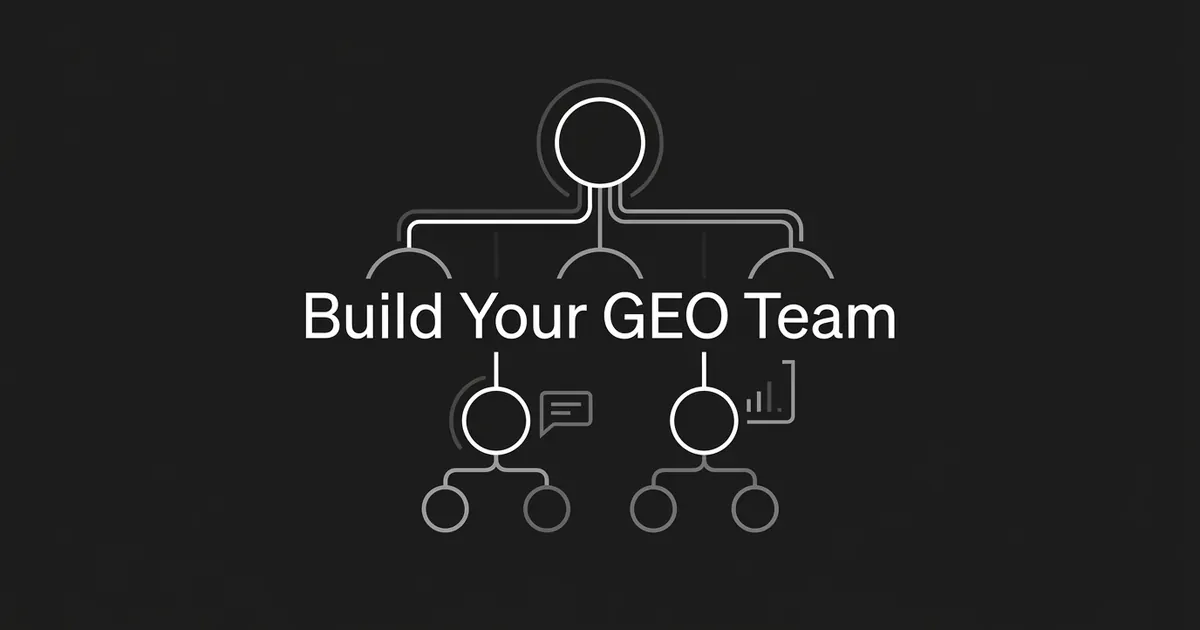
At six to ten people, separate every lane into its own role: a GEO lead, a prompt and audience strategist, a content strategist or managing editor, several writers organized by topic or format, a dedicated editor, a technical AEO owner, a measurement analyst, and a content operations manager, with shared support from subject-matter experts, compliance, and design.
This step is done when the pod has one accountable lead, every lane has a primary owner even when one person holds several, and you have set a maximum amount of work in progress so quality does not quietly slip as volume grows.
Pro tip: a track-and-write platform can make a two-person pod genuinely viable, because it collapses work that used to require separate people. DeepSmith is built this way: the same platform tracks your prompts, surfaces the gaps, and writes the article, so you are not paying for a tracker analyst and a separate writer to do work that overlaps most of the time. Put the capacity that saves toward audience judgment and editorial review, not toward publishing more unreviewed volume.
Step 7: Scale by bottleneck, not by adding titles
Once your pod is running, review it on a regular cadence and ask what is actually limiting quality, speed, or learning right now. Add a dedicated role only when the evidence shows the current setup cannot absorb the work anymore.
Watch for these signals: the GEO lead spends most of the week formatting instead of prioritizing, prompt discovery keeps getting skipped because production eats the available time, writers sit waiting on briefs or answers from subject-matter experts, editors only see drafts late and rubber-stamp them, technical fixes stay open across several publishing cycles, or reports come back with different numbers depending on who ran them.
When one of those becomes a repeated pattern rather than a one-off week, that is the lane to split first. A full GEO department eventually organizes into five groups: strategy and insights (the lead, strategists, and analysts), content production (strategists, writers, subject-matter contributors), technical AEO and SEO (a dedicated technical lead working with engineering), editorial governance (a managing editor and reviewers), and content operations (a program manager owning the workflow). Even after the department splits into these groups, one person still needs to own the combined operating picture, or you end up with five functions that each think someone else is watching the whole thing. This is also the point where a generative engine optimization team stops being a side project and starts looking like a real department on the org chart.
You know this step is working when specialization removes an actual, named bottleneck, reporting lines still make sense after a split, the team shares one definition of quality, and the GEO lead can see capacity, visibility, technical blockers, and editorial risk in a single review instead of five separate conversations.
The common mistake at this stage is adding writers before adding the briefs, editing, and measurement capacity to support them. More people producing content only increases output if the rest of the system can absorb what they make. Otherwise you get more drafts sitting in a queue waiting on the same bottleneck that was already there.

What to do next
If you take one thing from this guide on how to staff AI search team work, make it this: write the role cards, the responsibility matrix, and the reporting lines before you post a single job opening or reassign anyone's time. Then run one complete content item, from prompt to published page, through the workflow you just designed, and watch where it actually stalls. That will tell you more about your real bottleneck than any org chart exercise, and it is the fastest way to see whether your AI content team roles actually match the work your team does every week.
If you want a platform that already ties prompt tracking, content production, and measurement together so a lean team can cover more of this workflow without adding headcount, you can start a free trial and see how DeepSmith handles your own prompts and pages.