If you're trying to decide how to staff your content function, the honest answer is that there's no single content team structure that wins for everyone. An early-stage company usually does best with one strong internal owner plus rented senior help. A growing company tends to fit a hybrid model, where a permanent core sits inside and specialists or extra hands come from outside. A larger organization usually benefits from owning most of the recurring work itself and using agencies for the specialized or unpredictable stuff. Which one is right for you depends less on your company's size and more on how much daily context the work needs, how much output you have to produce, and how much time your team actually has to review what comes back.
This piece walks through what fully in-house, hybrid, and agency-led actually mean as a content marketing org structure, compares them on the axes that matter, and gives you a way to match the right model to your stage, budget, and workload. It skips the cost-per-article math and the specific hiring tactics. Those live in separate pieces linked below.
The three models, side by side
| Decision axis | Fully in-house | Hybrid | Agency-led |
|---|---|---|---|
| Strategic ownership | Internal | Shared, internal owner usually holds final say | Client sets objectives, agency may run day-to-day strategy |
| Brand and product context | Highest by default | High, if the internal core is solid | Has to be documented and kept current on purpose |
| Specialist range | Limited to what you employ | Broad, added selectively | Widest immediate access to pooled specialists |
| Review burden | You own the whole review chain | Internal team reviews judgment calls, partner owns production quality | You have to supply fast, accurate briefs and approvals |
| Scaling up or down | Slow, since it usually means hiring | Flexible on the outside, stable at the core | Fast, within the agency's real capacity |
| Best fit | Stable, recurring, context-heavy work at real volume | Growing or uneven demand, mixed skill needs | Early capacity gaps, specialist-heavy or fast-changing work |
Treat this table as a starting point for the conversation, not a scorecard that crowns a winner. None of these three structures is inherently better content. They're different ways of getting the same job done, and each one asks something different of you.
None of this happens in a vacuum. About three in four B2B marketers report having a dedicated content team or staff person, though under half describe it as running a genuinely scalable model. Enterprise teams show an even higher share with a dedicated team, but they name scalability and cross-team communication as recurring problems just as often as smaller teams do, which is a good sign that headcount alone doesn't fix a structure problem.
What "fully in-house" actually means
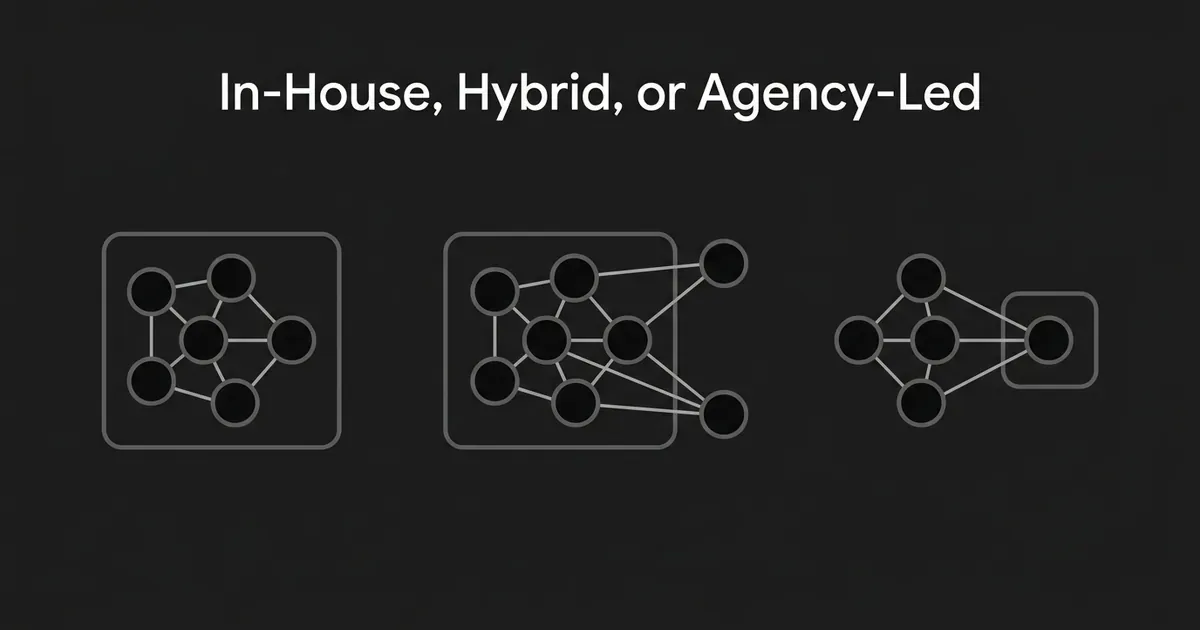
A fully in-house content team sits inside the company. Your own people, not an outside partner, own the strategy, the editorial calendar, the approvals, and the feedback loop that tells you what's working. That doesn't rule out tools or the occasional freelancer for a stretch project. It means the company runs the operating system, not just the writing.
An internal studio that serves several departments or brands from one team still counts as in-house, even if it works a lot like an agency internally. What makes it in-house is that the org chart, not a contract, is where the accountability sits.
The advantage is proximity. Your team sits in the same meetings, knows the product history, and can usually get a straight answer from a subject-matter expert without a formal brief. That closeness cuts down on repeated onboarding and speeds up the small, routine calls that make up most of a content operation.
The cost of that closeness is that an internal team can get too comfortable with the company's own assumptions. It's easy to keep producing the same kinds of pieces because that's what's always worked, and harder to notice when an outside perspective would catch something the team has stopped seeing. An in-house team also inherits whatever silos and approval habits already exist in the organization, for better or worse.
What "agency-led" actually means
An agency-led model makes an outside partner the primary engine for producing content. The agency usually brings the strategists, writers, editors, and project managers, plus specialist skills you'd otherwise have to hire for one at a time. You keep a business owner on your side, along with the people who can confirm facts about your own product and approve what goes out.
Agency-led doesn't mean you get to step back from the work. Someone inside your company still has to set priorities, supply accurate product information, sign off on positioning, and settle disagreements when two internal stakeholders want different things. An agency can execute well, but it can't invent your product truth or make your internal calls for you.
This model earns its place when you need real capacity or specialist skill before you can justify building a full internal bench, or when the work needs expertise that would be hard to keep busy as a permanent hire. It's a strong fit for a company that needs breadth fast and doesn't yet have the volume to support a large internal team.
What "hybrid" actually means
A hybrid content team keeps a permanent internal core and adds outside specialists, extra hands, or strategic support around it. The internal side usually holds the brand context, the priorities, and the final sign-off. The outside partner brings production capacity or skills the internal team doesn't have and doesn't need every day.
Hybrid isn't just "we outsource some of it." That's the trap. A real hybrid model works because the two sides run as one system, with a shared calendar, shared tools, and a clear line between what each side owns. Without that, you get two teams doing the same job badly instead of one team doing it well.
There are a few common shapes this takes. Sometimes it's one internal lead directing an agency that handles the writing and design. Sometimes the recurring production stays internal and the agency only handles launches or campaigns. Sometimes an outside team is embedded closely enough that it sits in your planning meetings and works in your project system, functioning as an extension of your own team rather than a vendor you email requests to.
Who actually keeps the context
Whoever sits closest to the brand day to day usually keeps the most context, and that's almost always the internal team by default. They hear the product roadmap discussed in the hallway. They pick up the customer language that shows up in support tickets. That reduces how often anyone has to stop and re-explain the basics.
Agencies work from more distance, which cuts both ways. That distance can bring fresh thinking and ideas borrowed from other industries the internal team never sees. It also means product facts, tone, and regulatory details have to be written down and kept current rather than assumed, because nobody on the outside absorbs them by osmosis.
A hybrid team tries to hold onto internal context while widening its range, and this only works when someone inside genuinely owns that context and treats the outside partner as part of the team rather than an order-taker working from a stale brief.
How wide the specialist bench needs to be
An internal team is only as broad as the people you can hire, afford, and keep busy. A small team usually ends up stretching generalists across strategy, writing, editing, SEO, and distribution, because there isn't enough recurring work to justify a dedicated hire for each.
An agency pools specialists across many clients, which is exactly what gives it an edge here. Depending on the partner, that might mean strategic planning, design, video, or specialist SEO work, all available without you making a permanent hire. The catch is that breadth on paper doesn't guarantee depth on your specific category or product. You still have to check whether the specialist assigned to you actually understands your audience, not just their own discipline.
A hybrid setup is the middle path: keep the context-heavy recurring work close to home, and rent expertise only when a launch, a technical topic, or a new channel genuinely needs it.
How the review burden actually lands
Review burden decides more of this than most people expect going in. An in-house team owns its whole review chain. If every piece has to clear product, legal, and three regional stakeholders before it ships, adding more writers won't raise your output, because the bottleneck was never writing speed.
Agency-led work cuts down your production load but doesn't remove your review load. You still have to supply the source material, catch the claims an outside team couldn't have known, and settle it when your own stakeholders disagree with each other. That slows an agency down more than any capability gap does.
Hybrid teams can lower the amount of mechanical review your own people do, but only when the split is explicit: your side reviews strategy, facts, and anything high-risk, and the partner is responsible for hitting an agreed quality bar before the work even reaches you. Skip that agreement and hybrid becomes the slowest option of the three, because now every decision gets debated twice.
How scaling and budget move together
An internal team gives you stable, controllable capacity once it's staffed, but it's slow to flex. Adding a skill means recruiting, onboarding, and managing someone, and cutting capacity later usually means a hard conversation. That fixed cost includes salaries, management time, and the slack capacity that sits idle in a quiet month.
An agency relationship converts more of the work into a flexible, external commitment. You can usually add or reduce capacity faster than you could hire, and the fee structure, whether retainer or project-based, makes the cost more visible up front. What you give up is direct control over exactly who's working on your account and when.
A hybrid budget is a fixed internal core plus variable outside support, which is the whole point: you get permanent ownership of the context that compounds, without paying to staff every capability at its own peak.
It's worth resisting the urge to rank these three from cheap to expensive. The real comparison is between the cost of running the operating system your actual workload needs and the cost of running one that doesn't fit. A company with software supporting the production side (research, structure, and metadata built into the writing step, for example) can lean the internal core smaller without losing ownership of the strategy and the brand facts that actually need a human in the room. That's a production-tooling choice sitting underneath whichever of these three structures you pick, not a fourth model competing with them.
Matching the model to your stage and volume
A widely used practitioner framework uses total monthly marketing spend as a rough signal for which stage you're in, and it's worth treating as a loose guide rather than a rule that applies to every company.
Below roughly $30,000 a month in total marketing spend, a full internal team often eats too much of the budget. The better pattern is usually one strong internal generalist who owns positioning and approvals, backed by agency or senior freelance help for the specialist and strategic work. Keep the scope narrow rather than trying to cover every format at once, and make sure one person can actually give timely feedback, because that's where this setup breaks.
Between roughly $30,000 and $150,000 a month, bringing the recurring engine inside while keeping concentrated spikes, like a launch or a campaign, external is the clearest default case for a hybrid team. You have enough steady work for internal context to compound, and enough irregular demand that outside capacity still earns its place.
Above roughly $150,000 a month, most companies do better owning most execution internally and narrowing the agency relationship to genuine strategic partnership or specialist craft. The failure mode at this size isn't too many agencies, it's an internal team and an agency roster both doing overlapping work with nobody clearly owning either piece.
There's no reliable article-count threshold that tells you which content team structure fits your stage. A single complex research report can need more coordination than a dozen short posts. What matters more is whether your workload is steady enough to justify a permanent role or volatile enough that flexible outside capacity beats it.
Company size shapes how content gets organized as much as who does it. At companies with more than a hundred employees, about half route content requests through one centralized team, while the rest split responsibility across departments or share it informally. In-house structures have grown the same way outside of pure content too, climbing from under half of the largest advertisers in 2008 to a large majority by 2023.
When each model wins
Most of this decision comes down to an in-house vs agency content team question, with hybrid as the option that lets you avoid picking one side too early.
Pick fully in-house when the work needs daily access to product or customer context, your cadence is steady enough to keep a team productive, and you can actually provide the management and retention a team needs to stay good.
Pick agency-led when you need a content function running before you can justify a full internal bench, demand is irregular or campaign-driven, and you have one capable person inside who can supply context and make the final calls quickly.
Pick hybrid when you have a real internal owner but not enough breadth or capacity, your recurring work needs to keep compounding while campaign demand swings, and you can run shared planning and quality standards across both sides without it turning into two teams working past each other.
Revisit the choice when the backlog keeps growing no matter how much capacity you add, when your reviewers spend more time rewriting than approving, or when nobody can say who actually owns strategy, facts, or the final sign-off. That confusion is a sign the structure has stopped matching the workload, not a sign you need to add more people to the model you already have.
Whichever model you land on, it's worth treating that choice as reversible. The right structure for a ten-person startup and the right one for the same company two years later usually aren't the same, and the point isn't to pick once and defend it, it's to notice when the fit has changed and move before the backlog forces the conversation.
If you're weighing this decision against a specific cost comparison rather than the structure itself, a total cost of ownership breakdown across AI platforms, agencies, and hiring more writers walks through that math on its own. If the question is really about AI visibility work specifically, the platform versus agency decision for AEO gets its own separate treatment too.