I see you. You’ve spent hours, maybe weekends, on blog posts that aren’t ranking. Now you’re staring at a blank calendar, wondering if you need to just publish more.
You don’t. You have a planning problem, not a volume problem. I’ve been there. The generic “publish three times a week” advice wasn’t written for a founder spinning a dozen plates at once. It’s a recipe for burnout.
What actually works is the opposite: a small, disciplined plan that creates assets that grow over time. This framework is my playbook for that. It’s a 60-minute repeatable planning process, some practical benchmarks I wish I’d had, and a simple system to keep your best content from going stale.
The trap most founders fall into: "publish more" is not a strategy
Why generic advice fails for lean SaaS teams
The standard advice to "publish more" assumes a content team you just don't have. When you're the writer, editor, and strategist, it's a fast track to hating your own blog. The other trap? That revolving door of freelancers who deliver generic posts with zero strategic backbone. I’ve wasted more money on those than I care to admit.
The problem isn't that content doesn't work. It's that unplanned, unloved content doesn't.
The real goal: compounding assets, not a busy calendar
A busy content calendar feels like progress, but it’s often just motion. Compounding content is progress. The difference is that a compounding post earns search traffic, gets shared in Slack groups, and still brings you leads six months after you hit publish. A busy calendar just generates activity that vanishes.
Our goal is to build a small set of assets that keep working for us. That means choosing topics deliberately, writing with real depth, and planning to keep those pieces relevant.
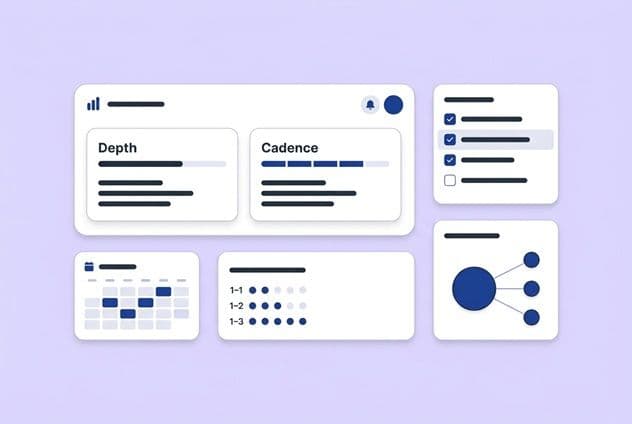
Quality vs. quantity is the wrong question. Use the Depth vs. Cadence decision.
This is where I used to get stuck, trying to answer an impossible question. The real question isn't "quality or quantity?" It's "which mode fits my situation right now?"
There are two modes: Depth and Cadence. You need to pick one as your primary focus and use the other to support it.
Choose "Depth" when…
Go deep when your product is complex, your buyer needs some education before they’ll even consider a solution, or you're competing in a crowded space. If someone has to understand a new concept before they understand why your product exists, shallow content is a waste of everyone's time.
Depth is also your best friend for building topical authority. Google and other search engines are getting smarter about this. They reward deep coverage of a subject. Thin content just signals that you're a tourist, not an expert. A single, solid 2,000-word guide for a buyer in the middle of their research can outperform five fluffy 500-word posts. Trust me on this.
Choose "Cadence" when…
Cadence wins when you're in the early days of educating a market, targeting lots of specific, long-tail questions, or just need to build brand familiarity. If your product is easy to understand but your brand is a ghost, you need presence more than you need epic depth.
Think LinkedIn posts, newsletters, and short-form blog posts that answer one specific question. This builds trust faster than disappearing for six months to write the perfect pillar post. Cadence is also great when you have a bunch of good ideas and not enough time. Publishing eight 600-word posts over a quarter can map to eight different search intents that one giant post could never capture.
The hybrid approach: one deep pillar + supporting cluster
You don't have to choose one mode forever. The most sustainable model I've found for a small team is this: one big cornerstone piece per quarter, surrounded by three to five shorter posts that answer related questions.
The pillar gets the "Depth" treatment. The cluster pieces give you "Cadence." They all link to each other, building a web of authority that tells search engines you own this topic, all without forcing you to write 10,000 words every month.
Founders need benchmarks: practical content length defaults for SaaS (by type + funnel stage)
Word-count benchmarks table (use as defaults, then adjust)
These are starting points, not sacred rules. Always look at what's already ranking for your target keyword and adjust from there.
| Content Type | Awareness (TOFU) | Consideration (MOFU) | Decision (BOFU) |
|---|---|---|---|
| Blog Post | 800–1,200 words | 1,200–2,000 words | 800–1,200 words |
| Pillar / Cornerstone | 2,000–3,500 words | 2,500–4,000 words | Not typical |
| Comparison Page | Not typical | 1,500–2,500 words | 1,200–2,000 words |
| Landing Page | 400–700 words | 600–1,000 words | 500–900 words |
| Help Doc / Tutorial | 400–800 words | 600–1,200 words | 400–800 words |
At the awareness stage, you’re just answering a question. Keep it focused. During consideration, buyers want details and comparisons, so go deeper. At the decision stage, they need clarity and confidence, not another novel to read.
How to tell if you need more depth (without adding fluff)
Before you start padding the word count, ask yourself these questions:
- Missing objections? Did you address the obvious reasons someone might not believe you?
- No concrete examples? Are you just describing concepts without showing them in action?
- Unclear steps? Did you explain what to do but not how to do it?
- No differentiation? Does your post sound exactly like the top three search results?
- Skipped nuance? Are there important exceptions or edge cases you just ignored?
If you can honestly say you've covered all five, the post is probably long enough. If not, add substance, not just sentences.
How formats change "length" (video, interactive, templates)
Depth isn't just about word count. A five-minute product video can deliver more understanding than a 1,500-word tutorial. An interactive calculator shows value instantly. A downloadable template is a piece of content with basically zero words.
When you're planning, think about the right format for the job. A video needs to address those same depth signals (objections, examples, steps). A template needs to be useful on its own. Plan for what the format needs to be helpful, not just what it needs to be long.
A simple content planning framework you can run in 60 minutes (and repeat monthly)
Step 1 — Pick one outcome for the next 30–60 days
What is the single most important thing content needs to achieve in the next two months? Is it pipeline from a specific segment? Better user activation? Educating a market that doesn't know you exist? Pick one. Everything else flows from this.
Step 2 — Build a ruthless topic shortlist (10 ideas max)
Go ahead and brainstorm 20 or 30 ideas. Then, force yourself to cut it down to 10. The real discipline isn't in coming up with ideas; it's in killing the ones that don't serve your main goal. For each one, ask: does this serve my outcome? Does anyone actually search for this? Do we have something unique to say? If not, cut it.
Step 3 — Prioritize with a founder-friendly scoring method
Score each topic on a simple 1–3 scale for five criteria:
- Strategic Fit: Does this serve your primary outcome?
- Search Value: Is there an audience looking for this?
- Proof: Do you have a unique story, data, or perspective?
- Effort: Can you actually produce this well right now?
- Expertise: Do you know this topic inside and out?
The topics with the highest scores get worked on first. Don't overcomplicate this with a fancy spreadsheet. The insights get buried. Just keep it in your notes or content system.
Step 4 — Assign the right format + depth (don't default to "blog post")
For each priority topic, ask what format would actually help someone. Is it a short answer, a huge guide, a comparison table, or a video script? Then assign it a mode (Depth or Cadence). Not every topic deserves a 2,000-word post. Some are 600 words, and that's perfectly fine.
Step 5 — Define "done" (including distribution + internal links + update date)
"Done" is not when the draft is approved. Done is published, with internal links added, shared on at least one channel, and with a refresh date logged in your calendar. If you don't define "done" this way, you'll end up with a graveyard of approved drafts that never see the light of day.
Where your time should actually go: create vs promote vs maintain
For years, I spent 90% of my time creating content and 10% wondering why it wasn't working. A healthy split for a lean team is more like 50% creation, 25% promotion, and 25% maintenance. The magic is in the promotion and maintenance.
Minimum viable weekly cadence (for founder-led teams)
- Weekly (30–60 min): Review one draft, approve one new topic, and glance at your analytics.
- Monthly (2–3 hours): Run the 60-minute planning process and check your key content for decay.
This simple routine can survive product launches and fundraising rounds. Use automation where you can, like scheduling first drafts, to handle the busywork so you can focus on the real thinking.
A simple distribution checklist that doesn't require a big audience
For every piece you publish, do this:
- Post a summary on your personal LinkedIn.
- Share it in one relevant online community (without being spammy).
- Send it to your email list.
- Make sure your sales and customer success teams know it exists.
Compounding requires reuse. If this feels like extra work, find tools that can help you repurpose a blog post into social and newsletter content. Make it part of the workflow.
What to measure (so you're not guessing)
Please, track only what you can act on:
- Organic sessions per post: Which articles are actually bringing people in?
- Content conversion rate: Are readers signing up or booking a demo?
- Keyword rankings: Are you moving up for the terms that matter?
- Time to rank: Give new content 3–6 months. Don't be impatient.
If a post gets traffic but no conversions, fix the call to action. If it doesn't rank after six months, it's time for a refresh.
Scale without losing trust: a hybrid human–AI workflow with governance
AI can help you write faster, but it's also fantastic at sounding confident while being completely wrong about your product. Ungrounded AI, the kind that isn't anchored to your actual product and point of view, damages trust faster than publishing slowly ever could.
The only AI rule that matters: "ground it or don't ship it"
Every single AI-generated draft has to be anchored to what's true. This means creating a structured source of truth for your company, a sort of internal "brain" with your positioning, product details, and customer stories. The AI should pull from this, not from the generic internet. The win isn't just using more AI; it's using grounded AI that enforces your accuracy and voice.
A 5-check QA pass (accuracy, intent match, differentiation, readability, conversion path)
Run every draft, whether from a human or AI, through this 15-minute check:
- Accuracy: Are all product claims and stats correct? (No, really, check them.)
- Intent Match: Does this actually answer the reader's question?
- Differentiation: Does it offer a unique perspective? Or does it sound like everyone else?
- Readability: Is it easy to scan and understand?
- Conversion Path: Is the next step obvious and easy?
A weak brief makes this QA process painful. Invest time in the brief to save yourself hours of editing.
How to prevent "generic competitor soup"
The fastest way to make any content feel human is to inject your actual point of view. Talk to your team. Ask sales for the top three questions they get on demos. Ask product what common misconception about your category drives them crazy. A 15-minute chat can give you more unique, trust-building content than a day of competitive research.
Make content compound: a lightweight content decay and refresh system
Hitting "publish" is the starting line, not the finish line. Content decays. Search results shift, products evolve, and competitors will publish better versions of your posts. A simple refresh system turns your content from a one-time expense into a compounding asset.
Refresh triggers (what tells you to update)
- Traffic drops by 20% or more over 30 days.
- Rankings slip for your main keyword.
- Your product or pricing changes, making the post inaccurate.
- The post's message no longer matches your company positioning.
- A competitor publishes a much, much better version.
Any one of these is a signal. A quick monthly check of your top 10 posts is all you need.
A simple refresh calendar (monthly triage + quarterly updates)
- Monthly (15 min): Scan your analytics for posts that hit a refresh trigger. Flag them.
- Quarterly (2–3 hours): Go update the posts you flagged. Fix internal links, update CTAs, and change the "last updated" date.
That's the whole system. You don’t need a 40-column spreadsheet. You just need a list, a calendar reminder, and a rule for when to act.
What to update first (the 80/20 refresh order)
For the biggest impact, update in this order:
- Title and introduction: These affect clicks and engagement the most.
- Outdated examples or feature talk: Fix these to maintain trust.
- Missing sections: What have competitors added that you missed?
- Internal links: Link to your newer, relevant content.
- CTA: Make sure it aligns with your current offer.
A 30-minute refresh can bring a dying post back to life. You rarely need to rewrite the whole thing from scratch.