I see you. Your competitors are publishing every day, probably using some AI tool to churn out posts. And a little voice in the back of your head is wondering if you’re already falling behind.
Let’s get one thing straight. Volume is not the answer. A startup that publishes 30 mediocre, AI-generated posts a month will get crushed by one that owns three concepts deeply and keeps its content sharp. The AI era doesn’t reward hustle. It rewards clarity, credibility, and consistency.
I’m going to give you a three-principle system to build that kind of content engine. Even if it’s just you, your laptop, and way too much coffee.
The AI era doesn’t kill SEO. It just punishes shallow, fragile content.
The way our customers find answers is changing, and fast. When someone types a question into ChatGPT, Perplexity, or Google's AI Overviews, they aren't browsing ten blue links anymore. They get a single, synthesized answer. The sources that feed that answer are chosen by an AI, not by a person clicking around.
This changes what "winning" at SEO looks like. Instead of hoping for a click from the #3 spot, your goal is to be the source that gets cited, paraphrased, or summarized in that final answer. You want your content to be selected by the AI, not just indexed by a crawler.
What “AI discovery” actually means
When a buyer asks an AI a question, the system looks for sources it trusts. It wants content that is clear, credible, and up-to-date. If your article is vague, outdated, or full of generic advice, it won't make the cut. I don’t care how well it used to rank on Google.
Being cited by an AI isn't magic. It's the result of your content being clear enough for a machine to parse, credible enough for it to trust, and recent enough for it to consider relevant.
LLM SEO vs SEO vs AEO vs LLMO (a simple map to the jargon)
People are throwing around a lot of new acronyms. Don’t get lost in the noise. Here’s all you need to know.
-
Traditional SEO: The stuff you already know. Optimizing for Google's algorithm with rankings, backlinks, and crawlability.
-
AEO (Answer Engine Optimization): This means structuring your content so an AI can easily grab and cite a direct answer from it.
-
LLM SEO / LLMO: A broader term for getting your brand to show up in any large language model output (ChatGPT, Claude, etc.).
-
GEO (Generative Engine Optimization): The nerdy academic term for the same thing.
You still need both. The technical basics of traditional SEO, like crawlability and quality links, are what let AI systems find and trust your content in the first place. Think of AEO as a new layer you build on top of that solid foundation.
Principle #1: Own concepts, not just keywords
I’ve been there. As a lean founder, your first instinct is to chase keywords. You try to write the "ultimate guide" on some broad topic where you have zero edge. In the AI era, that's a recipe for burnout and failure. You can’t out-publish a company like Hubspot, but you can absolutely out-position them on a niche you know better than anyone.
The "concept ownership" test (Can an AI summarize your POV in one sentence?)
Try this right now. Ask an AI to summarize your best article's key insight. If it spits back a generic summary, you don't own the concept. If it can actually articulate your specific point of view, you’re on the right track.
Concept ownership means an AI, or a human for that matter, connects a specific idea with your brand. Think "jobs to be done" and Clayton Christensen. You want that kind of mental shortcut forming around your company's unique take.
How to pick 3–5 concepts your startup can actually win
Start here. Run your ideas through these three filters:
-
Is it tied to your product's value? You need to be able to speak about the concept with real, earned depth. Don’t fake it.
-
Are your customers already asking about it? Your customer conversations, sales calls, and support tickets are a goldmine of ideas. Listen to the language they use.
-
Is the competition weak? If everyone else has written the same bland post, you have an opening. Write a better one with a real opinion, or find an angle they've all ignored.
This process should help you find 3–5 concepts your startup can genuinely own. I’m not talking about owning the entire internet. I’m talking about owning a small patch of turf in the minds of your specific buyers.
What to publish first: pillar → supporting articles → comparison content
For each concept, start with one strong pillar article. This should be a comprehensive, opinionated piece that defines the concept on your terms. It's not a listicle. It’s your manifesto.
From there, write 2–3 supporting articles that dive deeper into specific sub-topics. Then, add comparison or decision-support content (like "X vs Y") to capture buyers who are close to making a choice. This structure creates a powerful flywheel. Each new article links back to the pillar, and the pillar gains authority with every new piece you add.
What to avoid as a lean team (stuff that feels productive but isn't)
Seriously, stop writing the broad "What is [your category]?" posts. Anyone could write them. Skip the trend roundups that have no point of view. And please don’t do a "we tested 15 tools" post unless your product is directly related to them. This all looks like work, but it doesn't build authority. AI systems reward relevance and specificity, not just effort.
Principle #2: Make your content "AI-readable" (structured, citable, unambiguous)
You could have the most brilliant ideas in the world, but they're useless if they're buried in a wall of text. AI systems need structure. They look for clear claims, definitions, and step-by-step logic. If your formatting is a mess, you're invisible.
The citation-ready formatting checklist
This is the stuff that makes your content easy for an AI to extract and quote. We try to build this into every draft.
-
Lead with definitions. Define key terms in one clear sentence, right at the top.
-
Use tables for comparisons. AI loves structured data. Tables are perfect for this.
-
Use numbered lists for steps. Numbered steps get quoted. Prose instructions get ignored.
-
Add FAQ sections. These are literally pre-formatted answers to common questions.
-
Use descriptive headers. Your H2s and H3s should answer a question or state a clear outcome.
-
Make constraints explicit. "This works for teams under 20" is way more useful (and citable) than vague advice.
Some teams (like ours) build these checks right into their workflow so they’re part of the draft, not an afterthought.
Schema and semantic structure: what matters (and what's overkill)
For most of us, the highest-impact schema markup is Article, FAQPage, and Organization. These three cover most of what AI retrieval systems look for, and you can implement them without a huge engineering project.
Google prefers the JSON-LD format, so that's the safest place to start. Don't get lost trying to implement complex product or breadcrumb schema yet. Just nail the basics and move on.
Brand signals beyond backlinks
Backlinks still matter. But brand mentions, even without a link, are becoming a powerful signal for AI systems. The takeaway here is simple: get your company name and your core concepts mentioned in the places your buyers hang out.
This means guest posts, podcast appearances, community threads, partner webinars, and PR. Consistency is key. When your company name keeps showing up next to the same 3–5 concepts, AI systems start connecting the dots.
Don't forget the SEO fundamentals
None of this works if bots can't find or read your content. Make sure your site serves content in static HTML or uses server-side rendering. A site that relies only on JavaScript can be invisible to crawlers. Keep your sitemap updated and fix your broken links. It's not glamorous work, but it's the foundation for everything else.
Principle #3: Build a maintenance system (freshness is a strategy, not a chore)
One of the biggest mistakes I see is publishing an article and then forgetting about it. AI systems actively downweight outdated content. It signals that the source isn't reliable. Your content has a shelf life, but a simple maintenance routine can turn this into a huge advantage.
The "content debt" problem in AI search
Content debt is what happens when your published articles slowly become inaccurate as your product, your market, and the world change. An AI surfacing stale information from your site is brand damage.
A simple maintenance cadence for a team of one
-
Weekly (10 minutes): Scan for any urgent product or market changes that make your existing claims wrong.
-
Monthly (30 minutes): Pick your 2–3 best-performing pieces. Is the information still accurate? Can you add a new example or data point? (There are tools that can automate this scheduling, so you don't have to remember).
-
Quarterly (2 hours): Do a full review of your pillar articles. Update the structure, refresh the examples, add new FAQs, and check the schema.
Update triggers (when to revise, even if traffic is fine)
Don't wait for a traffic drop. Update your content immediately when:
-
You ship a product change that affects its claims.
-
A competitor publishes something that guts your main argument.
-
Customers start using new language to describe their problem.
-
A major industry shift happens (like, you know, AI changing search).
The update checklist (what to change so AI trusts you again)
When you revise a piece, do more than just tweak a few words.
-
Does the core idea still hold up? If not, reframe it.
-
Are the examples current and specific?
-
Can you add a table, FAQ, or step-by-step list?
-
Are your internal links still pointing to the right places?
-
Does the schema need to be updated?
-
Did you update the publish date? (Only if you made real, substantial changes!)
These principles mean making trade-offs. Here’s a simple way to think about it.
| Investment Area | Lean Team (Do This First) | Scaling Team (Do This Next) |
|---|---|---|
| New vs. Updates | 70% new content for your core concepts, 30% refreshing top performers. | Shift to a 50/50 split. Systematically update or kill anything older than 18 months. |
| Schema Markup | Basic Article, FAQPage, and Organization schema. Use a simple plugin. | Expand to HowTo, VideoObject, and Product schema. Automate it in your CMS. |
| Brand Mentions | Low-cost mentions: answer questions online, go on small podcasts, co-market with partners. | Add targeted PR and guest posting on big industry sites. |
| Content Format | Stick to well-structured text with simple tables and lists. | Add short videos, custom diagrams, or interactive tools to make content stickier. |
Measuring what matters: connecting AI visibility to leads (without fake precision)
Let's be honest, attribution for AI answers is a mess. But "imperfect" isn't the same as "impossible." You can still connect your work to business outcomes.
The 3 layers of measurement: visibility → visits → outcomes
Think in these layers:
-
AI Visibility: Are you getting cited? Once a month, run manual prompts for your key concepts in ChatGPT, Perplexity, and Google. See if your brand shows up. (Some new AEO tools are starting to track this automatically).
-
Visits and Engagement: Keep an eye on organic traffic, time on page, and scroll depth. Watch for referral traffic from AI sources. Monitor your branded search volume.
-
Outcomes: Track form fills, demo requests, and trial signups from your organic traffic. You won't get perfect attribution, but you'll see the trends.
A founder’s KPI mapping table
| Signal | What It Tells You | Your Action |
|---|---|---|
| Branded search is growing | Your awareness is compounding. | Double down on that concept. |
| High traffic, no conversions | You have the wrong audience or a weak CTA. | Fix the intent mismatch. |
| You're cited in an AI answer | Your content is well-structured. | Use that piece as a template. |
| Traffic is declining | You have a freshness or authority problem. | Run the update checklist. |
| No AI citations, despite ranking | Your formatting is poor. | Add tables, FAQs, and step-by-steps. |
How to run a 30-minute "AI discovery audit" each month
Pick 5–8 prompts your ideal buyer would ask. Something like, "What's the best content strategy for a seed-stage SaaS?" Run them in ChatGPT, Perplexity, and Google's AI Overviews. Note who shows up and what structure their content uses. Now you have a clear roadmap for closing the gap.
As you do this, you’ll notice subtle differences. Google seems to favor sources with strong authority and recency. Perplexity loves clear, direct answers. ChatGPT is great at synthesizing different viewpoints. Your content needs the right ingredients for the platform your buyers use most.
Responsible AI-assisted content: how to scale without sounding generic (or risky)
Look, we're all using AI. The problem isn't using AI to help you write. The problem is publishing undifferentiated AI output with no human judgment. The risk isn't the tool; it's the false confidence you get from a fluent-sounding first draft.
What AI can do vs. what you must do
Let AI handle: synthesizing research, creating outlines, writing first-draft prose, fixing formatting, and repurposing your published work into social posts or emails.
You must own: your point of view, your product claims, your real-world examples, and anything that touches on compliance, pricing, or your competition. This is where "confident nonsense" from an AI can do real damage to your brand.
Guardrails to prevent brand damage
Before you publish any AI-assisted draft, ask these four questions:
-
Can I verify every single factual claim?
-
Does this sound like us, or like a robot in a trench coat?
-
Does this overstate what our product can do?
-
Does this piece have a real opinion, or is it just hedging?
How to preserve your originality at scale
Add at least one thing to every post that an AI couldn't possibly generate on its own. It could be a specific story from a customer, a constraint your team discovered the hard way, a "what we'd do if..." scenario, or just a direct statement of what you don't believe. These are the human hooks that make content worth reading and citing.
A 2-week rollout plan for a lean startup
You don’t need a whole content team to get started. You just need a decision and a first step.
Week 1: Pick concepts, build your "source of truth," and outline your first pillar
Day 1–2: Apply the concept selection filters. Pick your first concept and write down your one-sentence POV on it.
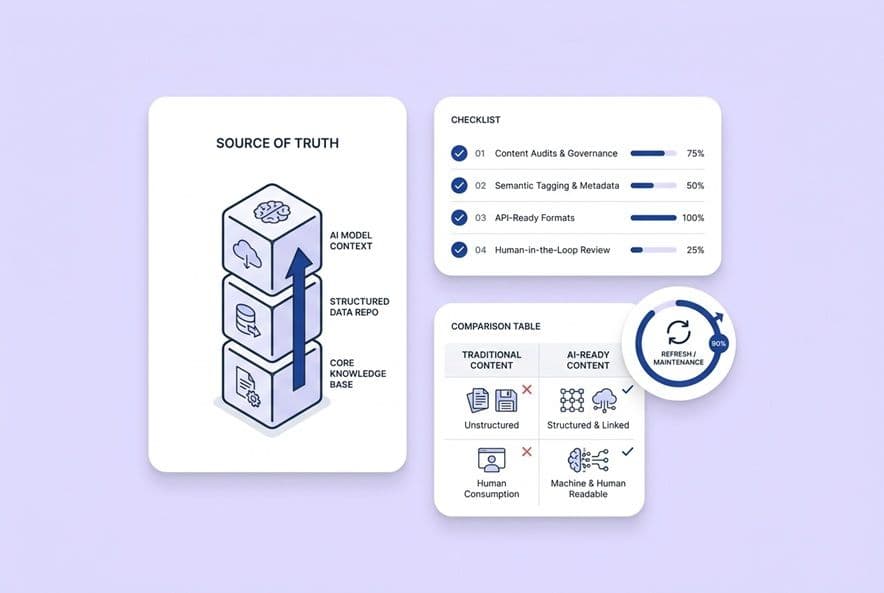
Day 3–5: Build a simple source of truth document. Include your positioning, product capabilities, target persona, and voice guidelines. (If you use an AI workflow, some tools can store this so every draft starts on-brand).
Day 6–7: Outline your first pillar article using the citation-ready structure from Principle #2.
Week 2: Publish, add structure, set your maintenance cadence
Day 8–10: Write and publish the pillar. Don't aim for perfect. Aim for defensible. Add your FAQ, tables, and schema before you hit publish.
Day 11–12: Set your maintenance reminders in your calendar. Now. Go find your top two existing articles and run the update checklist on them.
Day 13–14: Define your distribution loop. How does this article become a LinkedIn post or a newsletter snippet? Build that step into your process now, not later.
How to evaluate tools
When looking at tools, pick the ones that embed SEO and AEO checks into the workflow, help automate maintenance, and enforce brand accuracy. Ignore anything that just promises more volume or removes the human review step.
Keep your content strategy simple. Make it durable.
You don't need to chase every new AI trend. The most durable strategy is to choose 3–5 concepts you can own, apply a simple structure to your writing, and set a maintenance cadence you can actually stick to.
Just start with one pillar article this week. You've got this.