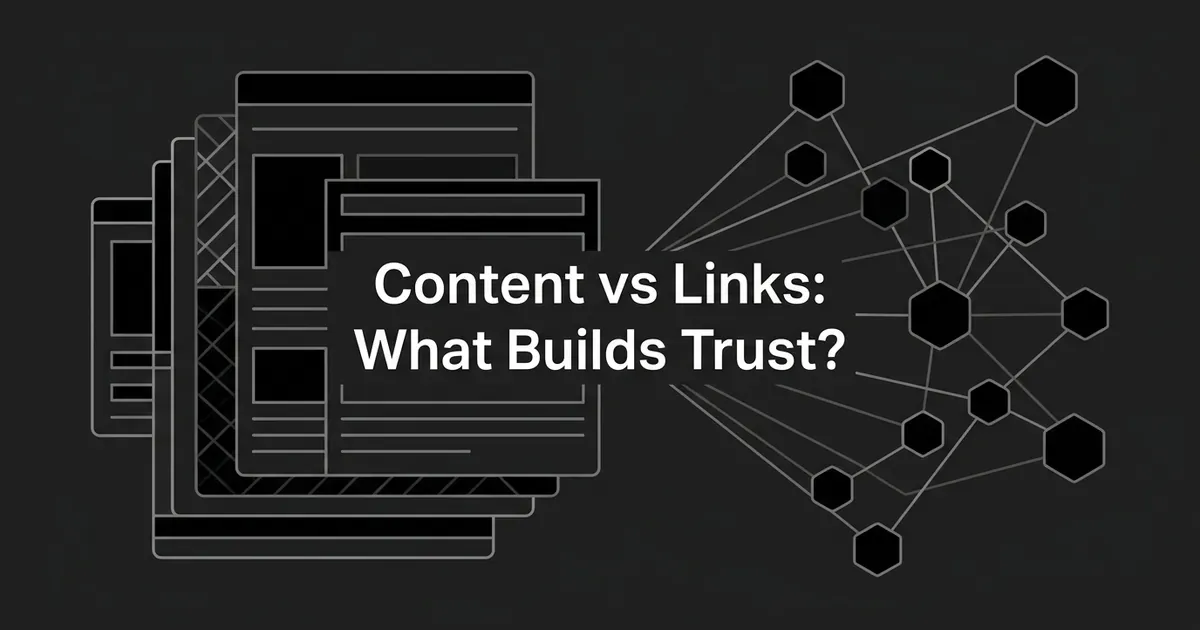
If you only have time or budget for one thing this quarter, where should it go: making a page better, or earning links to it? That's the real question behind content vs links SEO, and most teams answer it by habit instead of by looking at what's actually broken on the page in front of them.
Here's the short version. Fix the page first when it doesn't actually answer what the searcher wants, or when it's thin, outdated, or easy to beat. Shift toward earned links when the page is already solid and the thing holding it back looks like a lack of outside recognition, not a lack of substance. Neither one wins by default, and nobody, including Google, hands out a fixed percentage split between them.
| Content investment | Link investment | |
|---|---|---|
| What it answers | Does this page actually help the person who searched? | Do other sites vouch for this page? |
| What you control | Every word, every example, every fix | Your own outreach and promotion, not another site's decision |
| Easiest to fake | Word count, publishing more, generic sections | Raw link totals, a vendor authority score |
| Fixes what | A wrong, thin, or stale answer | A real recognition gap on an already-good page |
What Counts as a Content Investment
Content investment means making an important page actually do its job: answer the real question, say something accurate and specific, show you know the topic, and present it in a way someone can actually use. It's not the same as writing more. Adding sections nobody asked for, repeating a keyword, or publishing on a schedule regardless of whether anything new is being said doesn't count, even though it looks like effort.
Google's own guidance on helpful content asks whether a page gives original information, enough depth to be useful, clear sourcing, and something a competing page doesn't already offer. None of that turns into a number you can hit. It's a set of questions you answer honestly about one page at a time.
This can mean fixing a page you already have instead of writing a new one. A product page, a how-to, a comparison, a support doc, all of them can carry a content gap. We go much deeper on how to spot and close that gap, including the full quality-rater evidence behind it, in our piece on what Google's Quality Rater Guidelines actually say about good content. This piece only needs the short version: the question is usefulness, not volume.
What Counts as a Link Investment
Link investment, in the sense this article uses it, means earning links from other websites to pages on your own site. The work behind it usually looks like making something genuinely useful and then getting it in front of the people who'd want to reference it, not asking for a favor.
A backlink is one incoming link. A referring domain is a distinct website sending you at least one. Ten links from one site is a very different signal from ten links across ten different sites, and treating them the same is a common way teams overstate their own progress.
Two things get lumped into link investment that really aren't part of it. Internal links connect pages on your own site to each other, and they help people and Google find your work, but they're not an outside vote, they're housekeeping you control directly. Outbound links, the ones you add pointing to other trustworthy sources, can help a reader trust your page more, but they're not the same thing as another site choosing to link to you. If you want the full case for whether link building is still worth the time and money given how AI search is changing discovery, read our deeper piece on link building versus content marketing. This article sticks to the narrower question of which lever to pull next.
Relevance Versus Corroboration: What Each One Actually Proves
Content and links aren't two versions of the same thing. Content shows Google and the reader that the page is relevant and useful. Links help Google find the page, understand how it connects to other pages, and weigh outside corroboration. One doesn't substitute for the other, and treating them as interchangeable is where a lot of strategy goes wrong.
Google's own explanation of how it ranks results says the weight given to any one factor changes depending on the query. A search about breaking news leans more on freshness than a search for a dictionary definition does. Its ranking-systems guide also confirms that link analysis, including PageRank, is still part of its core systems today, not a retired idea from the early 2000s. So when someone asks does content or links build trust, the honest answer is both do, for different reasons, and the published guidance doesn't hand either one a fixed weight.
That hasn't stopped the industry from arguing about it. A Google analyst was once quoted saying people overestimate how important links are and that he didn't think they belonged in the top three ranking factors anymore, a comment that Search Engine Land reported in 2023 and that still gets passed around as if it settled the question. It didn't. A dated conference remark isn't a disclosed list of current weights, and Google's primary documentation still confirms link analysis is part of the system today.
Google also says it treats trust as the most important part of E-E-A-T, but it's explicit that E-E-A-T itself isn't a specific ranking factor you can tune directly. Quality raters feed into how Google evaluates its own systems over time, not into where an individual page lands this week. If you want the longer breakdown of what that actually means for your content, see our guide on what E-E-A-T is for AI search and how it differs from Google's version. For this comparison, the point to hold onto is simpler: trust isn't a single score that goes up when you add a link or a paragraph, it's a mix of signals, and some of those signals come from content and some come from corroboration.
What the Evidence From Two Big Studies Actually Shows
Two large industry studies get cited constantly whenever someone asks which matters more content or backlinks, and both are worth knowing, as long as you don't ask them to prove more than they can.
Ahrefs looked at the top 20 results for a million high-volume US keywords and found a correlation of 0.255 between a page's number of referring domains and its ranking, with backlink counts and domain authority scores showing similarly modest numbers. Ahrefs itself calls these weak to very weak correlations and is careful to say correlation isn't causation. The study also found the relationship got stronger for branded and informational searches, which hints that popular brands simply tend to collect both links and top rankings together, not that one definitely causes the other.
Backlinko's analysis of 11.8 million search results found that the number one result averaged 3.8 times the backlinks of the pages sitting in positions two through ten. It also ran a content-depth score against a subset of those results and found higher scores lined up with higher rankings, while plain word count did not. Those two findings together are actually the most useful part of the study for which matters more content or backlinks: both link signals and a content-comprehensiveness signal showed up together, not one instead of the other.
Neither study gives you a formula. A 3.8x ratio of average backlinks between ranking groups isn't a target to hit, and a 0.255 correlation doesn't mean links explain a quarter of your ranking. What they do support is that both levers are doing something, and that the size of the effect shifts by query type, which is exactly why this has to be a judgment call on your specific page, not a rule borrowed from someone else's dataset.
Which One Can You Actually Control
This is the part that tends to get skipped, and it matters more than the studies do. Content is entirely inside your own walls. You decide what the page says, how deep it goes, whether the examples are real, and when it gets updated. A link from another site is a decision made by someone else's editor, reporter, or reader, and no amount of effort on your end guarantees they'll make it.
That doesn't mean link work is wasted, it means it has a different risk profile. You can budget time to improve a page with near certainty that the work will land. You can budget time to promote a page and genuinely improve your odds of earning a link, but you're not writing a check that's guaranteed to clear.
This changes how you should measure each one. Watch Search Console impressions and clicks for the query set a change was meant to help, and give it a few weeks before judging, since Google's own guidance says some changes show up in hours and others take months. For link work specifically, watch whether relevant new sites are actually linking to the right page, not just whether your total count went up, since the Search Console links report only samples a slice of what Google knows about anyway. And if you change the content and the links at the same time, don't expect to know which one did the work.
When to Invest in Content, and When to Invest in Links
| If this is true of the page | Put the next effort into | Why |
|---|---|---|
| It answers a different question than what searchers actually want | Content | More links won't fix a wrong answer |
| It's thin, outdated, or offers nothing a competitor doesn't already have | Content | The gap is substance, not visibility |
| It's hard to find even on your own site | Internal linking and basic structure | An orphaned page doesn't need an external campaign first |
| It's genuinely strong, but competing pages get referenced by relevant outside sources and yours doesn't | Earned links and promotion | The page is doing its job, the recognition gap is the likely remaining constraint |
| The domain overall is well-linked, but this one page is weak | Content | Site-wide strength doesn't carry a specific weak page |
Don't force every page into this table. Sometimes a page is competitive on both counts and still underperforms, and the real issue is something else, like it's targeting the wrong intent entirely or it's losing to a format the searcher actually prefers. When that happens, the honest move is to step back and diagnose further rather than defaulting to whichever lever you haven't tried yet this month.
If you're deciding where to put a limited budget across your whole content program rather than one page, the companion piece on quality versus quantity in content publishing goes further into that tradeoff than this piece can. And if the recognition gap is the real issue, our guide on building authority for AI search without a strong backlink profile is the better next read than another generic link-building checklist.
One myth worth clearing before you make that call: a longer page is not automatically a better one. Backlinko's own data found no direct link between word count and ranking position, and Google has said plainly it has no preferred length. We cover the full evidence on this in our piece on whether content length affects SEO rankings. Padding a page to hit a number is one of the easiest ways to spend a content budget and get nothing back for it.
What This Looks Like Once AI Answers Are in the Mix
If you're wondering whether any of this changes once you factor in AI Overviews or AI Mode, Google's own guidance says the same foundational basics apply: a page still has to be crawlable, indexed, and eligible to show up in regular search before it can show up as a source in an AI answer. There's no separate markup or special file that unlocks AI citation, and no published rule that says content or links carries a different weight once an AI system is doing the answering.
There is a real difference worth knowing about between a backlink and an AI citation, since one is a durable vote that compounds and the other gets decided fresh with every single answer. We go into that distinction properly in our piece on AI citations vs backlinks. For the purposes of this comparison, the takeaway is narrower: don't drop either lever because AI search exists. Nothing in the published guidance tells you to.
If you take one thing from this whole content vs links SEO debate, it's that the answer lives on the page, not in a general rule. The practical move, on your own pages, is the same one this whole piece has been building toward. Look at one specific page. Ask honestly whether it answers the question well, and ask honestly whether the pages beating it have outside recognition yours doesn't. Fund whichever answer comes back weaker, check again in a few weeks, and don't change both levers at once if you actually want to know which one worked.