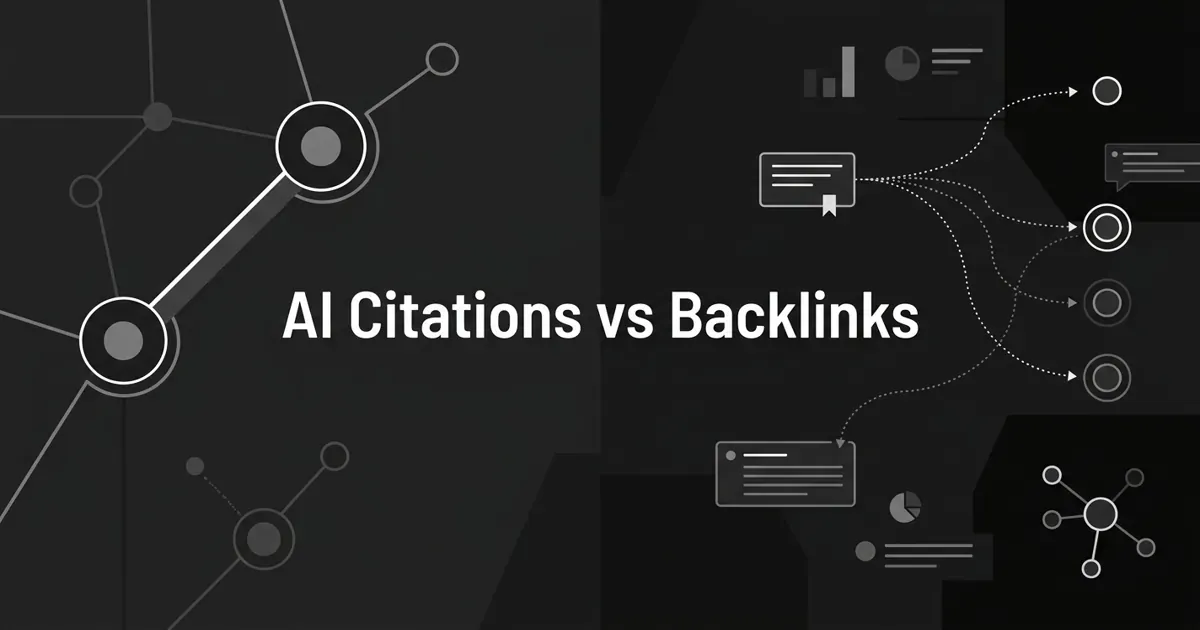
Most marketing leads arrive at the AI citations vs backlinks question already holding a backlink profile built over years. The decision is not whether backlinks still count. It is whether an AI citation is a rebranded backlink they already know how to earn, or a different kind of signal that needs its own strategy. The honest answer is the second one. Backlinks and AI citations share an underlying purpose, off-site authority, but they behave differently enough that treating them as interchangeable leaves visibility on the table.
A backlink is a durable vote cast once, held by the linking page, and re-weighted every time a crawler recomputes the link graph. An AI citation is a per-answer, retrieval-time selection that an engine can, and regularly does, swap for a different source the next time the same question is asked. Both belong in the strategy, neither replaces the other, and the two are not measured the same way. The sections below compare the signals dimension by dimension, then set out which one a team should weight first.
AI citations vs backlinks at a glance
| Dimension | Backlink | AI citation |
|---|---|---|
| What it is | A hyperlink from an outside page to yours, treated as a vote of confidence in a link graph | A named source attached to a generated answer by an answer engine |
| Where it lives | On a third-party page, persisted in that page's HTML | Recomputed each time an engine answers a prompt, not stored as a static edge |
| Who controls it | The linking site (the recipient influences, does not authorize) | The engine's retrieval and re-ranking pipeline |
| Decay curve | Slow to build, slow to lose, compounds over time | Fast to gain on a prompt, can be lost on the next prompt |
| Unit of evaluation | The URL and its page authority | The passage, judged on semantic match, information gain, and entity fit |
| Stability | High in the medium term | Low, with 40 to 60 percent of cited domains changing month over month |
| Trust it encodes | Other sites vouch for you (transitive authority) | This passage is the best available answer right now (contextual authority) |
| What earns it | Editorial links, credible third-party mentions, brand co-citation | Structured, factual, fresh content that matches a specific prompt |
| What it influences | A page's rank in traditional blue-link results | Inclusion as a source inside an AI-generated answer |
| Role in the stack | Upstream input that gates which pages engines crawl and trust | Downstream output of the retrieval pipeline, visible in the answer |
The short version: backlinks buy ranking authority, and citations buy presence inside the answer. A page usually needs the first to earn the second, but the second is the prize.
What a backlink is, and why the signal endures
A backlink is a hyperlink on a site other than your own that points to a page on your site. In PageRank-style systems, that link is treated as a vote of confidence: one site, by linking, signals that the destination is worth surfacing. PageRank models the web as a directed graph of pages and links and computes importance iteratively. The algorithm is content-agnostic: it does not read the page text, it weighs link equity, blending the quality and quantity of inbound links into a single cumulative number.
Three mechanics matter for the comparison. Authority transfer is weighted, so a link from a high-authority page with few outbound links is materially more valuable than one from a low-authority page with many. Backlinks compound, because they accumulate slowly and are hard to remove, which anchors the signal to a long horizon rather than a per-prompt one. Co-citation reinforces entity recognition, because a brand mentioned alongside authoritative entities across multiple third-party pages reads to a machine as a real entity worth recognizing later.
The strengths follow from durability. A single earned link can carry authority for years, links are countable in any standard SEO tool, and the marginal value of each new high-quality link tends to grow as a domain matures. The worst common failure mode, an absence of new links, is recoverable.
The limitations show up specifically for AI search. Feedback is slow, because a link earned today may take months to move AI visibility as the ranking effect propagates into the crawls an engine uses. The direct correlation is weak: a page with a strong backlink profile can remain invisible when its content is hard to parse, lacks structure, or does not match a prompt the engine is answering. It is the same distinction that explains why high-ranking pages still miss AI citations, because link authority governs ranking, not passage-level selection.
What an AI citation is, and how the engine produces it
An AI citation is a reference an answer engine attaches to a generated response, naming and usually linking the source it drew from. In Perplexity, citations appear as numbered footnotes and inline links. In Google AI Overviews and AI Mode, they appear as linked source chips beneath the answer. In ChatGPT, they appear as inline hyperlinks in web-search mode and as named entities in the body of the response otherwise. A citation is the public artifact of the engine's retrieval pipeline.
That pipeline follows a retrieve-then-generate pattern, often called retrieval-augmented generation. A complex prompt is first decomposed into several sub-queries; for Perplexity, a single question typically generates roughly three to five internal searches. The engine then retrieves roughly ten candidate pages per sub-query, reads each candidate at the passage level, and re-ranks them, discarding documents that score below a confidence threshold. Of the ten or so candidates, commonly three to four survive to be cited and the rest are dropped. Two mechanics deserve attention: engines run semantic and keyword-style search in parallel and merge the rankings, which is why both natural phrasing and exact-match terms matter, and they prioritize information gain, so passages that add new facts beyond the consensus are favored over passages that repeat it.
The strengths are specific to the format. When a citation lands, the brand is read out by the model inside the answer, which creates an impression even when no click follows, and a single densely written page can earn citations across many distinct prompts.
The limitations are equally specific. Citations are probabilistic rather than deterministic, so the same prompt can return a different source list from one run to the next. Studies place month-over-month citation change at 40 to 60 percent across major platforms, rising to 70 to 90 percent over six months. The criteria that ChatGPT, Perplexity, Gemini, and Google AI Mode apply overlap but do not match, so a page cited by one engine may be ignored by another. A brand's own sites also account for only about 5 to 10 percent of the sources AI search references, which means citations tend to favor visible third-party coverage of a brand over first-party depth.
Where the two signals overlap
Backlinks and citations are both authority signals, but they encode different authority. Backlinks encode transitive authority, the sense that other sites vouch for a page. Citations encode contextual authority, the sense that a passage is the best answer for a given prompt at a given moment. The overlap is real and worth naming, because it is where the backlink vs citation AI search debate produces its most useful conclusions.
The recurring question, are AI citations the new backlinks, gets a cleaner answer once the three overlaps are mapped. First, backlinks influence which pages engines retrieve, because traditional rankings still gate much of what engines crawl and trust; strong profiles get pages into the candidate set, and weak ones often get filtered out before re-ranking. Second, co-citation reinforces entity recognition, so a brand mentioned alongside category-defining entities on credible third-party pages is treated as a real entity worth quoting. Third, domains that earn both high backlinks and high citations dominate both signals, with Wikipedia the canonical case: it carries authority high enough to appear in roughly 47.9 percent of ChatGPT's citation set.
The careful framing is that backlinks are the prerequisite and citations are the prize. Backlinks alone do not earn citations, since the evidence shows weak-to-moderate direct correlation and a stronger indirect effect that runs through rankings. Establishing brand authority on third-party sites feeds the entity recognition engines rely on, but it does not substitute for structuring content an engine can extract.
Stability and decay: an asset you hold versus an outcome you re-earn
Backlinks compound slowly and decay slowly. A single earned link on a high-authority page can continue to contribute authority for years, whether or not the team does anything new. AI citations decay fast and re-form on every retrieval. Roughly 40 to 60 percent of the domains an engine cites today will differ a month from now for the same question, and the figure climbs to 70 to 90 percent over six months.
One counter-pattern keeps the picture honest. At the domain level, week-over-week stability is high, with observations near 96.8 percent of cited domains seeing no change in a given week, so engines rotate citations within a fairly stable set of authoritative sites rather than across the open web. The practical reading: backlinks are an asset bought once and ridden, while citations are an outcome re-earned with every release and structural fix.
Control: links you influence versus citations an engine chooses
Neither signal is fully controllable, but they fail at different points. A backlink's owner is the linking site, so the recipient holds influence through outreach, original data, and brand PR, not authorization. A citation's owner is the retrieval pipeline, so the publisher controls the inputs the pipeline reads rather than the decision it makes: the content's structure, factual density, freshness, schema markup, and the brand-entity signals present on third-party sites the engine already trusts. Backlinks are pulled from others; citations are chosen by a machine reading what a team has published.
That difference reshapes where effort goes. Chasing links means persuading people; earning citations means engineering pages an engine can parse and quote, which is closer to a content-structure problem than a relationship problem.
What earns each signal: linkable assets versus answerable passages
Backlinks reward linkable assets. Original research, useful tools, named experts, and definitive guides give other sites a reason to point at a page. Citations reward answerable content: passages that match a prompt's entities, claim specific facts, and sit inside pages with clear schema, recent updates, and coherent heading structure. The formats that consistently get cited tend to be structured for extraction rather than for persuasion.
The engine-side selection criteria favor several qualities at once: direct relevance to the sub-query, information density built from facts and named entities, institutional trust for technical and news queries, a neutral tone, freshness, parseable structure, and originality beyond the consensus. None of those is a backlink. The citation signal vs link signal contrast is sharpest here, because the levers that raise one do little for the other: a team optimizing only for links can produce an unlinkable answer, and one optimizing only for citations can produce a page that no site links to.
Where each signal appears: blue links versus in-answer presence
Backlinks earn positions on a results page, where the user sees a list and decides what to click. Citations earn presence inside an answer, where the user often never sees a list of links at all. With zero-click share running near 83 percent for searches that carry an AI Overview and around 58.5 percent of United States Google searches overall ending without a click, a citation frequently does brand work inside the answer regardless of whether it drives a visit. A backlink's return is legible through clicks and rankings, while a citation's return includes an impression that may never register as traffic, which is why per-prompt visibility, rather than sessions alone, becomes the honest unit of measurement.
Do backlinks help AI citations?
Do backlinks help AI citations? Yes as upstream input, and no as the final signal. Backlinks shape a page's traditional ranking, that ranking partly determines which pages AI Overviews and AI Mode retrieve, and backlink-driven authority plus third-party mentions reinforce the entity recognition an engine uses when deciding whether a brand is worth quoting.
The evidence supports the indirect reading and cautions against the direct one. Widely cited analyses put roughly 76 percent of Google AI Overview citations among the top 10 organic results, which argues that rankings gate retrieval, yet a large keyword study found that roughly 47 percent of cited sources did not hold a top-10 organic position for the same query, so rankings are necessary but not sufficient. Correlation work points the same direction: brand search volume, not backlink count, tends to be the single strongest predictor of citations, and the most-cited pages often carry fewer backlinks than less-cited ones once an engine is re-ranking passages. The takeaway for a marketing lead is not to choose. Backlinks still gatekeep rankings and build third-party authority, citation-ready content places the brand inside the answer, and the two function as stages of one growth loop.
The citation signal vs link signal comparison, by the numbers
The evidence base is directional rather than precise, and it should be read as ranges. Citation drift across identical prompts in one month-long window ran near 59 percent for Google AI Overviews, near 54 percent for ChatGPT, and near 40 percent for Perplexity. Engine-specific selection is stark: AI Overviews and AI Mode, despite drawing from the same search stack, overlapped on only about 13.7 percent of their citations, and source mix diverges too: ChatGPT leans on Wikipedia, Google AI Overviews on community and video, and Perplexity on community content. One-size-fits-all advice will be wrong for at least one engine, which is why per-platform tracking beats a single averaged dashboard.
Which signal to prioritize, by situation
The backlink vs citation AI search question resolves into a sequence, not a choice, and the right weighting depends on where a team already wins. The recommendation below maps three common situations to a next step, and none of them treats the two signals as substitutes.
- Teams that already win on Google and want to extend into AI answers. Maintain the backlink profile as the upstream input engines trust to crawl and re-rank candidate pages, and pair it with content structured for retrieval: entity-rich passages, schema, freshness signals, and clear question-scoped sections. The link work is largely done; the gap is usually structure.
- Brands that already earn citations but neglect their backlink profile. Expect a plateau. AI Overviews and AI Mode draw a large share of citations from the top of organic results, and organic still compounds on links, so a thin backlink profile eventually caps citation growth while better-linked competitors harden their positions.
- A marketing lead with limited bandwidth. Prioritize citation-friendly content first, since the marginal effort is lower than chasing links and the in-answer visibility is available now, then run steady-state backlink maintenance through annual original data, third-party brand mentions, and ongoing PR for co-citation. The failure to avoid is a link-building squad and a content squad that never talk to each other.
Across all three, the shift from SEO to AEO is additive: the backlink program keeps doing its job while a citation program runs alongside it.
Where DeepSmith fits
DeepSmith is a platform that tracks how AI engines answer questions about a brand, finds the gaps where the brand is invisible or losing, and produces on-brand content to close those gaps, all from the same data. It positions itself as a production engine rather than a writing assistant, so the output is meant to be publish-ready. In the frame of this comparison, DeepSmith operates on the citation half of the loop; it does not promise to manufacture backlinks, which remain a link-graph outcome earned through the team's own PR and outreach.
On the tracking side, the platform measures mention and citation across ChatGPT, Gemini, Perplexity, Claude, and Google AI Mode, with coverage rising by plan tier: Pro tracks ChatGPT, Grow adds Perplexity, Scale adds Gemini, and Enterprise covers all five. Because citations are per-prompt and per-platform, the tracking is built around exactly the volatility described above, reporting mention rate, citation rate, and share of voice per prompt rather than as a single averaged figure, and showing which competitor pages win the citations a brand is missing. On the production side, the writing pipeline is built around answer-engine formatting, with crisp answers near the top, headings mapped to questions, and schema.
DeepSmith does not control or guarantee rankings, citations, traffic, or revenue; it surfaces what is happening across the engines a plan covers and produces content designed to compete for citations, with a human able to review before anything publishes. For a marketing lead who needs both signals, it handles the production and tracking half while the existing link process continues in parallel. As Aparna K, GTM Lead at Skooc, reports, teams have gone "from four articles a month to fifteen with the same two people."
Teams that want to see the citation side in real data can start a DeepSmith free trial, which offers real data and real drafts before payment.