If you are staring at a marketing budget and trying to decide where the next dollar goes, the link building vs content marketing question usually shows up as a false choice. It gets framed like the two are competing for the same line item, and you have to pick a side. They are not the same kind of investment, so they do not compete the way it feels like they do.
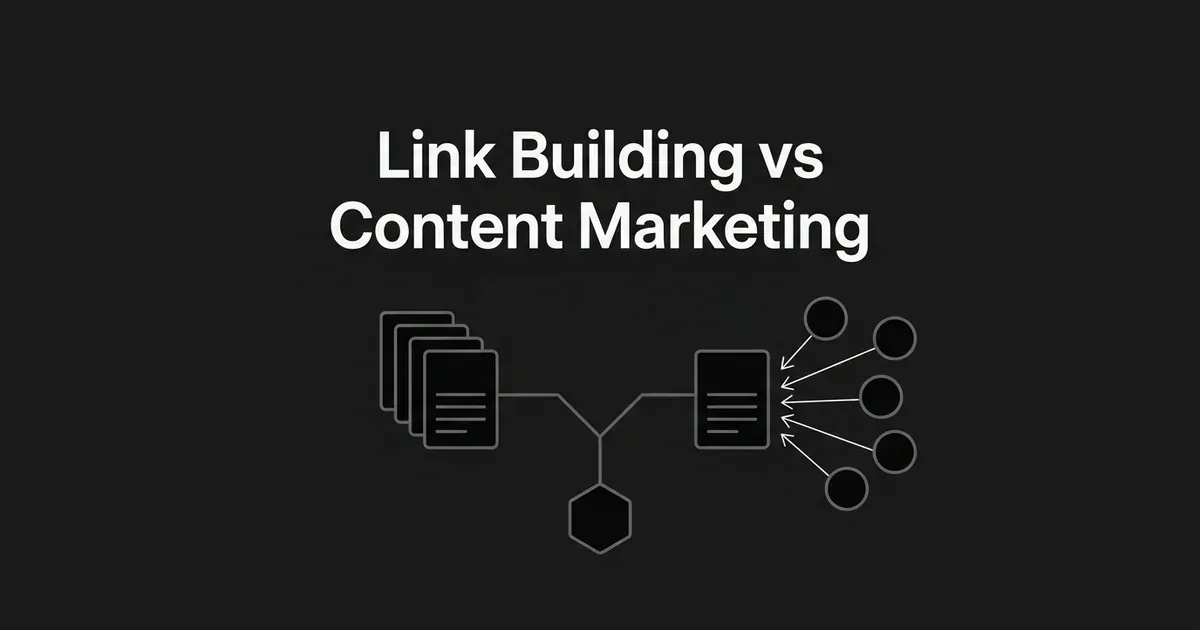
Content marketing buys you the asset. It is the page, guide, comparison, or answer that a buyer actually reads and acts on. Link building buys you visibility for that asset: other sites pointing at it, which can help it get found and trusted. For most lean SaaS teams, content comes first, because there is no point making a page easier to find when the page itself is not ready to do its job. Link building earns its turn once you have pages worth pointing people at and the thing actually holding you back is that nobody outside your own site knows they exist.
Here is the short version of what each one is actually for.
| Content marketing | Link building | |
|---|---|---|
| What it produces | Owned pages, guides, comparisons, and other assets you control | Other sites referencing your pages |
| What it fixes | A missing or weak answer to a buyer question | A good page nobody outside your site can find |
| Who's in control | You: the page, the message, the structure | Mostly other people: whether they link, how, and for how long |
| When it's the right move first | The asset doesn't exist yet or doesn't answer the question | The asset already works but isn't getting discovered |
What content marketing actually buys
Content marketing and link building get lumped together so often that it helps to be specific about what each one is. Content marketing is the ongoing work of creating and distributing useful material for a defined audience, and then using that material to move people from not knowing you exist to becoming a customer.
That is bigger than a blog. A useful SaaS content program includes the articles, comparison pages, guides, and product education, plus the distribution work of getting those in front of people and the measurement work of checking whether any of it moved the business. Publishing is one activity inside that system, not the whole system.
What you're really buying is an owned library that can do several jobs at once. It answers a buyer's question before they ever talk to your sales team. It gives an evaluating prospect a comparison page to work through on their own time. It gives your sales team something credible to send instead of writing the same explanation over and over. It gives your customer success team a page to point to instead of re-answering the same support question. Over time, that library becomes something you can update, link internally, and reuse across email, social, and sales conversations.
The test for whether any of this is working is not how many pieces you published. It's whether the library moves someone toward a decision: awareness, evaluation, a trial, a purchase, or staying a customer longer. A page that gets read but never nudges anyone toward any of that might still be worth having, but say so on purpose instead of assuming it.
What link building actually buys
Link building is the work of earning links from other websites back to your pages. What you're paying for is not the link itself. It's what a good link can unlock: search engines finding and trusting your page more easily, visitors clicking through from a site your buyers already read, and some borrowed credibility from being referenced somewhere your audience trusts.
Google has said plainly that its ranking systems look at how pages link to each other, and that PageRank is still one of the core systems it uses to understand and rank pages. That confirms links are part of how Google's systems work. It does not mean a specific number of links buys you a specific ranking, and it is worth being skeptical of anyone who promises otherwise.
Not every link is worth the same. A relevant link from a site your buyers actually read is doing real work. A link from an unrelated site that exists only to pass along ranking credit is not, and Google's own guidance treats link schemes built purely to manipulate rankings as against the rules. The quality and relevance of the link matters more than the raw count.
The part that trips teams up is thinking a link investment can rescue a weak page. It can't. If the page you're pointing people to is thin, generic, or doesn't actually answer what the visitor came looking for, more links just mean more people finding a page that doesn't help them. More links without a strong page behind them tends to produce exposure, not results.
Where content marketing and link building actually differ
Once you set the definitions side by side, three real differences show up, and they're the ones that should shape your decision.
Who's in control. You control your own content: the topic, the structure, the message, and when it gets updated. You have far less control over link building. You can create something worth linking to and put it in front of the right people, but you can't force another site to link, decide how they present the link, or guarantee the link stays live.
How much of the funnel it covers. Content can support a reader at every stage, from "what even is this problem" to "why should I pick you over the other option," as long as the content type and the call to action match where the reader actually is. Link building is more indirect. A link can help a page get found or look more credible, but it doesn't explain your product, handle an objection, or give someone a reason to buy. It amplifies a page. It doesn't replace one.
Whether it compounds. A content library can keep paying off: you update it, link it internally, and reuse it in new formats. A link profile can also build over time, as more relevant sites reference your best pages. Neither compounds automatically, though. A library only compounds if it stays accurate and useful. A link profile only compounds if the links stay relevant and legitimate, not just numerous.
What each one costs, and how to know if it's working
Ask "what percentage of my budget should go to link building" and you'll find a lot of confident-sounding numbers online and very little behind most of them. There isn't a universal figure, because link costs shift a lot depending on how competitive your market is, whether you're doing the work in-house or paying someone, and how much you value the referral visitors on top of the ranking effect. Be wary of anyone offering a fixed cost-per-link as if it were a business metric.
A more useful way to build a seo link building budget is to start from the outcome you're trying to move, then work backward: which pages are tied to that outcome, what's actually stopping them from performing, and how much internal time or outside cost it would take to fix that specific thing. That budgeting question applies on both sides of the ledger, not just to links. Content has real production costs too, research, writing, editing, design, and the ongoing work of keeping pages current. A content-first recommendation is not a claim that content is free.
Measurement should follow the same logic, not one blended traffic number. For content, look at qualified organic clicks and non-branded search visibility early on, then visits to your comparison and use-case pages, then whether content shows up in the deals your sales team is actually working. For link building, look at relevant referring domains to your priority pages, referral visits from those links, and whether search visibility for the linked pages actually moved. In both cases, resist treating volume, whether that's articles published or backlinks earned, as proof of anything on its own.
Content marketing research backs this up from the other direction. CMI's 2025 B2B benchmark study found that only 29% of B2B marketers with a documented content strategy rated it extremely or very effective, and 42% of the ones who rated it worse than that pointed to unclear goals as the reason. More content doesn't fix that. Clearer goals do.
When content marketing should come first
Content should usually come first if any of these sound familiar. Your site doesn't answer the questions buyers actually ask before they talk to sales. Your priority topics have thin or generic coverage, or no coverage at all. You don't have the comparison, use-case, or implementation content that shows up late in a buyer's decision. Visitors land on your site and have nowhere obvious to go next. Your sales and customer teams keep writing the same explanations by hand because there's no page to send instead.
For a lean team, content first doesn't mean cranking out a high volume of generic posts. It means building a small, deliberate set of pages that actually matter: the high-intent problem pages, the comparison pages, the use-case pages, and the pages that answer the questions your buyers ask right before they decide. Those are the pages closest to an actual business outcome, so they're the ones worth building first.
If the real bottleneck is that your team doesn't have a repeatable way to produce that content consistently, in your own voice, without every piece needing a from-scratch brief, that's worth naming directly rather than trying to solve with more link outreach. DeepSmith's writer works from stored brand and product context to produce drafts with internal linking and metadata already built in, so the constraint on getting the foundation built is less about hours spent per article.
When link building should come first
Link building earns its turn once your pages already do the job you need them to do, and the thing actually holding you back is that they're not being found or trusted the way they should be. That's the case when your priority pages are strong and match what the searcher is actually looking for, when they're technically indexed and accessible, and when competitors ranking above you clearly have stronger external references pointing at similar pages.
Even then, "link first" doesn't mean chasing link volume for its own sake. Google's spam policies are specific about this: buying or selling links for ranking purposes, running automated link schemes, and paid placements that pass ranking credit are all treated as manipulation, not legitimate SEO. Advertising and sponsorship links are fine when they're properly marked so they don't pass ranking credit. The goal is legitimate, relevant visibility, not a bigger link count.
It's also worth separating link building from AI visibility, since they don't move together the way you might expect. An Ahrefs study of 15,000 prompts found that only 12% of the links cited by ChatGPT, Gemini, and Copilot also appeared in Google's top 10 for the same query on average. That's not proof that links don't matter to AI search. It is a good reason not to assume your traditional ranking position tells you much about whether AI answers are citing you.
When to fund both, or neither
Fund both channels at once when you can point to two separate, real bottlenecks: you genuinely need more or better content to cover important buyer questions, and you also need external authority or referral reach to make the content you already have competitive. That only works if you can produce useful content consistently, you have a specific set of priority pages rather than a vague site-wide link goal, and you can actually tell whether the combined spend is doing anything.
Sometimes the honest answer is that neither channel should be funded next, because the real problem sits underneath both. If your site isn't reliably crawlable, if your positioning is unclear enough that you can't say who the content is even for, if traffic arrives but nobody converts, or if your analytics can't tell a qualified visitor from a random one, more pages or more links will not fix that. Fixing the foundation first will do more for growth than adding volume to either channel.
A simple way to check where you actually stand: if the asset is missing, build it. If the asset exists but nobody's finding it, look at authority and distribution. If people are finding it but not acting, the problem is the page's conversion path, not its visibility. And if you have a decent-sized library already but no consistent process behind it, the next dollar should go toward process and measurement, not more output.
The bottom line
Content marketing and link building are not really competing for the same job. Content builds the destination. Link building helps people find and trust that destination once it exists. If you're weighing link building vs content marketing for a lean SaaS team with limited budget, start by asking which one is actually missing right now: a page worth sending someone to, or visibility for a page you already have. Fund whichever is missing first, then bring in the other once the next real bottleneck is something you can point to and measure.
If the constraint you keep running into is production capacity, not ideas, DeepSmith can help you turn AI-visibility gaps into a content backlog and produce the on-brand pages to close them, without adding headcount.