Your competitor just got cited in ChatGPT. Again. You searched your core use case in Perplexity and watched a brand with half your content library answer the question you've been writing about for two years. You know you can't out-backlink an incumbent in the next quarter. So what do you actually do?
I've been there. The feeling is a unique mix of frustration and helplessness. Here's my take, based on building and advising a lot of startups: backlinks are no longer the fastest path to authority in AI search. They still matter, but AI engines don't see the world through links alone. They cite entities they recognize, trust, and can pull clean answers from.
This is great news for us. It means a smaller SaaS brand can actually compete right now by building the right signals in the right order. This is the playbook I wish I'd had: entity proof, authorship infrastructure, citation-ready content, and community corroboration.
What does "brand authority" mean in AI search (and how is it different from domain and topical authority)?
Brand authority vs domain authority vs topical authority: what each one predicts
We all know the old metrics. Domain authority (DA/DR) predicts how you might rank in Google based on your link profile. Topical authority is whether Google thinks you're a credible source on a subject.
Brand authority is something else. It's how well AI engines recognize your brand as a trusted, identifiable entity worth repeating to their users.
Domain authority is about links. Topical authority is about encyclopedic coverage. Brand authority is about recognition. Does the AI know who you are, what you do, and whether it's safe to put your name in front of its users? That's the whole game.
Why AI citations behave differently than blue-link rankings
When someone Googles a query, they get ten links and they get to decide what's true. When they ask ChatGPT or Perplexity, the AI often picks one or two sources to cite or synthesizes an answer and stamps a brand name on it. That's a totally different calculation of trust.
AI engines pull from their training data, live web searches, and other structured signals. They prefer sources that are consistently referenced, built for easy data extraction, and backed up by other voices on the web. A page with a dozen backlinks can absolutely beat a page with 200 if it has a crystal-clear claim structure and consistent entity signals. This is the leverage we smaller brands have, if we know how to use it.
How do AI engines decide which brands to cite when your backlink profile is weak?
If you don't have a solid mental model for how AI chooses sources, your tactics will feel random and you'll burn out your team. The whole strategy rests on understanding a few core signals.
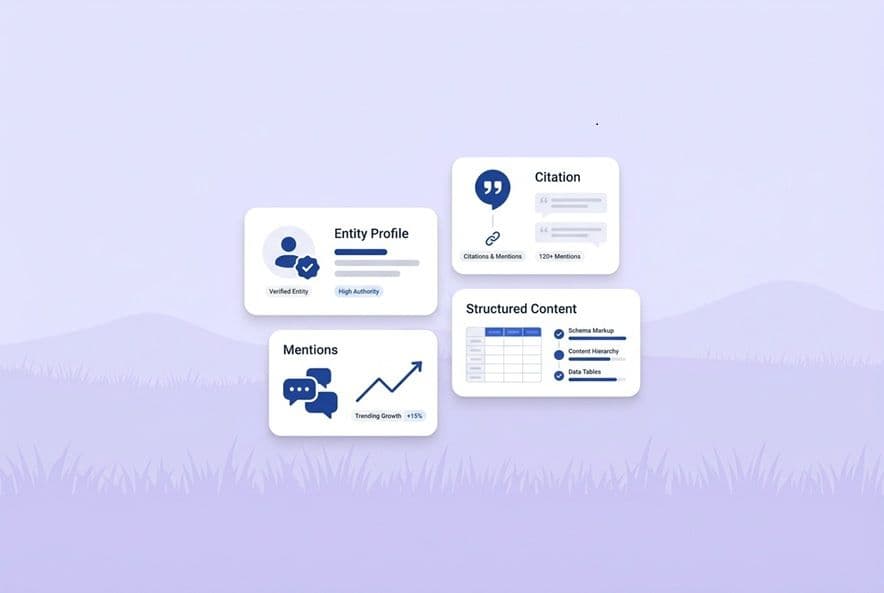
The 3 buckets of signals: entity trust, content extractability, and external corroboration
I find it helps to think of the signals AI engines look for in three buckets:
Entity trust asks: Does the AI recognize your brand as a coherent, consistent thing? This means your brand name, products, and category appear the same way across your site, social profiles, and third-party directories. Any inconsistency creates a flicker of ambiguity, and that's enough to prevent a citation.
Content extractability asks: Can the AI pull a clean answer from your page without having to decode vague, flowery prose? This is all about structure. Think claim-first paragraphs, clear definitions, tables, and step-by-step lists. Most "good" content fails here because it was written to engage a human reader, not to be a citable source for a machine.
External corroboration asks: Does anyone else on the internet agree with you? This includes backlinks, of course, but it also includes unlinked brand mentions, forum discussions, product reviews, and media quotes. Corroboration is basically the AI's version of a character reference.
When your backlinks are weak, you just pour all your energy into entity trust and content extractability. Those are the two you control completely.
What "entity recognition" looks like in practice for SaaS brands
Entity recognition sounds abstract, but it's simple. It just means the AI has seen your brand and product names together so consistently that it treats you as a known quantity, like it knows Salesforce.
For a Series A company, this means your brand name and your core use case (like "sales call recording for early-stage startups") show up together everywhere. On your website, your Google Business Profile, your Crunchbase listing, your founder's LinkedIn, your G2 reviews. That consistency is entity recognition. When an AI crawls those sources, it sees a clear, unified picture.
The failure mode: when your content is good but "uncitable"
This is the trap I see even the best content teams fall into, and I've been guilty of it myself. You publish a genuinely useful, 2,000-word post. It gets some traffic, maybe even ranks on page two. But no AI tool ever cites it. Why?
Because it was written for reading, not for extraction. The most important answer is buried in paragraph seven. The key claim is softened with qualifiers. There's no concise definition at the top. It reads like an essay, building context slowly before it finally makes its point.
AI engines are looking for the one paragraph they can lift and trust. If that paragraph doesn't exist in a clear, direct, self-contained form, your content is effectively uncitable. A content audit focused on citation readiness can help you spot these gaps fast.
What are the fastest authority signals you can build without backlinks?
When you have low link equity, you're not powerless. You just have to work different levers, ones that move faster. Here are my favorites.
Minimum viable digital footprint (profiles, directories, consistency checks)
Before you write a single new word, do a quick audit and close your entity gaps. Check your brand name, address, and value prop across your website, LinkedIn page, G2 and Capterra profiles, Crunchbase, and any niche directories. Inconsistency here is like static, just noise that works against you. An hour of updating profiles is the highest-leverage thing you can do this week.
Social proof assets that AI can safely repeat
AI engines are fundamentally conservative. They won't repeat your vague marketing superlatives, but they love verifiable, attributed, specific claims. "The best tool on the market" is an empty claim. "Customers reduce onboarding time by 40%" is citable if you attribute it to a customer story.
Build a library of proof points the AI can safely echo. This means specific use cases with named industries, verified review snippets from G2, and concrete outcomes from real scenarios. Publish these in structured formats on your site. You want claims that are specific, attributed, and can be cross-referenced somewhere else.
Lightweight digital PR that doesn't require a big launch
You don't need a huge product launch to get mentioned. Offer a quote to an industry newsletter. Go on a niche podcast. Get your tool listed in a "tools for X" roundup that your buyers actually read. This also means showing up in the communities where your buyers hang out. Find the right subreddits, Slack groups, or forums. Don't just drop links. Provide real answers and mention your approach when it's genuinely helpful. Every instance is a small corroboration signal that builds authority over time without a PR agency retainer.
How can smaller SaaS brands earn AI citations against incumbents?
Trying to match an incumbent's scale is a losing battle. The key is to find the terrain where their scale doesn't protect them, and often works against them.
Pick "citation winnable" queries: narrower, higher-intent, higher-specificity prompts
Incumbents own the broad queries like "What is a CRM?" Don't fight them there. But a query like "What CRM works best for a 10-person SaaS sales team that uses HubSpot for marketing but needs lighter pipeline management?" That's a gap they probably haven't filled.
Narrow, specific, high-intent prompts are where you can win. Incumbents rarely build content that's precise enough to answer these questions cleanly.
Sit down with your team and make a list of 20-30 prompts your ideal buyer would actually type into ChatGPT. Focus on the ones specific to your use case or segment. These are your targets.
Create "reference content," not just traffic content
There's a difference between traffic content and reference content. Traffic content is designed to rank. Reference content is designed to become the go-to answer. It includes precise definitions, proprietary frameworks, honest comparison tables, and implementation checklists.
AI engines love to cite reference content because it's stable, structured, and specific. A post titled "Top 10 Sales Recording Tools in 2024" is traffic content. A post titled "How to Evaluate Sales Call Recording Tools: A Framework for Sub-50-Person Teams" is reference content. We all need to be writing more of the latter.
Borrow trust ethically: expert collaborations, partner co-marketing, and credible third-party references
If your own brand doesn't have a ton of authority yet, you can borrow it. This is a totally legitimate strategy when you do it right. Interview a recognized expert in your space and publish a structured Q&A. Co-author a guide with a non-competitive partner company. Reference and link to credible third-party research that supports your claims.
These associations signal to AI engines that you exist within an ecosystem of trusted voices, not just shouting into the void. It shows you're part of the real conversation in your industry.
Competitive benchmarking: how to reverse-engineer why a competitor gets cited
When a competitor keeps showing up in AI answers for prompts you know you should own, it's time to get clinical. Don't look at their traffic numbers or domain authority. Look at the specific page that gets cited.
What's the H1? How does the first paragraph open? Is there a clean definition in the first 100 words? Does it use tables or numbered lists? Is there an obvious sentence you could lift that directly answers the prompt? You're looking for the format and proof structure. Then, you can replicate that structure with your own, better perspective and deeper knowledge.
Tools like DeepSmith's AI Visibility — Competitors can show you which competitor pages are winning citations, so you're not just guessing which pages to study. It gives you a starting point.
How should you structure content so AI tools extract and cite it (without sounding like AI wrote it)?
This is where all the editorial effort should go. The mechanics of writing for AI citation are repeatable, and they don't have to make your writing sound robotic.
"Claim-first" section openings and paragraph-level answers
Every major section (H2s, H3s) should open with its most important claim. Don't warm up.
Instead of: "When it comes to defining what makes a good onboarding flow, there are several factors to consider." Write this: "A good onboarding flow reduces time-to-first-value, a key metric correlated with 90-day retention."
That first sentence is the one an AI can lift. Make it a standalone claim that holds up even if the reader sees nothing else.
Citation-ready formatting patterns (tables, step lists, side-by-side trade-offs)
From what I've seen, three formats consistently earn AI citations:
- Definition + constraints + steps: "X is Y. It works when [constraint]. Here's how to do it: [numbered list]." This format is complete and self-contained, which AIs love.
- Comparison tables: Simple side-by-side trade-offs between two or three approaches or tools. Tables are easy for machines to parse and look great in an AI's output.
- Step lists with outcomes: Don't just write "Step 1: do X." Write "Step 1: do X so that [outcome]." The outcome clause makes each step self-explanatory and much more citable.
Go retrofit your highest-traffic posts to lead with claim-first sentences. It's often faster and more effective than writing something from scratch.
Voice search + snippet optimization for brand authority
This is an old SEO trick that's newly relevant. Write a 2-3 sentence "direct answer" block near the top of any post targeting a question. Think of it as the answer you'd give if someone asked you the question out loud.
This also builds brand trust. A brand that answers clearly, without hiding the ball, signals confidence and genuine expertise.
Schema markup and on-page signals that support entity trust
Schema won't save you if your content structure is a mess, but it absolutely reinforces your entity signals. Use Organization schema on your homepage with a consistent name, URL, and logo. Use Article schema with correct author and modification dates. For a deeper dive into implementation, check out this guide to schema markup for AI citations. It's basic hygiene that pays off over time.
How do you operationalize E-E-A-T with authors and SMEs (so it scales past a few hero articles)?
"Use experts" is advice everyone gives, but almost nobody explains how to do it without burning out your experts. Google's own guidance on creating helpful, reliable, people-first content makes it clear that demonstrated experience and expertise matter. Here's a system that works for small teams.
A practical authorship model: staff writer + SME reviewer + accountable editor
For our lean content teams, a three-role system has been a lifesaver:
- Staff writer (or an AI-assisted draft): Handles the structure, research, and first draft. Their job is to get it 80% of the way there.
- SME reviewer: This is a product manager, sales leader, or customer success person who does a 15-minute async review. They check for accuracy and add one or two real-world observations or anecdotes.
- Accountable editor (that's you): You own the final voice, the accuracy sign-off, and the attribution.
The byline can go to the SME, with the writer credited, or vice versa. Either way, the expertise signal is transparent and verifiable, and you didn't have to beg an engineer to write 2,000 words.
Contributor transparency checklist (author bios, contributor pages, review notes, sourcing)
For every article you publish, run this quick checklist:
- Does the author bio show their current role, real experience, and a link to their LinkedIn?
- Is the SME reviewer noted with their specific expertise (e.g., "Reviewed by [Name], Head of Customer Success")?
- Are all stats and claims linked to a primary source?
- Is there a "last reviewed" date on the page?
- Is there an author page on your site that collects all their articles?
This isn't about tricking an algorithm. It's about giving AI systems a consistent, verifiable trail of breadcrumbs to follow when they evaluate your trustworthiness.
Governance: claim boundaries, product accuracy, and update cadence
The fastest way to kill your citation trust is to make claims your product doesn't actually support. One inaccurate post can create contradictions that AI engines will find and surface. It's embarrassing and damaging.
Set a simple rule: any claim about what your product can do needs a source, like a help doc or a product page. Any statistic needs a link. And any post that mentions pricing, integrations, or competitors gets flagged for a quarterly review. AI engines are getting better at spotting and penalizing stale content.
A structured context layer, like the one in DeepSmith's Deep IQ, can store your positioning and claim boundaries. Then, a tool like DeepSmith's Content Studio can use that context during production, making QA part of the writing process, not a final panicked step.
What KPIs should you track for brand authority in AI search—and how do you respond when signals drop?
KPI hierarchy: leading vs lagging indicators (and what to ignore early)
Most teams track way too much and act on nothing. Keep it simple. Pick two leading indicators and one lagging indicator.
Leading indicators (these move first):
- AI mention rate (how often your brand shows up in AI answers, even without a link)
- Number of pages earning at least one AI citation per month
Lagging indicators (these confirm your strategy is working):
- Branded search volume (people hearing about you and searching for your name)
- Pipeline-attributed traffic from your content (the one the CFO cares about)
What to ignore early on: Domain authority and total organic traffic. They are vanity metrics in this context and will only distract you from the signals that matter.
Tracking AI visibility: prompts, mention rate vs citation rate, and page-level attribution
Set up a simple monthly tracking routine:
- Define your 20-30 core buyer prompts.
- Run them across ChatGPT, Perplexity, and whatever else your customers use.
- Log whether your brand was mentioned or cited with a link.
- Track how this changes over time.
A "mention" means the AI knows you exist. A "citation" means it's actively sending people your way. Citations are the goal.
Doing this manually is a pain. DeepSmith's AI Visibility suite automates this tracking across all the major platforms so you can spend your time analyzing trends, not copy-pasting into a spreadsheet.
Remediation checklist: what to do if citations drop or AI answers turn negative/inaccurate
Citations will drop. It happens. Don't panic. Here's how to respond.
- Diagnose: Is it a specific page, or is it brand-wide? Page-level citation data will tell you. A single-page drop usually means the page changed or a competitor just published a better-structured version.
- Audit: Check the cited page. Are there stale claims, broken links, or formatting issues?
- Update: Refresh the content, sharpen the claim-first structure, improve the definition block, and update the "last reviewed" date.
- Counter-signal: If an AI is spreading bad info about you, fight back. Update your own content to clearly contradict it with evidence and try to get corroborating mentions that counter the bad signal.
- Resubmit to Google Search Console after you make a big update to signal that something has changed.
How do you turn this into a 30/60/90-day plan your team can execute?
First 30 days: baseline entity hygiene + prompt set + retrofits to 5–10 key pages
Run that entity audit. Get your brand name consistent across all profiles, fix your schema, and publish real author bios. Build your list of 20-30 prompts and run your first baseline report. Then, pick your five to ten highest-traffic, question-based posts and retrofit them with claim-first openings and direct answer blocks.
Goal by day 30: Know where you stand, close the most obvious entity gaps, and have a small set of pages ready to earn citations.
Days 31–60: build 2–3 "reference content" clusters and ship distribution loops
Pick two or three "citation winnable" topic clusters and go deep. Publish two to three solid reference pieces for each cluster. For every article you publish, make sure it gets turned into LinkedIn posts and a newsletter mention. If you use a tool like DeepSmith's Agent Library, repurposing articles for different channels becomes a matter of minutes, not hours.
Goal by day 60: Have a handful of high-potential pages live and start seeing brand mentions tick up.
Days 61–90: systematize SME workflow + expand prompts + competitive iteration
Now you can systematize your authorship model. Set up that three-role review process and build out your contributor pages. Expand your prompt set based on what you're seeing in search data and hearing from sales. Start studying which competitor pages are winning the citations you want and build your counter-content.
Goal by day 90: Have a repeatable operating rhythm with monthly AI visibility reporting, a clear publishing queue, and a scalable way to involve your SMEs.
Resourcing + tooling questions to ask before you scale production
Before you try to triple your content output, figure out your bottleneck. If it's creating good briefs, a tool like DeepSmith Content Studio can help. If it's just raw publishing volume, Autowrite can schedule generation. If it's distribution, DeepSmith Agent Library automates creating assets. The goal isn't more tools; it's to remove the manual, soul-crushing steps that kill consistency.
Build your AI citation baseline (so you know what to fix next)
The gap between "we're not getting cited" and "we earn citations consistently" isn't a backlink problem. It's a signal problem. Inconsistent entity signals, messy content structure, and weak authorship proof are all things you can fix in the next 30 days without a massive link-building campaign.
And what about that backlink question we started with? Once you have these other signals firing correctly, backlinks stop being a prerequisite for authority and become an accelerator. You don't need hundreds. You just need a profile that shows you're a real, participating member of your industry. Think links from partners, credible guest posts, and mentions in relevant roundups. It's the final layer of validation, not the foundation.
The first step is simply knowing where you stand. Which prompts do your buyers use? Where does your brand appear? Which competitors are taking the citations that should be yours? Once you have that baseline, you'll know exactly what to fix next.