You published a solid article. It’s sitting at rank #4. Then someone asks ChatGPT the exact question your article answers, and a competitor gets cited instead of you.
I’ve seen this happen over and over. It’s like an invisible tax on all the hard work we put into traditional SEO. For founders, it’s maddening.
Ranking still matters, don’t get me wrong. But getting cited by an AI is a completely different game. Answer engines like Perplexity, Google AI Overviews, and ChatGPT don’t just hand the trophy to whoever ranked first. They pull from sources that are structured for extraction, trusted by the engine, and kept fresh. Most founders I know aren’t set up for any of those three.
This isn't about some bag of AI hacks you bolt onto your content strategy. AEO is a disciplined operating system built on four pillars: answer structure, machine-readable signals, authority, and a measurement loop. Nail all four, and you become the source that engines reach for. Miss one, and you’re invisible, no matter how good your content is.
Why founders are "invisible" in AI answers (and why traditional SEO advice isn't enough)
The problem isn't that your content is bad. I've seen beautifully written articles get completely ignored by AI. The problem is your content wasn't built to be extracted.
Traditional SEO is all about getting a human to click a blue link. Answer Engine Optimization (AEO) is about making it incredibly easy for a machine to pull a trustworthy quote from your page and use it in an answer.
That’s a fundamentally different job. Most SEO playbooks, even the good ones, just don’t cover it.
What "winning" looks like in the AI search era
Winning means your content is the answer. Not a link someone might click. Not a footnote. The actual answer.
This happens when an engine can clearly understand your content, pull it out cleanly, and trust your brand enough to stake its own reputation on your information. Your goal is to make citing your work the path of least resistance for the machine.
AEO in one page: how answer engines decide what to cite
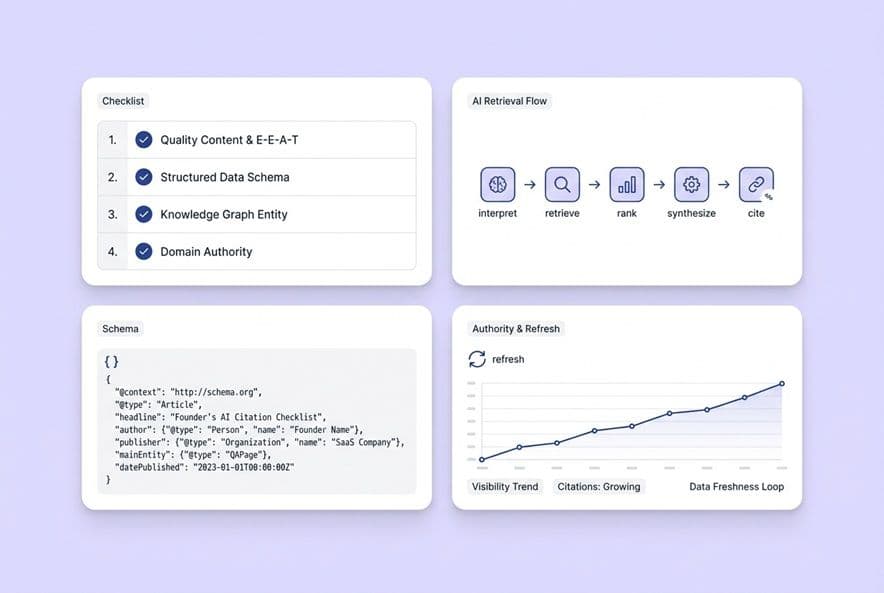
Most answer engines use a process called Retrieval-Augmented Generation (RAG). In simple terms, they find relevant content from their index and then use it to build a new answer. If you understand this flow, the four pillars will make perfect sense.
The citation funnel: interpret → retrieve → rank → synthesize → cite
Think of it as a funnel. At each step, your content is either helping or hurting your odds:
- Interpret: Does the engine get what your page is about and what question it answers?
- Retrieve: Is your page easy to find, crawl, and access?
- Rank: Does your site have enough authority for the engine to trust you over a competitor?
- Synthesize: Can the engine pull a clean, self-contained passage without butchering your meaning?
- Cite: Is your brand credible enough to be named as the source?
The four pillars map directly to this process. Your content structure helps with interpretation and synthesis. Your technical setup helps with interpretation and retrieval. Your authority helps with ranking and citation. And keeping things fresh helps with all five.
AEO vs SEO vs GEO (so you don't chase the wrong target)
Let’s clear this up so you don’t waste time. SEO gets you ranked. AEO gets you cited. Generative Engine Optimization (GEO) is the bigger picture of optimizing for AI systems in general.
For a lean SaaS team, you don't need to get lost in the definitions. The four pillars I’m about to share cover what you need to be competitive on all three fronts. Just do them.
Pillar 1 — Answer-first content that's easy to extract, quote, and reuse
This is the pillar where you can get the fastest wins. It costs the least to fix, and it's where I see most founders leaving citations on the table. The core shift is simple: stop writing to impress readers and start writing to inform engines. You can (and should) do this while keeping the human experience great.
The "first 30 seconds" rule: lead with the direct answer, then expand
Every single section of your content needs to open with a direct answer to the question it addresses. No long wind-ups. No scene-setting. The answer.
If your heading is "What is semantic chunking?" the very first sentence should be a clean definition. Don't start by explaining why it's important or where it came from. Engines scan for the passage that closes the loop the fastest. Give it to them in sentence one.
Here’s the format: Answer first. Evidence second. Nuance third. This applies everywhere, from blog posts and landing pages to your FAQ and docs.
Semantic chunking: write in self-contained modules, not long narratives
AI engines need to lift clean chunks of text. I used to love writing these long, flowing narrative paragraphs. They felt smart. But for an AI, a 600-word block of text is a nightmare to parse. Pull one sentence out, and the whole thing loses its context.
Semantic chunking just means each H2 or H3 section can stand on its own. It has its own topic, its own answer, and its own conclusion. If someone got dropped into that section cold, they'd understand what it's saying. That's what makes a section citable.
Practically speaking, just give each section a tight scope, open with the answer, and close it out before you move on. Think in modules, not long stories.
Formatting checklist for citation-ready passages
- Short paragraphs. I aim for 3–4 sentences max.
- Bulleted lists for steps or comparisons.
- Bold key terms the first time you use them.
- Consistent terms. Pick one name for a concept and stick with it.
- Tables for comparing tools, features, or options.
- Definitions for any jargon an engine might have to explain.
Voice/assistant nuance: writing for spoken answers without sounding robotic
Remember, a voice assistant might read your content aloud. That means a few little tweaks:
- Avoid parenthetical asides in the middle of sentences, as they sound clunky when spoken.
- Use full words. Write "for example" instead of "e.g."
- Keep your Q&A blocks tight. The question is the heading, and the answer is the first sentence. No preamble.
- Ditch any jargon that doesn't have a clean, spoken equivalent.
The goal isn't to sound like a robot. It's to make sure your answer is perfectly clear when someone hears it on a smart speaker.
Pillar 2 — Machine-readable signals: schema + technical clarity (without breaking things)
Schema is the technical layer that explicitly tells search engines what your content is and what it does. Most founders I talk to know they should add schema. Very few know where to start or how easy it is for it to break silently.
The schema types that matter most for founders (and when to use each)
Don’t boil the ocean. Start with these three:
- Article schema: For your blog posts and guides. It signals the author, date, and that it's, well, an article.
- FAQPage schema: For any page with clear question-and-answer pairs. This one has a huge impact on AI Overviews.
- BreadcrumbList schema: For site navigation. It helps engines understand your site structure and how your content fits together.
My one rule: don't add schema you can't maintain. A stale FAQPage schema with old answers is worse than having none at all.
A simple implementation recipe (JSON-LD, placement, validation workflow)
- Pick the schema that matches your content.
- Generate the code (the JSON-LD) using a free tool like Google's Structured Data Markup Helper.
- Put the code in the
<head>section of your page. - Immediately check your work with Google's Rich Results Test.
- Set a calendar reminder to review it quarterly. Seriously, do this.
Some modern content systems handle all this for you, which is a lifesaver. They apply the right data during production instead of having someone bolt it on later, which is usually when mistakes happen.
Common schema pitfalls that silently fail
I learned these the hard way.
- Mismatched content: Your schema lists questions that aren't actually on the page. The engine just ignores it.
- Invalid properties: You use a property that doesn't exist for that schema type. You get no error message, but you also get no benefit.
- Abusive FAQ markup: You stuff 15 irrelevant questions into your schema hoping to get more visibility. Engines are smart enough to spot this now.
- Stale markup: You updated the content on the page but forgot the schema. Now they contradict each other, and the engine loses trust.
Validation isn't a one-time thing. It’s part of the process.
Technical foundations that still matter (crawlability, internal links, clean IA)
AEO doesn't let you skip the basics. If search engines can't crawl your page, find it through internal links, and understand where it fits in your site, it'll never get retrieved. Good internal linking shows topical authority and helps bots explore your content cluster. Make sure your technical SEO house is in order.
Pillar 3 — Trust inputs: authority, entities, and accuracy controls (especially with AI writing)
Engines want to cite sources they can stake their reputation on. This means your content needs to scream "credibility" at every level: page, author, and site. This is also where AI-assisted writing can get you into a lot of trouble if you're not careful.
E-E-A-T in practice: what to show on the page
E-E-A-T (experience, expertise, authoritativeness, trustworthiness) is Google's framework for trust, and it's a great model for all answer engines. Here's how to turn that jargon into actual things on your page:
- Author byline with credentials: Who wrote this and why should anyone listen to them?
- Cited sources: Link out to your primary sources and data.
- Updated dates: Show when the content was last reviewed for accuracy.
- Clear claim boundaries: Don't state things as fact if you can't back them up. "Research suggests" is better than "Studies prove" if you don't have the study handy.
Entity strategy for SaaS: define your world so engines can place you in it
Entity recognition is how an AI understands what your brand is and where it fits in the universe. You need to be consistent in naming:
- Your product category (not just your brand name).
- Your core use cases.
- Your target customer personas.
- Your key integrations.
This consistency needs to go beyond your blog. Engines build your profile from your entire digital footprint, including your docs, LinkedIn posts, and YouTube videos. A coordinated strategy reinforces that you are the authority on your topic.
Editorial quality controls to prevent low-quality AI content
AI writing scales volume. Unfortunately, it also scales mistakes. If you're using AI to help draft content (which is fine!), you need a non-negotiable editorial standard.
- No unverifiable assertions: If you can't link to it or attribute it, kill it.
- Claim boundaries: Qualify your statements. AI drafts tend to overstate things with confidence.
- Voice review: Does this sound like someone with real experience, or like a generic summary of other articles?
- Source discipline: Every single fact should trace back to a primary source.
We learned this the hard way. The best way to manage this is to have a structured knowledge layer, a single source of truth for your product details and positioning. This dramatically cuts down on the "AI hallucinations" that can quietly destroy your credibility.
Pillar 4 — Measurement + refresh: prove ROI and prevent citation decay
Most founders I know check Google Search Console, see some numbers, and call it a day. The impact of AEO doesn't show up there cleanly. You need a different way to measure success and a rhythm for maintenance, or your hard-won citations will quietly disappear.
What to measure beyond traffic (a founder-friendly AEO scorecard)
As a founder, you care about results, not vanity metrics. Track these:
- AI citations/brand mentions: Are you getting cited in AI answers? For what prompts? On which platforms?
- Assisted conversions: Is your branded organic search growing along with your direct traffic? That's a good sign that AI-driven awareness is leading people to you.
- Sales cycle influence: Are prospects showing up to sales calls already knowing what you do? Are those calls getting shorter?
- Branded demand signals: Is search volume for your brand name going up, even if you haven't increased ad spend?
Some newer content platforms are starting to build this tracking in directly, which saves a ton of spreadsheet time.
How to design a refresh cadence by content type
Not all content needs the same amount of attention. Here’s a simple schedule:
- Evergreen definitions/explainers: Review quarterly.
- Comparison pages: Review monthly. Competitor features and pricing change fast.
- Tactical how-tos: Review whenever your product or the tools you mention change.
- News/trend commentary: Archive or redirect it when it's no longer relevant. Stale commentary hurts trust.
The best trigger is a real-world event: a product update, a competitor move, or seeing a page start to lose its citation frequency.
A practical monthly AEO workflow for a team of 1–2
This is the exact loop you can run even if you're a solo founder doing marketing.
- Week 1: Run your main target prompts in ChatGPT, Perplexity, and Google. Note who gets cited.
- Week 2: Look at your pages that should have been cited. What’s the gap? Is it structure, authority, or freshness?
- Week 3: Pick 1-3 pages and fix them. Tighten the lead answer, check the schema, update the examples.
- Week 4: Republish and share them again on LinkedIn, in your newsletter, wherever. This sends a fresh signal.
This is the engine. It's repeatable and manageable.
Decision support: prioritize your next 30 days (and avoid the common traps)
You don't need to do everything at once. You just need to do the right things first.
The 80/20 AEO plan (if you can only do a few things)
If you're swamped (and what founder isn't?), just do this for now:
- Restructure your top 5 pages. Make them lead with direct answers and use semantic chunking.
- Add Article and FAQPage schema to those same pages and validate them.
- Add author bylines and cited sources anywhere they’re missing.
- Run your core prompts monthly to see what's working.
That’s it. That's your first 30 days. Don't go on a 50-article writing spree. Fix your best five pages first.
AEO traps that waste founder time
I’ve fallen into some of these myself. Please, learn from my mistakes.
- Publishing volume without standards: 20 thin, AI-generated posts are far worse than five well-structured ones.
- Schema spam: Adding FAQ schema to every page just because you can.
- Chasing every engine: Pick the platform your audience uses most and win there first.
- Ignoring the refresh: A page that got you cited three months ago will lose its spot to a competitor who updated their version last week.
Competitor citation gap playbook (turn their citations into your roadmap)
This is my favorite trick. Run prompts for the questions your competitors are getting cited on. What concepts are they owning? Those are your content gaps.
Don't just try to outrank their article. Publish a better, more modular answer to the same question. Give it a tighter lead, a cleaner structure, better schema, and more specific examples. Give the engine a clear reason to choose your page instead. It's a direct path to stealing citations.