Your competitor just got cited in a ChatGPT answer for the exact problem your product solves. You didn't. The user never visited either of your websites.
I call that the AEO problem, and I’m seeing it happen to founders everywhere. The fix isn't just churning out more blog posts. It's about building your content in a way that AI answer engines can find, understand, and confidently cite. This is my plain-English explanation of AEO and a realistic starting plan for those of us running a lean team.
The Founder Problem AEO Actually Solves (and Why SEO Advice Feels... Off)
Why "Publish More SEO Blogs" Isn't Working for AI
The old SEO game was all about ranking to get a click. But AI Overviews, ChatGPT, and Perplexity are changing the board. Users get a neat, synthesized answer and often never click a single link. Your killer page-one article might as well be invisible if it’s not built for an AI to quote.
Publishing more content is still a good idea. But publishing it the same way you always have and expecting AI visibility is like optimizing your billboards for drivers who now only listen to podcasts. You’re shouting into an empty car.
The Mindset Shift: From Clicks to Citations
The new win isn't about being rank #1. It's about being the source cited in the answer.
Let that sink in. You're no longer optimizing for a click. You're optimizing to be the source the AI trusts enough to repeat to its users. This is the whole game with answer engine optimization. Once you really get this, all the tactics suddenly make sense.
So What Is Answer Engine Optimization (AEO)?
I’ll give it to you straight: AEO is making your content easy for AI answer engines to find, understand, and cite in their responses.
SEO gets you ranked. AEO gets you quoted.
Both matter, and they share the same foundation of quality and authority. But AEO adds a new layer of machine readability that we never really had to worry about with traditional SEO.
A Quick Look at How AI Answer Engines Work
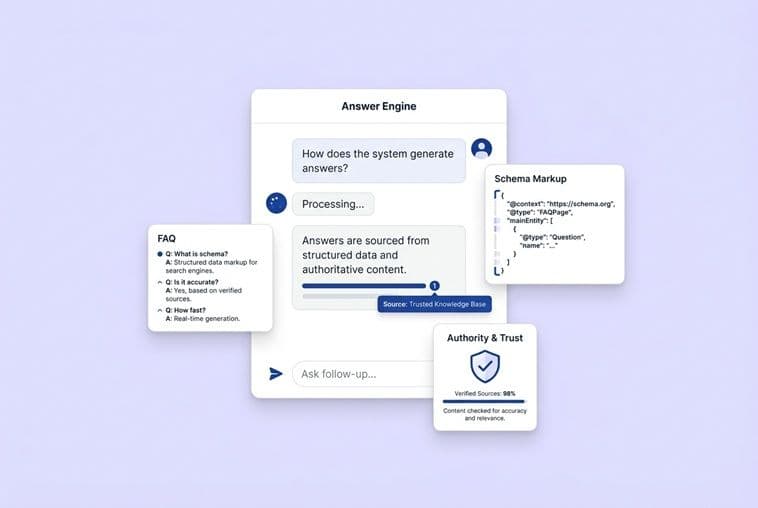
When you ask an AI a question, it scrambles to synthesize information from a bunch of different sources. It’s weighing them by credibility, how clearly they’re formatted, and relevance. Perplexity actively indexes the web and lists its sources. ChatGPT often pulls from its massive training data. Google’s AI Overviews use content it has already indexed and trusts.
But at the end of the day, every engine asks two simple questions about your content: Can I easily pull a clean answer from this page? And do I trust this source enough to stand behind what it says?
AEO vs. SEO vs. GEO (Don't Worry, It's Simple)
Here’s a simple breakdown so you don’t get lost in the alphabet soup:
- SEO (Search Engine Optimization) is for ranking in the classic blue links and driving clicks.
- AEO (Answer Engine Optimization) is for getting your brand or content featured in AI-generated answers. Think citations, mentions, and synthesized responses.
- GEO (Generative Engine Optimization) is just a broader term some people use for all of this stuff. I find AEO is more specific and useful for what we’re trying to do.
The good news is you don’t have to burn down your old SEO strategy. Think of AEO as a new formatting and trust layer you build right on top of the work you’re already doing. It’s an evolution, not a revolution.
How to Get Picked: Extractability + Trust
This is where AEO stops being an abstract concept and becomes a real playbook. Every AI answer engine is basically running your content through two filters.
Filter 1: Extractability (Can the AI Understand You?)
Extractability is all about structure. Can a machine lift a clean, self-contained answer from your page without getting confused? I've found a few patterns that just plain work.
- Lead with the answer. The first 40–60 words of any section should directly answer the main question. Don't make the AI (or a human) read three paragraphs of throat-clearing to find the point.
- Use atomic paragraphs. Each paragraph should be about one single idea. If you can't summarize a paragraph in one sentence, it's too complicated. Break it up.
- Write self-contained sections. Your headers should act like mini-questions. The section that follows should answer that question completely, without needing context from the rest of the page.
- Use lists and tables. When you’re comparing options or listing steps, structured formatting is a gift to both AI parsers and human skimmers.
Here’s a quick test I use: paste one of your key blog sections into ChatGPT and ask it to "summarize this in two sentences." If the summary is vague or misses the point, your content isn’t extractable enough yet.
Filter 2: Trust (Is Your Answer Credible?)
Trust signals for AI feel a lot like the E-E-A-T stuff Google has been talking about for years. For a small SaaS founder, this stuff isn't optional. It’s how you prove you’re not just making things up.
- Real authors, real credentials. An article by "Admin" is anonymous. An article by "Jane Doe, Founder & CEO" with a link to her LinkedIn profile is credible.
- Be consistent. If your homepage says your product does X and your blog says it does Y, you’re creating confusion. AI models pick up on these mixed signals across your site, social media, and other mentions.
- Show your work. When you make a claim, cite your source. Linking out to credible research or primary data shows that you verify your own claims, which makes you more trustworthy.
- Keep it fresh. Would you trust a restaurant review from 2015? Probably not. Dated content gets ignored. Simply updating your key pages is a powerful trust signal.
- Get mentioned by others. When other credible sites in your niche mention your brand or link to your content, it’s a huge vote of confidence. This is just off-page SEO authority, but it works for AIs, too.
Don't get overwhelmed. You don't need to do all of this on day one. Just pick two or three and build the habit.
A Quick Word on Distribution
AI models don't just see your website; they see the whole internet. If your brand only ever shows up on your own domain, you have a much thinner footprint than a competitor who’s being discussed on Reddit or in trade publications.
This doesn't mean you need to be everywhere. Just pick two or three credible places where your audience hangs out and show up consistently. A guest post, an active subreddit presence, or even a good directory listing helps build the kind of multi-channel trust that AIs look for.
One Content Strategy, Not Three
The best news I can give you is this: you don't need a separate content strategy for ChatGPT, Perplexity, and Google. Thank goodness, right? Who has the time for that? You just need one solid content system with a few minor adjustments.
But remember, AI answers aren't set in stone. You might be cited in an answer today and gone tomorrow. Don't panic. Your goal isn't perfect consistency. It's to build content that is so useful and well-formatted that you always have a high probability of being the source. Track the trends, not the daily blips.
ChatGPT-Style Assistants
These are conversation-first. Optimizing here is about building brand recall so your name comes up naturally in conversations about your space. This comes from consistent mentions across trusted web sources and having a crystal-clear definition of what you do on your own site.
Perplexity-Style Answer Engines
Perplexity loves citations, so this is the most direct competition for a spot in the answer. Focus on clean, indexable pages, structured formatting, and topical authority. Perplexity also seems to reward content that cites its own sources, so don’t skip that step.
Google AI Overviews
This is the closest to the SEO world we all know. Your existing authority and quality signals are huge here. The AEO layer is all about formatting. Use direct answers, clear H2s and H3s, and FAQ schema to signal to Google exactly which part of your page answers which question.
The "One Asset to Rule Them All" Rule
This is the systems-thinking founder's dream. Build one great piece of content, and it can work everywhere. A well-structured post with a direct answer, clear formatting, and the right schema can rank on Google, get cited in Perplexity, and inform ChatGPT. Master the fundamentals before you start worrying about over-specializing.
AEO Patterns You Can Use This Week
Lead With a Direct Answer
That 40-60 word direct answer at the top of a section is probably the single most impactful change you can make. Just write it like you’re giving a short, direct verbal answer. Then you can add all the nuance you want. The only time to skip this is when a question genuinely requires context first (like "should I pivot my pricing?"). In that case, just say so, then break down the answer below.
Atomic Paragraphs and Scannable Lists
You know the drill. One idea per paragraph. Use lists for steps or options. Use tables for comparisons. This isn't just good for AI, it's good for your busy, distracted human readers, too.
FAQs That Actually Work
FAQs are gold when they answer real questions your buyers have, not just keyword-stuffed nonsense. Keep your answers short, specific, and quotable, around 2-4 sentences.
Schema Markup: The No-Nonsense Starter Kit
This sounds technical, but it’s gotten way easier. Here’s all you need to get started.
The Only Schema Types You Need (For Now)
- FAQPage: For your FAQ blocks.
- Article / BlogPosting: For your blog content.
- Organization: For your brand itself (name, logo, etc.). This is foundational.
- BreadcrumbList: Helps search engines understand your site structure.
How to Get It Done
- Spec it: Map those schema types to your pages.
- Add it: Most modern CMS platforms have plugins or tools that do the heavy lifting here (like Yoast for WordPress or built-in tools in Webflow). You probably don’t need a developer.
- Test it: Use Google's free Rich Results Test to see if it worked.
- Monitor it: Check Google Search Console once a month for errors.
Common Mistakes I’ve Seen (and Made)
- Marking up content that isn't actually visible on the page. Google hates this.
- Using the wrong schema type for the page.
- Leaving required fields blank. Partial schema is often worse than none.
- Forgetting to update your schema after you change the content on a page.
How to Measure This Stuff (and Explain It to Your Board)
What to Actually Track
In an AEO world, website traffic alone is a vanity metric. Here’s what I track instead:
- AI citations/mentions: How often does our brand show up in AI answers for our top 10-15 target questions? You can start by doing this manually.
- Branded search volume: If people hear about you in an AI answer, they often search for your brand name directly. This is a great leading indicator.
- Assisted conversions: Look for people who visited a content page, left, and then came back later via a branded search or direct visit to convert. That’s the AEO journey in action.
- Share of voice: Are you being cited for the questions that actually matter to buyers?
Tools are starting to pop up to automate this tracking. Some teams use platforms like DeepSmith, which can monitor AI answers for you. But you can start with a simple spreadsheet. Just start measuring.
A Simple Reporting Workflow
You don't need a whole new dashboard. Just add these signals to your existing reports:
- Put a "branded lift" number right next to your organic traffic.
- Include your manual prompt tracking results.
- Tag your AEO-optimized content so you can spot assisted conversions.
How to Talk About AEO to Investors
They get this. Frame it as building essential infrastructure. "We're positioning ourselves to be the go-to source in our category for AI answers. Our citation rate is up X% in the last 60 days, and we're seeing a corresponding lift in branded search." That’s a story they can understand and track.
A Realistic Rollout Plan for a Lean Team
Where to Start
Don’t try to boil the ocean. Start where a citation will actually move the needle for your business.
- Comparison and alternative pages: Buyers asking "X vs Y" are ready to make a decision.
- Core definition pages: If you can own the definition of a key term in your category, you become the authority.
- Product-adjacent problem pages: Content that addresses the exact pain your product solves is prime real estate for AEO.
The Maintenance Problem
AEO isn’t a one-and-done project. Your content will go stale. I recommend a quarterly review: revisit your top 10 AEO pages, check the facts, update them, and re-test. Consistency is everything. This is where having a content system, not just a folder of Google Docs, becomes your secret weapon. A structured platform ensures your claims stay accurate and consistent as you scale, which solves the maintenance problem for you.
Don't Be a Jerk: The Ethical Lines
You can get clever with AEO, but don't get manipulative. Please, just don’t be that founder.
- Don't stuff your schema with invisible text.
- Don't fabricate credentials or statistics. Your credibility is your only real asset.
- Don't write for the model in a way that tricks a human. If your answer feels like a bait-and-switch, you’ve failed.
The right way to do AEO is simple: make your real expertise easy for everyone, including machines, to find, parse, and trust. Everything else is just noise.
Your next step: pick one page
Theory is fine, but execution is what matters. The best way to start is to pick one high-value page—a competitor comparison, a core feature explanation, whatever—and apply this playbook. Rewrite the intro to be a direct answer. Break up the long paragraphs. Add a real FAQ block. Add the starter schema. Then, track 3-5 related prompts for a month and see what happens. That single-page sprint will teach you more than reading articles for another week. You’ve got this.