I know the feeling. You ask ChatGPT for the best tool in your category, and it names your biggest competitor. You try again, phrasing it differently. Still them. Your own company is nowhere to be found.
It’s maddening, especially when you know your product belongs in that answer. I’ve been there. For months, we couldn’t figure out why we were ghosts. The good news is that this isn't black-box magic you can't control. It's an operations problem. And if you’re a founder, you know ops problems have operational solutions.
This isn't about hiring a huge SEO department. It's about building a repeatable system you can run with a lean team to fix a few specific problems: being hard to cite, describing your brand inconsistently, and being absent from the places AI actually trusts. Let's walk through the playbook.
First, what does being "invisible" to AI even mean?
Mentions vs. citations vs. recommendations
It's important to know which level of hell you're in because that tells you what to fix first.
A mention is just your name appearing in a response. A citation means the AI linked to you or credited your content as a source. But the holy grail is being recommended as a best option. This is when the AI names you as a specific solution to a buyer's problem.
If you’re not even getting mentioned, well, that's your starting point. You're completely invisible.
This isn't the same as your Google rank
I've talked to founders who are totally baffled because they rank on page one for their main keywords but are still absent from AI answers. It feels broken, but it makes sense when you see how the game has changed.
Traditional search gives you a list of links and lets you decide. AI engines are synthesizers. They pick sources they trust, assemble one answer, and hide the rest. Your job is to be one of those trusted sources.
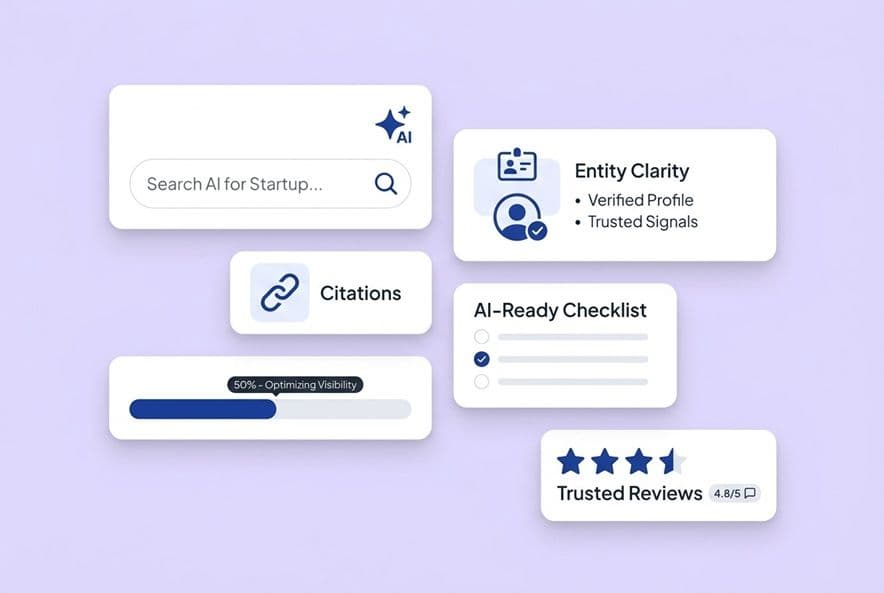
AI weighs things differently than Google. It’s looking for entity clarity (does it know exactly what you are?), answer-readiness (can it grab a clean response from your page?), and third-party corroboration (do other credible people agree with you?). You can win at the old keyword game and completely fail on these three points.
The 6 reasons AI is ignoring your startup
Founders get told to "improve your authority" or "publish more." That advice is useless because it isn't specific. Here are the real root causes I see over and over again.
1. Your content isn't "citable"
AI models are lazy. They need to extract a clean, self-contained answer from your page. If your best point is buried in the fourth paragraph after a long, flowery intro, the bot has already moved on to a source that got straight to the point.
This means you need to practice "answer-first" writing. Your H2 should ask a question, and the very first sentence should answer it. That’s a citable block. A 400-word intro that "sets the scene" is just noise to a machine.
2. Your brand story is a mess
I see this one all the time. Your homepage calls you a "workflow automation platform," your G2 listing says "project management software," and an old press release calls you a "productivity tool." The AI has no idea what you actually are, so it either skips you or gets it wrong, which is worse.
You need to lock in your entity. Pick one category label, one one-liner, and the same few use cases. Then, stamp them everywhere: your site, your profiles, your press, your founder's LinkedIn. AI is a pattern-matching machine. It needs to see the same story in a few different places before it feels confident repeating it.
3. You're the only one saying you're great
AI systems don't just take your word for it. They look for other people who agree. Reviews on G2 or Capterra, comparisons on independent blogs, and Reddit threads where real users talk about you are all forms of corroboration.
If the only place your positioning exists is your own website, that’s a red flag for the AI. It’s trained to be skeptical of a single source bragging about itself.
4. Your best info is locked away or stale
We've all got skeletons in our digital closet. That paywalled content, the unindexed PDF of a great case study, the JavaScript-heavy page that bots can’t crawl. All of these make you less citable. Freshness matters, too. If your best guide to a topic hasn't been updated in two years, a newer source will get the citation instead.
5. You're not hanging out in the right neighborhoods
So much of what AI models "know" comes from user-generated content and community chatter. Reddit threads, niche forums, "best of" listicles, and independent review posts are a huge part of their world.
If nobody is talking about you in those places, the AI has no record of your existence outside of your own marketing. This isn't about spamming Reddit. It's about genuinely showing up where your customers are and adding value.
6. A bad story is easier to find than your real one
The internet never forgets. That critical review from two years ago, an old forum post about a pivot that didn't work, messaging from before you found product-market fit. If that's the easiest narrative for an AI to find, it will default to it. You can't suppress it. The only solution is to create a louder, more credible, and more consistent story that's easier for the AI to find and trust.
How to check your AI visibility (without hiring an SEO team)
A one-off prompt will mislead you. AI answers are inconsistent. You need a simple, repeatable workflow you can do once a month.
Pick the platforms that matter
Start with two or three. Don't boil the ocean. Perplexity is great for technical research because it cites sources. Google AI Overviews is a big one. ChatGPT has the most users. If your buyers are in the Microsoft world, add Microsoft Copilot.
Build a standard set of prompts
Use prompts that mimic how your buyers actually search. Some examples we use:
- "What are the best tools for [your category] for a small team?"
- "What's a good alternative to [your big competitor]?"
- "What tool would you recommend for [a very specific job]?"
- "What do people on Reddit say about [your brand name]?"
Run each one a few times. A single answer isn't a reliable signal.
Repeat, record, and compare
Log everything in a simple spreadsheet: date, platform, prompt, and what happened. Were you mentioned? Cited? How were you described? Who else showed up? After three months, you'll have a real trend line, not just a random snapshot.
What to track
For a lean team, these four metrics are all you need: citation frequency (how often you appear), mention rate (your overall inclusion), sentiment framing (how you're described), and competitor share of voice (how often they appear instead of you).
When to get a tool for this
A spreadsheet is fine until it isn't. Once you're running 20+ prompts a month, it gets messy. Some content platforms are building this in. For instance, DeepSmith includes AEO prompt and citation tracking in its workflow, which helps our team stay consistent without living in spreadsheets.
Making your content "easy to cite" (a checklist that actually works)
Write in answer blocks
Every H2 or H3 should be a question or a clear outcome. The first sentence below it must provide a direct answer. Then you can add support. This structure lets an AI grab a clean answer without getting confused. Use bullet points for lists.
Build a tight "source of truth" page set
Your homepage has to answer three things in five seconds: what you do, who it's for, and the outcome. If a bot has to guess, you lose. Create specific, clear pages for your main use cases and how you define your category.
Use schema that actually matters
Don't go crazy with schema. Focus on these three. FAQ schema for blog posts and solution pages. How-To schema for step-by-step guides. Organization schema on your homepage to tell AIs your official name, URL, and social profiles. It’s like giving them your official ID.
Fix the technical blockers
The usual suspects are pages blocked by robots.txt, slow load times, and thin or duplicate meta descriptions. Also, do a sanity check in Google Search Console to make sure your most important pages are actually getting indexed. It's a basic mistake, but I see it all the time.
Use content clusters and internal linking
A single blog post doesn't build authority. A cluster of related posts all linking back to a main pillar page does. This signals to AI that you have deep expertise on a topic. Every time you publish something new, make sure it links back to your core pages.
A note on video and audio
For a lean team trying to get cited by AI, video and audio are usually a distraction. Most systems can't parse them well yet. The exception is if you have clear diagrams or screenshots that can rank in image search, or if you publish transcripts of your videos as indexable text. Focus on text first.
This all works best when it's just part of your process. We use a system (DeepSmith, in our case) that bakes citation-ready formatting and schema into the drafting process so we're not auditing every post after the fact.
Teaching AI what to say about you
Build your narrative kit
This is a five-minute exercise that will save you months of pain. Open a doc and write down these four things:
- Category: One phrase. For us, it's "AI content production system."
- One-liner: What you do, for whom, and the outcome.
- Use cases: The top 2-3 jobs people hire your product to do.
- "Not for" boundaries: Who you aren't for. This adds a ton of credibility.
Now, use these exact phrases everywhere: your site, G2, LinkedIn, founder bios, PR. Consistency is what builds confidence in an AI.
Get other people to tell your story
The most valuable assets are G2 or Capterra reviews that use your category language, third-party comparison posts, customer stories on other people's blogs, and thought leadership from you on platforms like LinkedIn. You don't need a hundred reviews, just enough to show a pattern.
Place your signals strategically
On your site, don't just hide testimonials on a "customers" page. Put them on the solution pages where they're actually relevant. In communities like Reddit, participate by answering questions. If your tool is a perfect fit, you can mention it. And for listicles, just email the authors of "best [category] tools" posts and ask to be considered. Those pages have a huge influence.
Dealing with negative or wrong information
If an AI says you're in the wrong category or mentions old features, the fix is to make the correct version louder. Create a dedicated page that clearly addresses the wrong information. Get it indexed and build a few links to it. Then, double down on getting new reviews and mentions that reinforce the correct story. You can't erase the bad info, but you can drown it out.
Where to start so this doesn't become another endless project
Okay, that was a lot. I get it. You can't do it all at once, and you shouldn't try.
The Impact vs. Effort grid
For every fix, ask two questions: How much will this help if it works? And how long will it take? Start with the high-impact, low-effort stuff. Fixing your homepage clarity and adding Organization schema are easy wins. Cleaning up your G2 profile is next. Save the big content cluster projects for later.
A 30-day plan for a lean team
Week 1: Run your first AI visibility check. Pick 2 platforms and 5-8 prompts. Log the results. Week 2: Fix your entity consistency. Standardize your category and one-liner on your homepage, G2/Capterra, and LinkedIn. Week 3: Update your top 3-5 content pages with answer-block formatting and FAQ schema. Week 4: Pick one off-site channel. Either ask to be included in a listicle or post one genuinely helpful comment in a relevant community.
Check your visibility again at day 30 and see what moved.
A quick word on paid content
Advertorials can work, but only on credible sites your buyers actually read. A good piece in an industry publication can create a strong corroborating signal. It backfires completely on low-authority content farms. AI can tell the difference between a real endorsement and spammy links.
This is where having strategy and execution tied together is key. A tool that finds coverage gaps and AEO prompt opportunities and lets you push them right into production is a game-changer. For example, DeepSmith's Topic Explorer finds these gaps and lets you turn them into drafts in one click. For a small team, that closes the loop between "ideas" and "done."
How to prove it's working when the data is a mess
I'm not going to lie to you, AI referral attribution is messy. You won't get a perfect dashboard. But you can get a good enough signal.
What you can measure today
Most AI tools don't pass clean referrer data. What you can measure is your citation frequency for your target prompts over time. You can also watch referral traffic from sources the AI cited (like a blog that was linked in the answer) and look for shifts in your branded search volume.
"Good enough" attribution
Here are three approaches that work:
- Unique landing pages: Use unique UTMs on pages you're optimizing for AI citation and watch their traffic.
- Self-reported attribution: Add a "How did you hear about us?" field to your forms. You'll be surprised how many people write "ChatGPT" or "an AI tool."
- Assisted conversions: Look for user paths where a visit to an AI-cited page happened sometime before they converted, even if it wasn't the last click.
When the AI gets things wrong about you
If an AI says you have the wrong pricing or lists a feature you discontinued, the fix is always the same: build a stronger signal for the correct information. Write a clear, specific page that addresses the wrong fact directly. Use schema, get it indexed, and link to it. Then go get new reviews and mentions that reinforce the correct story. You can't argue with the machine, but you can give it a better, louder, more credible story to tell.