If your team can generate a draft faster than anyone can safely check it, you already have a governance AI generated content problem, even if nobody has named it yet. The risk at enterprise volume is not only a hallucinated fact. It is an unsupported product promise, a stale statistic, a missing qualification, an accidental regulated claim, an inconsistent product name, or an approval record that cannot show who actually signed off on the version that went live. This guide walks through a release process for AI-assisted drafts, built around risk tiers, claim checks, human sign-off, and an audit trail, so you can publish more without letting AI content quality control become the thing that slips.
By the end you will have an eight-step process for moving a draft from generation to publication without treating the model as the final decision maker. It is written for marketing leads who need to grow output while keeping every piece accurate and on brand, and it is the practical version of what enterprise AI content accuracy actually takes day to day, not a policy document nobody reads.
Classify the asset and assign its risk tier
Before anyone generates a word, give the piece a short risk record. Note the content type and channel, the audience and geography, and whether it is educational, promotional, comparative, or transactional. This is also where you decide whether the piece is genuinely useful on its own, since Google treats generating many low-value pages primarily to manipulate rankings as scaled content abuse regardless of who or what wrote them. Flag anything that touches health, finance, legal matters, safety, children, employment, or another sensitive area. Note whether it makes a performance, pricing, savings, security, or competitor claim, whether it uses customer names or testimonials, and who owns the final publish decision.
Four practical tiers cover most content programs. Tier 0 is general educational material with no sensitive claims and no customer endorsement, and it needs only a content owner's review plus automated checks. Tier 1 is standard marketing: how-to articles, comparisons, and feature explanations with a content owner, editor, and marketing approver in the loop. Tier 2 covers performance claims, competitor comparisons, pricing claims, and testimonials, and it needs a subject-matter expert and legal review where applicable. Tier 3 is health, financial, legal, safety, or reputational content, and it needs a named legal or compliance approver plus an accountable executive.
This is the first real point of AI content quality control in the whole process, and skipping it is what lets everything downstream go sideways. You know this step is done when the asset has a recorded risk tier, a reviewer list, and a release threshold before the draft even enters production. The common mistake is assigning risk after the draft already exists, which lets the draft itself set the claims and tone that reviewers then have to unwind. A short blog post can still carry a misleading comparison or a regulated claim, so do not assume every article is automatically low risk.
Pro tip: make the risk tier a required field in your content workflow. If the field is blank, the draft cannot move to final approval. That one rule catches most of the pieces that would otherwise slip through unclassified.
Build your source of truth and claim ledger
Every piece of AI-generated content needs a compact evidence packet behind it, built before or during generation. That packet holds your approved company description, current product details, the claims you may make, the claims you must not make, and the proof behind each objective claim. It also holds your approved competitor names and comparison boundaries, and any customer names or testimonials you are cleared to use.
For each material claim in a piece, record a claim ID, the exact approved wording, the claim type (fact, opinion, feature description, comparison, or projection), the evidence behind it, the conditions or limitations that apply, and an expiry date that triggers a recheck. Words like reduces, prevents, guarantees, secure, best, and proven carry more review weight than descriptive words like includes or supports, so treat verb choice as a real editorial decision, not a style preference.
This step is complete when every material claim in the planned piece links to an approved evidence record, or the team has decided to remove or rewrite it. Teams often build a style guide but never build a claims system, and they approve a product description once and assume it stays true forever. Features, pricing, and plan limits change, so every evidence record needs an owner and a review date, not just a one-time approval.
Ground generation in approved brand and product context
Generation needs structured context, not an instruction to "sound professional." That context should cover the audience and their buying stage, the reader's problem, your brand positioning, approved product names and terminology, claims to make and claims to avoid, and your brand voice down to sentence length and formality. Give the system a clear instruction not to invent facts, customer results, statistics, quotes, or product capabilities. When evidence is missing, it should flag the gap for review rather than fill it in.
This is where a structured brand-context layer earns its place in your governance AI generated content process. DeepSmith's Deep IQ stores your company positioning, differentiators, claims to make and avoid, product and persona profiles, brand voice, and trusted sources, so every draft starts from the same approved foundation instead of a re-briefing session. That grounding does not make an article automatically true. What it does is keep terminology, audience context, and claim boundaries consistent across every writer, freelancer, and model you use, so human review is checking fewer avoidable errors and can spend its time on what actually needs judgment.
You know this step is done when a reviewer can look at the generation inputs and see exactly which approved context, sources, and risk tier shaped the draft. The mistake to avoid: never let a model's confident sentence turn a qualified product claim into an absolute promise. Confidence in the writing is not evidence behind the claim.
Run automated checks before any human sees the draft
Automation should be your first pass, not your only pass. Run factual and source checks: does every material claim have a claim ID, do the numbers and product limits match the source record, do citations actually point to the sentence they support. Run brand and terminology checks: are approved product names used consistently, are prohibited phrases and unapproved superlatives flagged, does the voice match your settings. Run safety and compliance checks: does a high-risk topic route to the right specialist, is personal or confidential information flagged, are required disclosures present and visible. Run search and publishing checks: does the piece answer the reader's question directly, are metadata and structured data accurate, does the page add value rather than lightly repackage another one.
This is where a production pipeline can carry real weight in your AI content review process. DeepSmith's Content Studio runs the Writer through research, internal and external linking, and metadata as part of drafting, so the mechanical checks that used to eat thirty to sixty minutes of a marketer's time per article happen during creation instead of after. That narrows what a human still has to check by hand, but it does not remove the human check itself.
You are done here when the automated report is attached to the asset and every failed check has been resolved or escalated with the original failure visible alongside the fix. A green automated score is not permission to publish. Automated checks are weak at catching implied meaning, misleading omissions, and whether a cited source actually supports the strength of a claim, so they should narrow the human workload, never replace the human decision.
Review facts, claims and sources like a skeptic
A human reviewer needs to read the final rendered content, not just the raw draft text. Start by reading the headline, opening, headings, and call to action alone, and note the impression a reader gets before they reach any qualifications. Then extract every externally verifiable statement, including implied claims and comparisons, and match each one to its evidence, checking that the source actually supports the exact wording rather than a related topic. Check the conditions attached to each claim (a plan, a product version, a time period), and check whether the overall page still reads honestly once you weigh the qualifications against the headline.
For advertising claims specifically, the FTC has stated that advertisers need a reasonable basis for objective claims before they publish, and the level of evidence needed depends on the wording and what a reasonable consumer would expect it to mean. That standard varies by claim, product, and market, so route anything with a performance or savings claim to legal or compliance review rather than applying one blanket threshold yourself.
If the piece includes an endorsement or testimonial, check whether the endorser received any payment, product, or perk, whether that connection is disclosed clearly enough that a reader would notice it, and whether the wording describes something the endorser could truthfully say. This step is done when every material claim has a recorded disposition (verified, rewritten, removed, or approved with an exception) and the reviewer has confirmed the page reads accurately as a whole. The most common failure here is checking only the explicit factual sentences while missing what the headline, image, or comparison table implies on its own.
Check brand voice, safety and accessibility separately
Run a second human pass focused on brand and safety, because an article can be fully accurate and still be unusable if it does not sound like your company or creates an avoidable risk. This pass is what actually keeps a program brand-safe AI content at scale rather than brand-safe on the pieces someone happened to slow down and reread. For voice, check whether the opening gets to the reader's problem quickly, whether the tone matches your approved voice instead of generic AI prose, and whether the piece keeps editorial judgment rather than just summarizing its sources. For safety, check for anything discriminatory, stereotyping, or manipulative, anything that misuses a person's name or quote, and anything that exposes confidential or personal information. For accessibility, confirm headings describe the structure of the page, links describe their destination, and images carry useful alt text.
Search platforms treat these elements as part of what gets evaluated too. Google's own guidance calls out metadata, structured data, and image alt text as pieces of content that can surface directly in search, so validate them as real editorial elements rather than a technical afterthought tacked on at the end.
You know this pass is complete when the brand owner or designated editor has approved voice and audience fit, and any flagged safety or accessibility issue is cleared. Teams often treat a style guide as a reference document instead of a release control. The fix is converting the rules that matter most into checks that fire automatically when a draft enters review, which frees the human pass to focus on meaning and judgment instead of re-reading a PDF.
Stress test the draft, then approve the exact version
For anything at Tier 1 or above, test the draft as though you were trying to make it fail. NIST's own guidance recommends this kind of adversarial testing to catch manipulation and unforeseen failures before they ever reach a reader. Ask which statements cannot actually be verified from your evidence packet, which single statement would be most damaging if it turned out false, and what the headline implies that the body only qualifies several paragraphs later. Ask whether a competitor, regulator, or journalist could reasonably challenge the wording, and whether there are hidden assumptions about geography, product version, or eligibility buried in the copy.
Once the draft clears that test, the approval record needs to capture the asset ID and risk tier, the context and source versions used, the automated check results, the claim ledger and its decisions, and the reviewer names, roles, and timestamps attached to the exact version being published. An approval of one version must never quietly carry over to a later edit.
This is the release gate, and it is where a production platform should reduce the manual work around approval without ever replacing the approval itself. DeepSmith's Produced Content stage is built for exactly this: review, edit, preview the live article, revise metadata, and publish to your CMS from one place, with a human decision required before anything goes live, even on pieces scheduled through Autowrite. The workflow should require that human release decision every time, because product capability is not the same thing as legal or editorial accountability.

You are done here when the exact published version has a complete, retrievable approval record with no unresolved blocking exception. The recurring failure at this stage is approving a draft in one place and publishing a slightly different version somewhere else, which makes the whole record useless if anyone ever needs to reconstruct what actually went live.
Monitor after publish and fix what breaks
Quality control does not stop at the publish button. Set up a loop to catch factual complaints, support tickets, and legal notices tied to published content, and to catch changes to your own product, pricing, or policies that make an existing claim go stale. Recheck time-sensitive claims on their expiry date, and review high-risk content more often than low-risk content. Track defect categories directly: hallucinated facts, stale claims, unsupported comparisons, missing qualifications, and broken citations, so patterns show up instead of getting treated as one-off mistakes.
When something does break, record what happened, how it was contained, and what changed in the process so it does not repeat. If a shared brand rule or product fact changes, re-run every piece of content built on that assumption rather than leaving old claims live because nobody remembered they depended on it.
Tracking how your content performs after publication is a natural extension of this loop, and DeepSmith's AI Visibility module reports mention rate, citation rate, and sentiment across the AI engines it tracks, which is useful context once your quality process is solid. It is adjacent to per-piece quality control, not a substitute for it, so keep the review process itself as the thing that decides whether a piece was safe to ship in the first place.
This closing loop is really where enterprise AI content accuracy gets tested against reality instead of against a checklist, because a claim that was true at publish time can go stale a month later without anyone touching the article. You know this step is working when your team can take any published asset, reconstruct exactly how it was created and approved, and correct a material defect quickly once one is found. Do not optimize only for review speed. A faster process that quietly increases unsupported claims or post-publication corrections is not actually an improvement, even if it looks like one on a dashboard.

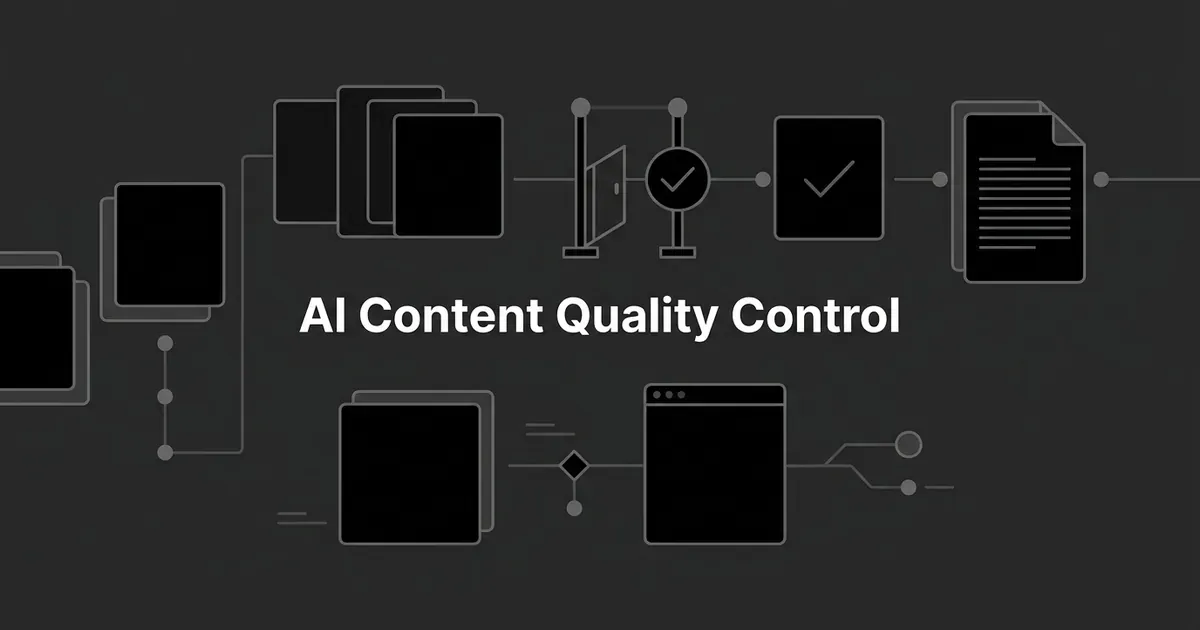
The eight steps above are not a straight line that ends at publish. They close into a loop: what monitoring turns up after publication is what sends a piece back through classification and evidence, not just a one-time correction to the live page.
What to do next
Start with one content type instead of trying to govern everything at once. Define its risk tiers, build its claim ledger, and convert the brand rules that matter most into automated checks before you touch a human reviewer's time. Require a human release decision before you expand the workflow to a second content type, then run the checklist below against a real draft and watch what it catches.
If you want the production side of this to move faster without cutting a review step, DeepSmith's Writer and Produced Content workflow builds the research, linking, and metadata into the draft itself, and hands you a publish-ready piece with the human approval gate still in place, which is what makes brand-safe AI content at scale realistic instead of aspirational. You can start a free trial and see it against your own brand context before committing to anything.
Pre-publication checklist
- Every material fact has a source, and the source supports the exact wording used.
- Numbers, dates, prices, and product details are current as of the review date.
- No unsupported statistics, customer results, or certifications appear anywhere in the piece.
- Claims and testimonials that touch performance, pricing, or comparisons have the required specialist review.
- Product terminology is consistent and approved, and the tone matches your brand voice.
- Headings, metadata, structured data, and alt text match what is actually on the page.
- The risk tier is recorded and every required reviewer approved the exact final version.
- Exceptions have a named owner and an expiry date, and the full record is retained for later audit.