You have two bad options right now, and you can feel both of them.
Send every AI-assisted asset through the same approval queue, and volume dies. Skip the queue to keep volume, and one day someone asks who checked a claim on a live page, and nobody can answer.
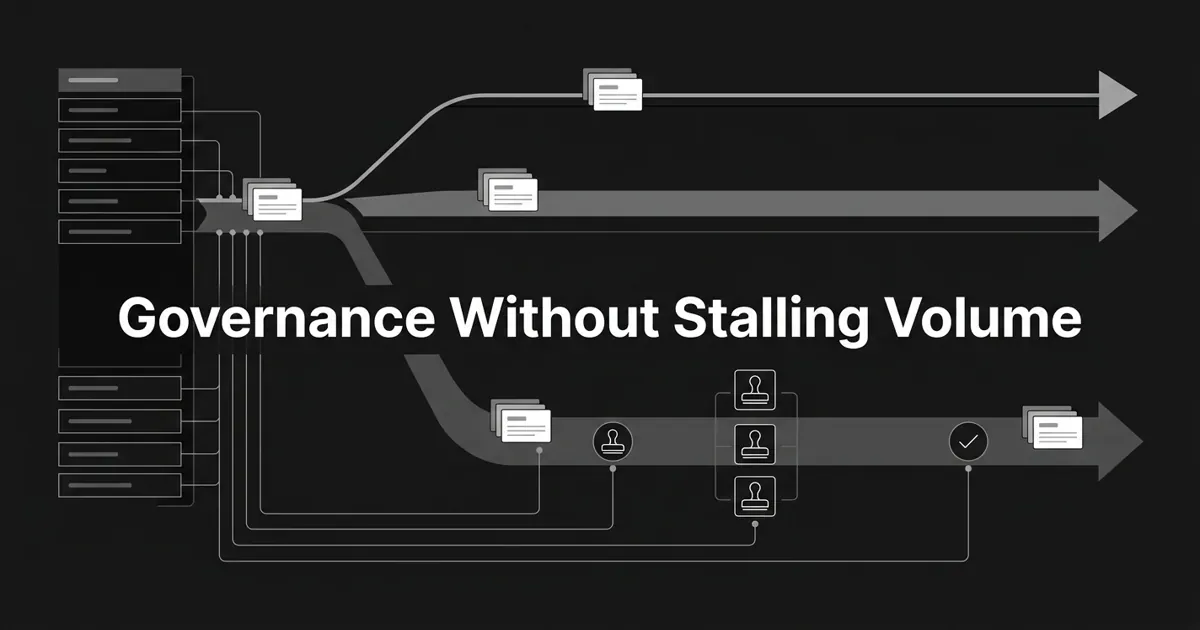
Enterprise content governance is how you stop choosing. Not a longer policy document. A routing system that decides which assets need legal, which need a subject-matter expert, which need a brand owner, and which need none of them, plus a record that survives the question "how did this get published?"
By the end of this guide you will have a policy scope, a three-lane risk matrix, a RACI for multi-team content approval, a claim packet, a brand rubric, an approval state machine, an audit record, and a monitoring loop. Start with one content family. You do not have to boil the enterprise.
Step 1: Inventory what you publish and map where risk enters
Start with content, not tools. Most governance programs stall because someone configures a platform before anyone lists what the company actually produces.
Write down every content family: internal drafts, meeting summaries, articles, landing pages, product pages, help-center drafts, sales enablement, social posts, email, customer communications, product UI copy, and any generated or manipulated image, audio, or video.
For each one, record:
- The business owner, publishing channel, audience, and markets it will appear in.
- Whether it carries objective product, performance, financial, health, employment, security, or safety claims.
- Whether it touches personal, confidential, customer, proprietary, or licensed material.
- The AI system, model provider and version, retrieval sources, and workflow.
- Whether you are a deployer of someone else's AI system or a provider offering one.
- A provisional risk tier and the people who must approve it.
Then map your control points. Governance has to cover the prompt, the source repository, the review queue, the CMS, the publication endpoint, and monitoring after launch. A policy that only governs the prompt misses the place where an unapproved draft quietly becomes a live asset.
Four artifacts hold it together: an AI content policy, an editorial policy, a brand style guide, and a workflow with states, owners, and publication responsibility.
You are done when: a reviewer can pick any planned asset and say what it is, where it goes, who owns it, what claims it makes, who must approve it, and what record you have to keep.
Common mistake: writing a policy that describes the model but not the publication system. Your release queue and your CMS are governance points too.
Step 2: Route every asset through a three-lane risk matrix
Here is the move that protects your volume. Enterprise content governance works when review is three lanes, not one queue, and assets route by consequence rather than by how polished the prose reads.
| Lane | Typical content | Minimum control path |
|---|---|---|
| Low risk | Internal drafts, brainstorming, meeting summaries, personal productivity work | Spot review, light prompt logging, an assigned retention rule |
| Medium risk | Marketing copy, social, sales enablement, help-center drafts, ordinary external editorial | Human approval, source review, brand review, a recorded approval state before publish |
| High risk | Legal, financial, healthcare, employment, security, regulated, public-interest, or customer-impacting claims; synthetic media; personal-data exposure; earnings or guarantee claims | Subject-matter sign-off, legal or compliance review, brand and channel-owner approval, a full evidence and provenance record |
That is an operating model, not a statutory classification. Your sector and jurisdictions decide the real rules.
Apply a highest-trigger rule. If one paragraph in an otherwise routine article contains a high-risk claim, the whole asset takes the high-risk path.
Write the escalation triggers down so nobody has to guess. An asset moves up a lane when it involves a claim needing objective substantiation, a claim about efficacy, safety, income, or superiority to a non-AI product, a regulated product, synthetic media, text meant to inform the public on a matter of public interest, third-party copyrighted material, or a changed model or market.
Each row needs a trigger, required reviewers, an evidence standard, a disclosure decision, publication authority, a retention class, and an escalation owner. Skip the numeric risk score unless a number actually changes the route. A score that changes nothing is decoration.
You are done when: two trained reviewers can classify ten backlog assets independently and land on the same route, or resolve the difference with a written rule.
Where teams go wrong is at both extremes. Sending every sentence to legal destroys throughput. Calling all AI text low risk misses the high-consequence claim buried in a routine article.
Pro tip: pre-approve low-risk templates, terminology, and recurring claims, then make that approval expire when the product, market, model, evidence, or law changes.
Step 3: Assign decision rights so nobody does someone else's job
Multi-team content approval breaks for a boring reason. Two people think the other one checked the claim.
Fix it with named people, never a team name or shared mailbox:
- Content producer: supplies the brief and intended use.
- Content owner: owns the objective, audience, channel, and final accuracy.
- Editor: checks clarity, factual accuracy, structure, accessibility, and brand fit.
- Subject-matter expert: verifies product, technical, clinical, financial, or security claims.
- Legal or compliance reviewer: decides claims, disclosures, rights, privacy, and jurisdiction.
- Privacy or security steward: reviews sensitive data and prompt inputs when triggered.
- Brand owner: approves voice, terminology, positioning, and exceptions.
- Channel owner: authorizes release into the public channel.
- Content operations: preserves the record, evidence, approvals, and final version.
- Incident owner: runs withdrawal, correction, and postmortem.
For medium-risk marketing, the core route is content owner, editor, brand owner, channel owner. High risk adds the subject-matter expert and the legal or compliance reviewer, plus privacy or security when a trigger fires, and keeps final release authority separate from whoever generated the asset.
Run reviews in parallel wherever dependencies allow. Brand and legal can read a stable draft at the same time while the expert verifies the claims they both rely on. Parallel review buys back days. It must never let a required decision get skipped.
You are done when: every content type has a RACI with named alternates, an escalation owner, a decision deadline, a rule for rejections, and a workflow that records each decision by person, role, timestamp, version, and reason.
The classic failures: asking legal to edit voice, asking brand to certify a medical claim, letting an author approve their own high-risk asset, or forming a committee with no accountable release owner.
Step 4: Build a claim packet before anything reaches legal
This is the step that makes legal review of AI content fast instead of dreaded. Counsel should never receive a raw draft. They should get a claim, its evidence, and the decision you want.
Build a claims register for recurring claims, then attach a packet to every claim-bearing asset. The packet carries:
- The exact proposed claim and its permitted wording.
- The claim type: descriptive, performance, comparative, safety, financial, health, or income.
- The evidence source, owner, date, scope, conditions, and expiry date.
- The market, audience, product version, and channel the evidence covers.
- Any required qualifier, disclaimer, or prohibited wording.
- The legal, compliance, and subject-matter decision, with the reason when it is a no.
- A link to the source record in your repository.
For US advertising, the substantiation test is old and still sharp. You need a reasonable basis for express and implied objective claims before they run. If your copy says tests prove it or studies show it, you need the level of proof that wording represents. A result that only holds under limited conditions cannot be presented as universal.
The FTC's AI-specific guidance adds questions worth printing on the checklist. Are you exaggerating what your AI product can do? Does the performance claim have scientific support under the conditions stated? And does the product actually contain the AI capability you claim? Using an AI tool during development is not the same as the product containing AI.
Operation AI Comply, announced on 25 September 2024, gives you a red-flag list: fake-review tools, a service promoted as a robot lawyer, and unsupported income promises. AI creates no exemption from ordinary law. A generated endorsement can still deceive, so route testimonials and customer results to legal.
Rights need a decision too. Purely AI-generated material is not protected by copyright just because you prompted it. A larger work can contain AI-generated material and still be protected for the human selection, arrangement, or creative modification inside it, and a registration application has to disclose the machine-generated portion when it is more than trivial. Keep the prompts, outputs, and edits so you can show what a human contributed.
If you publish into the EU, separate the provider duty from your deployer duty. Providers of systems generating synthetic audio, image, video, or text must mark outputs in a machine-readable, detectable format. Deployers must disclose deepfake media, and must disclose text published to inform the public on matters of public interest, with an exception where the content has had human review or editorial control and a named person or company holds editorial responsibility. Those obligations apply from 2 August 2026, so they are live now.
Do not read that as "every AI-assisted blog post in Europe needs a label." Public interest is a legal question about purpose and context, so let counsel decide which content families it covers.
You are done when: an independent reviewer can pick any objective claim in a published asset and find its evidence, scope, owner, date, permitted wording, and decision.
Where teams go wrong: asking the model to cite itself, treating a confident sentence as evidence, or leaning on a vendor's compliance statement while ignoring their own publication duty. AI content compliance is a decision you own, not one your vendor makes for you.
Step 5: Turn brand rules into production context and a scoreable rubric
Brand control at enterprise scale fails when the brand guide lives in a PDF the generator never sees. Two teams and three markets later, the voice has drifted and nobody can point to the rule that broke.
Convert the guide into structured context the production system and the reviewers both use: positioning, product profiles with approved names and claims to make and avoid, personas with goals and objections, voice and tone, approved terminology, visual rules, content-type templates, and a trusted-source list.
Then give brand review a pass/fail rubric instead of taste. Does the asset use approved positioning? Only permitted product claims? The right persona, terminology, and tone? No restricted language? Record exceptions in the log, not in a private chat.
This is the layer Deep IQ handles inside DeepSmith. It stores company positioning, product profiles, personas, brand voice, visual guidelines, and reusable content types, including claims to make and claims to avoid, and every article the platform produces is grounded in that stored context. Shared production context removes briefing gaps and voice drift at volume. It is not legal approval, and it does not replace your brand owner.
You are done when: a new producer can work from the structured context with no private briefing, and a brand reviewer can score the result against the same versioned rubric.
Where teams go wrong: keeping the voice guide away from the generator, measuring only whether keywords appear, or letting reviewers make subjective edits without logging the rule behind the change.
Step 6: Make approval a state machine, not an email thread
AI content compliance survives an audit when approval is a set of states with mandatory transitions. It does not survive a thread with a thumbs-up emoji.
Use these states:
- Briefed: objective, audience, channel, market, risk triggers, and owner present.
- Planned: due date, production route, model, and required reviewers assigned.
- Generated: prompt, system instructions, sources, model version, and original output retained.
- Evidence checked: claims have packets, rights and data checks complete.
- Brand and editorial checked: voice, terminology, structure, and channel fit pass.
- Legal or compliance checked: claims, disclosures, privacy, copyright, sector controls pass.
- Approved for release: the accountable owner and channel owner approve that exact version.
- Published and archived: final location, artifact, approval record, and correction path captured.
Not every asset walks every gate. The matrix from Step 2 decides which apply, and low-risk work should skip most.
Set service levels per queue, escalation rules, and a maximum age for a claim packet. Pick those numbers yourself, because no published benchmark tells you what a review hour should cost. Then automate the boring half: completeness checks, duplicate claims, required fields, evidence expiry, missing disclosures, and routing. Keep humans on risk, exceptions, factual meaning, rights, and final release.
Production tooling belongs here too. DeepSmith's Content Studio runs the multi-stage pipeline that researches, drafts, optimizes, links, and illustrates an article, and Autowrite generates a scheduled piece straight into Produced Content for review. The boundary matters: the platform produces and optimizes, your team reads, edits, and publishes. Production capability is never evidence that approval happened.
Use hands-off publication only for content families legal, compliance, and brand have classified as low risk and pre-approved. Everything else waits until the decisions exist.
You are done when: nobody can move an asset to release while a risk tier, evidence packet, reviewer decision, disclosure decision, or final owner is missing, and rejection sends it back to a named state with a reason and a version.
Where teams go wrong: treating generated, reviewed, and approved as synonyms, letting a scheduled job run past a changed product claim, or letting whoever configured the automation become the invisible final approver.
Pro tip: put the automated completeness checks in front of the legal queue. Counsel should be making decisions, not doing content operations.
Step 7: Keep a record you can reconstruct, not a checkbox
Human review is a decision. Provenance is the evidence that makes the decision reconstructable. An audit only accepts the second one.
Retain, per asset: content ID, brand, content type, channel, market, and risk tier. Policy, rubric, and brand-context versions. Model name and version. Prompt and system instructions, with access controls where those are sensitive. Retrieval and source inputs. The original output. Human edits and the final approved artifact. Reviewer names, roles, and decisions with timestamps. The evidence packet and the rights decision. The disclosure decision, including why none was required. Final location, publication time, and correction history.
Set retention by record class and jurisdiction. Nobody has published a universal number of years for AI-content records, so do not invent one. Let legal, records management, and privacy set it, and account for deletion, access, and legal hold. Lock down prompts and outputs holding confidential material.
You are done when: you pass a reconstruction test. Hand a published high-risk asset to someone who never touched it. From the retained record alone, they should identify the approved version, the model and prompt, the sources, the human changes, the claim evidence, the disclosures, every approval, and the final location. Chat history does not count.
Where teams go wrong: keeping only the final copy and a screenshot, storing model and source data where records management cannot reach it, or hoarding every prompt forever with no deletion rule.
Step 8: Monitor after publication and reopen when things change
Governance does not end at publish. Assign an owner and a trigger for each of these: a new model version, changed retrieval sources, changed product features or claims, expired evidence, new markets, complaints and incidents, a change in law or positioning, and AI answers that describe your brand inaccurately or credit a competitor's source.
Run it as a loop rather than a project. Govern sets policy, roles, and incident communication. Map identifies technology, data, third-party, privacy, and IP risk. Measure runs documented testing, including scenarios that reflect your high-risk contexts. Manage covers post-deployment monitoring, corrective action, and incidents. That loop is where enterprise content governance stays alive instead of becoming a document nobody opens.
Define the incident path before you need it: detect, preserve the record, withdraw the asset, notify the owner and legal, assess reporting duties, publish the correction, record the root cause and the control you changed.
Track both throughput and control quality:
- Volume by risk tier, and time spent in each approval state.
- First-pass approval rate and return reasons.
- Share of high-risk assets with a complete evidence and provenance packet.
- Missing-field, expired-evidence, and rejected-claim counts.
- Incidents, withdrawals, corrections, and time to containment.
- Brand exceptions and repeat terminology failures.
The outward-facing half of monitoring is what AI engines say about you. DeepSmith's AI Visibility tracks mention rate, citation rate, and share of voice across engines including ChatGPT, Gemini, Perplexity, Claude, and Google AI Mode, with the actual answers behind the metrics, so you can see how you are described. Read it as observation, not approval. A brand can be cited constantly and still be running an unsupported claim.
You are done when: there is a named monitoring owner, a review cadence, written change triggers, a corrective-action route, and a dashboard that keeps production speed separate from risk outcomes.
What to do next
Do not roll this out enterprise-wide on Monday. Pick one content family, ideally a medium-risk one you publish often.
Build its risk row, its RACI, its claim packet template, and its approval states. Run twenty assets through it, measure time in each gate, and count returns by reason. Then widen the pre-approved lanes where the data says it is safe, and tighten the ones where it is not.
That is the whole trick. Brand control at enterprise scale earns its speed by proving which lanes deserve to be fast.
If you want the production side already grounded in stored brand context, start a DeepSmith free trial and set it up on that one content family.