Your team can produce a draft in twenty minutes. Then it sits for three weeks waiting on legal, then compliance, then brand, in that order, because that is how the queue has always run. If that feels like the real bottleneck, you are right, and it is fixable.
The fix is not fewer reviewers. It is a compliance content workflow that decides how risky a piece is before anyone writes it, then opens the gates that matter at the same time instead of one after another. By the end of this guide you will have a repeatable enterprise AI content review process: eight steps, named owners, and an approval record you can hand to an auditor.
One honest note first. This is control design, not legal advice. Your counsel and your compliance owner decide the actual thresholds for your sector and your jurisdiction. Everything below is a starting shape for that conversation.
Step 1: Define the risk policy before anyone drafts
Most review queues are slow because every piece gets the same treatment. A blog post about hiring goes through the same three-week path as a performance claim. That is not caution, it is waste.
Start with a short intake form that travels with every draft. Before generation, capture the content ID, owner, business purpose, channel, audience, product, territory, and publication date. Then capture the risk questions. Does the piece give advice? Make an objective claim? Compare competitors? Use a testimonial, a performance number, pricing, or a guarantee? Does it touch personal, customer, employee, health, financial, or confidential data? Does it include synthetic images, audio, video, or a likeness?
Classify on two axes, not one. Content risk asks what harm follows if the piece is wrong. Communication class asks who receives it, on which channel, and which rule applies.
Then set tiers, because the tier is what decides which AI content approval gates a piece has to clear. A workable starting policy looks like this:
| Tier | Typical content | Minimum route |
|---|---|---|
| T0, low consequence | Internal working copy, no external claim, no sensitive data | Automated preflight plus the content owner |
| T1, standard external | Public educational or brand content, no regulated claim | Preflight, brand gate, owner, plus compliance sampling |
| T2, claim-sensitive | Regulated subject matter, objective claims, comparisons, performance, pricing, testimonials, personal data | Legal and compliance mandatory, brand, subject-matter when triggered |
| T3, high consequence | Individualized advice, safety-critical claims, sensitive personal data, deepfake risk, unresolved evidence | Senior legal and compliance owner, documented human release decision |
These tiers are internal policy, not legal categories. Calibrate them with the people who own the risk.
Hard triggers always win. A low score should never override a real trigger, and a polished draft can still hide an unsupported claim or a missing disclosure.
How to tell it is done: every item has a recorded tier, class, channel, territory, mandatory gates, named owners, and an escalation path before drafting starts. Someone can answer "why did this go to legal?" without reading the draft.
Common mistake: marking everything high risk. It feels safe and it builds a queue no control team can service. Make hard triggers mandatory, then use sampling for the rest.
Step 2: Build one approved context and claims pack
Here is the part that saves the most time later, and almost nobody does it first.
Reviewers spend their hours discovering things. What does this product actually do? Is that number still current? Did we ever approve this phrasing? Every one of those questions is a lookup that should have been answered before the draft existed.
Build one source-of-truth pack per brand, product, and content type. It holds approved positioning, product facts, differentiators, and terminology. It holds the claims you make and the claims you must avoid. It holds persona descriptions, brand voice rules, banned terms, regulatory boilerplate, channel disclosures, and jurisdiction variations. It holds your trusted primary sources with their dates and owners. And it holds the privacy rules for what may never go into a prompt.
Then keep a claim ledger, so nobody has to hunt for claims after the fact:
| Field | What to record |
|---|---|
| Claim ID | A stable identifier |
| Exact wording | The proposed sentence, with its numbers and qualifiers |
| Claim type | Product fact, comparative, performance, outcome, pricing, testimonial |
| Express or implied | What it says, and what a reasonable reader could infer |
| Evidence | Source, owner, date, method, scope, validity period |
| Territory and audience | Where and to whom it may be used |
| Required disclosure | The exact wording, if any |
| Status | Approved, conditional, unsupported, expired, prohibited |
| Gate owner | The person accountable for the decision |
| Version | The content version the decision applies to |
That implied-claim column matters more than it looks. The FTC substantiation principle asks for a reasonable basis for express and implied objective claims, and it asks for it before the claim goes out. A model cannot manufacture evidence after it writes a sentence.
This is where a structured brand context layer earns its keep. In DeepSmith, Deep IQ stores your company positioning, products, personas, brand voice, visual guidelines, content types, and trusted sources as structured data that shapes every draft the system produces. That removes briefing gaps and voice drift from the queue. It does not make Deep IQ a legal approval system or a claims-substantiation database, and you should not treat it as one.

How to tell it is done: the writer and the reviewer are working from the same approved facts. Every objective claim in the pack has an owner, evidence, a territory, and a review date. A missing claim goes to evidence review rather than getting invented.
Step 3: Generate the draft with its evidence attached
A draft that arrives as a wall of confident prose is a draft that costs a reviewer an hour. A draft that arrives with its receipts costs fifteen minutes.
Use a controlled generation template that separates writing from claim approval. Tell the system the purpose, audience, channel, territory, content type, approved source pack, required structure, prohibited claims, disclosure rules, and reading level. Then tell it explicitly to mark unsupported statements for review instead of filling the gap.
Generate a review record alongside the draft. It should carry the draft version and content ID, the model and template version where your policy requires it, the sources used, every claim linked to a ledger entry or marked unresolved, the citations and statistics and quotations that need checking, the suggested disclosures, and the open questions.
DeepSmith's Content Studio handles the production side of this. The Writer turns a planned idea into a researched, brand-grounded article with internal and external links, a cover image, and publish-ready metadata, and keyword coverage, headings, schema, and internal linking are built during writing rather than bolted on after. That takes SEO and formatting rework out of your human queue entirely.
One distinction to hold onto: publish-ready is a production state, not a regulatory approval state. For regulated content, the draft still needs its gates and its evidence packet.
How to tell it is done: the draft has a unique version, a source and claim inventory, a list of unresolved items, and enough metadata to route itself without a meeting.
Step 4: Run automated preflight before human queues open
Never open three human queues on a draft with an obvious problem. You will pay for the same finding three times.
Run machine checks first, tuned to your policy. A good preflight looks for personal, sensitive, confidential, and secret data. It looks for unsupported or expired claims, superlatives, guarantees, comparisons, and performance language, checked against the claim ledger. It checks numbers, units, dates, currency, percentages, and qualifiers for internal consistency. It checks required disclosures, footers, and territory-specific wording. It checks regulated words, prohibited recommendations, and restricted audiences. It checks source quality, citation presence, quotation accuracy, and link destinations. It checks product names, approved terminology, and banned terms. It checks copyright, trademark, likeness, and image rights. It checks whether AI-use disclosure or machine-readable provenance applies. And it checks for prompt injection or source instructions trying to bypass a gate.
Grade every finding at one of three levels:
- Blocker. Publication cannot proceed. An unsubstantiated objective claim, exposed sensitive data, a missing mandatory disclosure, or a wrong communication class.
- Warning. A reviewer decides, and the decision gets recorded.
- Information. A style or formatting suggestion that blocks nothing.
A preflight pass is what opens the human lanes. A preflight failure goes back to the owner or into the evidence queue, not out to three specialists.
If your production tool has a staging step, use it here. DeepSmith's Produced Content lets you review, edit, preview, and then publish to WordPress, Webflow, Strapi, Sanity, or Contentful, or to your own webhooks. Treat that as a staging point. Keep the approval record in your enterprise system of record, because the drafting tool is not documenting your legal or compliance controls.
Common mistake: treating an automated check as proof of truth. A scanner can find a number. It cannot decide whether the claim behind it is substantiated, fair, or legally permitted. Preflight removes duplicate work. It does not remove accountable reviewers.
Step 5: Fork legal, compliance, and brand review in parallel
This is the step that breaks the bottleneck, so take it slowly.
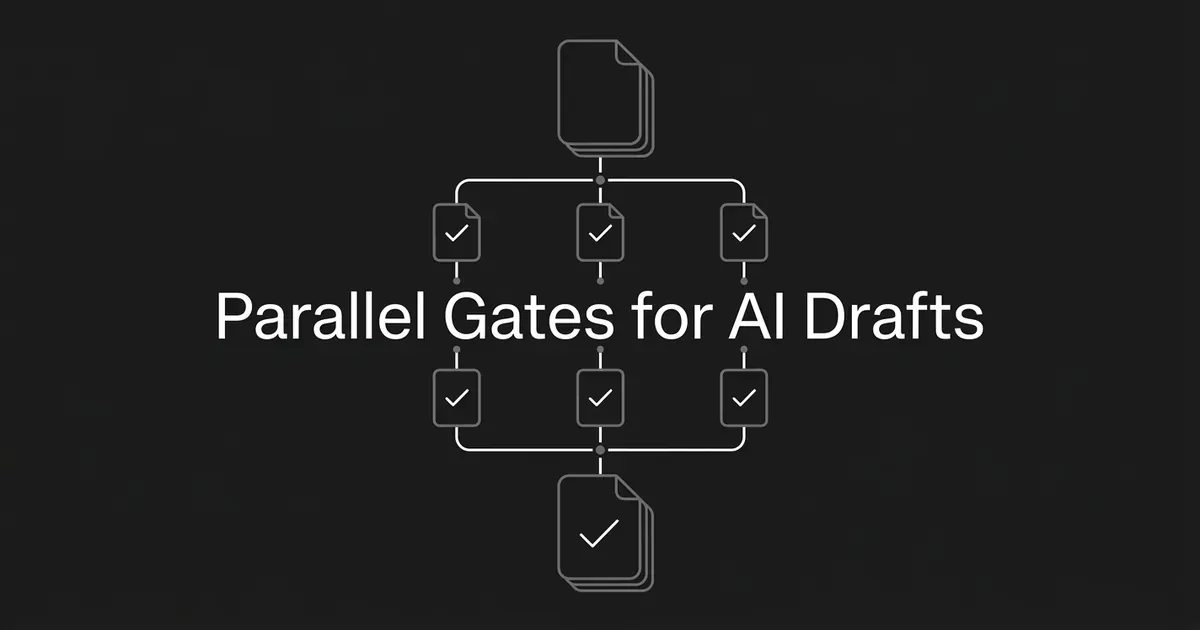
Once preflight passes, freeze one immutable review version and open every triggered gate at the same time. Legal does not wait for compliance. Brand does not wait for legal. They are answering independent questions, so make them independent lanes. These are your ai content approval gates, and running them concurrently is the single change that pulls weeks out of the calendar.
Each lane returns a structured decision, never a competing rewrite:
- Pass. No blocker in this lane.
- Pass with conditions. Named changes must land before release.
- Fail. A blocker prevents release.
- Evidence request. The owner must supply a source, a consent, or a factual answer.
- Not applicable. The lane was evaluated and is not required.
For legal review AI content lanes, keep the focus on exposure and interpretation, not line editing. Correct entity, product, offer, territory, audience, and terms. Objective and implied claims carrying their required support and qualifiers. Comparative, performance, safety, health, financial, and employment statements permitted and accurate. Testimonials, customer names, logos, likenesses, and quotations carrying rights, consent, and disclosures. Third-party text, data, images, and trademarks in an acceptable rights position. Personal data and cross-border processing with a documented basis. Disclosures conspicuous and placed as the applicable rule requires.
Compliance answers a different question: does this follow the applicable regulatory rule and our own written procedure? Classify the communication by audience, recipient count, channel, and product. Decide whether pre-use approval by a qualified reviewer is required. Check fair, balanced, non-misleading presentation. Check performance, testimonials, endorsements, ratings, fees, and risk language where the sector rule covers them. Then record the decision, the conditions, the approver, the date, and the exact version.
FINRA Rule 2210 is a useful example of how specific this gets. Correspondence there means a communication made available to twenty-five or fewer retail investors in any thirty-calendar-day period, retail communications need approval by a qualified registered principal before use, and a member in its first year must file retail communications published in electronic or public media at least ten business days before first use. FINRA's own guidance says AI-generated communications fall into those same classes depending on the recipients, and the firm stays responsible either way. Your sector rule will differ. The pattern of audience classification, risk-based prior approval, and records will not.
Brand governance AI drafts need is the third lane, and it protects identity without becoming a second legal review. Positioning, value proposition, product facts, and approved terminology accurate. Voice, tone, texture, and audience fit matching the brand context. Copy that does not sound generic or overconfident. Claims you make and avoid respected. Headlines, CTAs, comparisons, and visuals creating no new promise that legal has not seen.
Add privacy, security, subject-matter, and accessibility lanes only when the intake triggers them, and join them to the same parallel model. A hidden serial chain is still a serial chain.
How to tell it is done: every required lane has a named owner, a structured decision, and a timestamp tied to the same version. "Not applicable" is an explicit decision, never an empty queue.
Pro tip: make the lane contract explicit. Legal owns legal risk. Compliance owns regulatory adherence. Brand owns identity and voice. The content owner owns the editorial objective. Parallel review works when ownership is separate and adjudication is central.
Step 6: Merge issues through one controlled editing loop
Three lanes returning at once will produce conflicting comments. That is normal, and it is why one editor owns the merge.
Use a shared severity taxonomy so everyone means the same thing:
| Severity | Meaning | Release treatment |
|---|---|---|
| P0 blocker | Privacy exposure, fabrication, unsupported objective claim, prohibited content, wrong audience, missing approval or disclosure | Stop; resolve and re-run every affected gate |
| P1 material | Meaning-changing factual issue, material brand promise, unapproved comparison, evidence gap, disclosure change | Resolve before release; re-run the affected gate and preflight |
| P2 non-blocking | Grammar, clarity, or format that changes neither meaning nor risk | Merge under the owner's policy; do not reopen gates |
Write your re-review rules before the pilot, not during the first argument. Any model regeneration creates a new version and needs a new preflight. A change to a claim, number, qualifier, disclosure, offer, audience, territory, or visual meaning reopens every affected mandatory lane. A purely grammatical fix can stay with the editor. Adding or removing a section, CTA, comparison, or example needs an impact assessment. And never carry an approval from an old version onto a materially changed one without a documented decision.

Set service levels as internal operating settings and expect to tune them. A pilot might start with same-day handling for T0, one business day for T1, two for T2, and three for T3. Those are starting numbers, not benchmarks or deadlines. Give each lane a backup reviewer. Alert the owner at half the window, escalate at the breach, escalate again at twice the window. Cap work in progress so no reviewer carries an invisible pile.
Settle normal conflicts with a decision table instead of a meeting. A P0 or P1 blocker from legal review AI content lanes raised cannot be overridden by the editor. The accountable gate owner resolves it or formally accepts the risk. If legal and brand disagree on wording, keep the legal constraint and ask brand for a compliant equivalent. If compliance asks for evidence the owner cannot produce, remove or qualify the claim rather than asking the model to invent support. If reviewers disagree on tier, take the higher tier until the risk owner rules. Everything genuinely editorial goes to the content owner, with the rationale recorded.
How to tell it is done: one merged version, a change log, a disposition for every blocker and condition, and a precise list of which gates reopened.
Step 7: Release only the approved version and its evidence packet
Draft complete and approved for publication are two different states. Keep them apart, and put a release controller between them.
Before anything goes live, verify that the final render, headline, metadata, CTA, links, images, captions, and disclosures match the approved version. Verify that every mandatory gate is Pass, or Pass with conditions that are demonstrably closed. Verify that no P0 and no unresolved P1 remains. Verify that the claim ledger is complete, that privacy, rights, accessibility, and AI-use decisions are present, that the channel and territory and date match the approvals, that the release authority is allowed to publish this communication class, and that a rollback path exists.
Then retain the packet. It should hold the content ID, the final version with a hash or equivalent immutable identifier, the rendered artifact, and material prior versions. It should hold the owner, editor, gate owners, decisions, conditions, comments, timestamps, and approval dates. It should hold the risk tier, communication class, channel, territory, audience, and publication date. It should hold the model and template version where policy requires it, the source and claim inventory with evidence and expiry dates, the preflight results and issue dispositions, the disclosure and provenance decisions, and the post-publication history of corrections and complaints.
FINRA's record expectations show why a final PDF is not enough. The record covers the communication itself, the dates of use, the approving principal and approval date, and where applicable the preparer or distributor and the sources of any statistical or illustrative material. Retention periods are rule-specific, so do not invent one universal number for your whole enterprise.
Provenance tooling helps here without solving the whole problem. C2PA Content Credentials cryptographically bind a signed manifest describing origin, edits, tools used, and AI authorship, and a checking application can tell whether that record has been altered since creation. That is evidence of provenance. It is not evidence that a claim is true, lawful, or compliant.
If you need an emergency route, define it before the emergency. Name the authority, the narrow conditions, the required rationale, the maximum scope, and the post-publication review. A documented exception is fine. An informal bypass is how audits go badly.
How to tell it is done: someone who was in none of the meetings can reconstruct what was published, why it was allowed, what evidence supported it, and who approved it.
Step 8: Monitor the published content and improve the gates
The last step is the one that keeps the other seven honest.
Watch content risk first. Complaints, corrections, takedowns, regulator questions, customer confusion, near misses. Expired claims, changed prices, product updates, broken links, outdated disclosures, and shifting regulatory requirements. If AI search visibility matters to your business, also watch how AI engines repeat, distort, or omit your public claims.
Then watch workflow health, because an enterprise AI content review process nobody can service will quietly get bypassed. Track gate cycle time by tier and by lane, queue age, service-level breaches, review cycles per piece, rework causes, evidence-request rate, false-positive rate, and post-publication defect rate. Track the share of content with complete claim ledgers and complete approval packets.
Track queue age per gate, not only total time to publish. A healthy average can hide a legal lane that is stalled on exactly the high-risk pieces you most need moving.
NIST's AI Risk Management Framework, built around Govern, Map, Measure, and Manage, is voluntary and non-exhaustive by design, and it supports precisely this loop: test, monitor, document, and track errors and near misses. Use each incident to update your triggers, your preflight rules, your approved claims, and your reviewer training.
How to tell it is done: you can show trend data for queue time and content defects, every recurring failure has an owner, and the workflow actually changes when a near miss exposes a missing trigger.
Common mistake: measuring only publication volume. A faster queue that ships more unsupported claims is not a win.
What to do next
You do not need to roll your compliance content workflow out everywhere at once. Pick one content class, run it through the eight steps for a month, and measure two things: queue age by gate, and how often a piece comes back for rework. Those two numbers will tell you which triggers are too broad and which gate needs a backup reviewer.
Then fix the one worst gate. Just that one. Momentum matters more here than completeness, and the brand governance AI drafts need will tighten as you go.
The production half of this gets much lighter when your brand context, research, links, and metadata are built into the draft rather than added by a person afterwards. That is the part DeepSmith takes off your plate, so your specialists spend their time on judgment instead of formatting. You can start a free trial and see what a fully briefed draft looks like before it ever reaches a reviewer.