

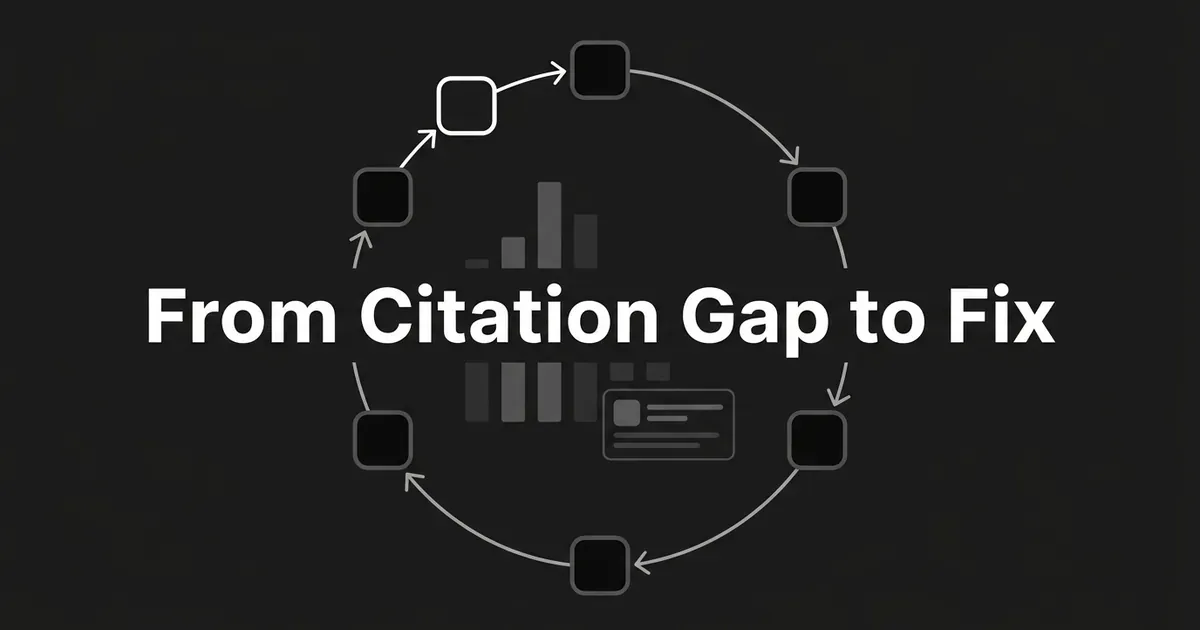
The citation gap to published fix loop is a repeatable process that turns a missing or competitor-won AI citation into an evidence-backed content change, publishes and verifies that change, and then checks comparable AI answers to decide what to improve next. If you have searched your core topic in ChatGPT or Perplexity and seen a competitor's page cited where yours should be, this loop is how you get from that one observation to a decision you can defend. A published fix is a hypothesis you have put live, and it is not proof that the gap has closed. Publishing finishes the production work, and remeasuring is what finishes the learning.
This guide walks through six stages in order: observe, diagnose, specify, produce, publish and verify, and reobserve. It focuses on what each stage hands to the next, because the handoffs are where most of these efforts quietly fall apart. The workflow is an editorial synthesis of documented search and measurement practices. No AI engine has published it as a ranking formula, and nobody can promise it will earn a citation.
What counts as an AI citation gap?
An AI citation gap is a monitored question or topic where your relevant pages are not cited, or are cited less often than a relevant competing source, within a defined set of observations. That is a working definition for planning, not a standard metric from any engine. The part that matters is "defined set of observations," because a gap only means something when you know which question, which engine, and which period you are talking about.
It helps to separate three things that often get blended together. A brand mention means the answer names your company or product. An owned-page citation means the answer links to a page on a domain you treat as your own. A third-party citation means the answer links to someone else's page. These can show up in different combinations for the same brand:
- The answer names you and cites your own guide, which is both a mention and an owned citation.
- The answer names you but cites an industry publication, which is a mention with outside attribution.
- The answer cites your educational page without naming your brand in the text, which is an owned citation without a mention.
Track these separately, since each one answers a different question. A mention-to-citation gap, where you are named but your pages are not used as a source, is a different problem from being absent altogether. It also helps to know how to tell citing from mentioning.
Two cautions are worth having in mind from the start, and the guide on what counts as an AI citation covers the first one in more detail. OpenAI says the Sources view in ChatGPT can include cited sources and other relevant links, so a careful process records which links were attached to the answer and which were just shown nearby. And one missing citation does not tell you that your page is poor, blocked, or unknown to the system. An answer might not use web search, might not show citations, or might pick a different source that day.
Choose questions you can defend
Start with the questions your buyers really ask, in the areas where you have real expertise. A tracked question is a point you chose to observe, and it does not prove that a certain number of people ask it.
Save the whole observation
When you see a gap, save the context along with the screenshot: the exact prompt wording, the engine, the date, the full answer text, the explicit citations and where they point, whether the brand was named, and the page on your site that should have answered the question. Note the language, location, and whether web search was on if you know them. These are recommended habits, and not every platform exposes every field.
Then open the cited page and read it next to your own. Does it give a definition yours never does? Does it have a checklist, an example, or a comparison that answers the question directly? You are looking for visible differences, and you should not treat them as proof of why the engine chose that source. One strong observation on a commercially important question can be enough to act on. Otherwise, repeat the check under similar conditions first. There is no validated rule for how many runs make a gap reliable, so use judgment and write down what you decided. A longer method exists for how to reverse-engineer why a competitor gets cited if you want one.
How does a citation gap become a content brief?
The saved question, the saved answer, the cited pages, and a comparison with your own page become a specific hypothesis about what to change, and the brief carries that hypothesis to whoever makes the change. This is the diagnose and specify part of the loop, and it is where many teams skip ahead, since writing a new article is only one possible response to a gap.
Diagnose before you commission
Here is how the common situations break down, and what each one points to.
| What you see | A reasonable response |
|---|---|
| No page of yours answers the question | Write a useful page, if the topic is relevant to you |
| A relevant page exists but leaves out the answer | Add the missing explanation, example, or evidence |
| The answer is there but hard to find | Make it clearer without removing the nuance |
| The page is outdated or wrong | Correct the facts and review the sources |
| The page cannot be reached or indexed | Send a technical fix to the owner |
| You are named, but another domain is cited | Improve a resource where there is a real gap in information |
| No search-based answer or citation appeared | Record it separately from a lost citation |
| Your page is complete and reachable but not cited | Keep the uncertainty and keep watching |
This is a decision aid and not a ranking of causes by how often they occur. The last two rows matter most for honesty, because some absences have no content fix, and inventing a rewrite to explain them wastes effort and muddies the next measurement.
From there you land on one of four moves. You can update an existing page when it already serves the same reader and the missing answer fits naturally inside it. You can create a new page when the question is truly distinct, and a keyword variation does not count. You can route a technical correction when access or indexing controls are the problem. Or you can take no action when the evidence is weak or you cannot give an authoritative answer. No engine has published these as requirements.
If you have several gaps, sort them by how relevant the question is to buyers, whether it keeps recurring, how sure you are about the deficiency, and how much work the change takes. Please do not invent a numerical score and call it a standard. A short ordered list with reasons is enough, and the walkthrough on which cited-prompt gaps to write first covers ordering in more depth.
Write the brief so it survives handoffs
A brief should carry the reason the work exists, and a generic topic title loses that reason by the time a writer opens it. A brief that holds up usually names the exact question and intent, what the answer did and what was missing, the target page, the specific deficiency, the change you are testing, the definition or example the reader needs, the evidence you can support, the owner and publishing checks, and the prompts and time window you will look at afterward. The guide on how to write a content brief covers the general craft.
Compare a weak hypothesis with a stronger one. The weak version says competitors are cited, so we need another article on the topic. The stronger version says the monitored question asks for an agency onboarding checklist, our current guide explains the concept but has no checklist, so we will add a usable checklist with its limits and then see whether the revised page starts appearing as a source for the same question. The second one names a visible deficiency, a specific change, and an outcome you can check.
DeepSmith's AI Visibility tracks mentions and citations separately and keeps the answer history for each prompt along with page-level citation information, so the observation stays attached to the question when it turns into a proposed change. Opportunity Agents can turn that evidence into content ideas with the reason attached, and platforms that track and write for AI search are one way to keep that record intact. They do not know the engine's private ranking logic and cannot guarantee the next citation.
What turns the brief into a publishable fix?
The page has to supply the missing information accurately and clearly, and covering the same keyword is not enough. This is the produce stage, and its test is simple: does the revised or new page now contain the answer the brief said was missing?
Add information, not filler shaped like a competitor
A competitor's citation is something to inspect, and it does not give you license to copy its wording or its unsupported claims. The goal is a page that is useful on its own terms. Good additions tend to be plain: a precise definition, a limit or exception that was missing, an explanation of when an approach applies, a worked example clearly labeled as an illustration, a checklist when the page's promise calls for one, better support for a claim you already make, or a correction to something out of date.
Google's guidance on helpful content values original information, expert involvement, and reliable facts, and it says that adding or removing content just to look fresh will not help a page. Originality does not require proprietary research. It can come from a clearer explanation or an honest example. What you cannot do is invent findings, customer results, or measurements. Microsoft's February 2026 publisher guidance recommends clear headings, tables, FAQ sections, examples, data, and cited sources, which supports writing clearly but does not establish a formula.
Review the substance
Before anything goes live, the reviewers should be able to confirm that the page contains the information the brief identified, that names, numbers, dates, and product claims are right, and that a reader can tell illustrative examples from real results. A subject expert should check operational claims, and the review should spend its time on whether the fix repairs the deficiency, since polishing the surface is the easy part.
DeepSmith's Content Studio covers the production side through New Ideas, Planned Content, and Produced Content, where you can review, edit, and publish. A finished draft does not tell you the visibility problem is solved.
When is the fix actually published?
A fix is published when the intended change is live and reachable, and access, indexing, and citation are three more checks that come after it. These are easy to treat as one event, so it helps to put them in order: draft complete, approved, live, accessible, discovered or recrawled, indexed where that applies, and finally observed as a citation.
Confirm the live page
A successful publish action only tells you that content was sent somewhere. The live page tells you what was delivered. So open the public URL instead of trusting the CMS status, check that the revised answer, tables, and links are really there, and write down the time and version. Confirm that the page does not sit behind a login or some other accidental restriction. That check still applies when an AI content tool with CMS auto-publish sends the post for you.
What the engines say about eligibility
Google states that a page is eligible for indexing when Googlebot is not blocked, the page returns an HTTP 200 response, and the page has indexable content. Those are the minimum technical requirements, and meeting them does not guarantee indexing. For links in AI Overviews or AI Mode, Google says the page must be indexed and eligible to appear in Search with a snippet, and that no extra technical requirements are needed. Being eligible still does not mean the page will be shown or cited.
OpenAI describes two separate crawlers. OAI-SearchBot is used for ChatGPT search, and GPTBot relates to content that may be used to train its models. A site can allow one and block the other, and how to configure robots.txt for AI crawlers walks through the setup. Sites that opt out of OAI-SearchBot will not be shown in ChatGPT search answers, and OpenAI says its systems can take about 24 hours to adjust after a robots.txt change. The OpenAI crawler documentation is explicit that placement is not guaranteed, so that interval is not a promise of a citation within a day.
In Google Search Console, the first URL Inspection result reflects the last indexed version, which is not necessarily what is live now. After a change, the live test fetches the current page, though it does not cover every indexing issue. The owner of a property can request indexing for a single page, but Google applies quotas and says repeated requests do not make it crawl faster. For many pages, Google recommends a sitemap, and its recrawl guidance says crawling can take a few days to a few weeks and may not result in inclusion. For the AI side, see how to get AI crawlers to recrawl updated content faster. IndexNow is another route. Microsoft describes it as a way to tell participating search engines when content is added, updated, or removed. It is not a command to every AI engine, and it does not guarantee a citation.
Publication, crawler access, indexing, and citation selection each need their own evidence, so check delivery before you try to interpret performance.
How does remeasurement close the loop?
You reobserve comparable questions and the page you changed, and then decide what the evidence supports doing next. This is the aeo content loop returning to its start, and it is the stage that turns a published edit into something you can learn from.
Keep the comparison fair
Go back to the same core prompts using the same collection method where you can. If the engine, language, location, or prompt wording changed, write that down. Do not swap hard prompts for easier ones. Choose your follow-up window before you look at the results, and leave room for discovery and recrawling without expecting a universal waiting period, since none is documented. Microsoft's June 2026 announcement describes comparing a current 30-day period against the prior 30 days, as one example.
Pick metrics with clear denominators
These are working definitions for this guide, and they are not claimed to match every analytics provider.
| Measure | How to calculate it |
|---|---|
| Answer-level owned citation rate | Answers with at least one owned-page citation divided by successful answers in the set |
| Answer-level mention rate | Answers naming the brand divided by successful answers in the set |
| Target-page citation rate | Answers citing the revised page divided by successful answers in the set |
| Query-specific citation share | Citations to the site divided by all citations across sites for the same grounding query |
The last row matches how Microsoft described Citation Share in June 2026, and its denominator is different from the answer-level rate, so the two should not be mixed in one chart. Be explicit about the counting rules too, such as which domains count as yours, and report failed collections separately instead of counting them as answers with no citation.
A worked example, with invented numbers
Every detail in this example is hypothetical. It is not a customer result, a benchmark, or a forecast.
Imagine a fictional workflow software company that tracks the question, "What should a small agency include in a client onboarding checklist?" In a baseline of 20 successful observations on one AI surface, its brand appears in 8 answers, but none of them cites an owned page, and a competing guide shows up among the sources. The company's own guide talks about the benefits of onboarding but never gives the checklist the question asks for. The brief says to revise that guide with a checklist, an explanation of each item, and clear limits. The writer adds the material, an editor checks the sources, a subject expert reviews whether the checklist fits real agencies, and the publisher confirms the revision is live and reachable. Later, in a comparable set of 20 successful observations, the brand is mentioned in 10 answers and the revised page is cited in 6.
| Measure | Baseline | Follow-up | Change |
|---|---|---|---|
| Owned citation rate | 0 of 20 (0%) | 6 of 20 (30%) | Up 30 percentage points |
| Mention rate | 8 of 20 (40%) | 10 of 20 (50%) | Up 10 percentage points |
A relative increase from a zero baseline is not meaningful, so use the percentage-point change. The team can say the revised page was observed as a source after publishing and that its rate rose within the sample. It should not say the revision caused a 30% lift, that every buyer now sees the page, or that the result will last.
Read results as evidence, not proof of cause
Many things move citation patterns. Microsoft names changing models, freshness signals, and competing content among the causes. OpenAI says ChatGPT search can rewrite a question into several targeted queries, so the prompt you see is not the whole retrieval process. Microsoft's Bing AI Performance report, announced in February 2026, covers Microsoft Copilot and Bing's AI-generated summaries, which is not every AI engine, and its grounding-query data is a sample. You can read the details in its Bing AI Performance announcement. A before-and-after rise fits with improvement, and it does not prove the edit caused it. A guide on how to re-measure a page after publishing a citation fix goes into baselines and intervals if you want to set that up carefully.
Where the loop usually goes wrong
Treating every gap as a request for a new article produces a backlog. Declaring success when the content reaches the CMS skips the live check. And rewriting again before you have interpreted the first change makes it hard to link any outcome to a particular revision. Do not call a gap permanently closed because one answer changed.
What to take from the loop
The loop does not end when a writer finishes an article or a CMS reports success. It turns an observed gap into a specific live change, and then uses the next round of evidence to decide whether to keep, refine, or replace the hypothesis. To close AI visibility gap with content, that is the order of work: know what is missing, change the page for a visible reason, confirm the change is live, and measure under the same conditions you started with.
A good way to try it is to take one question that matters to your business and trace it by hand, from the saved answer to a verified change and a follow-up check. If you would rather have the tracking, ideas, and production in one place while you do that, you can start a free DeepSmith trial.
Related guides
- How to Run a Weekly Track, Write, Publish Cycle With a Small Team: Run a weekly track, write and publish cycle with a small team by assigning roles, setting a fixed weekly rhythm, limiting work in progress and reviewing results before.
- How AI Search Changes What You Should Ask of a Content Platform: See how AI search shifts what to demand from a platform, such as grounded sources, answer-ready structure, citation tracking and freshness, compared with older keyword and ranking features.
- Are AI Agents Ready to Run Content Operations on Their Own?: Judge how much of content operations agents can run unattended today by separating tasks that work reliably, such as research and drafting, from those needing human approval, based.
- How to Submit New Articles for Indexing Automatically After Publishing: Automate indexing requests after publishing through sitemaps, IndexNow and the available Google options, and understand what each method does and does not guarantee about being crawled or indexed.
- How to Handle Canonicals, Slugs and Metadata in Automated Publishing: Set rules for canonical tags, slug formats, titles and meta descriptions in an automated pipeline, and check output for duplicates and conflicts before they turn into indexing or.


