You searched your brand in ChatGPT, saw your name in the answer, and felt a small rush. Then a doubt crept in. Did it actually cite you, or did it just say your name? That doubt is the right instinct, and learning how to tell if AI is citing or mentioning me is a skill you can build in an afternoon.
Here is the good news: you do not need a tool or a data team to figure this out. You need to know where each engine hides its sources and what a real citation looks like versus a plain name-drop. By the end of this guide you will have a repeatable, engine-by-engine routine you can run on any answer, on any day, in a few minutes.
Let's start by getting the difference straight, then walk it step by step.
The difference in one line
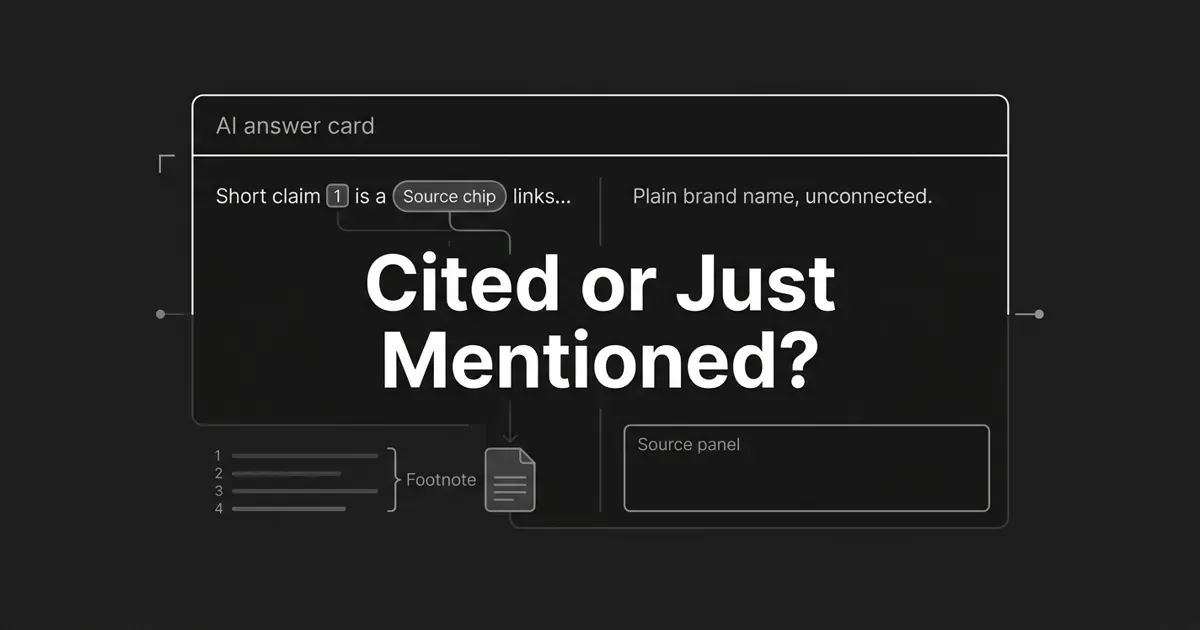
A mention is your brand name sitting in the prose. A citation is the engine pointing at one of your pages as the source of a claim, with something you can click: an inline number, a footnote, a source chip, or an entry in a sources panel.
That is the whole test. Name in the text with nothing to click? Mention. Name in the text and a clickable link back to your page? Citation. When you ask "is my brand cited or just mentioned," you are really asking one question: did the engine attribute a claim to a page you own, or did it just recognize you?
This matters more than it sounds. Industry analyses find that roughly 80% of brands sit in what people call the mention-source divide. The engines know them well enough to name them in an answer, but never link to their pages as sources. Only a small slice of mentioned brands, somewhere between 6% and 27% by most estimates, actually earn citations. So if you are getting named but not linked, you are normal, and you have a specific, fixable problem.
One more thing before the steps. Mention and citation are not either-or. A single answer can name you in the prose and link to your page. Your job is not to pick one label. It is to read both signals accurately. That is what good citation vs mention detection is. So every time you wonder how to tell if AI is citing or mentioning me, run the same test: a name in the text, or a link you can actually click.
Step 1: Build a starter prompt set of buyer questions
You cannot audit what you do not ask. So before you open a single engine, write down the questions your buyers actually type when they research your category.
What to do: list 10 to 30 prompts, each tagged by type. Cover four kinds. Brand-named ("What is [your brand] used for?"). Category-named ("What are the best [category] tools?"). Comparison ("[your brand] vs [competitor]"). And problem-to-solution ("How do I solve [the job your buyer needs done]?"). Mix in both directions too: ask the engine to list things it associates with your brand, and to list brands it associates with your category.
How to tell it is done: you have a simple spreadsheet with 10 to 30 prompts, each labeled by intent and funnel stage, and you can paste any of them into a fresh browser in under 30 seconds.
Where people go wrong: writing prompts that are too flattering to yourself. "Is [your brand] the best project tool?" almost forces the engine to name you, and it teaches you nothing. Buyer-leading beats brand-leading every time. The way you phrase a prompt shapes whether you get described or discovered, so build the set your prospects would actually use, not the one that makes you look good.
Pro tip: keep a few branded prompts anyway. They tell you how the engine talks about you when you are already on its radar, which is a different question from whether it finds you cold.
Step 2: Run every prompt through the five engines with web search on
Now you collect raw material. Same prompts, five engines, one sitting.
What to do: open a fresh incognito window, logged out, and run each prompt in ChatGPT, Perplexity, Gemini, Claude, and Google (AI Mode or AI Overviews). Turn web search on everywhere you can. Paste each raw reply into your spreadsheet in its own column, and note the date, the exact prompt wording, and the model version if it shows.
How to tell it is done: you have one row per prompt, with five replies side by side, all captured on the same day, with the source panels visible in your screenshots.
Where people go wrong: two mistakes, both common. The first is running while logged in. Personalization and memory bend the answer, so a logged-in reply is not the answer a stranger sees. Always use a clean, incognito profile. The second is auditing only ChatGPT. Perplexity and Gemini tend to cite far more aggressively on buyer questions, so a one-engine check misses your biggest citation opportunities.
This is the step where doing it by hand starts to feel heavy, and it is worth naming that. Running five engines against 30 prompts every week is real work. This is exactly the job DeepSmith's AI Visibility module was built for: it runs a defined prompt set on a schedule across ChatGPT, Perplexity, Gemini, Claude, and Google AI Mode, then stores the full answer history plus per-prompt mention and citation rates. Coverage rises by plan, from ChatGPT on the entry tier up to all five engines on Enterprise. You can still learn a lot by hand, and this guide keeps the method manual, but know that the repetitive part can be automated when you are ready.
Step 3: Label each answer mentioned, cited, both, or neither
Raw replies are noise until you label them. This is the heart of the whole routine, and it is where "is my brand cited or just mentioned" stops being a guess and becomes a label you can defend.
What to do: for each reply, run four quick checks in order.
- Body check. Does your brand name appear in the prose at all? If no, label it NEITHER and move on.
- Source check. Does any clickable element (an inline mark, a footnote number, a source chip, a link card, a sources-panel entry) point at your domain? If yes, that claim is CITED.
- Combined label. If the prose names you and a source points at you, label it BOTH.
- Capture the URL. When it is CITED, write down the exact URL the engine linked to. You will need it in Step 5.
How to tell it is done: every cell has a one-word label, and you can tally the results per prompt and per engine at a glance.
Where people go wrong: calling something CITED because it "looks important." Prominence in the prose is not attribution. The only test is a clickable link to a page you own. Watch the near-miss too: a competitor with a similar name, or a third-party article about you, is not a citation of you. Always read the actual source URL, not the brand name in the sentence. This is the discipline that makes citation vs mention detection reliable instead of wishful.
Step 4: Learn the citation signal for each engine
Every engine renders a citation differently, and the visual cue is the only thing you can trust. Learn the tells once, and you will be able to spot AI citation in answer panels in seconds instead of squinting.
ChatGPT
Look for clickable inline marks woven through the reply and a "Sources" button underneath that opens short snippets from each cited page. Those marks and that panel are your proof. Here is the catch: ChatGPT only shows sources after it runs a web search, and most turns do not trigger one. Roughly one in eight first questions pulls citations, and that likelihood drops fast the deeper you go into a conversation. So if there is no mark and no Sources entry pointing at your URL, your brand got a mention at most. Always audit the first turn of a fresh chat, because that is when citations are most likely to appear.
Perplexity
Perplexity is the friendliest to check. Look for footnote numbers like [1] and [2] right after a sentence, plus a numbered source list at the end with the matching URLs. Hover a number and it previews the cited paragraph; click it and the source opens. If your brand name sits in a recommendation list with no bracket attached, that is a pure mention. Worth knowing: Perplexity retrieves many pages but cites only three or four, so if you made the final list, you survived a heavy filter. Its source panel also leans on community sites like Reddit, so a "non-brand" looking panel is normal.
Gemini
Gemini shows a "Sources" affordance and related links below or beside the response, usually as chips. If a chip or link opens your page, that is a citation. If your brand appears only in the prose with no chip, it is a mention. The trap here is specific: Gemini often names your brand but points the actual source chip at a third party, like a review site or a wiki page, not your own URL. The sources list is the source of truth, not the wording. Sources also appear only sometimes, so an unsourced factual claim is a normal Gemini output, not a bug.
Claude
When web search is on, Claude shows inline citation marks that resolve to the source URL on hover or click. When web search is off, you get a brand-named answer with no attribution at all, same pattern as ChatGPT. Claude also tends to be sparing with citations, so if you see your name but no marks, do not assume a citation is hiding. It usually just did not run a search. Anthropic documents the underlying citation behavior in its API, where cited passages carry the exact source and text used, which is a good reference for how the model attributes.
Google AI Overviews and AI Mode
Look for a small source icon next to a claim, or supporting link cards beneath the AI snapshot. Hover or click the icon to see whether the URL is yours, a competitor's, or a third party. Google has been adding inline links directly onto words and phrases in AI Mode, and prefacing its source carousel with an AI-written blurb about each source. That blurb is where people get fooled: it can paraphrase your page while the actual link goes elsewhere. Confirm the clickable URL, never the description. Google's own help pages explain where these source links live in the layout.
Common mistake to avoid across all five: trusting the prose over the panel. The prose is what the engine says. The panel is what the engine attributes. They can disagree, and when they do, the panel wins.
If tracking each of these by hand across dozens of pages sounds like a lot, it is. DeepSmith's Pages view shows exactly which of your pages are being cited, each page's share of your total citations, and the prompts driving them, so you can skip the URL-by-URL tally when you would rather spend the time acting on what you find.
Step 5: Sort each citation by which page of yours got linked
A citation is not just a yes or no. Which page got linked tells you what kind of win you actually have.
What to do: for every CITED label, take the URL you captured and drop it into a bucket. A pricing or product page is the strongest, most buyer-ready signal. A comparison or "vs" page is your strongest competitive signal. Educational or how-to content means the engine trusts your topical depth. And a third-party article about you means the engine cited someone else's page that happens to name you. That last one is the mention-source divide in miniature: you have a mention inside their citation, not a citation of your own domain.
How to tell it is done: you can answer "which three of my pages got cited most this week?" in about a minute, just by scanning the URL column.
Where people go wrong: skipping this step because it feels tedious. It is the one step that turns watching into action. A brand cited only on its homepage is not really earning ground. A brand cited on a comparison page is winning the exact moment a buyer is choosing.
Step 6: Catch the false positives and broken citations
Not every clickable link is a real, verified citation. This step keeps you honest.
What to do: hunt for three patterns. First, a brand name in the prose with no source link or chip. That is a mention only, so do not log it as a citation. Second, a source URL that goes to a third-party page mentioning you. That is a citation of the third party, not of you. Third, and the sneakiest, a confident claim about your brand pointing at a URL that is wrong, dead, or does not actually say what the answer claims. AI has told people a product was discontinued when it only rebranded, and described features that do not exist. When the link 404s or the page does not support the claim, treat it as a broken citation, not a real one.
How to tell it is done: you have a separate column for broken or misattributed citations, and you can list them in seconds.
Where people go wrong: trusting the answer without clicking through. A clickable URL is a claim of a citation, not proof of one. The whole point of the routine is this habit: open the link and confirm the page really says what the engine says it says.
Here is the version of this problem that stings most: a competitor eating a citation that should be yours. DeepSmith's Competitors view shows who wins citations for your tracked prompts, on which exact pages, and how each competitor performs by engine, which is the fastest way to see that gap for what it is.
Step 7: Turn it into a weekly routine to check AI citation vs mention
One audit is a snapshot. A snapshot goes stale fast.
What to do: fold Steps 1 through 6 into a single weekly ritual. Same prompt set, same five engines, incognito, same labels, logged into one table with the date, the prompt, the engine, the label, and the source URL whenever it is CITED. Give it 30 minutes a week. After four weeks you can answer trend questions ("is my citation rate climbing?") without ever opening a dashboard, just by reading your own log.
How to tell it is done: a repeatable half-hour audit that produces a labeled row per prompt per engine, every week, with no engineering.
Where people go wrong: running it once and stopping. Cited sources churn quickly, with industry analyses estimating that a large share turn over every couple of weeks. Citation status also flickers. A brand shows up for a prompt one run and vanishes the next, which is why running the same prompt a few times beats trusting a single lucky result. A once-a-quarter check is already out of date by the time you read it.
Pro tip: run each prompt with web search both on and off. Off tells you what the model already believes about you from training. On tells you what it retrieves from the live web right now. Those are two different questions, and both are worth an answer.
What to do next
You now have a method to check AI citation vs mention on any answer, in any engine, on demand. Once you can spot AI citation in answer panels without stopping to think, the rest is just rhythm. That is the foundation. The next two moves build on it: tracking your citation rate over time so you can see the trend, and deciding which prompts are worth prioritizing so you spend effort where buyers actually are. Remember that a citation is a visibility signal first: even on Google, very few people click the link inside an AI summary.
If running this across five engines every week sounds like more than your week can hold, that is a fair reason to let software carry the repetitive part. You can start a free trial of DeepSmith and watch the full routine run itself across all five engines, so you spend your time acting on the gaps instead of hunting for them.
Take it one prompt at a time. You are closer to a clear answer than you think.