You searched your brand in ChatGPT, saw your name in the answer, and felt a little jolt of relief. Then you paused. Was that actually a citation, or just your name floating in a sentence? If that question has ever stopped you mid-scroll, you are in the right place, and the confusion is completely normal.
Here is the promise for the next few minutes. By the end, you will know exactly what counts as an AI citation, you will be able to name the near-misses that fool almost everyone, and you will have a simple three-question test you can run on any reference you see. No jargon spiral. Just a clean line between "yes, that counts" and "no, that is something else."
Let's draw that line.
What Counts as an AI Citation?
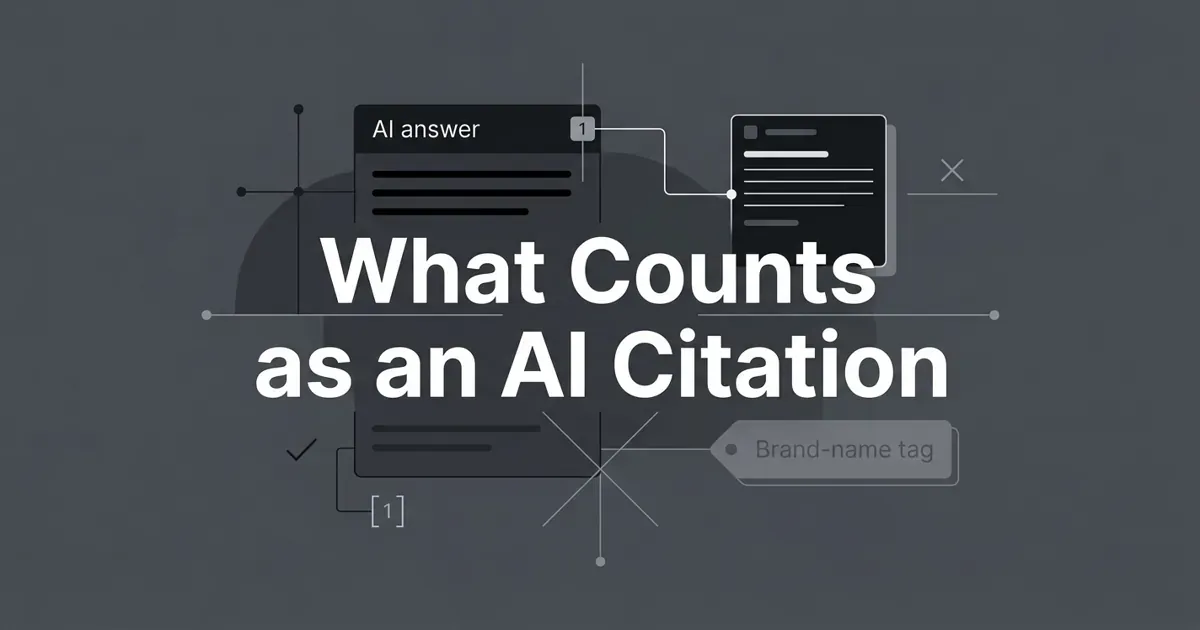
An AI citation is an explicit, attributed source that an AI engine credits for a specific claim in its answer. Think of it as the AI's version of a footnote. The engine tells the reader where a piece of information came from, and it usually makes that source clickable.
That is the whole AI citation definition in one sentence. If you want the short version to keep in your head: a citation credits a source, by name or link, for something specific the answer says.
The reason this AI citation definition is worth pinning down is that the word "citation" gets used loosely. Some people call any appearance of their brand a citation. Others reserve it for a linked footnote and nothing else. Neither habit is wrong, exactly, but they lead to very different conclusions about how visible you actually are. So we are going to use one strict meaning and stick to it, because a fuzzy definition is how you end up celebrating a mention as if it were proof.
Three things always travel together in a real citation. Miss any one, and it stops being a citation.
- Explicit attribution. The engine names the source. That can be a URL, a domain, a page title, or a numbered reference that actually resolves.
- Usually a link. The attribution is clickable, or it at least points to one specific real page you could visit.
- Tied to a specific claim. The source gets credit for a particular statement, not for the vibe of the answer as a whole.
When all three are present, you have an attributed source in AI answer output, and that is a citation. When one is missing, you have something else: a mention, a paraphrase, a training-data guess, or a broken footnote. We will name each of those in a minute, so you never mix them up again.
Good news: once you see the three attributes, you cannot unsee them. The rest of this piece is just practice.
What a Real Citation Looks Like
A citation looks different in every engine, but underneath, it is always the same three attributes doing the same job. You do not need to memorize each format. You just need to recognize the pattern.
Here is the quick tour, so the test later feels concrete.
In ChatGPT with web search on, citations show up as small inline markers or clickable links woven into the text. If you do not see inline markers, a "Sources" button sits under the answer and opens a panel of the pages it used.
In Perplexity, you get numbered references like [1] and [2] dropped right after the claim they support. Click a number, and it jumps you to the source.
In Google AI Overviews, small link icons appear next to sentences, plus a panel or carousel of cited pages you can expand.
Different wrappers, same signal. Every one of them is a clickable, attributed pointer from a specific sentence back to a specific page. That pointer is the thing that counts. Everything else is decoration.
One detail helps here: engines only cite a handful of sources per answer, not the whole web. Google AI Overviews typically credit somewhere in the range of three to eight sources per response, and Perplexity tends to name a similar small set out of the many pages it pulled. So a citation is a deliberate pick. When your page is one of them, the engine did not just brush past you, it leaned on you.
That is also why the ChatGPT citation vs reference question comes up so often. People see a "Sources" list and wonder whether every item is really crediting a claim, or whether some are just related reading. The honest answer to the ChatGPT citation vs reference puzzle is that the label on the button matters far less than whether that pointer exists, leads to a real page, and backs a specific thing the answer said.
The Near-Misses: What People Mistake for a Citation
This is the part that trips up almost everyone, so take a breath. None of these are failures on your part. They are just references that look like citations and are not. Once you can name them, you will stop miscounting your own visibility.
A reference only counts as a citation if all three attributes from earlier are present. Each near-miss below is missing at least one.
The brand name with no link
"Writesonic is one of the most popular AI writing tools."
Your brand is named. That feels great. But there is no link, no attribution to a source page, no credit for a specific claim. This is a brand mention, not a citation. It still matters for visibility, and it lives under its own topic, but it does not count here.
The paraphrase with no attribution
"Most AI engines now prefer short, structured content with clear headings."
True, and you could source it to dozens of places. The problem is that the engine did not name which source it leaned on. You cannot click through to check it. This is the single most common reason a brand thinks it is being cited when it is not.
The footnote to a different page
The engine claims something specific, then footnote 3 links to a generic article that does not actually contain that fact. There is a number, and the link even works. But the page does not back the claim. A real citation is an honest credit. A footnote that points to the wrong page is not one.
The hallucinated citation
"According to Smith et al. (2024), 64% of buyers prefer AI-assisted research."
The reference looks scholarly. You click, and you land on a 404, an unrelated article, or a paper that does not exist. Not a citation. It is a fabricated reference, and it is a documented failure mode across AI tools, not a rare glitch.
The training-data guess
"Based on common industry practice, the best time to post is Tuesday at 10 a.m."
The engine is pulling from what it learned, not crediting a source it just read. No source was offered, so you have no way to verify or visit anything. That implied, "trust me" reference is not a citation either.
The mention inside someone else's citation
This one stings, so I want to name it clearly. The AI cites a third-party article, and that article happens to mention your brand in passing. Your name appears on screen. But the citation points to their page, not yours. You are visible, and you are not credited. This is the everyday case, and it is the exact reason so many people ask, is it a citation or a mention.
The comparison-row mention
A "best tools" or "X vs Y" answer lists your brand in a row alongside competitors. No link on the row, no source credited for its claims. Mention, not citation. Common, and easy to over-count in your head.
There is one more subtle case worth naming, because it hides in plain sight. Some engines lean on their training data and phrase it as if it were sourced, without ever offering a link. That is implicit attribution, and by the strict definition we are using, it does not count. An attributed source in AI answer output has to point somewhere you can actually go. If it only gestures at "common knowledge," it is a paraphrase wearing a citation's clothes.
Notice the pattern. Every near-miss is missing attribution, a real link, or an honest match between the link and the claim. That is exactly what the test checks next.
And if reading through seven near-misses made you realize you have been over-counting your citations, that is not bad news. It is clarity. You would rather know your real number than a flattering one, because only the real number tells you where to put your effort.
The Three-Question Test
Here is the part you can actually use tomorrow. Run any reference through three questions. If every answer is yes, it is a citation. If any answer is no, you can name precisely what you are looking at instead.
Question 1: Is there attribution? Is there an explicit credit to a specific source for the claim, whether a URL, a domain, a page title, or a numbered reference that resolves?
If no, you are looking at a mention, a paraphrase, or a training-data guess. Stop here.
If yes, keep going.
Question 2: Is it linked, or at least linkable? Is the attribution clickable, or does it point to one specific real page you could visit?
If no, it is a brand mention. Stop here.
If yes, keep going.
Question 3: Does the source actually back the claim? When you click through or visit the named page, does it genuinely support what the answer said?
If no, it is a hallucinated or misattributed citation. It looks like a citation on screen, but treat it as not real.
If yes, congratulations, that is a citation.
Keep the footnote picture in your head. A citation is a footnote that points to a real page that backs the claim. Miss the footnote, point to nothing, or point to the wrong page, and it is not a citation, no matter how scholarly it looks. That mental model handles every edge case without you memorizing a single rule.
Not sure where to start applying this? Start with one prompt. Pull up an AI answer that mentions you, run the three questions, and label what you find. One reference. That is the whole first step.
Why the Confusion Happens
If you have been mixing these up, you are in very good company, and there is a clean reason why. Three different things all look like the AI "knowing" your brand, and they do not behave the same way at all.
- A mention is your brand name in the answer with no link and no source credit. It is reach. People see you.
- A citation is an explicit, attributed, usually linked source the engine credits for a claim. It is proof. The engine leaned on your page.
- A recommendation is a step further: an active endorsement that positions you as the option to pick. It implies the engine evaluated you, not just credited you.
Here is the twist that causes most of the head-scratching. An engine can use one brand's content as its cited source while naming a different brand as the recommendation. Your page can be the proof behind an answer that recommends your competitor. That gap is exactly why marketers track mention rate and citation rate as two separate numbers instead of one.
It also explains a feeling you may have had: "the AI clearly knows us, so why does it never point people to us?" Knowing you is a mention. Pointing to you is a citation. Recommending you is the endorsement on top. They can move in completely different directions, and a brand can be strong on one while quietly weak on the others. That is not a flaw in your content so much as a reason to measure each job on its own, rather than trusting a single gut impression from one screenshot.
You do not need to master all three today. You just need to know that when you ask, is it a citation or a mention, you are really asking which of these three jobs the reference is doing. Name the job, and the confusion clears.
One thing worth setting aside: citing an AI tool in an academic paper is a completely separate concept from an AI engine citing your brand. Different rules, different world. Do not let that overlap muddy your definition here.
When You Are Ready to Track This at Scale
Running the three-question test by hand on a few prompts is genuinely useful, and I want you to do it. That is real work, and it builds instinct fast.
The catch is that it does not stay small. Once you are checking many prompts, across several engines, and watching competitors too, the audit stops being something you can hold in your head between meetings. That is the point where a platform like DeepSmith's AI visibility tracking is built to absorb the repetition, separating true citations from mentions across engines so you are measuring the right thing instead of eyeballing screenshots.
But that is a later chapter. Today, the win is smaller and more important: you can look at any reference and know what it is.
The Line, in One Breath
Let's land where we started. A citation credits a specific source, by name or link, for something specific the answer says. Attribution, a real link, and an honest match between the two. All three, or it is not a citation.
Everything else you saw today (the bare brand name, the paraphrase, the mismatched footnote, the mention inside someone else's source) is a near-miss with a name. And now you know all of their names.
That naming is the real skill. Anyone can screenshot an AI answer and feel something. Very few people can look at the same answer and say, calmly, "that is a mention, that is a citation, and that footnote is broken." You can now do the calm version, and that steadiness is what keeps you from chasing the wrong wins.
You did the hard part already, which is caring enough to ask the question instead of celebrating a screenshot. Take that three-question test to your next AI answer and try it once. Momentum matters more than perfection here.
When you want to stop counting by hand and start tracking citations, mentions, and share of voice as a system, you can start a free DeepSmith trial and see your real data before you commit to anything.