You hit publish on the update. New numbers, a sharper answer, the outdated claim finally fixed. Then you ask ChatGPT, and it quotes the old version right back at you. Annoying, isn't it?
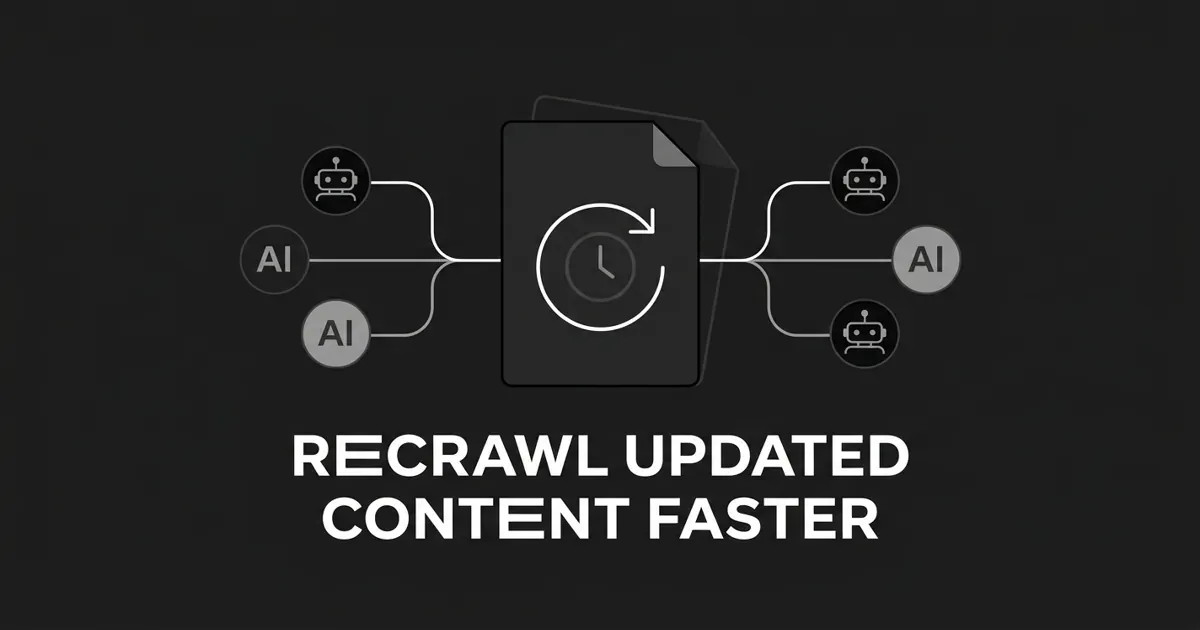
Take a breath. This is normal, and it is not a sign you did anything wrong. The AI crawler recrawl process runs on the engine's schedule, not yours, and no publisher can flip a switch to force it. What you can do is send the strongest possible "this page changed" signals, then set honest expectations for the wait.
That is what this guide is for. By the end, you will know which levers actually move an AI crawler recrawl, which ones are myths, and how to check whether the new version landed. Closing that update content AI search gap, the delay between your edit and the answer catching up, is the whole point. Let's make this feel doable, one step at a time.
Here is the honest truth first, so nothing later surprises you. No AI vendor publishes a guaranteed recrawl time. None of them sell a priority-recrawl tier for organic pages. When you update content AI search engines re-fetch on their own cadence, and anyone promising faster-than-that is selling something. Your job is to maximize the signals that make a bot want to come back sooner. That is a real job with real wins, and you have more control than you think.
Step 1: Know which crawler you are actually trying to reach
Before you touch anything, get clear on who you are talking to. "AI crawlers" is not one thing. There are three kinds, and they behave completely differently.
Training-data crawlers fetch pages to fold into a future model. GPTBot from OpenAI and ClaudeBot from Anthropic live here, along with Bytespider, CCBot, and others. They are batch-oriented and low-frequency. If your goal is to get GPTBot to recrawl a page so the next model knows the new facts, understand that this is a slow, model-training timeline you cannot rush. That is a different game from getting today's answer to change. Content that shapes model knowledge is worth building, and it works on the scale of months.
Retrieval and grounding crawlers are the ones that matter when you just updated a page and want the new version in the answer. OAI-SearchBot powers ChatGPT search. PerplexityBot builds Perplexity's index. Googlebot feeds Search, AI Overviews, and AI Mode. Bingbot feeds Bing, Copilot, and ChatGPT's search mode. These are the crawlers this guide spends most of its time on.
User-triggered fetch bots are the third kind. ChatGPT-User, Claude-User, and Perplexity-User only fire when a person does something that needs a fresh pull. There is no schedule to influence. Your only lever is making sure that when the request comes, it succeeds and returns the new content.
You will know you have this step right when you can name your target. Faster answers means retrieval crawlers. Long-term model knowledge means training crawlers. Two different clocks.
Where people go wrong: they treat GPTBot and OAI-SearchBot as the same thing, get frustrated that training data does not update instantly, and give up on the levers that actually work for retrieval.
Step 2: Push every changed URL through IndexNow
This is your single highest-leverage move, so start here.
IndexNow is a push protocol. When a URL changes, your site sends one notification, and every participating engine hears about it at once. It is the only direct, immediate "I changed this" signal that exists.
To use it, generate an IndexNow key (any hex string works), host it as a plain-text file at your domain root, then POST the changed URLs to the IndexNow endpoint. Most people never touch the raw API. Plugins for WordPress, apps for Shopify, and SEO suites like Rank Math and Yoast submit URLs automatically on publish and update. Turn one on and you are done.
Here is the part to be clear-eyed about. IndexNow notifies Bing, Yandex, Seznam, Naver, and Yep. It does not notify Google. It does not notify DuckDuckGo or Apple. Any tool that claims IndexNow "pings Google" is wrong. Even so, this covers a lot: Bing feeds Microsoft Copilot and ChatGPT's search mode, and many answer engines inherit Bing's discovery. In observed practice, Bingbot often revisits an IndexNow-pushed URL within minutes to a few hours. Nothing else you do is that fast.
You will know it worked when the endpoint returns a 200 status. A 403 means your key file is missing or does not match. A 422 means the URLs do not belong to the host you claimed.
Common mistake: re-submitting the same sitemap over and over and expecting it to act like IndexNow. It does not. Repeated sitemap submission does nothing on its own. Only a real push of a genuinely changed URL carries the signal.
Step 3: Keep your sitemap lastmod honest
Your sitemap's <lastmod> field is the most widely consumed freshness signal on the web. It is also the one people quietly break.
The rule is simple: only bump <lastmod> when the visible body actually changed in a way a reader would notice. A real edit to the copy, new data, a rewritten section. Not a template refresh. Not a whitespace change. Not a version bump nobody can see.
Why so strict? Because crawlers learn whether your lastmod is trustworthy. If they see it set to "now" on every URL every day, they conclude the field is noise and start ignoring it. Google's own sitemap guidance is blunt about this: an inaccurate date is worse than no date. That trust, once lost, takes months of honest values to rebuild. An honest lastmod on a page that truly changed is a clean, believable signal that pulls crawlers back sooner.
You will know you have this right when your lastmod dates map one-to-one with actual content changes, and pages you have not touched keep their old dates.
Common mistake: letting your CMS stamp today's date on every page at every render. This is the fastest way to train every crawler to distrust your whole sitemap. Check what your platform actually writes.
Step 4: Add a fresh internal link to the updated page
Here is a lever that costs nothing and needs no one's permission. Link to the updated page from a page crawlers already visit often.
Crawlers re-fetch pages they know about, on a rhythm. When they re-crawl your homepage, your blog index, or a popular article and find a new link pointing at your updated URL, that target gets re-encountered on the next pass. You have essentially put the page back in front of the bot.
Two patterns work especially well. A "recently updated" block on a high-traffic page, with the date visible. Or a contextual inline link inside a related article, with anchor text that names the updated content. Both are natural, both help readers, and both nudge the crawler.
This is exactly the kind of work that eats an afternoon when you do it by hand across a big site. A production platform like DeepSmith scans your enriched sitemap and places relevant internal links as it writes each piece, so a fresh internal link to a related update happens as a matter of course, not a manual chore. The point stands whether you automate it or not: an updated page with no fresh inbound links is easy for a crawler to overlook.
You will know this step is working when your updated URL is linked from at least one frequently crawled page, not stranded on its own.
Common mistake: the orphan page. A URL that only lives in the sitemap, with no internal links pointing to it, is hard to prioritize even when the sitemap lists it.
Step 5: Refresh your feeds and structured data
When your body changes, the machine-readable signals around it should change too. Two of them matter here.
Your RSS or Atom feed is a change-notification channel that feed-aware crawlers watch. Make sure the feed's <updated> or <lastBuildDate> reflects the real modification time, not the moment the feed was generated. Ship full text or long excerpts, not title-only entries, so a crawler gets real content to compare. Google has said publicly it uses RSS and Atom feeds to discover URLs, and Bing lets you submit feeds directly in Webmaster Tools.
Then update your structured data. The dateModified property in your JSON-LD and the article:modified_time in your OpenGraph tags should match the real edit date. This is the same discipline as your sitemap lastmod: accurate dates are a signal, invented ones are noise. Marking up your posts with proper Article schema gives every crawler a clean, explicit statement of when the page changed.
You will know this is done when your feed date, your dateModified, and your sitemap lastmod all agree and all point at the actual change.
Pro tip: keep these three dates in sync automatically. When they contradict each other, crawlers get mixed signals and lean on the most pessimistic one.
Step 6: Make sure the bot can actually read the new version
None of your signals matter if the crawler cannot see the updated content when it arrives. This is where a lot of quiet failures hide.
Most AI retrieval crawlers do not execute JavaScript. If your updated copy only appears after a client-side component renders, the bot sees an empty shell. Serve your primary content server-rendered in the initial HTML. If you run a JavaScript-heavy site, this needs deliberate attention so your pages stay visible to LLMs at all.
Check the obvious blockers too. A login wall or paywall the bot cannot pass means it never sees the new body. An accidental block is even more common: a "Block AI Bots" toggle, an over-aggressive firewall rule, or a robots.txt line that quietly disallows the very crawler you want citing you. Some AI bots also fail JavaScript challenges served at the edge, so a bot-protection setting can 403 them without you realizing.
You will know this is right when you can fetch your page as a plain HTML document and see the updated content in the raw source, with no bot-blocking rule in the way.
Common mistake: turning on a broad "block AI bots" setting for privacy, then wondering why the updated page never appears in AI answers. That toggle is an opt-out. If you want AI inclusion, it stays off.
Step 7: Keep your server fast, stable, and clean
Crawlers ration attention per site. A host that is slow or flaky gets less of it, which means your updated page waits longer in line. Faster, healthier origins earn more frequent visits, and a higher AI crawl frequency is exactly what you want here.
A few things move this. Keep your time to first byte quick, ideally well under a second for HTML. Avoid 5xx errors, because a spike can trigger a crawl-rate cooldown that lasts days. Support conditional requests: send proper ETag and Last-Modified headers so a crawler can ask "did this change?" and get a clean 304 Not Modified when it did not. That efficiency is what keeps a bot willing to check back often. Cap redirect chains at a single hop and keep your canonical URLs consistent, so no fetch is wasted. The same discipline runs through a solid technical SEO foundation for retrieval, and it is worth a periodic check.
If a bigger change is coming, like a site redesign, plan the crawl impact in advance rather than cleaning up after, because a migration can reset a lot of this hard-won trust.
You will know this step is solid when your logs show fast responses, few errors, and clean 304 replies for unchanged pages.
Common mistake: soft 404s. Returning a 200 status with a "not found" body wastes crawl budget and erodes trust. Use a real 404 or 410 for content that is gone.
Step 8: Promote the update so fresh links point at it
This lever lives a little off your own site, but it is real. A burst of new external links pointing at your updated URL is a strong recrawl trigger. It is the same mechanism behind rapid refresh on high-authority pages.
You cannot manufacture backlinks out of thin air, but you can create honest link velocity. Pitch the update to a newsletter that covers your topic. Post it where crawlers watch, like X, LinkedIn, or a relevant subreddit. Update the places that already reference the old version, an industry directory or a docs page, to point at the new URL. Each fresh, crawled link is another path back to your page.
You will know this is working when new referring links to the updated URL start showing up in your backlink or analytics tools within a week or two.
Pro tip: treat this as supplementary, not primary. It is slower and less certain than IndexNow or an honest lastmod, but on an important update it stacks nicely on top of them.
Step 9: Verify the recrawl landed, then check whether the answer changed
You have sent your signals. Now confirm the work actually happened, because "I updated the page" and "the AI answer changed" are two separate events, and the gap between them is where people lose the thread.
Start with your server logs. They are the source of truth. Filter by user-agent for GPTBot, OAI-SearchBot, PerplexityBot, ClaudeBot, Googlebot, Bingbot, and the rest, and look for a fresh fetch of your updated URL that returns a 200 with a real body size, dated after your change. That is proof the bot pulled the new version. Search Console and Bing Webmaster Tools help too: Google's URL Inspection lets you ask Google to recrawl a single URL, though the daily quota is small and it is a nudge, not a guarantee.
Confirming the fetch is only half of it. The other half is whether the new content actually changed what the engines say. Ask ChatGPT, Perplexity, or Copilot a question that should pull from the updated page, and read the citation and the quoted text. Is it the new version or the old one?
This is the part that is genuinely hard to eyeball across five engines and dozens of prompts, and it is where dedicated tracking earns its keep. Instead of manually re-checking, a tool like DeepSmith watches how AI engines answer the questions that matter in your space, tracks which of your pages get cited, and surfaces when a citation is still pulling stale content. That turns "I think the recrawl landed" into something you can actually see. Pair that with a periodic audit of your content for AI citations to find where a refresh is still needed. Watching your AI visibility metrics over time then shows whether the change moved anything.
One honest note for your sanity. Sometimes the bot has recrawled, and the answer still shows the old text. That usually means the AI service has its own cache layer, and you cannot manually refresh AI cache entries on demand. There is no button to refresh AI cache state inside ChatGPT or Perplexity from the outside. If your logs show a fresh 200 and the answer is still stale, the ball is in the engine's court, and the reasons your citations keep changing are worth understanding on their own.
You will know you are done when your logs confirm a fresh fetch and a downstream spot-check shows the new content in at least one AI answer.
What to do next
If this felt like a lot, here is the smallest version that still works. Turn on IndexNow so every changed URL gets pushed. Make sure your sitemap lastmod is honest. Add one fresh internal link to the updated page from somewhere crawlers visit often. Then check your logs in a day or two. That short stack covers Bing, Copilot, and many downstream answer engines, and it is most of the win.
Everything else on this list is a bonus you layer on for your most important updates. You do not need to do all nine today. You need to do the first three well, and know that the rest are there when a page really matters. Deciding which pages deserve that full effort is its own useful question, and the best gains usually come from a focused content refresh on pages that already have traction.
Want the tracking and production side handled for you, so you can see where AI answers cite you and close the gaps with on-brand content? You can start a free DeepSmith trial and watch your real pages and citations before you commit to anything.