If you're trying to decide whether your blog, social, and email should run on one strategy or three separate ones, here's the short answer. For most teams, an integrated content strategy should be the default. That doesn't mean posting the same thing everywhere. It means one shared plan decides why each piece exists, and each channel decides how to execute it.
Siloed content marketing, where each channel sets its own priorities and calendar with little visibility into the others, only makes sense when a channel genuinely serves a different audience, job, or publishing rhythm than the rest of your content. Even then, it should still share basic governance: brand rules, approved claims, and a view of what else is going out.
| Integrated strategy | Siloed strategy | |
|---|---|---|
| Strategic direction | One set of priorities and themes | Each channel sets its own |
| Editorial calendar | Shared, with channel-specific views | Separate calendars, reconciled by hand |
| Message consistency | One source of truth and approval path | Higher risk of conflicting claims or dates |
| Content reuse | Planned during ideation | Often discovered after publishing, if at all |
| Governance overhead | Higher upfront setup | Lower setup, higher ongoing cleanup |
Cross-channel content governance is the piece that makes either model work in practice, so we'll spend real time on what that actually looks like, not just which model wins.
What an integrated content strategy actually means
An integrated content strategy treats your blog, social, and email as connected parts of one plan, not three separate content businesses that happen to share a logo. The channels share a few things: the strategic goals and priority audiences you're writing for, the core themes and campaigns running that quarter, a calendar everyone can see, the claims and facts your team has approved to say in public, and a way to measure whether the whole effort is working, not just whether one post did well.
What integration does not require is identical copy, the same creative, or publishing everything on the same day. A blog article can go deep on an idea with examples and a full framework. An email to existing subscribers can summarize the same insight in three sentences and point them to the article. A social post might just pull out one sharp question from the piece and start a conversation. The message stays the same underneath. The packaging changes by channel, and that's the point, not a failure of coordination.
A good way to picture it: you start with one core idea, say, how a marketing lead can spot content gaps worth filling. The blog carries the detailed explanation and the framework. The email summarizes the insight for people who already read you and sends them to the deeper piece. Social pulls out a single diagnostic question or a point of view and invites people to respond. Then you look at how each piece performed and decide whether the topic deserves a follow-up article, an email sequence, or more social discussion. That's an integrated plan working the way it should: one idea, adapted three ways, with a feedback loop back into what gets planned next.
What siloed content marketing actually means
Siloed content marketing gives each channel its own plan, its own calendar, and often its own content pool that the other channels never see. Your blog team plans articles on its own timeline. Your social team pulls from a separate queue. Your email team schedules newsletters without much idea of what the blog or social calendars are doing that same week.
It's worth being precise about what makes something a silo, because specialization by itself isn't the problem. Having a social specialist who understands platform conventions, or an email writer who knows your subscriber list, is healthy in either model. What makes a channel siloed is whether it can make its scheduling and strategic decisions without a reliable view of what else the organization is planning, what's already been approved to say, and what could be reused instead of rebuilt from scratch.
Silos aren't always a deliberate choice. Sometimes they happen because each channel inherited its own tools and workflow years ago and nobody unified them. Sometimes a fast-moving team believes narrow focus makes them faster, and for a single task, it often does. The problem shows up later, when nobody can say with confidence what the blog, social, and email programs are each working on this month.
Where the two models actually differ
Consistency and the risk of conflicting messages
When each channel builds from its own content pool with no shared source of truth, you end up with real risk: different claims, different dates, different descriptions of the same product feature, showing up in different places at the same time. Cross-channel content governance reduces that risk by giving every channel one place to check what's approved to say and what the current facts are. Consistency here doesn't mean every channel sounds identical. A social post can be short and casual, an email can be more direct, and a blog post can be more thorough, all without contradicting each other on the facts.
Reuse and how much duplicate work you're doing
An integrated strategy exposes chances to turn one solid piece of research or one strong idea into several assets, without copying the same sentences into each one. The efficiency comes from reusing the underlying research, the expert input, and the approved claims, while still adapting the output for each audience. In a siloed setup, that reuse usually gets discovered by accident, if it gets discovered at all, because nobody was looking at the other channels' plans when they started writing.
Speed, and this one cuts both ways
Siloed planning can genuinely be faster for a single isolated task, since there's no shared calendar to check and no approval thread to wait on. But across a whole campaign, integrated planning is usually faster in the end, because the dependencies are visible up front instead of discovered late. A launch email that has to wait on a blog post that isn't finished yet is a coordination failure that a shared calendar would have caught weeks earlier.
Measurement and what you can actually learn
Integration makes it possible to ask a bigger question than "did this post get engagement." You can ask whether the article supported the campaign's goal, whether email readers actually clicked through to the resource, and whether the whole sequence moved the audience toward the action you wanted. In a siloed model, each channel's metrics tend to stay disconnected from the others, which makes it hard to explain why a campaign worked or didn't.
Where centralization backfires
Integration isn't automatically the safer choice. A unified calendar can turn into a gatekeeping system where a routine social post waits on the same approval process as a high-stakes product claim. That slows everyone down and teaches people to quietly work around the process, which defeats the purpose of having one. The fix is tiered governance: heavier review for anything regulated, high-risk, or reputation-sensitive, and lighter rules for the routine, low-risk work that already fits inside approved guidance.
Integration can also go wrong in a quieter way, by becoming format-blind. Not every channel needs the same treatment of an idea. A topic might need a long article for people searching for it, a short email for people who already trust you, and a discussion-starting post for social. Integration fails when it treats every channel as just another pipe for the same content instead of a different environment with its own conventions and its own reader intent.
When siloed planning is the right call
There are real situations where keeping a channel mostly independent makes sense. A channel that serves a genuinely different audience with a different need, one running on a publishing cadence too fast for a central review process, or one carrying legal or compliance constraints the rest of your content doesn't have, is a reasonable candidate for its own workflow. So is a channel you're testing as an experiment, where you deliberately want a bounded, separate effort before deciding whether to fold it into the main plan.
Even in these cases, full isolation isn't the goal. The channel should still see current brand guidance, know what's been approved to claim publicly, understand the major campaign dates coming up, and have a way to flag something important to the wider team. What actually works here is channel autonomy inside a shared operating system, not a complete information blackout where nobody on that channel knows what anyone else is doing.
The coordination cost, honestly
There's no reliable public benchmark that converts the coordination cost of an integrated plan into a specific number of hours saved, and this article isn't going to invent one. What's defensible is the shape of the tradeoff.
Integration asks you to pay costs upfront: agreeing on shared goals and themes, maintaining a calendar, deciding which choices are made centrally versus at the channel level, and holding regular planning check-ins. Those costs are visible, which is exactly why integrated planning can feel slower when you're setting it up.
Siloed planning defers those costs, but it doesn't eliminate them. It tends to create work that repeats: rechecking what other channels are publishing, reconciling conflicting dates and claims after the fact, redoing research that another team already did, fixing messaging that turned out to be inconsistent once it was already live, and combining separate reports by hand because there was never a shared view to begin with. None of this is a precise, universal number. It's a pattern of recurring cleanup instead of one-time setup, and it tends to grow as the number of channels and the volume of content grows.
A decision rule you can actually use
Four questions get you most of the way to a decision:
Does the content serve the same strategic priority or campaign as your other channels? If yes, plan it together.
Does one channel depend on another channel's content, timing, or claim? If yes, you need a shared calendar, not just good intentions.
Would forcing this channel through a shared process genuinely hurt its speed or relevance? If yes, let it keep its autonomy, but keep it inside shared governance.
Can your team actually explain what it plans to reuse, what it will adapt per channel, and how it will measure the result? If not, the current setup is probably under-governed, whichever model you're nominally running.
Put simply: high interdependence and high reuse potential call for a fully integrated strategy and shared calendar. High interdependence with low reuse still needs shared campaign governance even if production stays channel-specific. Low interdependence with high channel specificity is fine as channel-owned execution, as long as strategic guardrails still apply. Low interdependence and low reuse is the one place where lightweight, mostly independent planning is genuinely sufficient.

Building the shared calendar
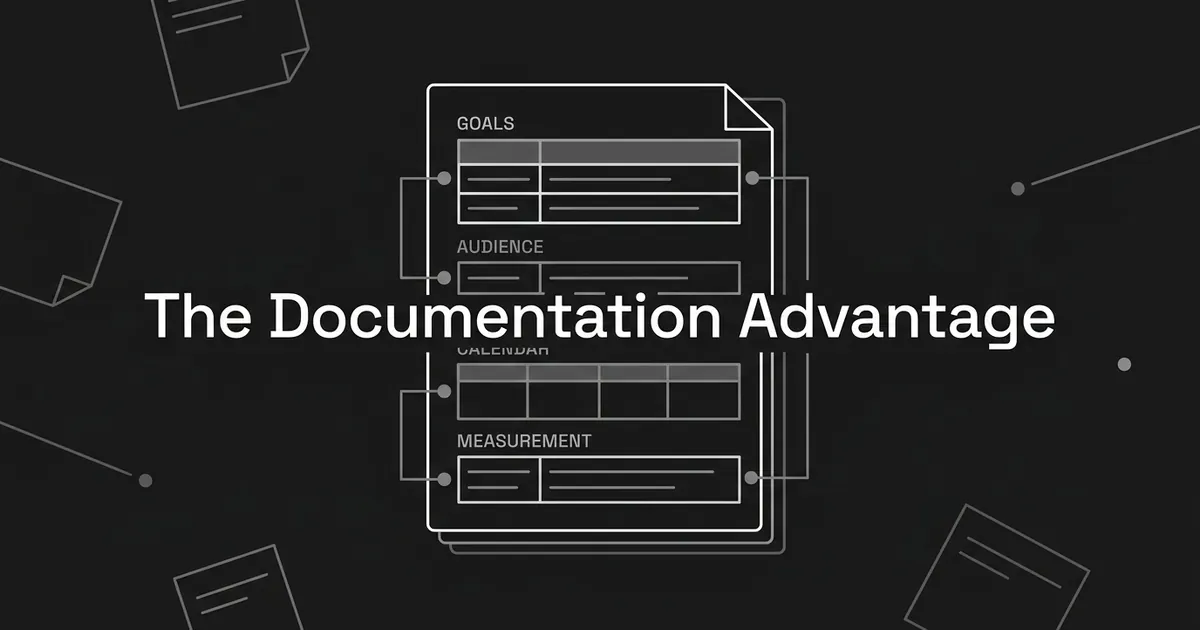
A shared calendar earns its name when it holds more than a title and a publish date. Useful fields include the working title and central topic, the strategic objective it serves, the target audience, the primary channel and any supporting channels, the core message, the owner, the current status from draft through published, key dates and dependencies, the assets it needs, the approved source material or claims backing it, and the distribution plan.
This can work as one strategic view with filtered channel views underneath it, rather than one flat spreadsheet everyone has to scroll through. The strategic layer covers quarterly themes and campaign priorities and gets reviewed monthly or quarterly. The production layer tracks weekly tasks, deadlines, and approval status, and that layer deserves a weekly or biweekly look. After a major campaign wraps, it's worth a separate review of what got reused, what got missed, and where the process itself created friction.
Governance rules worth writing down
Some rules genuinely belong at the shared layer: brand voice and terminology, how you describe your product or service, which claims need evidence or sign-off, your audience and persona definitions, and your version control and approval process. These are the things that, if two channels disagree on them, create real damage.
Other rules belong at the channel layer and should stay there: format and length, the specific creative treatment, cadence, audience segmentation, platform conventions, and channel-level performance targets. Trying to centralize these just slows channels down without protecting anything that actually needed protecting.
This distinction matters practically for teams using a system like DeepSmith to help manage content at scale: shared brand context, approved claims, and voice can live in one place that every channel-specific piece draws from, while the format and execution still flex per channel. The point isn't that software makes the governance decision for you. It's that a shared context layer makes it easier to actually keep the shared and channel-specific rules separate instead of them blurring together, which is where most governance breaks down in practice.
Whatever rules you set, write them down somewhere visible, and plan to revisit them. A governance framework isn't finished the day it's written. Your channels, tools, and content volume will keep changing, and the rules need to keep up.
If you want to see what that shared layer looks like running in practice, DeepSmith's free trial lets you set up shared brand voice, product facts, and approved claims once, then draw on them for every channel from there.