Your homepage says one thing, your LinkedIn another, and that last press release sounds like it came from a third company entirely. Sound familiar? If you're coordinating writers, freelancers, and a PR team all moving at a full sprint, you know that "update the brand guidelines" is a fantasy, not a solution.
We've all been there. Inconsistency isn't just messy. It's a tax you pay in trust and clarity every single time.
For years, I thought the problem was our brand guidelines. It wasn't. The problem was we didn't have a system. A dusty brand book in a forgotten folder can't create consistency when a deadline is breathing down your neck.
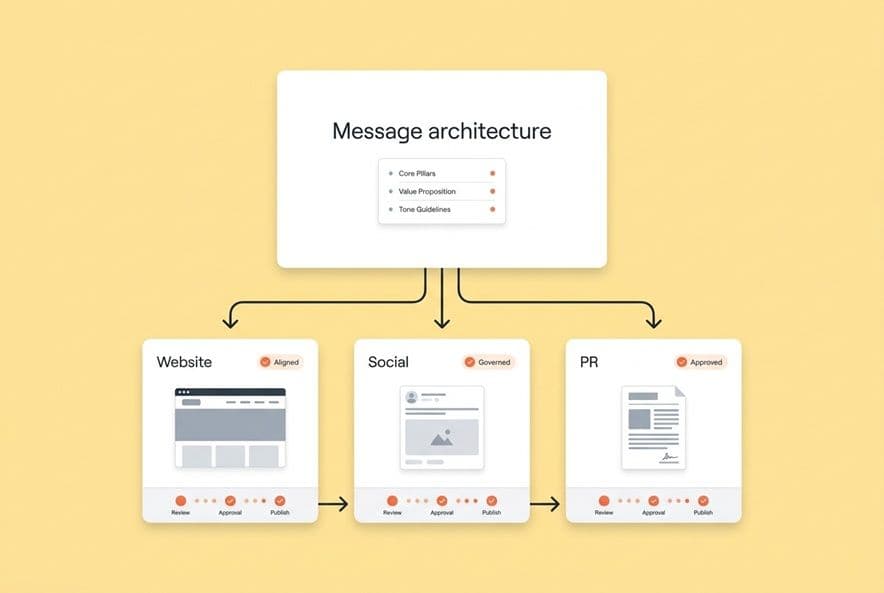
This is the practical alignment framework we built to fix it. It's built on three layers: a central message architecture, channel-specific translation rules, and a simple governance model. The goal isn't brand uniformity. It's brand cohesion. Same meaning. Controlled variation. Consistent trust.
What does "brand consistency across website, social, and PR" mean (and what it doesn't)?
Let's clear something up fast: consistency does not mean copy-pasting the same text everywhere. That's how you get a LinkedIn post that reads like a press release, or a homepage that sounds like a legal disclaimer. Nobody wants that.
Real brand consistency means one thing. A customer who finds you on your website, sees you on LinkedIn, and reads about you in a TechCrunch article should walk away with the same core understanding of what you do and who you are. The format, length, and tone will be totally different. That's the point.
The 3 layers of consistency: meaning, voice, and execution
I think of it in three layers:
- Meaning stays locked. Your positioning, your core value prop, your proof points. These don't move.
- Voice stays recognizable. Your personality, your perspective, your "this is how we do things" signal. It's present everywhere, even if it's dialed up for social or down for a formal announcement.
- Execution adapts by channel. A homepage headline, a tweet, and a CEO quote in a press release are completely different animals. They should be.
The mistake most of us make is trying to control the execution (which needs to be flexible) while leaving the meaning and voice totally undefined. You have to flip it.
Why PR is where consistency usually breaks first
We learned this one the hard way. Social is usually on-brand because one or two people own it. The website gets a review before anything goes live. But PR? That's earned media. It means third parties like journalists, analysts, and even your own agency reps are translating your story through their own lens.
And when they're working from a one-page press release and a 30-minute briefing, they fill in the gaps with their own interpretations.
Add speed to that mix. A news hook appears, your PR agency needs a quote in two hours, and whoever picks up the phone gives an answer that drifts just a little from your messaging. Six of those moments over six months, and your brand narrative has quietly shifted in ways you never intended or approved. It's a slow, silent killer of brand cohesion.
The practical alignment framework: Source of truth → channel translation → governance
This is where the real work is. It's three steps that connect into a single operating system.
Step 1 — Build a "message architecture" that every channel can pull from
A message architecture is not a tagline. It's a living document with five to ten core elements that every writer, PR contact, and agency can use to build content without reinventing the brand from scratch. It's your single source of truth.
At a minimum, yours needs:
- Core positioning statement (one sentence, for internal use): who you help, what you do, what makes you different.
- Value propositions (three to five): the specific outcomes you deliver, stated as claims you can back up.
- Proof points: the evidence behind each value prop. Think data, customer outcomes, or product capabilities.
- "Do say / don't say" list: specific phrases you always use and specific claims or framings you always avoid.
- Audience framing: a quick sketch of who you're writing for and what they care about.
This document only works if people actually use it. Consistency breaks when this critical context lives in scattered PDFs, old decks, and the founder's head (I was guilty of this for a long time). The best teams I know store this where it feeds into every workflow automatically. If you use an internal context layer (we use our own, DeepSmith's Deep IQ) to store positioning and personas, you reduce drift because every piece of content starts from the same approved inputs.
Step 2 — Create channel translation rules (so content is consistent, not copy-pasted)
Once you have your message architecture, you need a translation layer. This is just a set of rules that maps your core message to what it should look like on each channel.
Here's a simple channel translation matrix you can build for each of your top messages:
| Core message | Website (homepage/landing page) | LinkedIn post | Press release quote |
|---|---|---|---|
| We help SaaS teams close pipeline gaps with content | Headline: "Turn content into pipeline, not just traffic" | "We kept asking why our content was getting views but not demos. Here's what we found..." | "DeepSmith helps SaaS growth teams convert content programs into measurable pipeline." |
| AI-generated content that stays on-brand | "Every article starts from your company context, so voice and accuracy are built in, not edited in." | "We stopped rewriting AI drafts. This is the system that changed it." | "The platform enforces brand voice and claim boundaries across all outputs." |
The format changes. The core meaning doesn't. Build this out for your key messages, and you've got a reusable reference your writers and PR team will actually use.
Step 3 — Put governance around the system (so it survives scale, speed, and turnover)
A framework without ownership is just another document doomed to be forgotten. To make it operational, you need three things:
Owners: Who maintains the message architecture? Who approves new messaging pivots? Who handles the exceptions in fast-moving PR moments?
Approval tiers: Not everything needs the same level of review. Low-risk content (like standard social posts) can move fast. Medium-risk content (like product launch messaging) needs one sign-off. High-risk content (like crisis communications) requires your defined escalation path.
Refresh cycles: Commit to reviewing your message architecture quarterly. Proof points get stale and positioning evolves. Put a recurring event on the calendar and treat it like a product release.
Which brand assets and documents you actually need (minimum viable "brand system")
You don't need a 60-page brand bible. You need a tight, usable set of assets that someone on your team opens every single week.
The "must-have" set: brand standards, voice guide, messaging framework, PR boilerplate
- Brand standards: The visual identity layer, like your logo, colors, and typography. This is necessary but not sufficient.
- Voice guide: Your tone described in three to five adjectives, with "sounds like this / not like this" examples. Show, don't just describe.
- Messaging framework: Your message architecture from Step 1. This is the document most teams are missing.
- PR boilerplate: A single approved paragraph describing your company for the end of every press release. Review it quarterly.
The "nice-to-have" set: crisis playbooks, spokesperson Q&A banks, partner/influencer kits
Once the must-haves are locked, you can add these to level up:
- Spokesperson Q&A banks: Pre-written answers to common questions for fast, consistent exec responses.
- Crisis response templates: A holding statement and modular paragraphs you can assemble quickly.
- Partner/influencer kits: A brief telling collaborators exactly how to describe you and what not to say.
How to keep assets current without turning it into a quarterly rebrand project
Assign a single owner for each asset. Run a 30-minute messaging review every quarter where you compare your message architecture against what actually went out. Any drift you spot becomes a targeted update, not a full-blown revision project.
How to translate one message into website copy, social posts, and PR without losing the plot
The channel translation matrix in Step 2 is your core tool here, but a few principles make it work even better.
Build a channel translation matrix (table) for your top 5 messages
Start with your five most important messages. This usually means your main value prop, your key differentiators, and your top use case. For each one, write the web version, the social version, and the PR version side-by-side. The discipline of this exercise is incredibly clarifying. If you can't translate a message, it probably isn't clear enough to begin with.
Voice and tone: what stays constant vs what changes by platform
Your voice is your personality, and it stays constant. Your tone is how you dial that personality up or down for a specific situation. Here's a quick cheat sheet:
- Homepage: Direct, confident, and outcome-focused. No jargon. Use the first or second person ("you," "we").
- LinkedIn: Conversational, insight-led, and a little opinionated. Use short paragraphs and put the hook in line one.
- Press release: Credible, factual, and written in the third person. Let the quotes carry the personality.
The brand should feel like you across all three platforms, even though the formats are completely different.
The "claim boundary" rule: what you can say on social vs what you can put in PR
This one is a bigger deal than most teams realize. Social posts have a lower proof threshold. You can be opinionated, use informal framing, and speak to patterns you've noticed. Press releases, on the other hand, are public record. Journalists will quote from them. Analysts will cite them.
Build a simple rule: any quantitative claim in a PR piece needs documented evidence. Any competitive comparison needs a quick legal review. Any claim about customer outcomes needs either a citable reference or a qualifying phrase like "teams commonly report..." Put this rule in your governance document and make sure your PR agency has it.
How to keep brand consistency in real time (social moments, PR responses, and mini-crises)
This is the section most brand guides completely skip, and it's where inconsistency does the most damage.
Triage framework: low-risk, medium-risk, high-risk communications
Assign every content type a risk tier before the moment arrives, not during it.
- Low risk: Standard social posts, evergreen newsletters, FAQs. Use pre-approved language. No extra sign-off needed.
- Medium risk: Product announcements, media pitches, executive quotes, reactive posts on trending topics. Needs one sign-off from the brand lead.
- High risk: Crisis communications, major narrative pivots, anything involving claims about competitors or compliance. Requires brand, legal, and executive review.
This tiering system removes the bottleneck because 80% of your content will fall in the low-risk category and can move freely. The review layer is reserved for the 20% where it actually matters.
Pre-approved building blocks: statements, disclaimers, and "do-not-say" lists
Build a modular language bank. This sounds like more work than it is, since you're mainly documenting what you've already figured out. Include things like:
- Approved ways to describe your product category
- Standard responses to the three to five questions you get most often
- Phrases that are off-limits (like competitor comparisons you can't back up or superlatives without evidence)
- Approved language for common sensitive topics in your category
When a journalist needs a comment in two hours, your team isn't improvising. They're assembling from a kit.
Escalation paths and response SLAs (so consistency doesn't become a bottleneck)
Every governance model needs a response Service Level Agreement (SLA), or it will quietly die under deadline pressure. It can be as simple as this:
- Low-risk: no approval needed, just publish.
- Medium-risk: brand lead response within two hours.
- High-risk: requires three sign-offs, maximum four-hour window.
The specific numbers matter less than having them defined and communicated. When the window is clear, the urgency triggers the right behavior instead of causing people to skip the process entirely.
How to measure brand consistency across channels (KPIs + a lightweight audit cadence)
"It feels more consistent" is not a metric. Here's how to make this stuff measurable.
Consistency KPIs that work across website, social, and PR
- Message alignment rate: What percentage of your content hits the key messages from your architecture?
- Revision cycle reduction: Are your PR and social drafts requiring fewer brand alignment edits over time?
- Response time for brand-sensitive approvals: Are your medium-risk reviews hitting their two-hour SLA?
- Terminology consistency: Are you using your defined terms correctly across all channels?
A monthly "brand drift" audit you can run in 60 minutes
Once a month, grab 10-15 recent pieces of content from your three main channels. Read them back-to-back with your message architecture open. Flag anything that:
- Uses a claim or positioning phrase not in your framework.
- Sounds significantly different in tone from the other pieces.
- Makes a proof point that lacks an approved source.
Fix the top three drift patterns you find. Document them as updates to your "do not say" list or governance doc. This 60-minute audit, run monthly, will help you surface drift before it compounds into a real problem.
Where AI visibility fits into measurement (mentions, citations, and narrative control)
Here's a new dimension we've started tracking: how our brand shows up in AI-generated answers. When a potential buyer asks ChatGPT or Perplexity about a problem you solve, are they seeing your framing or your competitor's?
AI visibility is now a signal of brand consistency. There are tools for this (we built DeepSmith AI Visibility for ourselves) that let you track how often you're mentioned and cited across platforms like ChatGPT and Gemini. It gives you a feedback loop on whether your narrative is landing the way you intended or getting lost in translation.
How to scale consistency with more creators (freelancers, agencies, execs, and AI)
The framework only holds if it works for everyone who creates content for you, not just your core team.
Governance model: who owns what across content, social, PR/comms, and legal
Keep it simple. Assign clear lanes to avoid getting stuck in sign-off-by-committee hell.
- Brand lead (often a content or marketing director): Owns the message architecture and voice guide. Has the final say on messaging pivots.
- Social lead: Executes the channel translation for social media. Owns the modular language bank for their channel.
- PR/comms lead: Owns press materials and spokesperson guidance. Coordinates with the brand lead on any narrative changes.
- Legal/compliance: Is a review trigger for high-risk communications only. They should not be in the daily workflow.
AI workflow: how to use AI while enforcing voice, messaging, and claim boundaries
If you let them start from a blank prompt, AI tools will produce generic content that drifts from your brand. The fix is to give them structured inputs, not just edit the output after the fact.
We found a multi-step pipeline is much safer than one-prompt drafting because each stage has a defined checkpoint. This is the logic we built our Content Studio on. The pipeline runs from research and briefing through drafting and QA, with a final humanization pass, all grounded in the context stored in our system. That's how we get AI-generated content that doesn't require a full rewrite to sound like us.
Partner/influencer/UGC consistency: how to shape narratives you don't fully control
Sending a style guide to a partner doesn't work. We tried. What does work is sending a one-page brief with three approved descriptions, two example posts, and a short list of what not to say. Build usable partner kits, give them the exact language they can reference, and ask for a quick review before they publish. You can't control every word, but you can control the inputs they start with.
If you struggle with repurposing content, a good system can help. We built an Agent Library that generates channel-specific variants from any published article (like LinkedIn posts or newsletter drafts) in our brand voice. This helps us keep things consistent without extra work.
Build your cross-channel consistency system (and make it runnable)
Here's what to do this month to get started.
Week 1: Write your message architecture. Get the positioning statement, three to five value props, supporting proof points, and a "do say / don't say" list on paper.
Week 2: Build a channel translation matrix for your top five messages. Write the web, LinkedIn, and press quote versions side-by-side.
Week 3: Define your governance model. Figure out who owns what, your approval tiers, and your response SLAs. Share it with your PR agency and freelancers.
Week 4: Run your first 60-minute brand drift audit. Find the top three drift patterns and fix them.
Then, set a quarterly reminder to review the message architecture and a monthly reminder for the drift audit. That's the whole system. Not a rebrand, but a repeatable process that actually works.