You published the article. It was good. Then it sat there, and the LinkedIn post never happened.
That gap between publishing and distributing is almost never a discipline problem. It is a missing workflow. Content repurposing with AI closes that gap, as long as you build the workflow before you open the prompt box.
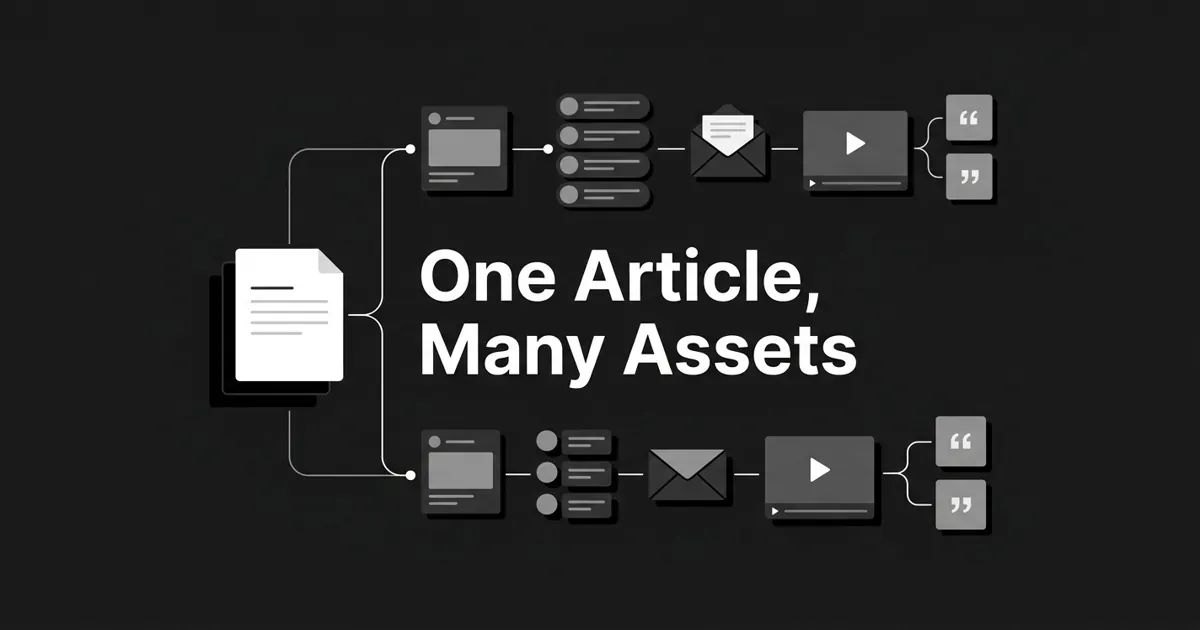
Here is the short version. Lock and refresh the approved source, break it into atomic ideas, write down your brand and channel rules, generate each format separately with the source attached, fact-check every asset, then save the whole thing as a playbook. The central idea stays the same. The wording, structure, length, and CTA change for every channel. That is what one article many assets means.
By the end you will have a repeatable repurposing workflow that turns one published article into a reviewed batch. You repurpose blog into social posts, an email section, a video script, and snippets that still sound like you.
One honest note first. This guide stops at a clean handoff. It does not cover when to post, how often, or how to measure.
What you need: one published article you are happy with, its current approved text, and about half a day for the first run.
Step 1: Lock and refresh the approved source
Content repurposing with AI is only ever as good as the source you feed it. So build a small source record before you write a single prompt.
Write down the article title and a working ID, the approved text or a clean export, the publication and last-review dates, the intended reader, and the central thesis in one sentence. Add the primary call to action and a canonical link placeholder.
Then add the two lists that do the real work. First, claims that must not change: figures, dates, product details, customer results, quotations. Second, anything needing a rights check, plus anything out of date or ambiguous.
Read the article once as an editor, not a prompt engineer. Fix or cut stale material now. Mark anything disputed as NEEDS REVIEW and keep it out of the batch.
Pro tip: add a "do not invent" section to the source record. List unsupported statistics, unapproved claims, competitors you never name, and phrases your brand does not use. That beats telling a model to "be accurate."
You are done when there is one source-of-truth copy, every high-risk claim has an owner or a verification status, and you can trace the batch back to the exact version used.
Where people go wrong: handing a model a URL and assuming it fetched the current page. Repurposing a superseded article because it performed well two years ago. Letting the model fill in a product detail nobody approved.
Step 2: Atomize the article into a traceable idea map
Ask AI to analyze the article before you ask it to write anything. That one reorder changes everything downstream.
AI content atomization is the deliberate breakdown of one strong source into its smallest useful units of meaning, each still tied to the passage it came from. Each atom carries one claim, lesson, example, definition, or step.
Build the map as a table:
| Field | What to capture |
|---|---|
| Atom ID | A short identifier such as A1, A2, A3 |
| Source passage | Section reference plus the exact supporting text |
| Message | The one claim, lesson, example, definition, or step |
| Audience problem | The reader friction this atom addresses |
| Proof | Data, example, explanation, quote, or product fact |
| Caveat | The qualification or exception that travels with it |
| Possible formats | LinkedIn, X thread, email, video, snippet, or none |
| Risk | Low, medium, or high |
| CTA role | Learn, compare, try, reply, or no CTA |
Ask for the central thesis, the major claims, definitions, steps, examples, objections, memorable lines, data points, caveats, and the original CTA. Do not force a number. A short article may give you three strong atoms. A dense guide gives more.
The extraction prompt that works looks like this:
You are an editorial content strategist. Analyze the approved source
below before writing any derivative assets. Return one row per atom
using the fields above: atom_id, source_passage, message, audience
problem, proof, caveat, possible formats, risk, cta_role.

Rules:
- Use only information present in the source.
- Do not create statistics, examples, quotes, customer results, or
  product claims the source does not support.
- Preserve qualifiers, dates, units, and conditions.
- Split compound paragraphs into separate atoms.
- Mark an item NEEDS_REVIEW when the source is unclear or stale.
- Do not write social posts yet.

### APPROVED SOURCE
{{paste the current article text here}}
You are done when every planned asset points to one or more atom IDs, every factual sentence traces to an exact passage, and the map has flagged the ideas that should not be repurposed at all because they lean too hard on context.
Where people go wrong: asking for "ten social posts" before finding the article's actual ideas. Merging a source claim and an AI suggestion into one row. Dropping a caveat because it made the short version less punchy.
How much range is possible? The Content Marketing Institute documented a case where one newsletter article became ten different pieces over two years: three blog posts, three podcasts, a presentation, a board game, an infographic, and a quiz. The board game alone took sixteen months. Read that as range, not a quota. Nothing says your article owes you ten assets.
Step 3: Write the brand voice card and the channel contracts
Now tell the model what stays the same and what changes. Two documents, kept separate. That separation is what stops your voice drifting while your formats flex.
The brand voice card covers audience and expertise level, point of view and pronouns, tone range, sentence rhythm, words and claims to use, words and claims to avoid, product naming rules, approved proof points, and CTA style. Two or three approved examples help more than another adjective.
Adjectives are where most voice briefs fail. "Sound authoritative" gives a model nothing. "Use short sentences, name the reader's problem in the first two lines, explain one mechanism before recommending a tool, end with one clear next action" gives it something to follow. Brand consistency across channels is a translation problem, not a tone problem.
The channel contract is one row per asset: audience, job, source atom IDs, format, working length, structure, CTA, production notes, prohibited moves. Here are house settings to start from.
| Asset | House setting | Adaptation rule |
|---|---|---|
| LinkedIn post | One idea, 80 to 180 words, four to six short paragraphs | Open on a specific tension, add the insight and a point of view, one CTA. Never paste the article intro. |
| X thread | Five to seven posts, up to about 270 characters each | Post one states the promise, each middle post carries one atom, the last summarizes. Every post stands alone. |
| Newsletter section | Three subject lines, one preview line, 100 to 180 words of body | Lead with the reader's problem, give one insight, one next step. |
| Short-video script | 30 to 60 seconds, 90 to 150 spoken words | Hook, promise, two or three beats, on-screen text, visual direction, closing CTA. |
| Standalone snippets | Three to five, one or two sentences each | Each makes sense without the article. Name the subject, keep the qualifier. |
Treat these as defaults, not platform law. X's help documentation describes a typical 280-character post alongside a longer format reaching up to 25,000 characters, and access varies by account. A 270-character house buffer beats hard-coding a limit into your prompts. Check current limits at publishing time.
If you already run DeepSmith, this is what Deep IQ is for. Your company, product, persona, brand voice, and content types live there as structured context, so the same rules reach every asset instead of being rebuilt in a one-off prompt. The model still does not read your mind. It stops starting from zero.
You are done when every planned output has a channel job, its source atoms, a length budget, a structure, a CTA rule, and a voice rule.
Where people go wrong: one master prompt that says "make this social" for all five channels. Treating LinkedIn, X, email, and video as interchangeable containers. Writing "fairly short" instead of a range.
Step 4: Generate each asset as a channel-native draft
One format at a time. Same source, same idea map, same voice card, same channel contract. Most teams repurpose blog into social in one giant mixed request, and get five versions of the same mediocre post back.
Use a controller prompt that stays constant, then swap the channel module.
You are adapting an approved article into one channel-specific asset.

JOB
Create the requested asset for the named audience and channel. Preserve
the source's meaning, evidence, qualifiers, and point of view. Make it
useful when read without the full article.

HARD RULES
- Use only the source article and the approved brand-context block.
- Do not invent facts, figures, dates, quotes, customer results,
  product capabilities, or competitor claims.
- Keep every material caveat attached to the claim it qualifies.
- If a point is unsupported, write NEEDS_REVIEW instead of guessing.
- Do not copy the article's paragraphs or generic introduction.
- Use the brand voice rules and the channel contract exactly.
- Return the article link and CTA as placeholders.

RETURN
1. Draft asset.
2. Source atom IDs used.
3. Claims needing human review.
4. Visual or production notes.
5. CTA and link placeholder.

### BRAND VOICE CARD
### CHANNEL CONTRACT (one row)
### IDEA MAP (relevant atom rows only)
### APPROVED SOURCE CONTEXT (the passages this asset needs)
Then add a small channel instruction on top, without touching the source rules:
- LinkedIn: generate two hook options, pick the clearer one, build one post around one idea. No article summary, no unsupported benefit list.
- X thread: five to seven numbered posts. Post one is useful even if they stop there. One idea per post, qualifiers intact.
- Newsletter: three subject lines, one preview line, one short section. Lead with the recipient's problem. One action, one link placeholder.
- Short video: return a table of time, spoken words, on-screen text, visual or b-roll, and atom ID. Rewrite for speech. Captions and on-screen text belong in the brief, not as an afterthought.
- Snippets: five alternatives, each labeled with its atom ID, standalone copy, and intended use. Reject anything that needs the previous paragraph.
OpenAI's own prompting guidance points the same way: put instructions before the source, separate instructions from source material, specify context, outcome, length, format, and style, and replace vague length words with measurable ones. Apply that to every format and your drafts stop wandering.
Working inside DeepSmith, this step happens in context. Every finished article arrives with social posts already written, and the Apps Library turns it into platform-native versions for LinkedIn, X, Medium, Substack, newsletter email, Reddit, and more, inside the same production pipeline. It runs the generation step. It does not replace the review that comes next.
You are done when each output is labeled by channel, uses only its assigned atoms, follows the house length and structure, carries a link placeholder, and reports unresolved claims instead of filling gaps silently.
Where people go wrong: generating everything from a summary instead of the source and the atom map. Letting a model write a video script as an article with stage directions bolted on. Accepting a fluent first draft without checking traceability. Fluent and true are different tests.
Step 5: Review for facts, voice, rights, and channel fit
AI can preflight the batch. A human still owns approval. Run the checks in this order, because a wrong sentence survives any review that starts with polish.
Traceability. Mark every claim as source-supported, approved brand context, needs review, or remove. Compare numbers, dates, units, names, quotes, and qualifiers against the source record. If a derivative added a claim, find support or delete it.
Meaning. Does the shortened asset still mean what the article meant? Watch for false certainty and a conclusion stronger than the source. Shorter is not automatically better. Cut repetition before you cut the condition that made a claim accurate.
Voice. Read it aloud. Strip generic AI phrasing, hype, and repetitive sentence patterns. Voice is not only vocabulary. It is what you choose to emphasize, qualify, and leave out, which is one of the signals readers notice before any detector does.
Channel. Does the LinkedIn post carry one clear viewpoint? Does each X post stand alone while the sequence still progresses? Does the newsletter opening earn a subscriber's attention? Does the script sound natural spoken? Would a snippet make sense with no article beside it?
Rights and privacy. Confirm permission for customer material, third-party quotes, screenshots, and visuals. Permission for the article does not extend to everything inside it. Keep confidential information out of AI systems unless there is an approved process.
CTA and handoff. One next step, approved in the brief. Keep an [ARTICLE LINK] placeholder until the publishing owner supplies the real destination. No guessed URLs.
Here is a QA prompt worth saving:
Audit these derivative assets against the approved source and brand card.
Return a table with: asset, line, source atom, exact support, status,
risk, required edit. Statuses: PASS, NEEDS_EDIT, NEEDS_REVIEW, REMOVE.

Flag invented facts, altered numbers, missing qualifiers, unsupported
product claims, unattributed quotes, rights-sensitive material, generic
AI phrasing, and CTAs not in the brief. Explain every flag.
Do not rewrite silently.
Common mistake: approving a whole batch because the first asset was good. Batch generation repeats one wrong interpretation across every channel. Check the atom map and one asset from each format before signing off on the rest. Knowing when to edit an AI draft and when to start over is a skill you build fast here.
On disclosure, some nuance helps. AI assistance is not a quality failure by itself. Google's guidance on AI-generated content focuses on people-first usefulness, originality, accuracy, and clear authorship where readers would expect it. Follow your own policy where one exists.
You are done when a human has approved or removed every asset, no NEEDS_REVIEW items remain, and no rights question is still open.
Step 6: Package the batch into an asset manifest
Do not hand a publisher a folder of unnamed drafts. Build a manifest. It is the bridge between production and distribution, and it takes ten minutes to fill in.
| Field | Required value |
|---|---|
| Source article | Article identifier and version used |
| Asset ID | Stable ID for each derivative |
| Channel and format | LinkedIn post, X thread, newsletter, video script, snippet |
| Audience and job | Who it serves and what it helps them do |
| Source atoms | Atom IDs used |
| Draft | Final approved copy or script |
| Visual notes | Image, carousel, b-roll, captions, design direction |
| CTA | Approved next action and destination placeholder |
| Rights status | Original, licensed, permission confirmed, or n/a |
| Review status | Approved, owner, date, plus any open issue |
Package each format the way its producer needs it. A video script travels with spoken copy, on-screen text, scene direction, and caption guidance. A thread travels as separate labeled posts, not one paragraph.
You are done when someone else can pick up the manifest and know what each asset says, why it exists, which passages support it, and who approved it.
Where people go wrong: files called social-final-final-2. Stripping atom IDs during editing. Treating a visual brief as permission to reuse an image.
Step 7: Save the workflow as a playbook you can rerun
The first batch is the expensive one. Everything after it gets cheaper, but only if you save the parts you would otherwise rebuild.
Keep the source-record template, the atom-map schema and extraction prompt, the brand voice card, the channel contracts, the controller prompt, the QA prompt, the manifest, and a short list of the corrections your editor keeps making.
That last list is the most valuable thing on the page. When you fix the same problem three times, the prompt is wrong, not the model. Update the prompt or the voice card, give it a version name and an owner, and stop burying corrections in a chat thread nobody reopens.
Building this as a team of one? Even better. A written playbook is what lets a small team hold a realistic publishing cadence without a briefing meeting for every article.
You are done when the next approved article can enter the same seven steps cold, with explicit inputs, outputs, and review gates.
Where people go wrong: saving only the final copy and losing the source map. Expanding the asset list until review becomes the bottleneck. Measuring volume instead of source fidelity.
What to do next
Pick one published article. Not your best one, just a solid one. Run these seven steps on it this week and keep the first batch to five outputs: one LinkedIn post, one five-to-seven-post X thread, one newsletter section, one 30-to-60-second video script, and three to five standalone snippets.
A dense article may support more, an FAQ or a carousel outline. A thin one supports fewer. The right number is the number of useful, source-supported assets you can review and publish well. Anyone quoting a fixed multiplier is guessing.
If it feels slow the first time, that is normal. You are building templates, not just posts. The second article takes maybe half the effort, and the fifth barely feels like work. That is when one article many assets stops being a slogan and starts being a system.
If you would rather not rebuild brand context in every prompt, that is what DeepSmith does. Deep IQ holds your company, product, persona, voice, and content-type context, and every finished article arrives with social posts plus an Apps Library that turns it into channel-native versions. It comes with a 7-day free trial and no long-term contract. Start a free trial and run one article through it.
Your blog does not have to sit there. One article at a time.